

Dublin city councillor proposes reducing contacts with US government, given its crimes
Although it’s unclear exactly what the council could do on this front.
For years now, the group Save Our Sands has been asking the council to remove lyme grass that’s helping to stem erosion on the beach.

As the sun rose over the harbour on Tuesday morning, the grassy banks around Balbriggan Beach were covered in frost.
On the northern end of the pathway over the beach, a man stopped for almost five minutes to take photographs.
Up at the train station, there were roughly a dozen people waiting on the eastern platform with their backs turned to the railway, ogling the orange and blue sky as 8am approached.
A pair of female sea swimmers marched along the smooth sand, walking some 75 metres out to the water while the tide was out.
Unlike the foreshore, which glistened under the sun, the backshore was covered in seaweed, and there were large patches of lyme grass binding the sand together to create dunes.
The grass was also surrounded by chestnut paling fences, which Fingal County Council installed in September, according to the council’s Facebook page.
Their purpose was to help trap sands that moved from the beach to the harbour and promenade, the post said.
Erosion on the beach relates mostly to the redistribution of sand from one end of the beach to the other, a council spokesperson said on Tuesday.
But for almost two and a half years, the presence of this lyme grass on the Front Strand Beach has been a highly divisive matter.
Since late 2023, a local campaign group known as Save Our Sands has been requesting that the council remove the grass, primarily for aesthetic reasons.
As the council moves forward with the establishment of a beach management committee to take care of this stretch of coast, members of this group should be given a seat at the table, independent Councillor Tony Murphy said.
That would enable them to voice their concerns, while also giving them an understanding of the council’s decision-making process, Murphy said. “So in all of this, I think that we need to expedite that group as soon as possible.”
In September 2023, a local resident Josephine Thompson launched a petition, saying the “soft golden sandy beach” had disappeared under the coarse grass.
The petition, which gathered 441 signatures, asked that Fingal County Council would remove the grass, and return the beach to its “former glory”.
By November 2023, Thompson’s petition had evolved into a campaign group Save Our Sands.
But, despite the activists’ efforts to persuade the council to rid the Front Strand Beach of the grass, a spokesperson for the council said at the time that they had no plans to remove it as it helped to combat erosion by binding the sand and supporting the creation of sand dunes.
Independent Councillor Grainne Maguire said on Monday afternoon that she and others can appreciate that today, the beach doesn’t look like it did in previous decades. But the lyme grass wasn’t intentionally planted by anyone. “That has come in from the sea, from the wind, and naturally grown.”
Normally, it is planted in areas where there is erosion, but here it formed naturally, she says. “And we have been advised that we are unable to remove the grass for a variety of reasons; ecological, environmental reasons, and also, if you touch this invasive species, it will grow twice as fast.”
The dunes are nature-based solutions to erosion, Kevin Lynch, a lecturer in the University of Galway’s Geography Department, told the Balbriggan/Rush-Lusk/Swords area committee meeting on Thursday.
They bind the sand together, he said, “and actually prevented erosion further back in towards the railway line and back in towards the upper part of the beach”.
Lynch was presenting to local councillors a report on how the council should go about setting up a beach management committee.
Our Balbriggan, the council’s rejuvenation project for the town, lists the establishment of this beach management committee as one of its goals under the local initiative’s climate action and biodiversity action plan for 2025 to 2030.
As part of his work, Lynch held meetings with locals to understand what issues they felt were important on the beach, he said.
That consultation consisted of a workshop in June 2025, and survey administered in August and then again in September, he said.
A total of 337 surveys were completed, according to his report, with 44.8 percent of respondents saying they were extremely concerned about the poor water quality.
Meanwhile, 43.7 percent of respondents said they were extremely concerned about the spread of sand dune grass, in comparison to 18 percent who said they weren’t concerned at all, the survey says.
The removal of the grass and fences, and the restoration of the sandy beaches was mentioned a total of 160 times, the report said, noting that many of these contributions expressed a sense of nostalgia for the “postcard” look that the beach historically had, the report said.
One submission said they understood that climate change was now an issue, but that they also wanted the beach clean and welcoming for their grandchildren. “We never had grasses on our beach when we were growing up, back in the 60's.”
After the grass, issues like the need for improved amenities and cleanliness were mentioned 93 times, while accessibility was mentioned 75 times, the report said.
Environmental concerns, primarily the maintenance of the dunes, were only referenced 23 times in these surveys, the report said.
A lot of the country’s east coast has suffered erosion, Lynch told the area committee on Thursday. But the dunes down on the beach had ensured this wasn’t an issue on the Front Strand Beach.
Independent Councillor Tony Murphy said that not too far away, approximately 100 metres north of the Front Strand Beach, beside the town’s Martello Tower, the coast had recently experienced erosion.
On Tuesday morning, a sea-facing car park to the north of the beach was partially closed off by metal fencing.
Located beside the Martello Tower, a part of the grassy ledge next to the car park, and overlooking the small rocky beach between Front Strand and Tankardstown Bay had collapsed.
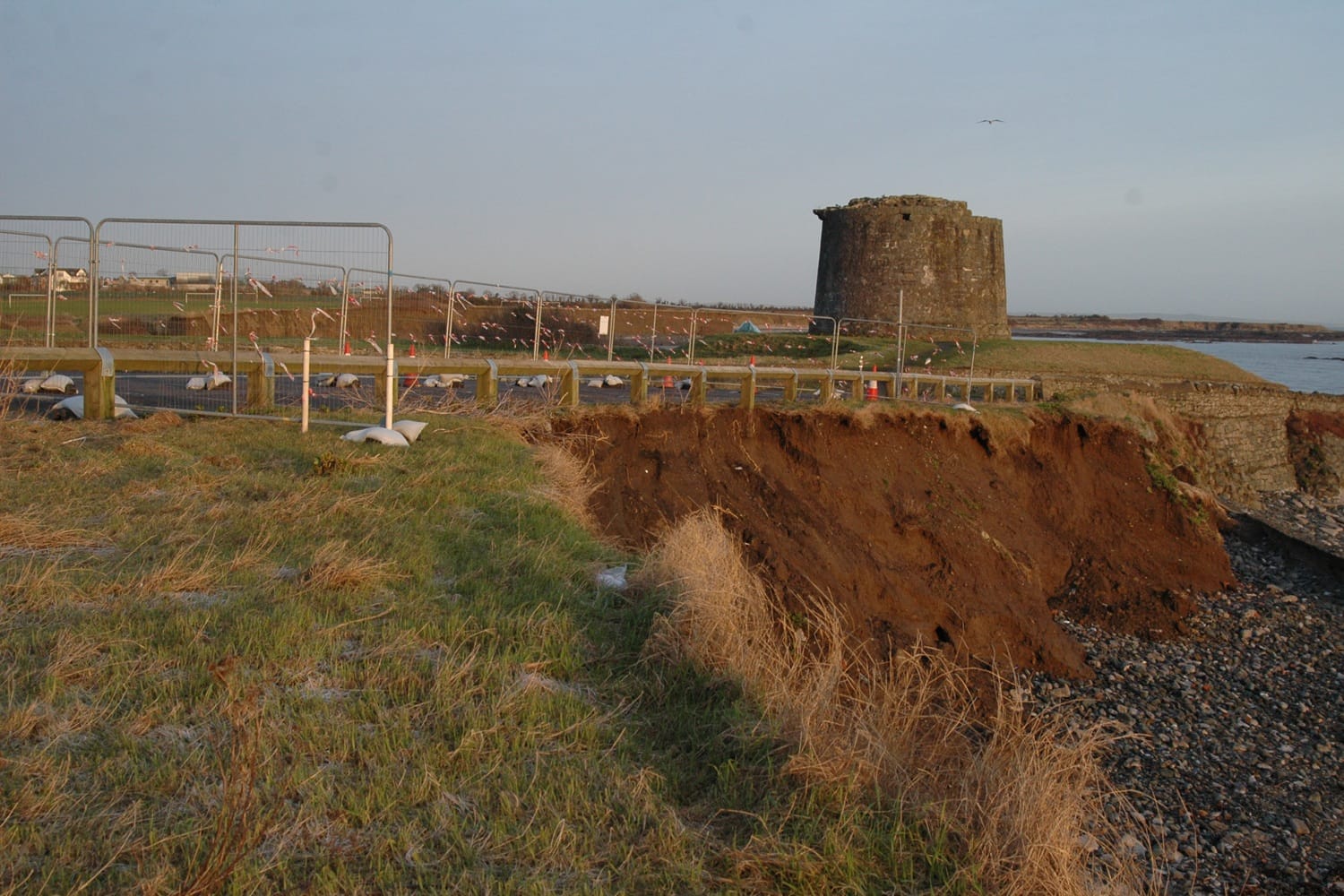
This was due to recent storm coastal damage, a council spokesperson said on Tuesday.
Nothing is staying the same in the area, Murphy said. “However, I think what’s important is to respect that fact that people who raised their voice out of concerns for – and I’ll put it in inverted commas – ‘aesthetics’, making sure the beach presents in a way that is usable to the public, as well as maintaining the ecosystem that lives within the same space.”
That is the biggest challenge for the council, he said.
Next, the council needs to set out the terms of reference of what any beach management committee will discuss, he said. “But I think the key factor for me is communication, communication, communication.”
If locals can be informed as to what the council is trying to achieve down there, everyone will be able to achieve holistically the best practice down on the beach, he said.
A council spokesperson said on Tuesday that the membership of the Beach Management Group still needs to be finalised, and that invites to groups will be issued in the next two weeks.