

Dublin City Council, again, bans poster to spare US president's feelings
Even a version which made no direct reference to Trump and removed his image, and simply read: “No welcome for warmongers” was turned down.
The recently published report from the government's Local Democracy Taskforce recommended that if it does, it should get the money back.

At the moment, if the council owns a piece of vacant land larger than 0.05 hectares in an area that is zoned as suitable for housing, it has to pay the Residential Zoned Land Tax (RZLT) to the Revenue Commissioners.
But if the council owns a derelict site, it doesn't pay the Derelict Sites Levy, which it is responsibile for collecting from others, and gets to keep the money from.
Starting later this year, though, that levy is due to to be replaced with a Derelict Property Tax collected by the Revenue Commissioners – and it's unclear right now who that money will be passed on to, to spend.
A recently published report from the Local Democracy Taskforce, which the government set up last year, says that no matter who collects there, it should actually be councils that benefit.
The council should benefit from the RZLT and the Derelict Property Tax and should ring-fence the money to tackle vacancy and dereliction, the report says.
Even if the council itself sits on long-term vacant or derelict property, it should still get the cash back that it pays in taxes, the report says. “Should the local authority have a liability, ensure this liability accrues back to it as beneficiary of the tax,” it says.
But if the taxes are intended to prompt owners to bring disused properties back into use, couldn't that work to motivate the council as well?
Dublin City Council owns a lot of long-term vacant, derelict and disused land and buildings across the city. It faces thousands in fines over a long-term vacant site it owns in Kilmainham, for example.
Ciarán Cuffe, a former Green Party councillor, TD and MEP, points to a long-term vacant site on Bridgefoot Street and says the council should face taxes for disused land and buildings it owns, as a way to incentivise action on them. “I strongly think so,” he says.
“All around the city there are Dublin City Council-owned sites that we could be making better use of, ” he says. “I think an incentive is needed to tackle the issue, and if the money goes back, the incentive disappears.”
The council did face fines under the now-phased out Vacant Sites Levy for the disused site it owns at the top of Bridgefoot Street, near Thomas Street. And 2026 RZLT map shows the site is subject to that annual charge too.
Despite these incentives to do something with it, though, it's still vacant.
People Before Profit Councillor Conor Reddy disagrees that making the council liable going forward too, and depriving it of the money, would change things.
“As a principle, I think the money should go back into the local authority,” he says. The council can then use the money to build new homes or refurbish existing ones, he says.
Usually when the council has long-term vacant homes for example, it's because there is no funding stream available to do them up, says Reddy. So there is no point in further starving the council of funds, he says.
“Overall I’d favour the carrot approach rather than the stick,” he says.
The Local Democracy Taskforce report says councils should have more capacity to raise revenue.
“Local government that is more financially autonomous, with greater capacity to raise and optimise its own resources,” is a key objective, says the report. A big part of that is the ability to borrow more.
But it also means getting more in taxes. As well as the Derelict Sites Levy and the Residential Zoned Land Tax, the report also says the council should benefit from the Vacant Homes Tax.
Owners pay that on homes that were not lived in for at least 30 days in the previous year. There are exemptions where an owner has recently died, or the house is up for sale, among others.
The amount of the tax changes depending on the value of the property. It is seven times the Local Property Tax rate for last year.
It's unclear yet whether the government intends to take this recommendation from the Local Democracy Taskforce.
The government's implementation plan for the taskforce report's recommendations, published 22 July, says this would require new legislation, and will be considered as part of the ongoing development of Derelict Property Tax policy.
Councils should be able to raise money by levying a tourist tax, introducing congestion charges, leveraging EU funding and “ensuring local authorities are the direct beneficiaries of land-use taxes”, the report says.
In January 2024, Green Party Councillor Darcy Lonergan asked what the council was doing with the disused site it owns at the top of Bridgefoot Street, near the corner with Thomas Street.
The council chief executive’s response indicated that it hadn’t decided yet.
“The site is managed by Property Management and currently in use by the Council’s Parks Department as a temporary depot facility while options for use are considered,” says the written reply to Lonergan.
On Thursday afternoon, the gates of the site were open. There were cars and vans parked there, and bushes were growing around the fences in places.
In January 2024, Lonergan asked the council what it is doing with its land in Bridgefoot Street to bring it back from dereliction.
The land is not on the derelict sites register. But it was on the vacant sites register back in 2018, according to a council report.
The council has not yet responded to a query sent Thursday afternoon about what its plan is for this site on Bridgefoot Street.
Over in the north inner-city, the council owns a long-term vacant three-storey building at 19 Buckingham Street, which is boarded up and with greenery growing out of it, which also doesn’t appear on the derelict sites register.
If the home appears “ruinous”, “dangerous”, or “unsightly”, then the council can put it on the register.
In 2018, the council painted Dracula-themed murals on the house and erected a plaque. Bram Stoker lived in a house nearby, at 17 Buckingham Street in the mid-1800s.
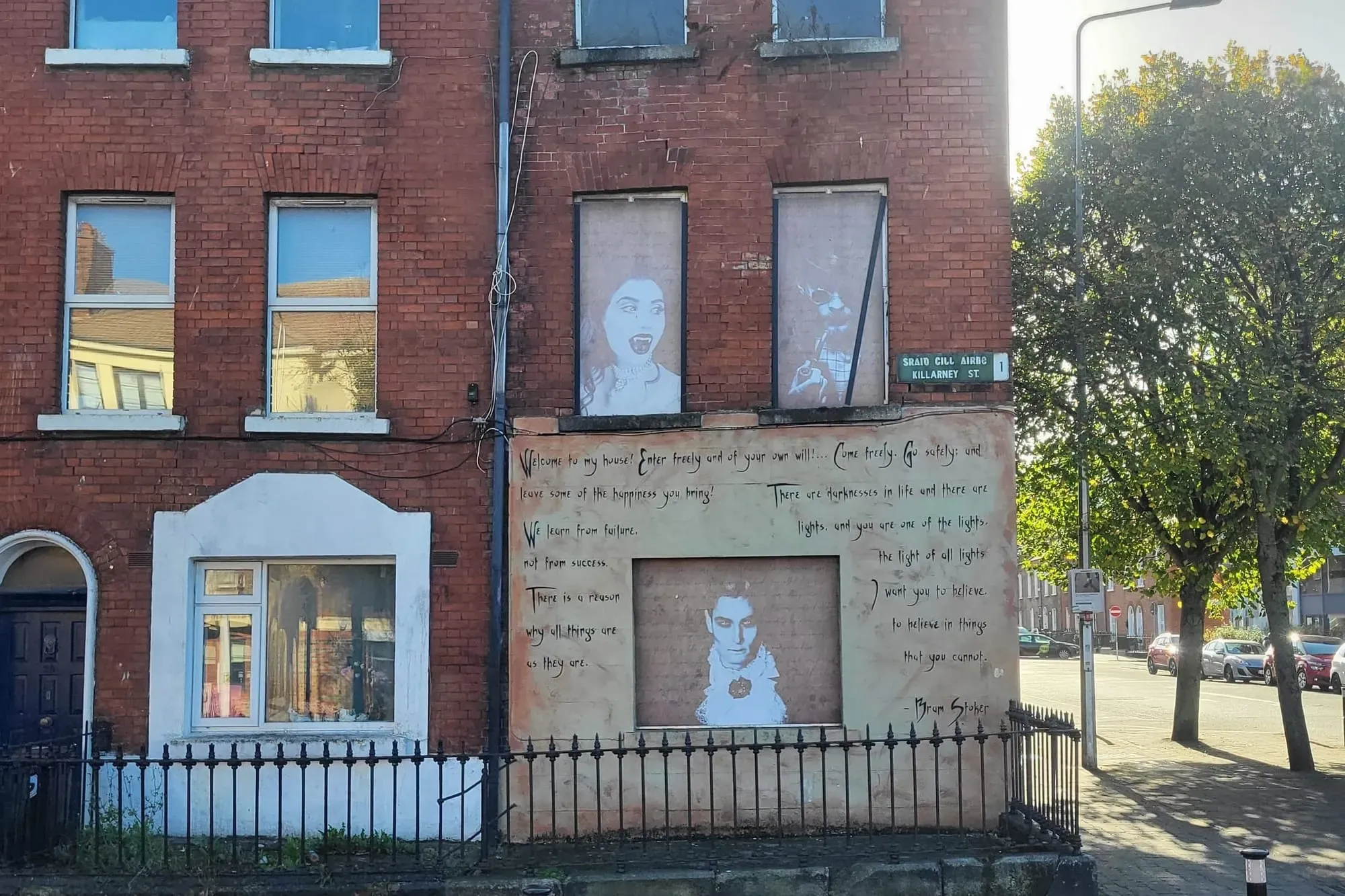
Dublin City Council also owns quite a few homes that are on the derelict sites register, in Connaught Street, Fergusson Road, and Chapelizod, among other locations.
It bought those homes because they were disused or derelict, said Robert Buckle, a council senior engineer at the Central Area Committee meeting in April.
The council succeeded in restoring around 100 homes under the Buy and Renew Scheme, turning long-term vacant and derelict properties into social housing, Buckle said. But it got stuck with some houses that need more work and are too expensive to do up, he said.
Reddy, the People Before Profit councillor, was among a group on the council’s housing committee who recently visited some of those long-term vacant and derelict homes to try to work out what to do with them.
Some need to be demolished and fully rebuilt, says Reddy. But “there is no funding stream available", he says.
The solution, he says, is for the council to be provided with funds to do up or rebuild the homes.
“What we need is much more decisiveness,” says Fine Gael Councillor Danny Byrne, who has been pushing for details of all council-owned vacant homes. “Whether it's a carrot or a stick approach.”
Some of the derelict homes the council got stuck with were initially approved for funding, he says. Then, while the purchase was underway, the Department of Housing changed its protocols so the council no longer had a way to renovate the homes, he says.
That, says Byrne, was not fair on the council. “It was incredibly frustrating for the council officials,” he says. “I blame the bureaucracy.”
Regardless, he says the council must act to prevent dereliction because the buildings are deteriorating and it's detracting from the overall appearance of the city.
If the council doesn’t have the resources to bring a home back into use, it should sell it on to another owner that can do the work, says Byrne. “If it's clear that we can’t do it up, we need to move it on immediately,” he says.
Reddy say the council should be resourced to maximise its assets and do up the homes.
At the moment, the council has to pay the Residential Zoned Land Tax, which is collected by Revenue.
In Kilmainham, the council has sat on a vacant site for years, racking up thousands in fines, following issues over restrictions attached to the title, and the collapse of a charity housing plan for it.
So the taskforce recommendations, if implemented, would mean a major shift in that the council would face no penalty for sitting on large tracts of residential land and failing to develop them. It would get that money back.
Cuffe says one of the reasons sites get stuck is that the council doesn’t have enough senior project managers.
It has a shortage of personnel who can take on a big project like tackling dereliction or developing College Green, he says.
The solution is that central government should fund the council to hire the staff it needs, he says.
But the council should have to face nonrefundable taxes if it fails to fix up its properties, he says. “You need to concentrate the mind and hitting them where it hurts is the way to do it,” says Cuffe.

Even a version which made no direct reference to Trump and removed his image, and simply read: “No welcome for warmongers” was turned down.

"As you can imagine, you've got 20 parking spaces, and we come along and say we're going to take out two of them or something like that to give spaces for people on bikes, it doesn't go down particularly well."

Louth County Council passed a motion calling for other local authorities – including Dublin City Council – to join it in pressuring the government to change national planning regulations.

“I don’t think we do have a policy on displacement,” says Labour Councillor Darragh Moriarty. “But there probably should be something in light of the private rental market being so volatile and so precarious.”