

Council retreats from idea of turning part of city centre arts space into a public toilet
It wasn't meant to as an insult, a council official said. More a sign of desperation in the hunt for the right places to put them.
But it is it?

"I think a lot of the objections to data centres at the moment are through misinformation," said Mike Meyer, the CEO of the advisory firm Portman Partners.
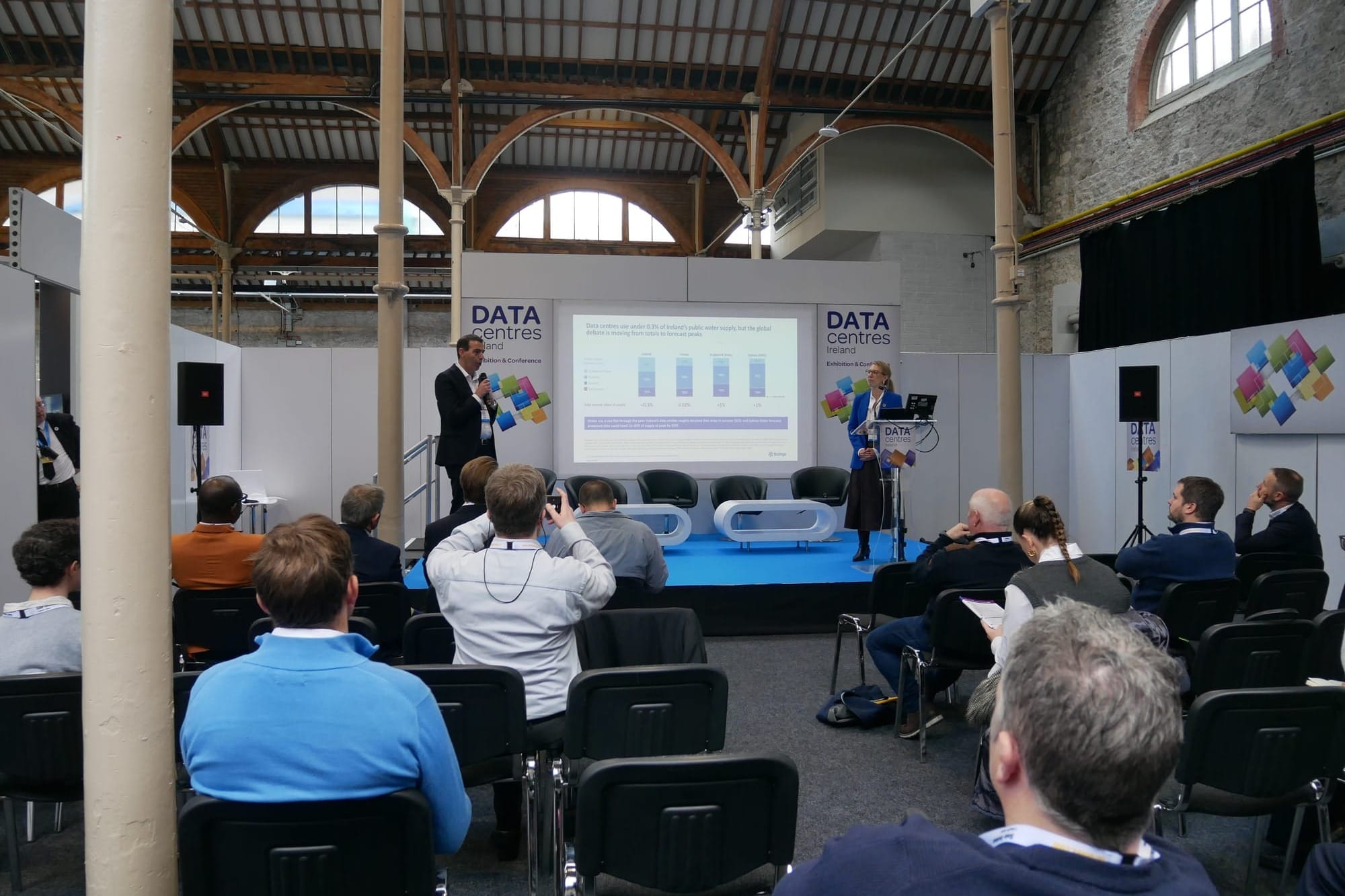
Meyer was sat on a chair on a slightly raised stage in one of the cubes set up to host talks at the RDS in Ballsbridge during the two-day DataCentres Ireland conference last week.
"I've tried to fight that battle on Instagram and given up, because the backlash is astronomical," said Meyer, whose firm "advises leaders in the digital infrastructure sector", its website says.
It was the final session of the conference, and the main hall of the RDS was growing chillier as visitors and exhibitors emptied out.
The topic for this talk? "Data centres as investors – are they giving back to their communities or could they be doing more?"
But the conversation also orbited the same question as many of the panels over the couple of days. Some variation of, how does the industry get the general public to overcome their ignorance, and understand the importance and benefits of data centres in today's world, and how great they are?
And, isn't this opposition just misplaced and misdirected fear of AI writ large? Data centres are used for all kinds of processing – banking services, transport apps, video calls with far-flung relatives.
"They're objecting to AI data centres, not data centres," said Meyer.
Communities need to understand that we won't survive without data centres, said Meyer. "If we lost data centres we wouldn't be able to do anything."
They need to change how people see data centres, he said. "Humanise them."
When questions opened to the floor, a hand went up in the third row of the audience.
"I want to ask," said Ellen O'Reilly, a student, leaning forward a little in her seat. "Who is 'they' who are complaining about AI, as opposed to the impact of data centres?"
Have there not been huge environmental impacts? she asked, with a nod towards the massive peat slide on the Donegal-Tyrone border, which stemmed from construction on a wind farm being built to feed an Amazon data centre.
"Are those concerns not valid, or are they just dismissed with this patronising, 'Oh, it's just a fear of AI.' There are genuine environmental impacts that people are afraid of," she said.
As talks unrolled in the wings of the RDS, exhibitors at aisles and aisles of booths showed off their hardwares.
There were displays with the latest in steel doors, concrete flooring solutions with anti-shrinkage fibres, and shiny gas turbines. There were magnet filters for closed-loop cooling systems, and cable ties.
Sean Leach wandered down one of the aisles, lugging tote bags of goodies from the stalls.
He passed by the Galetech Group's stand showcasing its renewable power generation, and went further down the row, and sat down on a tall white stool, on the edge of the Schneider Electric display.
He needed to rest his legs, he said.
At 78 years old, Leach was towards the older end of the attendees.
He had thought he was coming to The Retirement Expo, he said, until he walked in and saw all the machinery.
"I thought, what's that got to do with retirement?" he said, amused.
Turns out, he was a week early.
"But I'm enjoying every minute of it," he said. "What we're seeing in every stand is what's happening today."
Look at those images even, he said. Opposite, a giant digital screen glowed with video of the inside of a data centre hall, aisles and racks.
"I know that's all out there. But when I'm actually seeing the stands," he said, pausing to find the words, "I know about it in general, all this modern stuff, but I'm actually seeing it."
During the talks at the conference, panellists put some of the blame for data-centre backlash on the secrecy of the industry.
It's like a darkened house in a neighbourhood where people don't see who lives there, and get worried, said Jo-Ann Garbutt, director of sustainability and government engagement at Digital Realty, which has nine data centres in Dublin.
Data centre operators haven't talked enough about themselves and their innovations, said Garbutt, during a talk on AI data centres and sustainability on 18 November. Or they've talked in performance indicators that nobody understands.
More than 80 percent of the Digital Realty data centres use closed-loop cooling systems, said Garbutt – so don't use water at the thirsty rate that is often assumed.
Ireland is an outlier in Europe, with data centres consuming 23 percent of the grid's metered electricity last year, said Fine Gael TD James Geoghegan.
Government, though, thinks that data centre investment can accelerate renewable energy investment, he said. "That's the sweet spot, we have to get to."
As industry insiders mused on transparency and sustainability at the RDS, across the city in Leinster House on that same day, Social Democrats TD Jennifer Whitmore stood up to put forward her party's Data Centre Transparency Bill 2026.
Ireland hosts about 123 data centres, Whitmore said – about 10 times the EU per capita average. "Despite the scale of the data centre sector in Ireland, basic information is really difficult to access."
Even though the EU's revised Energy Efficiency Directive requires large data centres to report information such as water use, energy use and waste heat, to a central European database, and members states to facilitate and oversee that reporting.
"Unfortunately, we have one of the lowest reporting rates in the EU with only 18 of the approximately 123 Irish data centres having submitted information to the European database, a compliance rate of 15 percent," she said.
"The CSO estimates their electricity consumption is approximately 23 percent of total demand, yet it does not know how many data centres we have," she said. "When it tries to work out how much electricity they use, it estimates."
"Uisce Éireann has repeatedly assured me data centres are not creating significant pressures on our water supplies, yet when I questioned its numbers it could only point to 57 data centres that are connected directly to its networks," she said.
"If we have approximately 123 data centres – or 70 or 90 according to Government estimates – where are the others getting their water from?" she said.
The data centre industry has worked to block transparency around its use of resources.
Any data that is collected and published by the European Commission at the moment is aggregated – preventing people from understanding how resources use might vary, site by site, catchment by catchment.
That's because of lobbying by big tech, by Microsoft and Digital Europe, a trade organisation that represents the tech sector, according to a report published earlier this year by Investigate Europe.
It is true that some data centres operators are hesitant about releasing environmental data, said Mark Acton, a data centre consultant, after the conference by email.
"I think the important question here is which operators are against and which are comfortable with the release of information," Acton said.
"I am not an operator and do not represent any operators but in my opinion that horse has already bolted and more transparent reporting will inevitably be required," he said.
"I know of operators that would be happy to share non commercially sensitive data and I personally believe this is a good thing and only that way we can counter the inaccurate representation of the sector is by producing accurate and verifiable data," he said.
The type of operator involved also comes into it, Acton said.
"The large hyperscale operators that own and operate their own data centres to support their own service and platforms are likely to have a different position to colocation operators who in very basic terms simply provide ‘hotels’ for their clients’ IT infrastructure," he said.
"Colocation operators therefore have little control or even knowledge of the performance of their customers’ IT infrastructure and in many cases are not even allowed in the rooms where this is held, other than in an emergency," he said. "This does present a genuine problem when the Commission request data about the colocation clients’ IT platform performance."
In a session on water use at the conference last week, James Piggott and Bridget Teirney, consultants at Baringa, suggested a new approach for data centres on questions and concerns about their resource usage.
Rather than debate the exact amount of water data centres use nationally, try to look locally, and to bring communities on board by making a centre a net positive for water use for the local community and catchment, they said.
In the RDS hall, a giant photo on one of the booths' panels shows a solar farm and a tall wind turbine that the Galetech Group team built to decarbonise the power to a big factory.
Those are the kinds of projects that the Irish renewable energy company does, says Georgina Quigley, at the round table in the booth.
She can't say if the company has data centres among its clients yet, she says. That would be confidential. The company works with any large energy users, as the jargon, goes, to help them to decarbonise their supply.
Right now, Galetech Group is looking ahead to when the Oireachtas passes some version of a "private wires" bill.
With private wires, the idea is to develop wind or solar on or near the site of a large energy user and transmit it directly to them, said Quigley. "Reducing the reliance on the grid."
The impact of data centres connecting on the grid, of course, came into sharp focus last year when a report from the Commission for Regulation of Utilities (CRU) said ESB Networks was worried that ballooning data centre demand put at risk its ability to connect new homes, heat pumps, EVs and major electrified rail projects.
There's no denying that data centres use a huge amount of electricity from Ireland's grid, said Quigley, but she asks what alternative they have right now.
Since December 2025, there has been a new connection policy in place for data centres, from the CRU, ending the de-facto moratorium on grid connections.
That new policy mandates that new big data centres source at least 80 percent of their annual electricity demand from new renewable projects in Ireland, with six years to hit that goal.
As the conference rolled on at the RDS, hearings in the High Court were underway challenging that new policy.
Friends of the Irish Environment, Friends of the Earth Ireland and ClientEarth have argued that the new connections policy would lock Ireland into high-emitting fossil gas for years to come.
That's because it lets them continue fossil fuel generation for the next six years, and even after that, to for part of its needs, the groups argue.
At a session on private wires, moderator Fergus Wheatley, an engineering director of Smart Power, suggested that the audience write to politicians to support independent TD Barry Heneghan's version of the private wires bill.
That gives remit to the CRU to set out the rules for private wires, rather than the government's more restricted version, which allows private wires in a few scenarios.
"I'd encourage everybody in this room to make contact with their local TD," said Wheatley, whose LinkedIn profile styles him as "Champion for Private Wires Legislation".
Leach, the pensioner, sat on the stool near the Schneider Electric booth, said he hadn't heard much about protests against data centres over their electricity use and environmental impacts.
He spent his life working on construction sites mostly, he said – in Ireland and over in England.
Although his earliest job away was when he was 15 years old, he said, after he bugged his father to take him on the walking harvest, and they sailed to Holyhead, and took the train – with a change at Crewe – onwards to Wootton in Lincolnshire.
There, he and the crew, led by a "ganger", were loaded into a farm wagon and driven past the big manor house with its pillars either side of the door, he said, and past the estate cottages, and out to an old barn at the back where they slept each night after long days harvesting potatoes by hand.
He has been retired 26 years now–- he is 78 years old – and often comes to expos, he says.
Everybody has their own hobbies, says Leach. "Some people go up mountains or go down pot holes. Whatever you're into."
Otherwise, he would be sitting in the house, looking outside the window, he said. "There's a lot of people doing that. There's a lot of depression out there."
Time and again at the conference last week, conversations returned to how to get communities on board with data centres.
What about more education in primary and secondary schools? suggested John Booth, of consultancy Carbon3IT, during that final panel of the conference. "Just one module that explains about digital infrastructure."
Or, having data centres pay more in development levies? he said. That's money that goes to local councils and often funds things like parks and playgrounds.
Or, a different process for community consultation that takes account of the development model, which at times means that the developer who goes in for planning is not the operator who will ultimately engage with the community long-term?
Or, a data centre covenant, a pledge with benefits, like the UK's? said Booth.
The covenant in the UK did seem to take some of the heat out of the argument, said fellow panelist Venessa Moffat, managing director of the Data Centre Alliance, a trade association.
"It's almost a PR stunt and almost like, saying, 'Okay we'll have data centres but there will be conditions.' I think maybe that's the strong statement that you're talking about," Moffat said.
It's something she could do at council level for sure, said Clare Colleran Molloy, a Clare county councillor for Fianna Fáil, who was also on the panel.
"We would certainly bring a motion at council level seeking the government to adopt a covenant such as the recently published one in the UK," she said.
Generally, though, her feeling is that consent comes from making life more affordable, said Colleran Molloy. "I think this all goes back to how do you convince people that this is a good thing. And most of the time, it's concerning their money, I think."
That's why she is interested in the potential for district heating from data centres to lower household energy costs, she said.
Although there's a district heating scheme in Tallaght that uses waste heat from a nearby data centre, and it's not at all clear that this small, early pilot results in lower energy bills for its nearby customers.
 Lois Kapila
After that last panel of the last day of the conference wound up, O'Reilly – the student who'd asked the question about environmental impacts, like the peat slide on the Donegal-Tyrone border – sat a while in her chair, a friend beside her.
Walking into the conference had been like walking into another world, she said, and intensely frustrating. "This patronising attitude that anyone who has a concern with data centres is a Luddite, anti-technology."
During her speech in Leinster House as she presented her bill, Whitmore, a Social Democrats TD, had talked about the numbers that had come out of government around job creation and data centres.
A few years back, then Taoiseach Leo Varadkar, of Fine Gael, had told her there are between 30 and 50 jobs created in each data centre, she said, "yet the government now says data centres underpin 876,000 jobs".
Panellists at the conference, too, had spoken of the jobs being created downstream of data centres.
People need to understand the great jobs being created in the AI industry, said Rosalind Griffin, director of Europe at LiquidCool Solutions – there are jobs in sales, engineering, marketing, product development, HR.
"People just think, huh, AI is going to take my job, that isn't just not the case," she said.
The money is good too, she said. "So I think I would say, if you're not going to come to the party, you're going to get left behind."
That kind of talk doesn't ring true for O'Reilly, she says.
There was no real recognition of the impact that AI could have on her future job prospects, she said, and she doesn't want to work in PR for an AI company.
 Laoise Neylon
Chris Kavanagh, an energy consultant from Baringa who writes its Green Energy Report, dropped down into the row in front.
He was glad O'Reilly was in the room, as an out-of-the-bubble voice, Kavanagh said.
But do you give the tech industry any credit for the wealth creation in Ireland? he asked, turning around on his chair to talk.
When he steps off the plane now from the UK, he thinks, this country is rich, he said. Pretty much the only country in Europe worrying about its budget surplus and how to spend it.
His position, he said, is that "there are some impacts and they need to be thinking about those, they need to be good grid citizens and good social citizens if they are going to build them", he said.
Sustainability is complicated, he said. But "if they do it properly there can be data centres that are positive, for the power system, positive for the water system, positive for biodiversity and all those things, and helpful for communities".
Said O'Reilly: "Economic growth is totally important but what does that mean when social housing isn't being built and nobody can afford to live here anymore?"
Jan Low, a student at the University of Copenhagen doing research in Ireland, hovered to one side shyly.
The boundaries of the discussions had been so narrow, he said. "You could build an internet that requires far fewer data centres, far less power."
But they would need to pay attention to all the waste data stored in data centres, all the dark data processed maybe once and used and stored indefinitely. Like ancient emails never looked at again, or near-identical images saved onto Google Photos.
"I think there is a real question to be asked about how we are allocating our resources," said Low. "I will be a bit anti-growth here, and say, maybe we don't need infinite data centres for ever and we can use the existing infrastructure that we have in a way that is much smarter."
He has been doing research in Rochfortbridge, in Co. Westmeath, said Low, where a data centre has recently been proposed.
Some people don't know much about data centres, while others have spent months educating themselves, said Low, going through realms of paperwork, planning and environmental documents, building up deep knowledge.
"And it is very frustrating to hear that ignorance is the problem," he said.

It wasn't meant to as an insult, a council official said. More a sign of desperation in the hunt for the right places to put them.

Amendments from Sinn Féin and People Before Profit, would have raised rates on city businesses, and reduced rents for tenants in social housing and on HAP.

It comes as students from some countries face mounting barriers to Irish student visas.

These are "reshaping the property market, damaging the historic core of the capital city, and eroding public confidence in the planning system", the report says. It's time for the planning regulator to step in, it says.