Lauren Fernandes noticed menus and flyers all over with the same sterile look, and thought: what if she could help out small businesses which can't afford creative work, usually?
It would use extra heat from the Poolbeg rubbish incinerator to warm water and send it through pipes underground, into buildings in the city, to keep homes and offices cosy without burning additional fossil fuels.
"He's a local lad here from Carpenterstown, he's a local schoolteacher," said Fine Gael Councillor Ted Leddy, who proposed the motion. "A mural or something like that would be very appropriate."
Trish Sissons will once again headline her live storytelling show at the Tara Building, she says, as a way to set the tone.
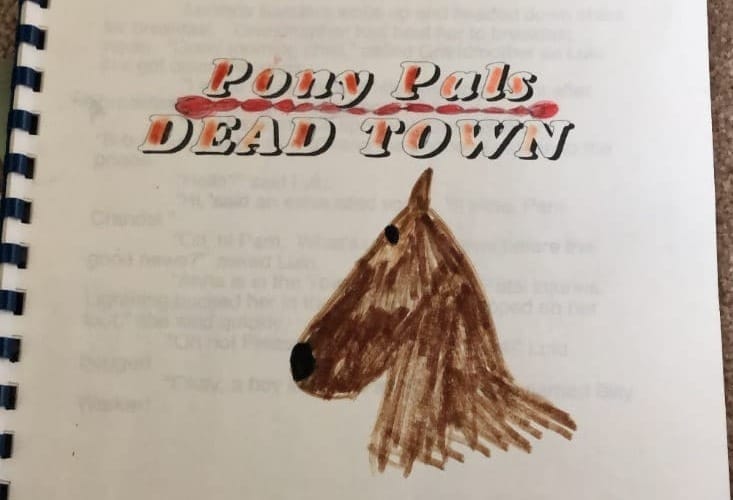
She’ll read lore she wrote at 11 or 12 about her childhood favorite series of books, Pony Pals, in which each story turned on a different pony-related crisis.
“I wrote my own Pony Pals book called Pony Pals: Dead Town. Spoiler alert, everybody dies," she said.
The first performance of this rediscovered work will take place, she says, on 6 November at the second run of Angst from the Archives, which she organises, produces, and curates.
“It’s a very comedic reading of the most dramatic, cringy teenage writing,” says Sissons.
Pony Pals: Dead Town, by Trish Sissons.
The rules
Sissons started the show this past May, not long after she’d moved to Ireland, she says, “on a bit of a whim”. She’s an organiser, she said.
Vicky Cannell, the general manager of the Tara Building, a coworking space on the southside of the Liffey in centre city, was around when the spark came to Sissons.
"She just literally was like, ‘Wouldn't it be so funny if people read from their diaries,’ one day at lunch,” she says. “And then she just made it happen.”
Sissons had seen similar shows back in Vancouver, she says.
She figured that there might be the same sensibilities in Ireland, she said. “I was like, I bet we have a collective shame.”
There are a few requirements, Sissons said. “You have to have been a teenager when you wrote it, and you can’t be a teenager now.”
“And you cannot be proud of it,” she said. “That’s the main rule. It has to be embarrassing.”
Last time, there was a mix of material: Tumblr posts, poems, diaries, emails.
“We had a guy who now works in tech sales who read from his teenage emo band’s manifesto,” she said.
“We had a girl share, like, a slideshow of the emails she sent back and forth to her best friend before they could have cell phones, and there was a lot of Twilight images.”
Sissons said she treats hosting like a wedding dance floor. “You have to be first and worst. I share some of my own teenage writing to set the bar low.”
The audience reaction last time was cathartic, she says.
“It sort of turns into this wonderful collective,” she said. “We’re all laughing, because if you don’t laugh, you’ll cry.”
Sissons pre-vets everything, says Cannell. People send in short briefs and she mixes older and younger readers. Some bring props or old photos.
“She puts so much thought into the running order and it shows,” Cannell said.
Building a following
Cannell said she debated participating in the first show. “I was like, God, do I have access to my old Tumblr account?”
But she decided just to watch.
“There was definitely a sense of pride for a lot of people being able to speak about something they used to find embarrassing,” she said.
“Everyone was there to be a little bit cringy, so it just made it funnier — everyone was really relaxed,” she said.
Sula Awad, a crowd favorite from this past spring’s show, said she could feel something looser in this show than she usually does in many cultural spaces.
Angst from the Archives is this super informal space for people to be more candid, Awad said.
"I really hope this grows,” she says, “and I really hope that it builds kind of, I don't want to use the word cult, but I hope it builds a following."
Grazing in public parks means other uses are being pushed out, and adding momentum to calls for an equine centre and stable club to properly support horse culture in the area.
"I think the public do understand that prison isn't addressing the underlying issues for those people who are committing minor offences but can't get the help that they need to stop that cycle."