

Against a backdrop of policy shifts, Ukrainian refugee children embrace their Irish life
Ireland is the place they started school, joined sports clubs – yet their parents worry about how changes to citizenship eligibility may haunt their future.
While tenant complaints about the e-bike, and also noise, were referred to in the notice to quit, that was to illustrate the breakdown between the occupants at the property, said the landlord's agent to the tenant.

Gianluca Pollastro was rattled when a housemate plugged in his electric bike to charge overnight in the living room of their ground-floor flat this past May, and he emailed the landlord's agents.
He was stressed out by the fire risk, he said.
It wasn't the first email he had sent to the agents, Be Lettings, about tensions between him and one of his housemates, one of whom he says would talk and play music loudly through the early hours, as contemporary messages show. He asked the agency to intervene.
But each time, they said they couldn't get involved. "We can’t get involved with tenants’ issues; this needs to be discussed amongst yourself," said a staff member in one of the responses.
Then, on 5 June, Pollastro and his two housemates got an eviction notice.
They had breached tenant obligations, with anti-social behaviour, it said, citing what Pollastro said he could only understand as a nod towards his own outreach.
"Numerous complaints have been made by you as tenants in relation to anti-social behaviour, including excessive noise, charging an electric bike within the apartment space and thereby creating a fire hazard for the apartment and the apartment block," it read.
In house shares with a single tenancy covering everyone living there, housemates are generally "jointly and severally liable", so all share the rights, obligations, and liability for each other's breaches.
The notice is deeply unfair though, says Pollastro. "I reported all those issue. And in the end, they're using my own complaint to evict me as well."
Although, in correspondence with Pollastro, a staff member told him that, "The reference to complaints between tenants reflects the breakdown between the occupants at the property. It is not a response to any complaint made by you in good faith."
Pollastro's two housemates have now left the apartment, a three-bedroom flat in the gated complex at St James's Wood on South Circular Road, owned by The Vestry Limited Partnership.
The Vestry General Partner DAC, which acts for The Vestry Limited Partnership, is the registered owner of more than 1,000 properties, almost all of them apartments in Dublin, according to Land Registry records.
But while his co-tenants are gone, Pollastro is still there in the flat.
And he is challenging the notice at the Residential Tenancies Board (RTB), he said last week, even as he is now also squeezed trying to pay the whole rent each month because the landlord won't allow him to replace his housemates to help cover it.
The tenancy he is on now dates back to 2013, with rent increases controlled for years, so the rent for the place sits currently at €2,061. These days, comparable places in the area are renting for well over €3,000.
Neither Vestry Limited Partnership, nor Be Lettings have responded to queries sent on Wednesday last week. Or a follow-up query sent on Monday, asking whether they are hoping Pollastro will leave so they can re-set the rent at the current, higher market levels.
New rental-sector rules that came into effect from 1 March change how rents can be set between tenancies. It used to be that rents could generally only be raised 2 percent a year or the rate of inflation, regardless of whether there was tenant turnover.
Now, the rent-increase cap of 2 percent a year no longer applies in many cases, including where tenants have been evicted because of a breach of tenants obligations, such as anti-social behaviour, and new tenants moved in.
In these cases, a landlord can reset the rent to market rent with the new tenancy.
With only three months of data published by the RTB since the new rules came in, it's too early to say whether this heralds an increase in allegations of breaches of tenant obligations and anti-social behaviour, or stronger responses from landlords to any incidents.
In the second quarter of this year in Dublin, 21 percent of notices to quit were on the grounds of "breach of tenant obligations", up from 11 percent percent in the previous quarter – but similar to the rate in the second quarter of 2024, according to RTB data.
The process that a landlord has to follow to end a tenancy based on allegations of a breach of tenant obligations, and anti-social behaviour, depends on the kind of breach, and its seriousness.
If the tenant is considered to "engage, persistently, in behaviour that prevents or interferes with the peaceful occupation" of other tenants, or neighbours, then the landlord can issue a warning notice, followed by a 28-day notice of termination.
The landlord has to give the tenant "a reasonable amount of time" within which to rectify their behaviour, though, before they can serve that second notice of termination.
For serious anti-social behaviour such as violence or intimidation, or that which constitutes an offence that is likely to affect directly the wellbeing or welfare of others," and behaviour that "causes, or could cause fear, danger, injury, damage or loss to any person living, working or otherwise lawfully in the dwelling concerned or its vicinity", there's a different route.
In this case, the landlord can right away issue a seven-day notice of termination – telling tenants they have to be out in week – and doesn't have to give any warning.
Pollastro and his housemates got a "final warning" in the early evening of 4 June, with an email telling them that a notice of termination would issue the following day.
The notice of termination issued was on the RTB's template for a seven-day notice, for serious anti-social behaviour – one not requiring a warning – but also gave the tenants until 16 January 2027 to leave.
Pollastro said he hadn't had any warning before that final warning, and wasn't aware of any issued to his co-tenants either.
As he sees it, the landlord should have sent the other tenants a warning when he was making his complaints, he said, and they may have started to behave better.
The lease set-up is a problem, he said. "A joint-tenants lease is only an excuse to evict everyone, from my point of view."
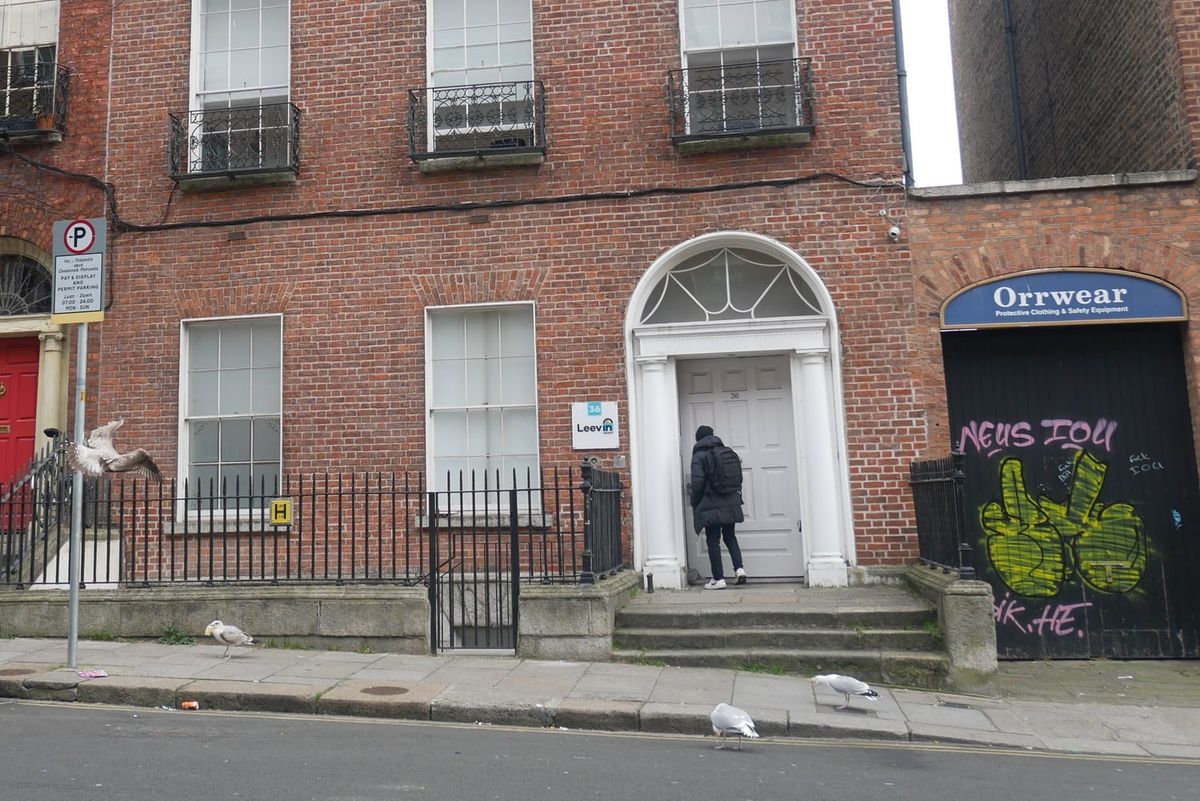
What's the current alternative? As of April last year, hundreds of other homes owned by Vestry were let out through an agency, Leevin Ireland, with the renters who shared them on licences rather than tenancies. But licencees fall outside of the remit of the RTB, and have even fewer protections.
 Lois Kapila
Pollastro says the solution is to put everybody on a separate tenancy within the same house. At the end of the day, he was the whistleblower here, he said, calling out the late-night noise and the fire-safety issue with the charging bike.
Pollastro has been looking for a new place anyway, he said last week, sat on a wooden chair pushed up against one wall, his elbow resting on the table beside him.
The kitchen-living room was uncluttered, bare even. Cleaning products lay around.
He has been through the process of fighting an eviction before – while living in Tathony House in Kilmainham, which later become a homeless hostel. "Again, the same nightmare," he said.
But he can't find anything, he said. "If there was something, it was in a sharing room with three, four more people," he said. He can't face it at his age, 46 years old.
He went to one viewing for a single bedroom in a shared house that was €1,300 a month, said Pollastro, who works in a restaurant in Temple Bar. "It's a nightmare."
He has a reference from the letting agent, Be Lettings, dated mid-September. "The rent for this apartment is always paid in full and on time, there are no complaints from," it says – the sentence ending there.
Since his housemates moved on, Pollastro has been struggling to cover the monthly rent of €2,061, he says. He gets a little help from the Housing Assistance Payment, but still.
It's less, he knows, than it would be at the current market rate. As the last rent review, the list of similar properties nearby showed three-bed homes for well above €3,000 a month.
The underlying tenancy for the flat dates back to April 2013. Pollastro himself had moved into the property in June 2024, taking over the spot from a tenant who was leaving – but as a continuation of the existing tenancy rather than a new one.
In mid-October, Pollastro asked Be Lettings if he could continue that chain. If he could move new tenants in to join him, to help him cover the rent.
"Under the Act, the tenant is responsible for the acts of any person in the dwelling with the tenant's consent. Given the anti-social behaviour notice in place, the landlord will not accept additional occupants in the property," said the email response.
Opposition TDs have criticised Ireland's biggest private landlord, Ires REIT, for blocking tenants in rent-share situations from replacing those who leave since the new rent regulation came in earlier this year, arguing that it leaves them financially squeezed and so with little option but to "voluntarily" also leave.
Pollastro casts his mind back to when he moved to Ireland, 13 years ago.
The affordable housing crisis was already biting but it still was easier to find a place even then, he said, and it has just gotten worse and worse. "It's getting very tough."
Right now, he can't imagine any real path to a stable home in the near future, he says.
He is on the social housing list, he said. But "buy a home with a mortgage? It's impossible." A stable rental home? "It's impossible, Even if you find a place, cheap, they'll find a way to kick you out."

Ireland is the place they started school, joined sports clubs – yet their parents worry about how changes to citizenship eligibility may haunt their future.

As it stands, Pear Tree Crossing would see more than 700 new homes, businesses, cultural and community facilities, creches, and an acre of open space.

In other jurisdictions, residents count many upsides from such a streetscape design, but maybe not those intended in this case.

The plan as voted through has 82 social homes, and a small "community hub".