“I wouldn't necessarily say we're looking at a looming full automation, but a really, really drastic shakeup is definitely on the horizon,” says Jen Wayne of the Animation Workers of Ireland.
The last few weeks, beneath the statue of Father Mathew, behind the Spire, groups of capoeristas have been practising their Brazillian martial art and game.
Leading up to the local and European elections in June 2024, Michelle McGoldrick of the Belmayne Community Group had a feeling that something just wasn’t right.
She asked herself: “How can someone's voice be heard when no one's even knocking at their door?”
It was evident, she says, that many residents of Belmayne did not feel politically engaged. They didn't feel they had the ability to influence happenings in their own area, she said.
And so the grassroots Belmayne Social Inclusion Voting Campaign was born, aiming to increase voter participation in the new area.
On Tuesday, an event was held in the Oak Room of the Mansion House to launch a report by the Think-tank for Action on Social Change (TASC) on the campaign’s efforts.
Among the speakers at the event was Lord Mayor of Dublin Daryl Barron, a Fianna Fáil councillor for the council’s administrative North Central Area, which includes Belmayne.
Like many new communities, Belmayne has experienced a wave of home building, he said. “But alongside the growth came a real challenge.”
“As more apartment developments were built, it became increasingly difficult for elected representatives to access every resident to have meaningful conversations to ensure that every voice had the opportunity to be heard,” Barron said.
It’s important that people feel a connection with those who represent them, and that they feel they can speak to politicians, raise issues that matter and help shape the future of their communities, he said.
So, in 2024, McGoldrick and the Belmayne Community Group decided to take simple but, as the TASC report shows, effective steps to help the residents of the area feel politically engaged.
They ran information campaigns, delivered flyers, and promoted events on local social media groups. They held voter registration drives.
They also collaborated with the Dublin Adult Learning Centre on a voter education programme called “Make Your Voice Heard”.
They held coffee mornings and canvassing events so people who live in apartments, a few doors and floors out of reach of door-knockers, could meet local candidates face to face, and encouraged local candidates to set up constituency clinics.
The tangible result, McGoldrick told the Mansion House crowd, was that 300 people registered to vote, and voter turnout in Belmayne increased.
As Tiarnán McDonough, democracy researcher with TASC, said on Tuesday, when examining the campaign, there were obvious spikes in voter registration around the time that these activities had been clustered in the run-up to elections.
“But also, kind of qualitatively, the people we spoke to reported that the programme had a really positive impact on those who participated,” he said.
Residents were more engaged, and had a better understanding of how to lobby local representatives effectively, he said.
This has already had a positive impact on the community, said McGoldrick.
“A new playground has been installed, and we're in talks regarding a new community centre,” she said. “So, we have seen how valuable it is to engage with our elected representatives.”
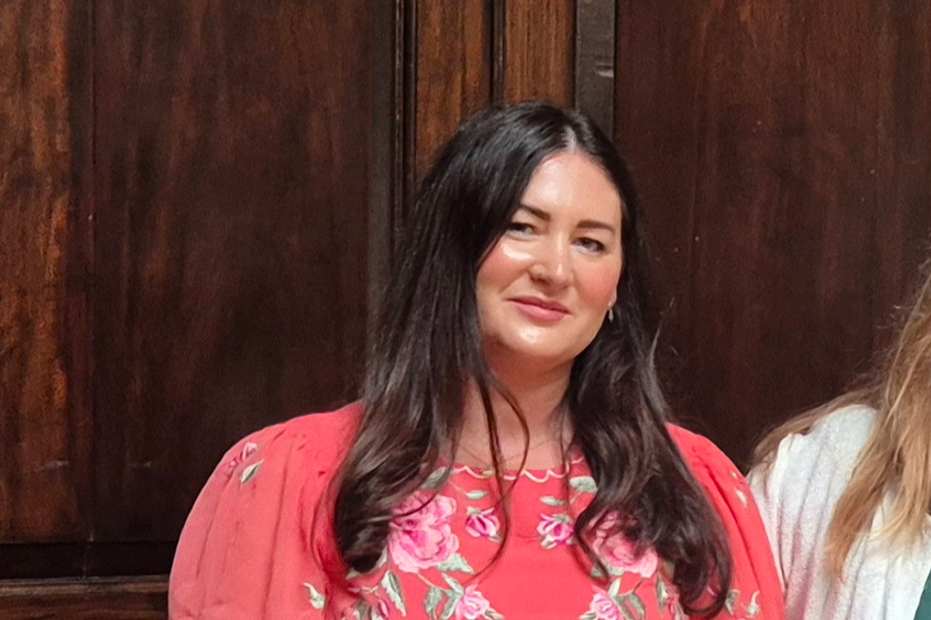
Michelle McGoldrick. Photo by Eoin Glackin.
Voter turnout in decline
As the TASC report notes, voter turnout in local and general elections is dropping.
Despite a major voter campaign by the Electoral Commission, national turnout for the most recent general election fell by 3.19 percent on the previous election in 2020 to just below 60 percent, the report said.
Housing tenure is a major predictor for voter turnout, said McDonough.
People who own their own homes are more likely to vote than those living in social housing or privately rented accommodation, he said.
Housing tenure aligns with a range of other factors too, he said.
“People living in social or rented accommodation are more likely to be single, living in an urban area, less financially secure, managing work or caring responsibilities that make voting more difficult, and particularly in the private rental sector, younger,” he said.
While we know that these correlations exist, he said, there is less research on the specific barriers that discourage people in Ireland from voting.
“As the Belmayne group identified, we need a better understanding of those barriers if we're going to address them and make democratic participation more inclusive,” he said.
A review and strategy document published by the council last summer forsees how the mix of residents in Belmayne is set to change.
As of the 2022 census, 40 percent of homes in the area were owner-occupied, the council report says. Another 36 percent were private rentals, and 17 percent were social housing, it says.
But that mix is changing fast, the report says.
Planning permissions show many apartment schemes to be delivered for Approved Housing Bodies (AHBs), it says – mostly social homes, with some cost-rental.
“When these figures are added to the existing known figures the results show that 55% of all housing in the area will be social housing rental [from the council or AHBs] based on current known sites that are being delivered,” it says.
Yet, politicians tend to focus canvassing in high-turnout neighbourhoods, meaning they often target areas that are less diverse, have more older residents and established community networks, says the new TASC report.
“Residents in these areas are far more likely than those in low-turnout areas to live in houses and own their own homes,” it says.
Belmayne meanwhile has high levels of people living in social housing, it says. And in apartments.
“The Belmayne Social Inclusion Voting Campaign identified that the inaccessibility of housing blocks to canvassers exacerbates low levels of engagement between politicians and those living in them,” the TASC report says.
“This contributes to persistently low levels of political trust among people living in social housing, who can feel forgotten and as though their vote doesn’t matter,” it says.
McDonough told those gathered at the Mansion House how TASC’s research showed that the participants of the Belmayne Social Inclusion Voting Campaign felt that one of the most important elements of the campaign was the presence of strong local voices, who residents felt they could trust.
Importantly to the campaign’s success, the Belmayne Community Group were seen as politically impartial, motivated by the needs and aspirations of local residents, rather than by political gain or careerism, he said.
“Our research seems to suggest that that trust was essential to the take up and engagement with the programme,” he said.
Far-right
Until recently, Ireland has avoided the emergence of a significant far-right movement, unlike other European countries, said McDonough. “But I'm not sure that we can kind of confidently say that this remains true.”
There is an emergent “politics of grievance”, he said.
This is particularly concerning in the context of a decline in voter turnout, he said. “And kind of does indicate the dangers of political disaffection.”
There's a belief among “many observers” that inequality and declining social cohesion are contributing to the rise of far-right politics in Ireland, he said.
Together, he said, these factors can undermine trust within local communities and weaken people's sense that they're being heard.
“The example of the Belmayne Social Inclusion Voting Campaign suggests that community-led responses can be important tools for rebuilding trust and solidarity,” McDonough said.
These responses enable people to identify their own local needs, push for solutions, and organise themselves effectively, he said.
Building for the future
The Belmayne Social Inclusion Voting Campaign can serve as a model to be rolled out across the city and country, McGoldrick said.
Directly off the back of what has happened already with their campaign, she says, the Electoral Commission has begun linking in with the AHBs which manage new apartment blocks.
And while it can be difficult for some people to commit to a three-week voter education programme, the Electoral Commission have also now created shorter bespoke resources that AHBs can share with their residents, she said.
There are just over 2,000 homes in Belmayne and neighbouring area Clongriffin that belong to five AHBs – Clúid Housing, Tuath Housing, Respond, the Iveagh Trust, and Oaklee, she said.
They have all responded really positively, McGoldrick says, and have started facilitating leaflet drops from elected representatives.
“We're not quite at the point where the AHBs are comfortable facilitating canvassing events just yet,” she said, “but I am hoping with the work that we do between now and the next elections that they will be at the point where they will facilitate canvassing events.”
Over the coming years, McGoldrick wants to see the relationship between AHBs and the Electoral Commission continue to strengthen.
As more and more apartment blocks spring up around Ireland, she says, “it's an issue nationally that needs to be dealt with.”
“I wouldn't necessarily say we're looking at a looming full automation, but a really, really drastic shakeup is definitely on the horizon,” says Jen Wayne of the Animation Workers of Ireland.
The last few weeks, beneath the statue of Father Mathew, behind the Spire, groups of capoeristas have been practising their Brazillian martial art and game.
It included designating the street as an architectural conservation area, widening footpaths, installing a cycleway, and helping businesses transform their shopfronts.
A spokesperson for Ireland’s Ombudsman for Children said it is “very concerned” that the best-interests principle was not referenced in the new policy.