"There is just a ridiculous overconcentration of short-term accommodation," in the Blackpitts and Newmarket Square area, says Sinn Féin Councillor Ciaran Ó Meachair.
Paul Duane first encountered the work of artist Valerie Gannon around the Liberties during the 1990s.
He would pop into the fruit and vegetable shop run by Jack Roche on Meath Street, Duane said on Sunday afternoon while drinking a coffee with Roche outside the Bakeology cafe nearby.
“He’d have these mad colourful paintings with text on the walls,” he said. “I’d say to him, ‘Who are these paintings by?’ and Jack would tell me about Valerie Gannon.”
She painted a lot, and would take them to the Oxfam shop just over on Francis Street, Roche said. “She never actually sold a painting to her knowledge.”
“Most of them went to the charity shop,” he said.
There are probably paintings everywhere, because she’d give them away to everybody, Duane said. “She’d go to the Wexford Opera Festival every year, and Paris, and give them to train drivers, bus drivers, taxi drivers. She was just very prolific.”
Gannon’s name however, slipped from Duane’s memory until a friend asked him six months ago if he knew of any Liberties-based artists, he said. “I couldn’t remember her name, so I texted Jack.”
Roche told him that many of Gannon’s paintings were in the possession of Noel Fleming, the owner of Noel’s Deli just a few doors down the street, Roche said, chuckling. “I’d a few. But he had a big collection.”
“Noel must have 70,” Duane said. “He started pulling out boxes and boxes and boxes.”
“Oh jaysus, he must’ve bought them all,” Roche said.
When Duane realised the sheer extent of Fleming’s collection, he reached out to the organisers of the local festival Culture Date with D8, he said. “There was no venue. So we put our heads together.”
They came up with the idea of using the old Books At One shop at the bottom of the street as a venue to host Imaginationism, the first exhibition of Gannon’s work.
“We have 50 up,” Duane says. “Which is a lot for a debut show.”
Faces and places
As the sun beamed down over Meath Street, Duane and Roche walked across the road to Books At One.
Duane doesn’t know Gannon, he says. “I haven’t met her. I only know about her through Jack.”
Gannon grew up not too far away from Meath Street, in Pimlico, and it does feel strange to be curating a show for a living artist who he hasn’t actually met, he says. “She’s only just up the road, and I’m learning about her in the same way as I would if she’s a long ago historical artist.”
He wanted to approach it with sensitivity as Gannon has faced challenges with mental health throughout her life, he says. “I haven’t met the family. But all the communication with them is being done through Noel [Fleming.] Apparently they’re very excited about it.”
But you see her personality in the works in the same way that one might see James Joyce in his books, Roche said. “She’s quite a character.”
The shutters were down as they entered the shop, and the interior was almost wall-to-wall with her vivid paintings.
Behind the old shop counter, more than 15 of her pieces, painted on sheets of paper, were attached to the walls. Some were highly abstract renderings of cityscapes: shop fronts, rooftops, cobbled pavements, archways, bridges.
There was a Warhol-esque tribute to footballer Eric Cantona, and recollections of sights at Dublin Airport, like the rear end of a Go Bus and the prayer room.
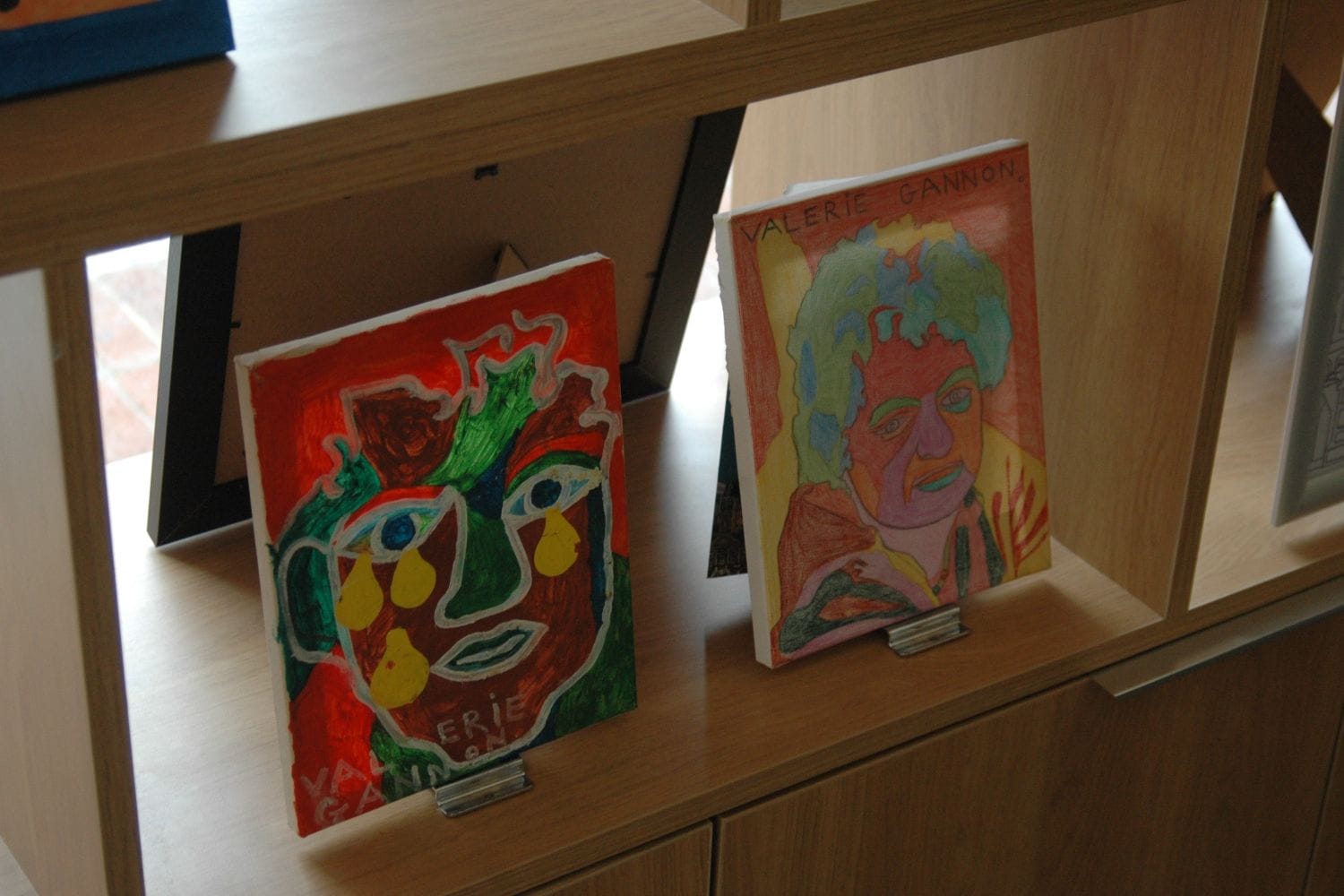
On a shelf inside the window, there were small framed pieces: self-portraits, portraits of her mother. Their skin was coloured purple, orange, green and blue.
One was crying thick yellow tears.
She gave that one to Roche, he said. “Having the fruit and veg shop, she did this face. But the tears are pears. Teardrops are in the shape of pears.”
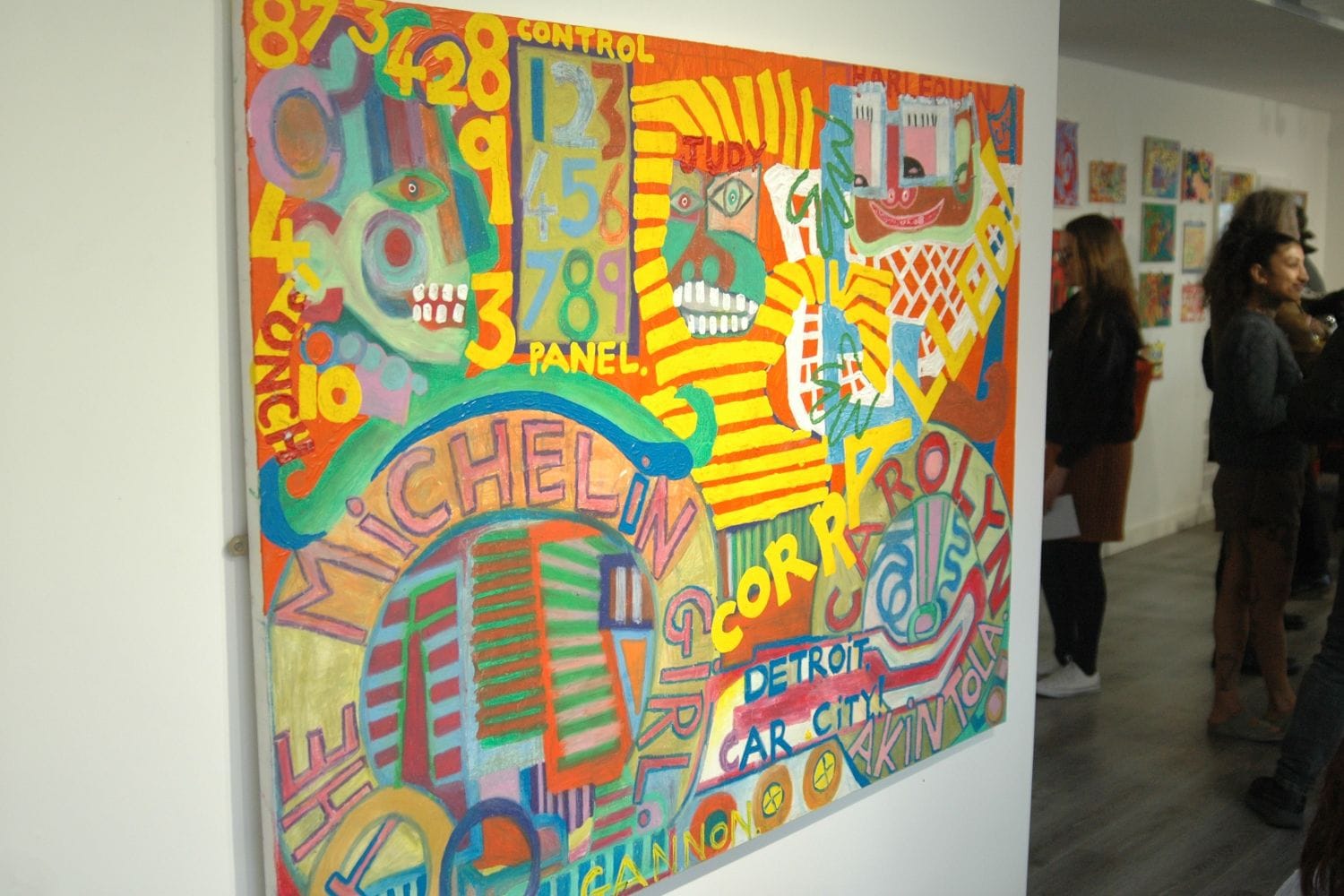
A lot of the works relate to people she knew, Duane says. “People’s names are worked into them. There are paintings of her mother’s history working at the drapery counter in Clerys.”
In the far corner of the room were four large oil-on-canvas works. One was a smiling portrait of Thomas Dudley, a Dublin figure better known by the nickname Bang Bang.
Another was composed of abstract shapes, in orange, brown, blue and maroon, and covered in green text that made reference to the murder of journalist Veronica Guerin.
She references the news quite a bit, Duane said.“Her antenna was out there picking up all kinds of stuff.”
Nearby was a painting of dogs, their bodies blending together like the wax in a lava lamp, and staring out at the viewer with enormous yellow eyes, white arching eyebrows.
Most of them have no teeth, except one which has a single tooth.
She has a fear of dogs, Duane says. “If I was afraid of dogs, I’d be painting their teeth. She just goes for the eyes. It’s quite unnerving the way they are staring out at you.”
Intangible cultural heritage
As six o’clock came around on the bank holiday Monday, Books At One filled up rapidly.
Beside the four canvas works, Duane had set up a table where children were colouring in A4 print-outs of a black-and-white sketch Gannon made of the Liberties’ architectural features, including Christ Church Cathedral and Noel’s Deli.
A few members of her family sat next to the kids as they coloured in the white spaces.
Her aunt, Marie Gannon, laughed, saying it was always difficult trying to see any of her artworks, because she was always giving them away. “I had never seen any of these.”
“If you were sitting in front of her on the bus, she’d draw ya, and then give it to you before you got off the bus,” she says.
A few moments later, the room fell silent as Duane introduced the show.
Gannon is a brilliant, naturally gifted artist, he said. “And is a typical Liberties person who travelled the world, always comes back here, loves this place, and her art is very rooted in the Liberties.”
The next day, Noel Fleming pulled up a seat at the table to look at some of the A4 print-outs of Gannon’s impression of the Liberties.
She drew it right after the 11 September 2001 attacks in the USA, he said, tapping his finger on the sheet of paper three times. “There was a picture in one of the Sunday papers of the New York skyline without the Twin Towers.”
He asked her if she had ever thought of doing a picture of the Liberties skyline, he said. “Just threw it out there. The next day she came in with that, and I laminated it because it was on such thin paper.”
She’s a highly intelligent person, he said. “And when she got motivated for something, that was it.”
But viewers seeking a beat-by-beat summation of jazz musician Bill Evans’ career will be disappointed by Grant Gee’s film, which is not meant to be a biopic.