

In radio in Ireland, the “accent ceiling” persists
On volunteer-run community radio, there’s room for people with all kinds of accents – but it’s rare to move beyond that.
Róise McGagh’s exhibition “sticks and mountains and huge lone birds” is on now at the College Lane Gallery.

The sky over Howth was cloudy, but the sun shone through the grey.
The squawk of gulls and strums of an acoustic guitar echoed up from the harbour to Abbey Street, where a couple of tourists were happily remarking at how beautiful it was out, as the temperature hit 14°C.
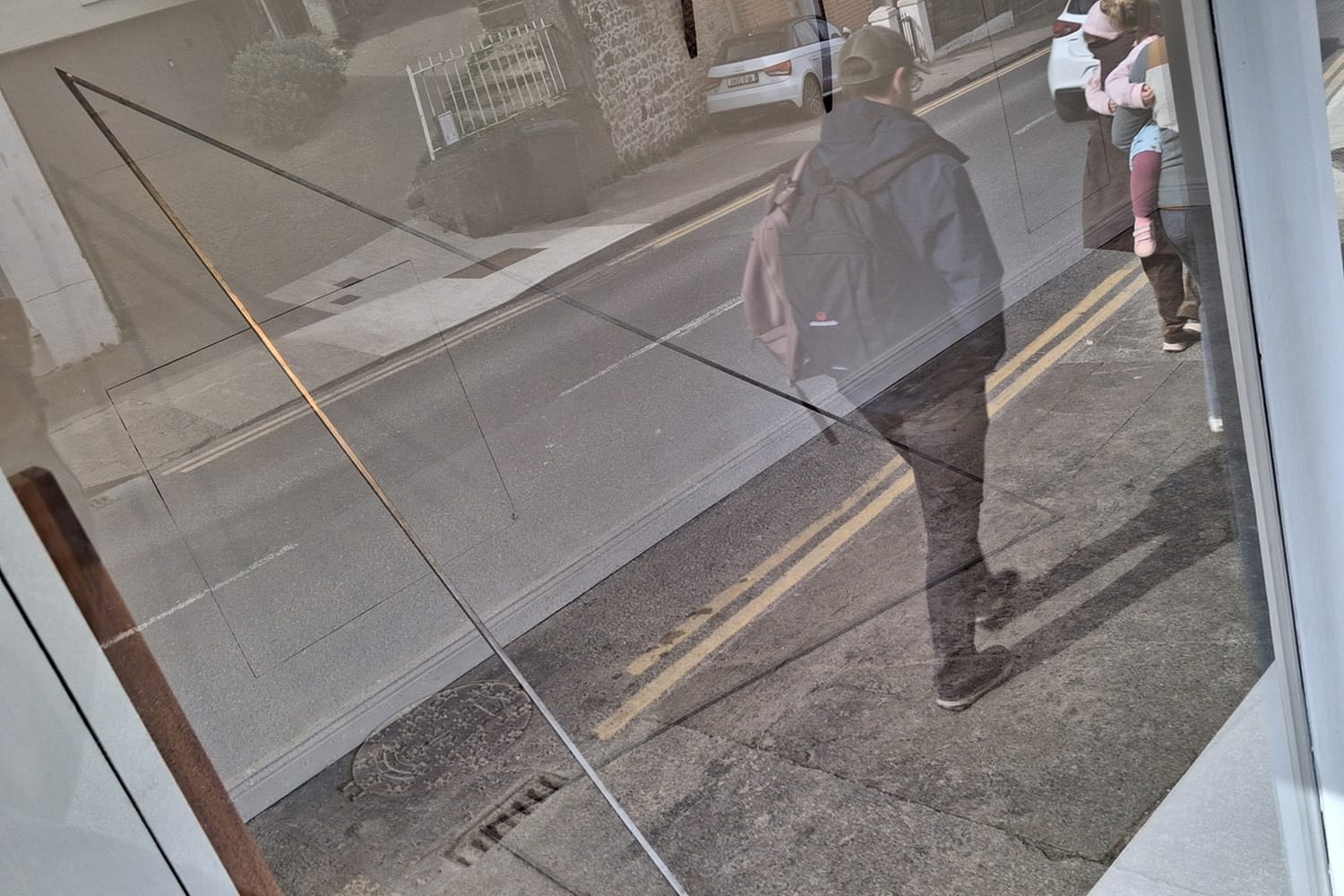
As they passed the front windows of the College Lane Gallery, they paused briefly, catching a glance of their reflections in a silver square of film that had been fixed to the glass.
The two-way mirror – stuck there by the artist Róise McGagh – was titled “Transpose”, according to a sheet of paper lying inside the white windowsill.
Part of McGagh’s exhibition “sticks and mountains and huge lone birds”, the piece kept grabbing people’s attention – school children, friends out for a stroll pushing buggies, visitors to the peninsula.
In part, this simple installation was there to jolt passers-by out of their immediate viewpoint, McGagh said on the last Monday in March, sitting on a step in the exhibition room that connects the gallery to the house behind it. “You’re outside, you think you’re looking outside, but you’re seeing outside again.”
When nobody was in its reflection, the mirror’s chief subjects were the pebbledash and red-brick houses across the street, and the Howth Music School.
That’s where the name “Transpose” came from, McGagh said. “Like, it’s opposite the music school, and that’s a music term, to transpose, to take one thing and to put it somewhere else.”
McGagh’s show is composed of different installations, mostly conceived during a month-long residency in the gallery during March, they said. “Just, y’know what I’ve seen from wandering around.”
It’s a show that asks the audience to re-examine their immediate surroundings, they said. “I wanted to observe different things around here, distill them into a show which encourages you to look at the sculptures and then look around again.”
McGagh sat on a white step in the corner of the gallery on Monday 30 March, two days after the opening of the show.
A big part of their practice is focused on how it feels to share space, be it public or private, with an object, they say. “I kind of will walk around, just look around, see what catches my eye and how it feels to be on the street or around a building.”
Howth was newish territory to explore for the artist, who grew up between Donegal and Drogheda, before moving more recently to Dún Laoghaire, they said. “I’ve, like, visited before but haven’t been here much.”
Over the course of the residency, they took casual strolls, visited the library, got lunch in the deli, they say. “And I’d be in here watching the music school and seeing the back of people’s heads when they’re practicing. A nice thing to observe.”
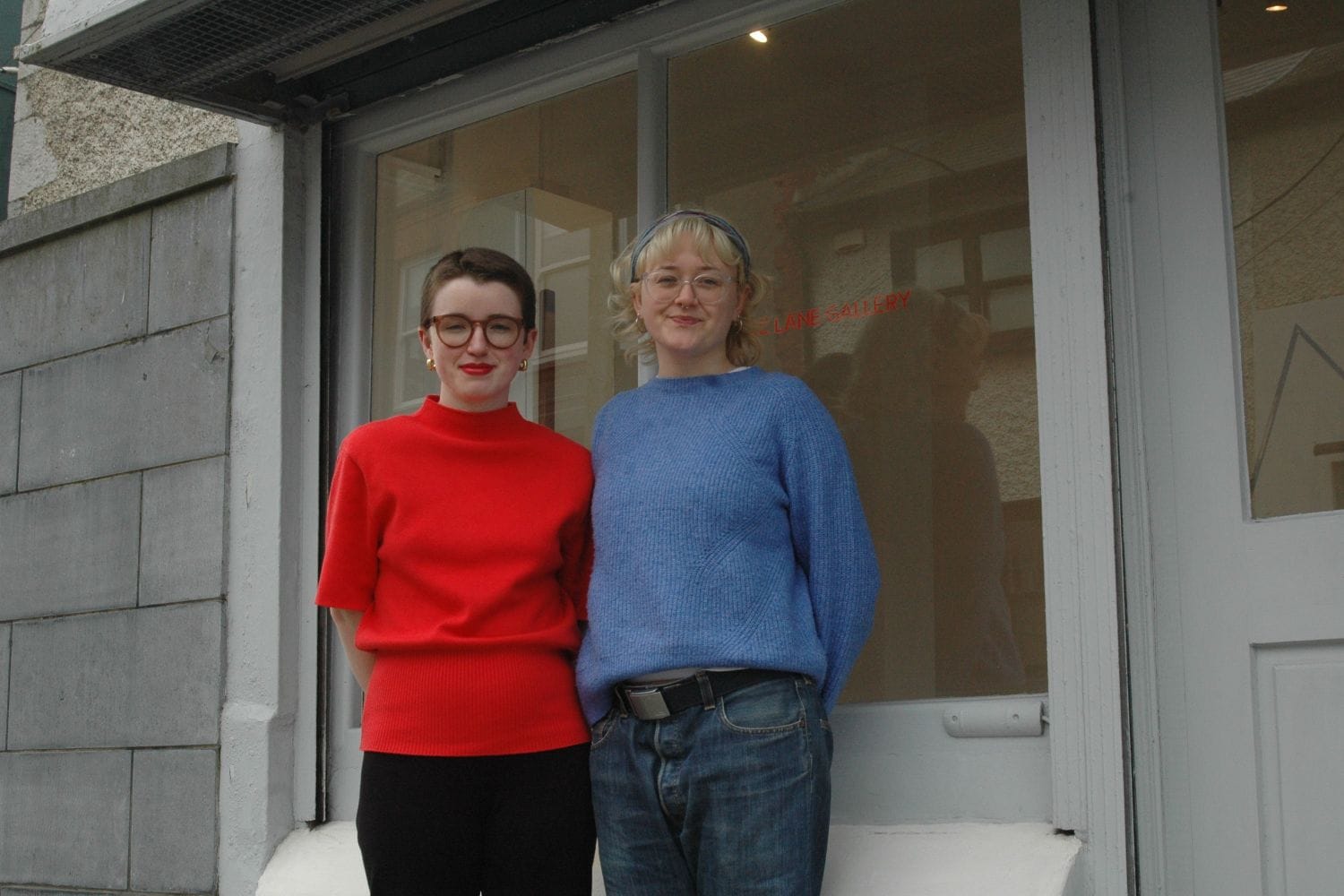
They were joined by its curator, Aoife McCloughlin, who leaned against the windowsill.
On the opposite side of the gallery space, there was a stainless steel trapezoid, which McGagh had folded into a pyramidic structure.
It is an imposing piece, McCloughlin said. “It’s interesting. When people came in on Saturday, it was controlling their movement around the room.”
It is big because most people would be viewing it from outside on the street, McGagh said. “And when everyone came in, people stood as far away from it as possible.”
Known as “Steeple”, the piece imitated the ruins of St Mary’s Abbey next door to the gallery, McGagh said. “It picks out the tall narrow roof. It picks out a shape that is repeated in the area, and it’s also repeated in the hazard signs on the electrical boxes right in front of the gallery.”Q
It was windy and a little chilly outside College Lane Gallery as McGagh and McCloughlin stepped outside onto the street.
Right around the corner, McGagh had fitted one sculpture onto the side of the building.
It was a steel frame, painted yellow and curving like an old shop sign. It was bent out of shape and missing the product it was originally supposed to advertise.
Depending on the vantage point, either it acted as a viewfinder for the grey wall supporting it, the door of the house behind the gallery, the cloudy sky overhead or the music school across the street.
The choice to paint it yellow was, like “Steeple”, inspired by hazard signs in the locale, McGagh said. “It was also the last piece I made, actually.”
Quite simply, they wanted to make a part of the exhibition exist in the public realm, they said. “And it does, like, echo the front of the gallery. It wasn’t super intentional.”
After a couple of minutes on the windy street, the pair retreated back inside to sip tea from dark red glasses.
The exhibition’s title, “sticks and mountains and huge lone birds” had taken its title from author Claire-Louise Bennett’s debut collection of short stories, Pond, McGagh said.
Bennett had written about how children see the world, McGagh said. “I kinda liked that as a starting point for people coming into the gallery, seeing simple shapes that might have been picked out of a scene somewhere in the surrounding area.”
“I think to me the purpose of making things like this is to present another perspective on interacting with things in the world,” they say, before pausing.
Save for the sound of a car rushing by, the room is quiet for a second before McGagh laughs. “So, I guess, that’s what I’m doing here.”

The expected timeline is the 18 months plus the breaks over the summer and winter months, said Shane McMorrow, at a recent council committee meeting.

A year ago, after much work, the council published a plan for how to revitalise the village. “I’m wondering why we all went to the bother, to be honest.”

Fingal has been working for years towards building a small number of apartments on a long-vacant site at Tuckett’s Lane.

“I feel like, if I don’t vote [for it], I’m voting against housing. If I do vote, I’m voting against greenbelt.”