

Issue linked to 1941 Nazi bombing sees councillors stall €1 transfer of North Strand property
Are there any other properties in the area that might face similar ownership complications? a councillor asked at a recent meeting when the case came up.
Are there any other properties in the area that might face similar ownership complications? a councillor asked at a recent meeting when the case came up.

Dublin city councillors have deferred a proposed €1 transfer of a North Strand property after raising questions about an unusual ownership arrangement dating back to the aftermath of the German bombing of Dublin in 1941.
The proposed sale concerns 10 North Strand Road, which these days has a graffitied shuttered shopfront on the ground floor along with an old sign for a pet-food shop, and a residential space above.
The freehold was transferred to Dublin Corporation – as the council was then known – in 1942 under legislation introduced to compensate victims of wartime bombing.
But the original freehold owner was never compensated, according to a council report, so they hung on to the property.
The council itself never took possession or sought rent, and its legal advisers have concluded that it forfeited its interest in the building.
This has all come up now because a receiver began selling the premises and pre-contract enquiries revealed that the freehold remained registered to Dublin City Council, the report says.
But when the step of the €1 disposal to new owner Resortique Limited came before the Central Area Committee at its most recent meeting in October, councillors questioned the legal advice.
They wanted to know more too about the valuation and whether there were other properties acquired under the same wartime legislation with similar status.
The item should be deferred until more background information was forthcoming, said Independent Councillor Nial Ring.
"It's just I've only just looked at the report now," he told the chamber, adding that although it referred to the North Strand bombing and the freehold, "it's not really clear".
Fine Gael Councillor Gayle Ralph supported Ring’s request. She questioned why the property was valued at €1, and asked for more information about Resortique Limited.
"I'm just curious about that, and I'd be curious about who the company are, and what the plans are for the property," she said.
And, she said, "Are there other kind of properties that date back to 1942 that the council might have similar ownership issues with? I'd like clarifying those issues before I agree to anything."
Grainne White, a solicitor acting for Resortique Limited, said by email on Thursday that the company is looking forward to resolving the historic issues. They plan to renovate the home and shop "in line with the transformative regeneration ongoing on North Strand Road", she said.
A Land Registry folio associated with the North Strand property lists several other plots in the surrounding area under the same registered ownership.
Some, the council acted as owner of, over the years, according to the folio. It shows the council leasing some of the properties out, and transferring others to individuals.
Asked last week whether the original freehold owners of any other properties had also gone uncompensated, potentially creating similar title problems to what's happened with 10 North Strand, a council spokesperson said: "The question is speculative, and the question should at least specify what information is sought.”
Asked how it intended to resolve the situation with 10 North Strand Road, the spokesperson said: "By providing further information to the Elected Members. The Council is bound by Section 183 of the LGA Act 2001."
Section 183 governs the disposal of property by local authorities, including the role of elected councillors in that process. They can amend or block a proposed disposal.
A report circulated to Central Area councillors proposed disposing of the title to Resortique Limited for €1, “if demanded.”
The purchaser would also be responsible for its own legal costs and approximately €1,500 plus VAT towards the council's legal expenses, it said.
The report doesn't identify the original owner, nor does it explain why compensation was never paid.
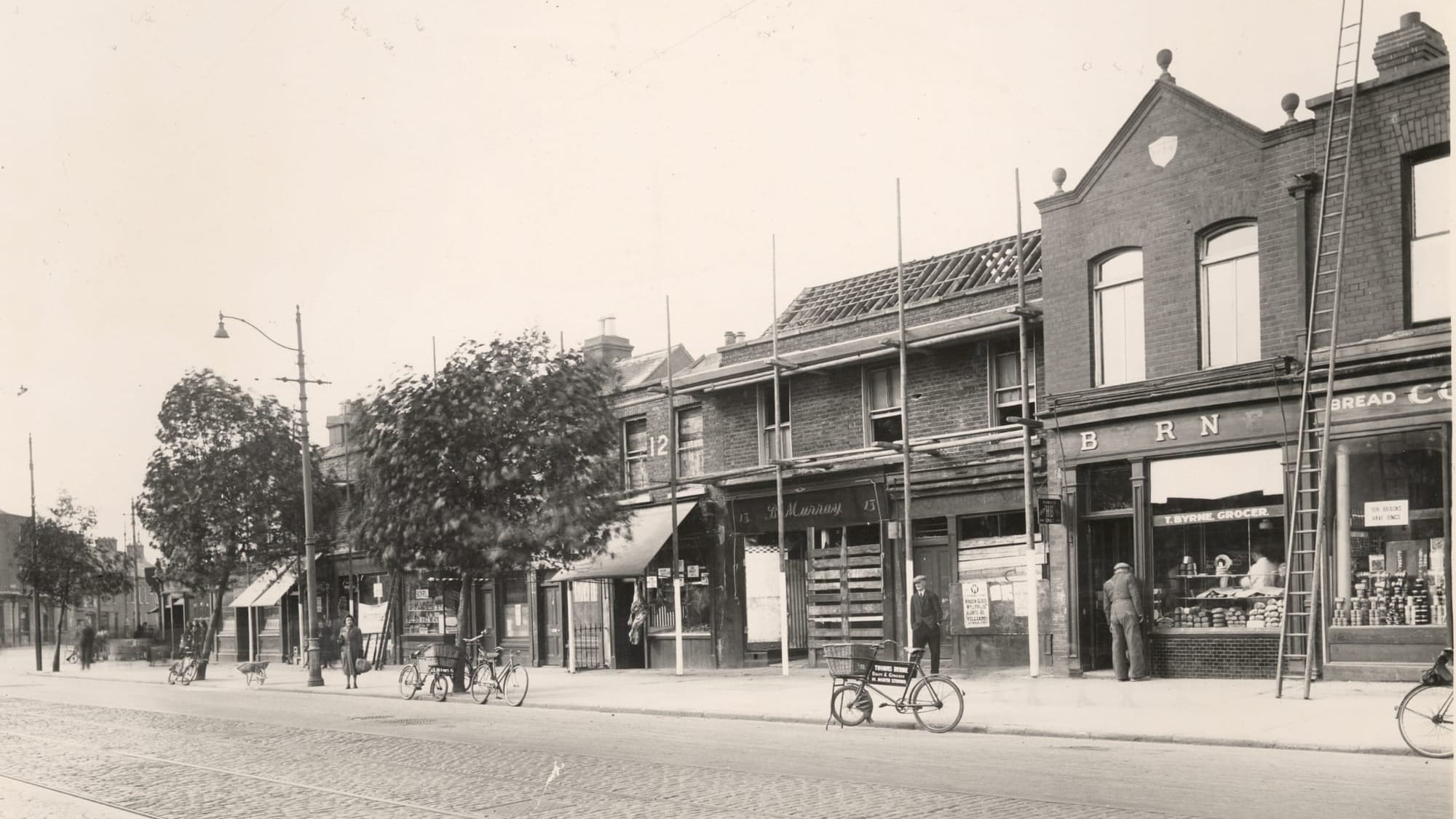
The curious situation traces back to a deadly attack on Irish soil during the Second World War.
Ireland, governed by Éamon de Valera's Fianna Fáil administration, was neutral during the war.
But in the early hours of 31 May 1941, German aircraft dropped four bombs over Dublin, with the most destructive explosion in North Strand.
The attack killed 28 people. It injured more than 90. Hundreds of homes were destroyed or damaged, according to the council's historical records.
Families were homeless, businesses were devastated, and chunks of the neighbourhood needed to be rebuilt.
The government protested to Germany, while Dublin Corporation began clearing debris, repairing damaged properties and finding accommodation for displaced residents.
However, the recovery faced issues.
An Irish Press report from 7 August 1941 described complaints that some North Strand families rehoused in corporation accommodation in Cabra had been left without beds.
Dublin City Manager P.J. Hernon responded that about 350 families had been supplied with blankets, mattresses and cash allowances to purchase household necessities.
One member of the Dublin Board of Assistance said he had received a letter from a displaced family claiming they were sleeping on the floor.
Alongside those immediate relief efforts, the government began developing legislation to compensate people whose homes and businesses had been destroyed.
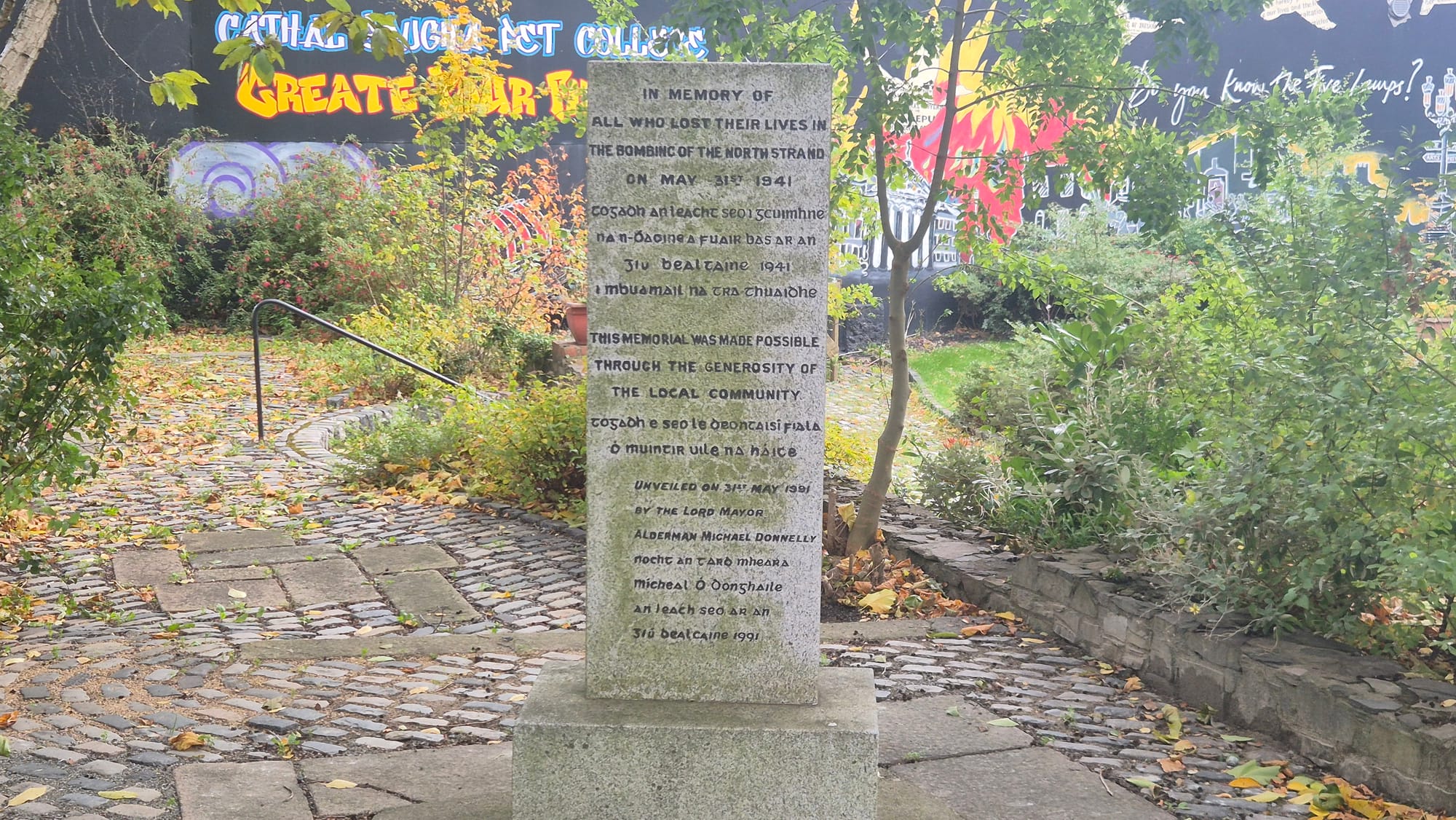
The Fianna Fáil government introduced the Neutrality (War Damage to Property) Bill in July 1941, prompting debate about the compensation victims should receive.
Questions arose over whether payments should reflect the market value of damaged buildings or the cost of replacing them, and how losses to livelihoods should be treated.
In August 1941, the Irish Press reported on a meeting at Connolly Memorial Hall in North Summer Street, where residents protested against what they considered inadequate compensation provisions.
The meeting raised concerns about owners and leaseholders of demolished buildings and people who had lost their livelihoods.
An Irish Independent editorial on 21 August welcomed amendments to the bill. Public criticism had helped remove some of its most objectionable provisions, it said.
Meanwhile, Dublin Corporation was considering acquiring bomb-damaged land for redevelopment.
On 27 September 1941, the Irish Press reported that the corporation was preparing to consider acquiring sites under the new legislation, with compensation "being paid on a valuation basis".
The report also referred to the possibility of constructing a square of flats on acquired land.
By July 1942, the scale of the compensation programme was becoming clear.
During Dáil debate on 16 July 1942, Minister for Finance Seán T. O'Kelly, of Fianna Fáil, said that 2,034 applications for property-damage compensation mostly arising from German bombings, totalling £317,000, had been received by 30 June.
Those included "18 from Campile [Co. Wexford], 20 from Sandycove, 397 from Terenure and South Circular Road, and 1,488 from the North Strand. Claims are still coming in at the rate of 25 to 30 each week", O'Kelly said.
Indeed, tremors from the North Strand bombing had damaged houses across a wide area of Dublin, according to a survey by Dublin Corporation's Dangerous Buildings section staff, and reported on July 1941 in the Irish Press.
Claims arose mostly from those bombings, but, "There were other incidents causing less extensive injuries arising from the dropping of bombs – e.g., in Counties Carlow, Louth, Wicklow, or the explosion of land or sea mines by the Army authorities, or from sea mines exploding from time to time around the coast – notably in County Wexford," O'Kelly said.
The Minister also said offers to date had been made in 970 cases, and government had spent £111,880 over the past financial year. These largely involved reimbursement of local authorities for housing repairs and other costs, but also included compensation to individuals.
Fine Gael TD Patrick McGilligan said he'd met about compensation with a number of the victims of the North Strand bombing, who'd found shelter in Cabra, which was in his constituency.
"It may be true to say that none of these claims proceeded as far as the Circuit Court but, if that phrase is intended to create the impression that these people were satisfied, it is very far from being the truth," McGilligan said.
Those who were bombed in North Strand were "mainly people who had no money or resources", he said. "Yet, we had meticulous calculation in respect of depreciation in respect of cases under this Act."
He related the story of a man and his wife he'd met, who told him that on the night of the bombing, "old lady member of the family who had retired to bed had, according to the best practice, a glass of water beside her in which she kept her false teeth".
"The bomb came, and the false teeth went," McGilligan said. "That lady applied for compensation. The claim was ruled along the lines that she had had the teeth so many years, and that, therefore, a depreciated value should be put upon them. When she interviewed me, she was without teeth because she had no resources wherewith to get a new set."
Should there be another bombing in future, the government should not be so mean with compensation, McGilligan said.
O'Kelly, the minister, defended the compensation programme.
"The whole attitude of the officials was to meet the claimants sympathetically, but the officials have to bear in mind that they are subject to the Comptroller and Auditor-General, who examines each one of these payments in a very scrupulous way. So does the Committee on Public Accounts," he said.
He also confirmed that provision was being made for payments to Dublin Corporation relating to North Strand buildings acquired for a town-planning scheme.
The present-day dispute concerns one of the properties apparently caught up in that process.
The council's report identifies 10 North Strand Road as "reference 247" among properties vested in the corporation under the 1941 Act and says the freehold vested in the local authority in 1942.
Yet more than eight decades later, the council's own records indicate that the original owner was never compensated.
The council has promised further information to councillors at the next Central Area meeting planned for next week.
Funded by the Local Democracy Reporting Scheme.

"Housing supply alone will not solve the challenge. The key issue is delivering the correct tenure mix," said a recent presentation to councillors.

Even with no arrest or fining powers, private patrols can assert considerable authority over who gets to use public spaces.

This "Integrated Spatial Framework and Delivery Plan" will serve as the roadmap for the work of the planned Dublin City Development Company, the tender says.

Public consultations are planned, with meetings in the Lucan Spa Hotel at 7pm on 1 December, and the West County Hotel, Chapelizod at 7pm on 3 December.