

Issue linked to 1941 Nazi bombing sees councillors stall €1 transfer of North Strand property
Are there any other properties in the area that might face similar ownership complications? a councillor asked at a recent meeting when the case came up.
This "Integrated Spatial Framework and Delivery Plan" will serve as the roadmap for the work of the planned Dublin City Development Company, the tender says.

Dublin City Council has launched a tender for a team to draw up a plan for Dublin city centre's regeneration, charting out what should happen next, where – and how to make that case.
The "Integrated Spatial Framework and Delivery Plan for the Dublin City Taskforce Area" is intended as the main document guiding future investment and decision-making within the area around O'Connell Street, the tender documents say.
It'll be "non-statutory" but serve as the roadmap for the work of the planned Dublin City Development Company, a special purpose vehicle (SPV), to be owned by Dublin City Council to take on the transformation of the city centre, it says.
The vision is to build on two main bodies of work.
One is the recommendations which came out of the Dublin City Taskforce, set up by the then-Taoiseach, Fine Gael's Simon Harris, in May 2024 "to address urgent inner city challenges and devise ways to regenerate this important inner-city core", the tender document says.
Another is the work of the council's Urban Redevelopment Working Group, with its pilot of street-by-street regeneration in the north inner-city, taking aim at vacancy and dereliction with the aim of turning what the council can into cost-rental housing.
Whoever wins the tender is expected to get the plan done within nine months, the tender says, although a couple of extensions are possible.
A key point of tension in debates around changes to governance for the taskforce area – a smallish but central part of the north inner-city around O'Connell Street – has been the future of democratic input into work being done by the future Dublin City Development Company, and changes in the area.
For this tender, the winning team is expected to lay out how they will go about consultation with "stakeholders", as they draw up this integrated area plan, documents say.
They'll need to engage with, among others, council officials, other state agencies, landowners and key businesses, community groups, service delivery organisations, and local residents, it says.
There should be at least six public drop-in events, 10 stakeholder meetings, and a smaller number of bespoke creative events with groups such as young people, it says.
As part of all this work, the team will also be expected to identify a number of "strategic opportunity areas" and lay out how ideally they would be developed – alongside an investment prospectus for some projects, with a "portfolio of priority opportunities and investment propositions".
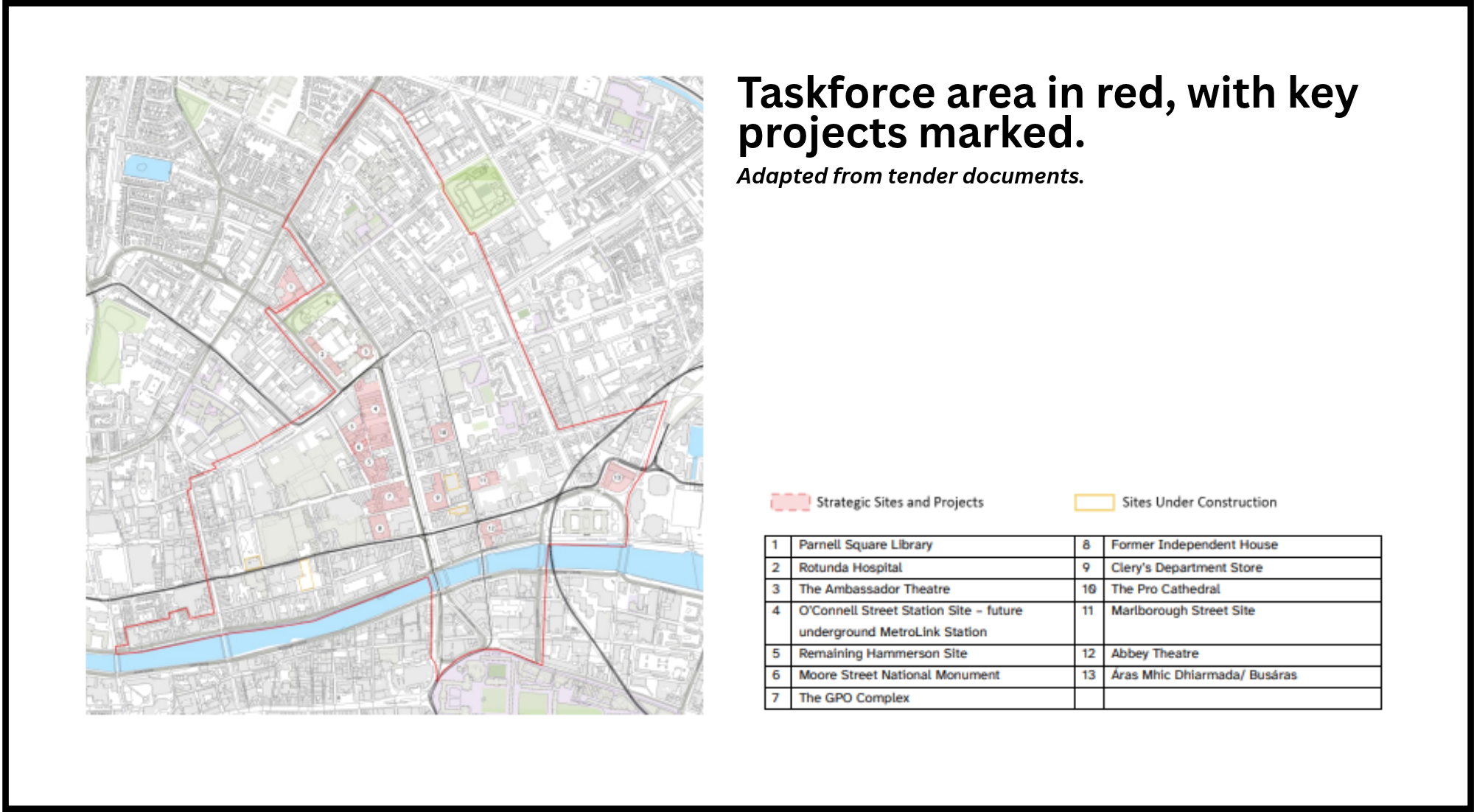
The taskforce area covers a range of historic blocks around O'Connell Street – taking in Henry Street, Middle Abbey Street, and North Frederick Street, with their busy shops, cultural facilities, apartment buildings and transport hubs.
A map in the tender documents shows 13 key projects within its boundaries. Among them, the reinvention of the GPO, the planned Metrolink station on O'Connell Street, the former Independent House, Busarás, and the long-planned new Parnell Square library.
Key to the area's future success is reimagining the role of O'Connell Street, says the document, "currently facing challenges with commercial vacancy, architectural dereliction and anti-social behaviour, prioritising public realm improvements, vacancy reductions and transforming key buildings".
The city centre is already subject to so many existing and planned investments, policy initiatives and regeneration projects, says the main tender document.
These all "present a significant opportunity to accelerate positive change across the area", says the tender document.
But given the scale and diversity of all these plans, the area needs an "integrated framework" that can set priorities, and lay out how they'll be delivered and sequenced, it says. To chart out what should happen where, when, and how.
"Building on the recommendations of the Dublin City Taskforce, there is potential to unlock strategic development sites, increase city centre living, enhance public spaces, improve connectivity and create a more liveable, vibrant, attractive and inclusive urban environment," it says.
The aim of the integrated plan is to establish "an ambitious and compelling long-term vision for the area", which builds consensus among different groups.
It should identify opportunities to transform the public realm, and show the potential for mixed-use inclusive growth with "high-quality design and a clear sense of place for the benefit of current and future residents, businesses and visitors".
It should lay out a phased and coordinated delivery strategy too, the tender says.
And it should be delivery-focused, the tender says, "enabling the review of publicly owned assts and engaging third party landowners and investors to test, shape and promote proposals as part of a coherent investment proposition to secure comprehensive sustained transformation of the city centre".
The team will have to draw up a "baseline" analysis of the area as it is at the moment. They'll assess strengths, opportunities and constraints such as land ownership and viability, impacting future development.
"This assessment should consider physical, environmental, social, economic, ownership, infrastructural and governance factors, together with planned public and private sector investments," it says.
The team's assessment must also identify "priority intervention areas", with an evidence base to help select projects, investment decisions and delivery sequencing, it says.
It should set out a compelling 10-15 year ambition for the city centre, showing "how it can transform into a distinctive, inclusive and economically resilient urban neighbourhood at the heart of Dublin".
The aim is to have more people living in the city centre, with the amenities that they need, it says. There should also be retail, as well as food, culture, leisure and workspaces.
The team should show "a proactive approach to vacancy, dereliction and poor stewardship, using support, facilitation and statutory tools in a targeted and coordinated way".
And, "a coherent development pipeline that connects individual sites and buildings in a way that supports a wider placemaking strategy", the tender says, among other broad goals.
As well as the main integrated spatial framework, the team appointed will also have to draw up a "Public Realm and Greening Framework", looking at how to make the city centre welcoming for all, and consider also how people get around.
Special consideration should be given to plans for the new Metrolink Station on O'Connell Street, it says, and the impact on accessibility and pedestrian movements in the wider area. Laneways, too, should be a focus on this public realm plan, building on past council work, it says.
 Laoise Neylon
The framework should identify "character areas" to help with place-making and provide guidance on future development and investment within these areas, it says.
Meanwhile, the team will be expected to identify a series of "Strategic Opportunity Areas" within the taskforce area, each with an urban design brief.
Those briefs are to set a clear vision and development framework for each area, of which there should be up to five, it says.
Each of these briefs should define how the "strategic opportunity area" sits within the city centre taskforce area, develop options for land uses within the area, building heights, landscaping, climate resilience and so on.
It should illustrate "preferred development scenarios", and test the commercial viability and deliverability of each scenario, it says.
It should look at meanwhile uses, and key public benefits which can come from any development, and "detailed viability, investability, and deliverability information including options testing and funding solutions".
These briefs should also measure social return on investment, it says.
Another part of the contract is to prepare a "site development brief" for the Carlton Cinema and O'Connell Street Station site, with a vision for that site's development over the coming five to 15 years.
How is it all going to be paid for and rolled out? The consultants will have to look at that too, the tender says, and come up with a plan that the future Dublin City Development Company and Dublin City Council can turn to coordinate it all.
They'll have to identify lead partners and governance structures.
They'll also have to assess potential funding sources and investment mechanisms, it says, "including public sector funding programmes, private investment, development contributions, community-led and cooperative funding arrangements, public-private partnerships and other innovative funding opportunities".
The work also includes coming up with an "investment prospectus" based on all this work, focused on up to five – as yet unchosen – "priority projects".
"It would be written for multiple audiences and formulate a portfolio of priority opportunities and investment propositions," it says.
It lists the kind of thing that should be in the prospectus – the project proposals, indicative capital and revenue implications, potential funding sources and investment partners, any constraints, and benefits from the intervention.
As all this is drawn up, the team is to work effectively as part of the council's Project Management Unit, it says. The governance structure is also to include a "stakeholder working group", although who'll sit on that isn't yet decided.
Councillors would be briefed at key milestones, the tender document says.

Are there any other properties in the area that might face similar ownership complications? a councillor asked at a recent meeting when the case came up.

"Housing supply alone will not solve the challenge. The key issue is delivering the correct tenure mix," said a recent presentation to councillors.

Even with no arrest or fining powers, private patrols can assert considerable authority over who gets to use public spaces.

Public consultations are planned, with meetings in the Lucan Spa Hotel at 7pm on 1 December, and the West County Hotel, Chapelizod at 7pm on 3 December.