

Against a backdrop of policy shifts, Ukrainian refugee children embrace their Irish life
Ireland is the place they started school, joined sports clubs – yet their parents worry about how changes to citizenship eligibility may haunt their future.
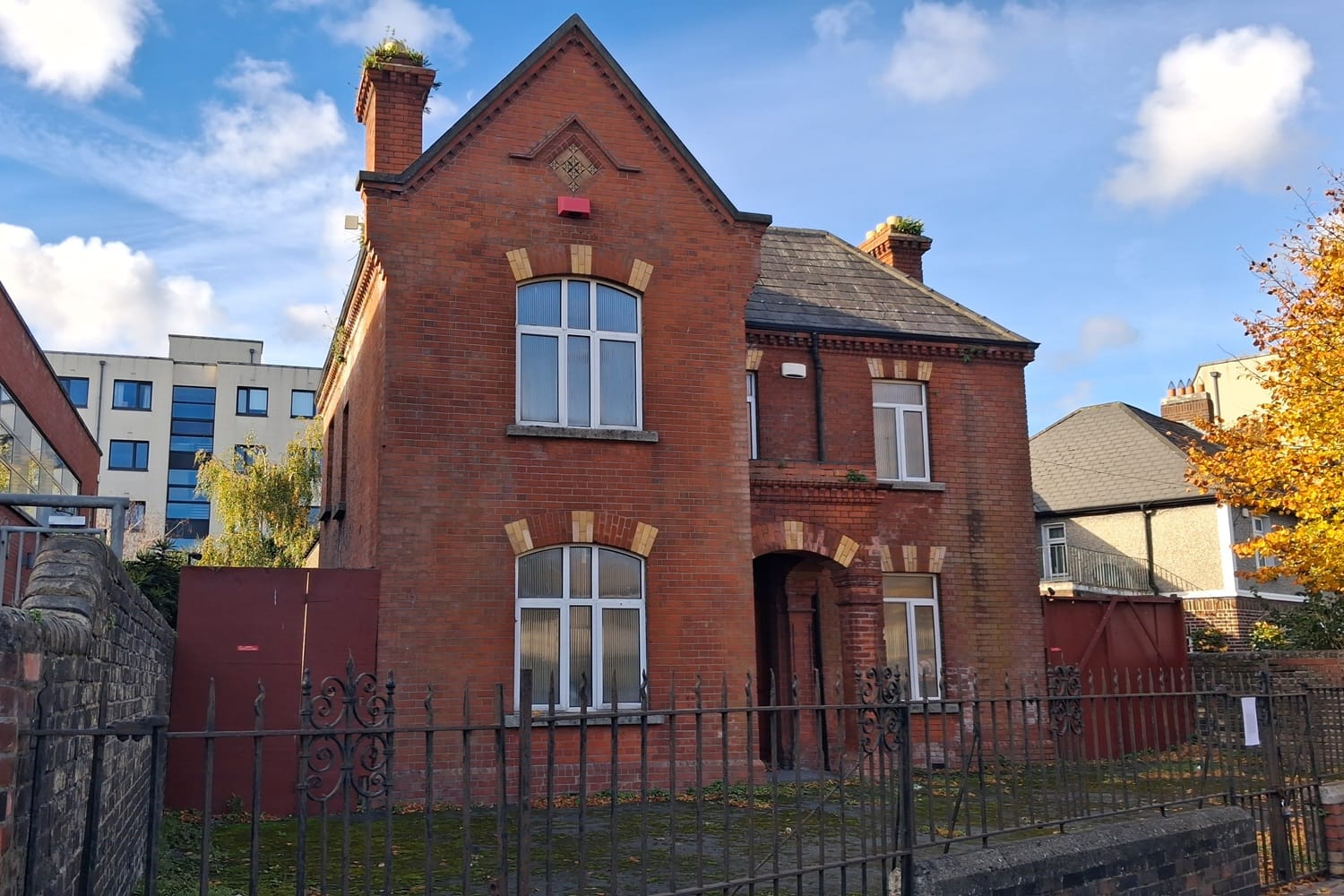
Also known as Dolphin House and Bottler’s Hall, Bottlemaker’s Hall was built as a recreational hall by the Irish Glass Bottle Company in 1915.

The two-storey detached red brick building known as Bottlemaker’s Hall sat at the end of a short weed strewn driveway.
Two padlocks sealed its brown front door, and another kept its gate closed off too on Monday morning.
Located on the Irishtown Road, just 78 metres away from the Art Deco-style Ringsend library, the building was kept under watch by a pair of black CCTV cameras.
They were mounted to reddish-brown wooden hoardings which stood to either side of the house, obscuring from view one of the property’s defining features, an assembly hall, approximately 20 metres long.
Also known as Dolphin House and Bottler’s Hall, Bottlemaker’s Hall was built as a recreational hall by the Irish Glass Bottle Company in 1915, according to a conservation report by Bradfield Devlin Architects.
It is listed by Dublin City Council on its record of protected structures.
But, images from Google Street View show that the property had been vacant with a chain around its gate since 2009.
Fixed to the gate on Monday however, was a site notice, informing locals of the intentions of its owners, Margaret and Gary Costello, to redevelop the property as housing.
The owners were seeking the council’s permission to change the use of the vacant social club and manager’s apartment to three three-bedroom houses, two of which would be built within the redesigned single storey dancehall to the rear.
The Costellos were reached for comment via the architecture firm Antipas Jones and the Ringsend and Districts Historical Society on Monday morning.
According to the society’s acting chairperson, Rachel Lopez, the owners declined to comment on the project.
But Lopez, speaking on behalf of the society after viewing the application, said on Tuesday that they were delighted to learn of the proposed conversion of the hall.
Ringsend attracted glass manufacturing firms operations from as early as the 18th century, "owing to its location by the sea as sand constituted 80% of the ingredients", according to an October report by Bradfield Devlin Architects.
At the start of the 20th century, "the small port was a prosperous community which boasted six carpenter sheds and four bottle factories. The four companies were The Ringsend Bottle Co, The Hibernian Glass Co, The Irish Glass Bottle Co, the King Brothers Bottleworks," the report says.
Bottlemaker’s Hall was designed by Aubrey Vincent O’Rourke, a Drumcondra-born architect who counted among his pupils and assistants the social housing architect Herbert Simms, the report says.
It was commissioned for the Irish Glass Bottlemakers’ Society between 1913 and 1914, with construction completed by the builder John Dillion in September 1915, it says.
Employees of the nearby Irish Glass Bottle Company used it as a recreational hall, it says, while the secretary of the Society, James Longmore lived in the residential portion with his family.
The trade union leader Jim Larkin used the hall for political rallies, according to a walking tour map prepared by Dublin City Council and the Ringsend Irishtown District Historical Society.
Journalist Ger Siggins, whose late father Brian was a local historian, recalled a story about his uncle David.
In the early 1940s, during the Second World War, Siggins’ uncle, aged 8, was sent to buy coal in Ringsend on a freezing cold day, he said. “The wheel broke off the cart.”
As he lugged the broken cart past its hall, the caretaker, Giggins O’Reilly, brought the boy inside to thaw while he mended it, he said. “David never forgot the kindness and 80 years later, he had a mass said for Giggins in Ringsend.”
From 1960 to 1965, the son of James Longmore resided in the hall, before it was listed under the ownership of R J Campbell (Builders) Limited, the conservation report says.
Around 2007, it was used as a site office by developers McInerney Contracting, it says, “and remained vacant until purchased by the current owners".
The hall was put on the market for €700,000 by estate agents Ganly Walters in 2017.
Three years later, in March 2020, its current owners were granted permission by Dublin City Council to refurbish and reconfigure its existing ground for offices.
The main hall had last been used as a workman’s social club 25 years prior, they said in their application, while asking to change its use to a showroom, open plan office and/or training room.
The owners put the property on the market again, this time for €1.25 million, the Business Post reported in May 2021.
Five months later, in October 2021, the building was used temporarily for a live sound installation project and for an arts event with the street artist Fink, according to a report at the council's South East Area Committee in November 2021.
The owners’ plans to repurpose the hall as an office space stalled when its planning permission expired in July 2025, according to the planning application.
Their new application to redevelop the hall as housing is currently active, with locals invited to submit their observations until 25 November, according to the new application.
Rachel Lopez of the Ringsend and Districts Historical Society said they were delighted to learn of the proposal.
The owners were demonstrating a commitment to preserve the historic fabric of the hall with the proposed plan looking set to “honour” its history through minimal intervention and sensitive restoration, she said on Tuesday.
“The architecturally sensitive conservation and adaptive reuse of Bottle Maker’s Hall will reinvigorate this unique place of Ringsend’s built heritage, filling it with life and honouring the glassmaking history of Ringsend and Irishtown,” she said.

Ireland is the place they started school, joined sports clubs – yet their parents worry about how changes to citizenship eligibility may haunt their future.

While tenant complaints about the e-bike, and also noise, were referred to in the notice to quit, that was to illustrate the breakdown between the occupants at the property, said the landlord's agent to the tenant.

In other jurisdictions, residents count many upsides from such a streetscape design, but maybe not those intended in this case.

The plan as voted through has 82 social homes, and a small "community hub".