

Frustrated with the service from Dublin Bus, one man took them to the Small Claims Court
"Please note, I am only looking for the restitution of €2.75 – the fare cost."
But the planning application for the Oscar Traynor Woods development, where it's to be located, envisioned the "minimisation of night-time lighting" to avoid disrupting local wildlife too much.

A new skate and scooter park is due to open soon at the new Oscar Traynor Woods development in Coolock.
But as the evenings shorten, one potential problem has been flagged – it has no dedicated lighting.
That makes the facility much less useable, says skateboarder David Hussey.
During winter, young people are still at school – and adults are still at work – when the remaining daylight begins to disappear.
“You cannot skate in the dark. It’s just not possible,” Hussey said. “It’s very fast-moving. You’re going to injure yourself. It’s like trying to play hurling in pitch black.”
Local Labour Party Councillor Alison Field recently raised the issue with the council executive.
In a written question, Field suggested that timed, push-button lighting could extend the park's opening hours while limiting energy use.
A written reply from the council's chief executive, Richard Shakespeare, said the developer of Oscar Traynor Woods, Glenveagh Homes, was bound by the planning permission for the development, which did not provide for lighting in the skatepark.
Indeed, Glenveagh's 2022 planning application for the 850-home development included an environmental impact report.
And that flagged the potential for lights to disrupt local wildlife, and proposed measures to mitigate this, including "minimisation of night-time lighting".
On foot of this, council planners, as a condition of the planning permission, required the developer to submit a lighting plan for approval – which it did.
However, despite the limited lighting in the new development itself, some light spills into the skatepark from streetlamps beside the main road, the chief executive said in his response to Field.
The council did not respond to query on who would be liable should someone injure themselves due to poor lighting while skating in the park.
When asked if anything could be done to add a light source closer to the skate park, a spokesperson for Glenveagh said, “We have nothing further to add, and must work to the planning permission that is in place.”
For Hussey, the lack of lighting at the Oscar Traynor Woods skatepark reflects a wider failure to consider how skateparks will function in Dublin’s climate.
Rain already wipes out many potential skating days, he says.
Leaving parks unlit during the darkest months further narrows the window in which people can use them, he says. “Lights installed in any park double its usability.”
Hussey pointed to other park facilities that do stay available after dark.
Tennis courts at Albert College Park can be used under lights until later in the evening, he said, while the playground in Fairview is also illuminated. "But we're always just fobbed off."
While it is encouraging to see a new skatepark spring up in Oscar Traynor Woods, the council should concentrate on delivering at least one centrally located, well-designed facility that is accessible by public transport, properly lit and, ideally, protected from rain, he says.
Dublin currently has no dedicated indoor skatepark, he says.
In other cities, spaces beneath bridges have been turned into sheltered skating facilities – like the Bridges Urban Sports Park in Belfast, which is partially undercover beneath the city's M3 flyover.
Hussey says skateboarders had previously built makeshift obstacles beneath a motorway bridge near the Royal Canal at Castleknock, and this is the kind of thing that should be formally explored.
Such a location could provide shelter from the rain, Hussey said, making it possible to skate in weather that would leave Dublin’s outdoor parks unusable.
Field, the Labour councillor, says she would like to see young people involved in the decisions in designing such facilities in future. “To give their opinion and to get them involved.”
The more skateparks the better, she says. It’s important to keep thinking outside the box, for those youngsters who aren’t into football.
“There is a need out there – and anything to keep kids from hanging around corners and up to all sorts is just always a win,” she says.
Field adds that the council should consult experienced skateboarders and the Irish Skateboarding Association before designs are finalised.
She points to the skatepark in Kinnegad, Westmeath which gained negative attention online last year for its bizarre, awkward design, which critics said was unsuited to actual skating needs.
The skatepark beside Cabra Parkside Community Sports Centre was once busy with skateboarders and scooter riders.
Oisín MacInnes said in January 2025 that he used it every day after school between the ages of 11 and 13. After the council closed it, he had to cycle four kilometres to Fairview to skate.
That skatepark in Fairview now has a rusted hole in one of its ramps, says Field, “posing risk of injury and tetanus, also some of the features have been incorrectly installed making them unfit for purpose”.
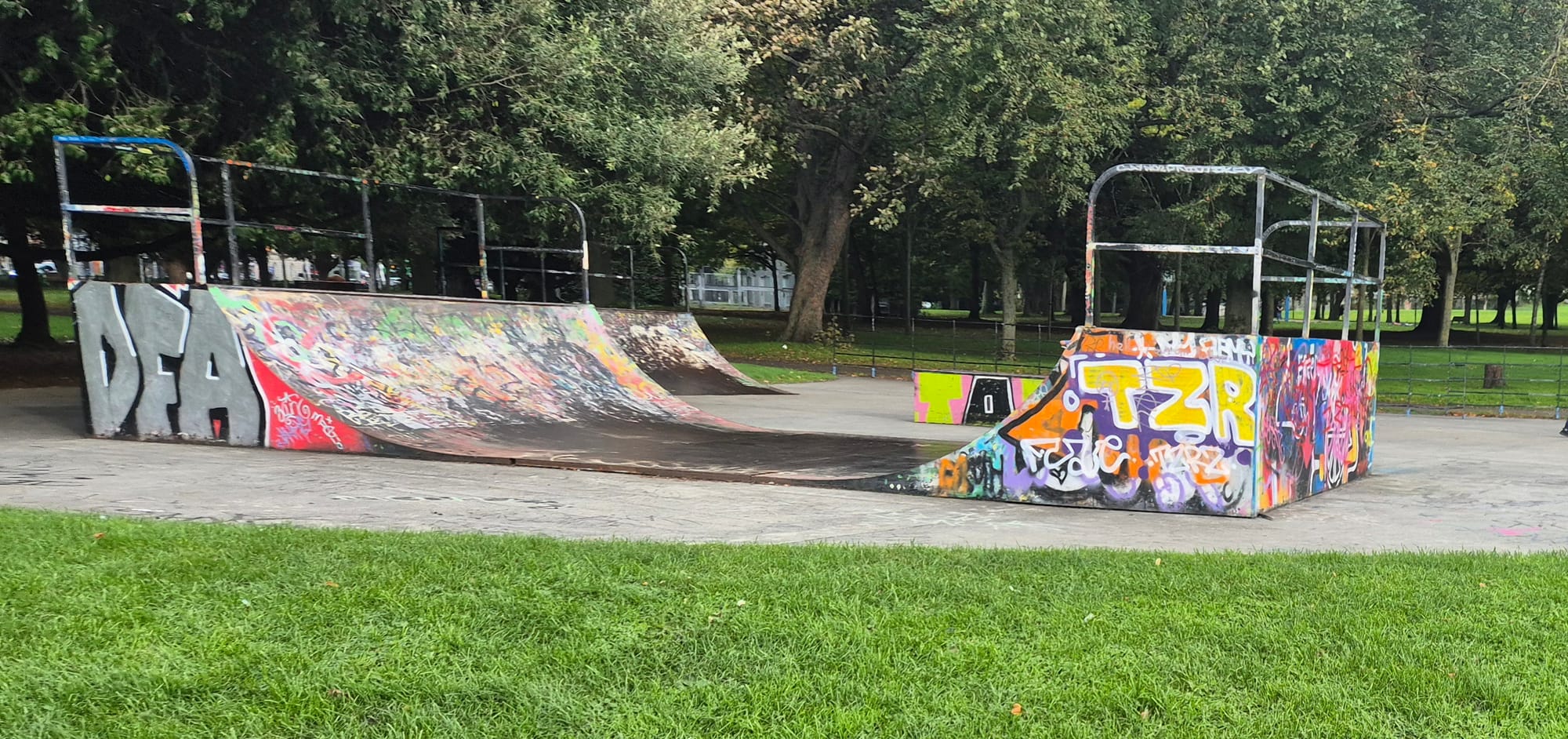
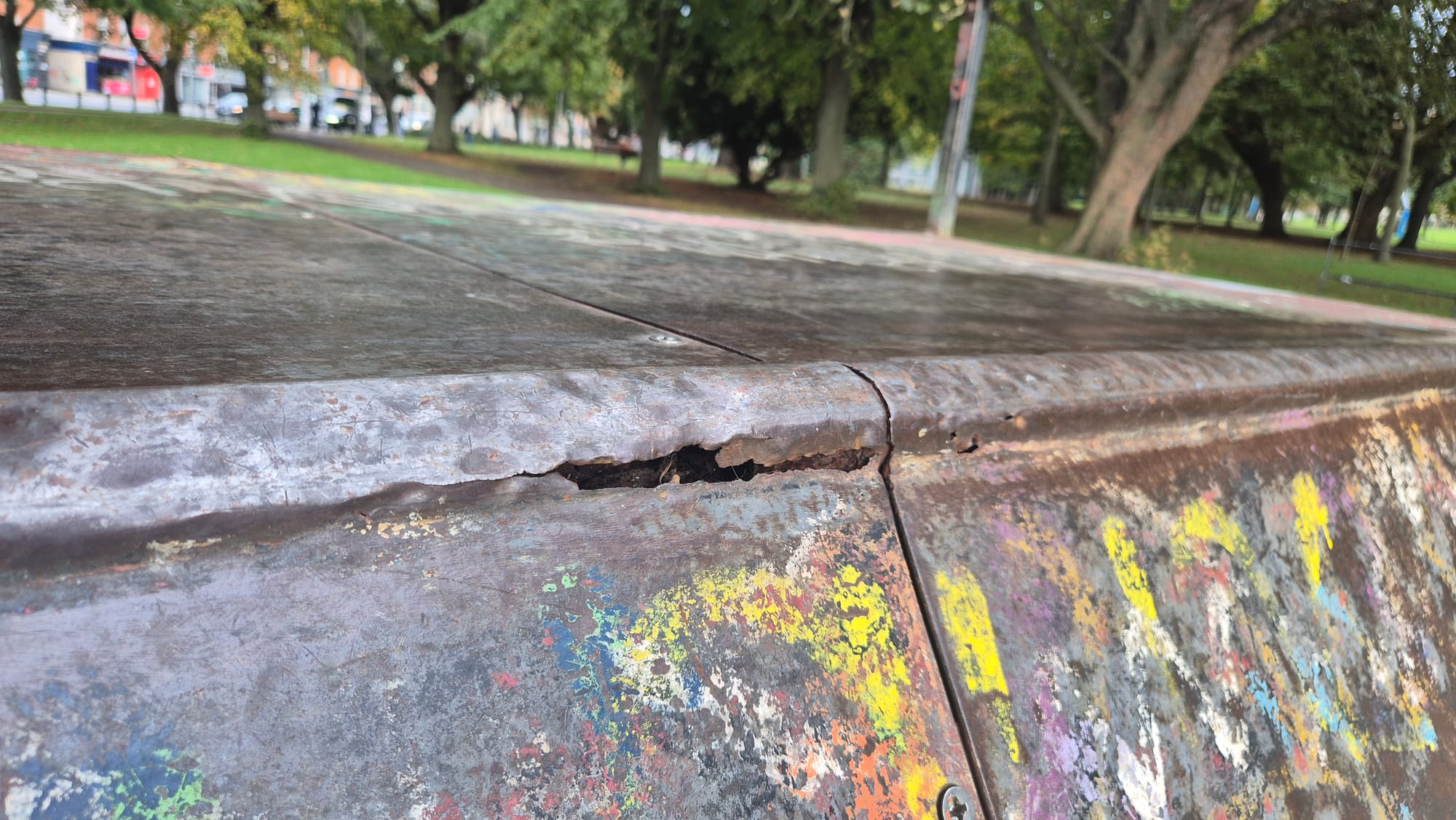
A petition launched in February 2020 calling for the Cabra park to reopen attracted 274 signatures.
In January 2025, Green Party Councillor Feljin Jose brought a motion, which was rejected, before the council’s Central Area Committee seeking its reopening.
The council said the park had been closed on health and safety grounds following a failure in its metal structure.
Officials also cited access difficulties, as users had to enter through the nearby sports centre, and concerns that some people were not wearing safety equipment.
Philip Halton, founder of Irish skateboarding magazine Goblin, said at the time that the Cabra park had not been designed or built well enough to last.
He argued that the metal ramps should be replaced with a higher-quality concrete facility modelled on the skatepark in Ballyfermot.
Concrete skateparks generally demand a larger initial investment, but Halton argued that they offer a better skating experience and avoid some of the corrosion and maintenance problems associated with metal ramps.
“If they can maintain a skatepark in Ballyfermot, why can’t they do it in Cabra?” Jose asked in January last year.
Le Fanu skatepark in Ballyfermot is an example of what Dublin can get right, says local Sinn Féin Councillor Daithí Doolan.
It has had a “hugely positive impact” on young people in Ballyfermot and draws users from outside the area, he says.
As well as skateboarding and BMX riding, it has hosted workshops and bicycle-maintenance activities, he says.
The park also gives youth workers a setting in which they can build relationships with youngsters who may be less likely to engage with formal services, he says. “So, it's not just about the skateboard.”
“It's about interaction between the youth services and those young people to keep them on the straight and narrow, to have a positive impact on them, and then to allow them put back into their communities because it's seen as a positive development,” he says.
“So rather than that negative image of young people, it's a positive image for young people, and that's hugely important as well for their confidence and self-worth,” he says.
That wider value is central to the argument, agrees Hussey.
A facility provides little benefit if it is closed, deteriorating, inaccessible or unusable during the hours when people are free to visit it, he says.
Unlike the new facility at Oscar Traynor Woods, the skatepark in Le Fanu Park, Ballyfermot, is lit when the sun goes down by dedicated, timer lights – and remains open until 9pm, or 9.30pm during the summer.
The open spaces, including the skatepark, at Oscar Traynor Woods are to remain under the developer’s management for two years before the council’s Parks Service considers taking them in charge, the chief executive told Field.
They'll review the need for lighting then, the reply said.
Funded by the Local Democracy Reporting Scheme.

"Please note, I am only looking for the restitution of €2.75 – the fare cost."

“It's extremely disappointing to hear once again that the children have been left short, and it's disappointing given the incredible work that the youth workers in the country do for us.”

But until earlier this year, people had been sleeping in the 125-bed hostel.

In the future, councils will consider whether a building is disused, boarded up, or damaged when deciding whether to add it to the Derelict Sites Register, says a tax policy document.