

Start of construction at Guinness Quarter is near, says developer – as it seeks tweaks to planning permission
Proposed changes include dropping three-bedroom homes, in favour of more smaller ones in the block of future social housing.
“It’s an indulgent thing, a fry-up, rammed into a luxury baguette. It felt like such a symbol of contemporary Ireland, and the perfect identity for the project.”

The red room above Anseo on Camden Street sweltered as it quicky filled before 9pm on Saturday night.
Just inside the entrance, the artist Niall Cullen towered over a small table, on which he had laid out clear grip-seal sandwich bags with cassette tapes inside.
The cassette boxes were white and decorated with a cartoon sketch of a jumbo breakfast roll. It was a monochrome drawing, except for the yellow yolk, and some red zig zags for ketchup.
Wavy lines of steam rose from the top of the roll. Beneath it were the words, “Breakfast Bastard”.
In the back of the room, Cullen was projecting eight identical images of former president Michael D. Higgins as he delivered a speech, which surrounded the message “Album Video will play at 9.15pm”.
Once 9.15pm came, and the 30 or so seats had been taken by people chattering excitedly and clutching pint glasses – the condensation on which was rapidly evaporating in the heat – Cullen stood in front of the room,
“There’s a bit of confusion from some people as to what this is,” he said, as the room burst out laughing. “This is an album under the name Breakfast Bastard, and this is a film for the whole album.”
Cullen switched the film on, and the room quickly stifled a laugh as a stern looking grey-haired, grey-suited male told Gay Byrne in a 1987 episode of the Late Late Show that he would never encourage his 28- or 21-year-old sons to wear condoms.
Edited to resemble someone channel surfing, the film jumped over to a clip of Wham! performing "I’m Your Man", then a brief video of the 1980s computer-generated TV presenter Max Headroom, a variety of adverts, and then back to the Late Late Show condom debate, in which the man’s wife was saying the media encouraged people to “fornicate freely”.
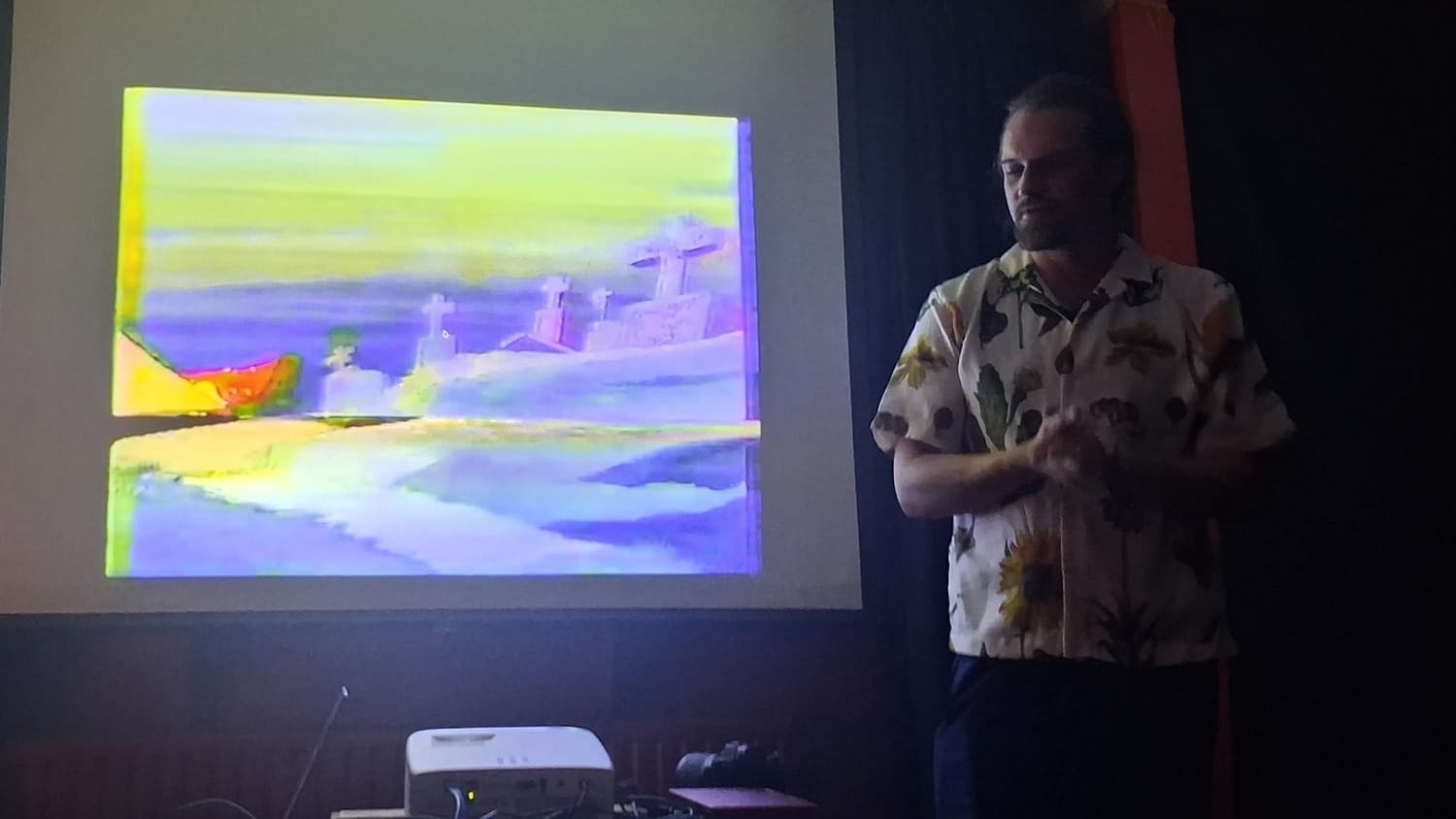
The collage-like film was composed of bootlegged RTÉ archives, footage from festivals, President Higgins delivering a speech applauding artists, old videos of O’Connell Street and Capel Street, a burger being mashed by a Luas, young priests eating dinner, and CGI renderings of the present-day Dublin cityscape.
As the footage rolled on, it was accompanied by pounding, lo-fi dance music, the rolling snares of drummer Jason McNamara, hazy distorted synthesizers, a deep voice chanting to tear the city down, and wonky, almost clanging melodies that accompanied a high-pitched female voice expressing her love for an AI boyfriend.
The debut album from visual artist Cullen, Breakfast Bastard which playfully processes – through gritty electronica and grainy visuals – questions of Irish identity, sexuality, spirituality and generational trauma with its recurring motif the breakfast roll.
It’s an object of convenience and indulgence, Cullen said on Tuesday. “It’s an indulgent thing, a fry-up, rammed into a luxury baguette. It felt like such a symbol of contemporary Ireland, and the perfect identity for the project.”
The roll is also an object that has adapted with the times, he says. “There was a moment when all the shops like Gay Spar and Centra did ‘recession buster’ rolls. You could get it or a chicken fillet roll for €2.”
It is also an object that invokes a sense of nostalgia, something which the album and accompanying video examine in a multitude of ways, he says. “People being able to see a point in time in Ireland with contemporary music layered over it, like romanticising the way public space used to be.”
Cullen gradually assembled Breakfast Bastard over nine years, beginning in 2017, he says.
It was recorded in a flat off Pearse Street, a studio on Abbey Street, in bedrooms and his parents' front room, he says. “You can even hear at the end of one track, my dad walking into the room going ‘Hiya Niall’ and the door opening before the song fades out.”
But the moniker "Breakfast Bastard" has been floating around for a lot longer, he says. “It could be 20 years ago. I published maybe a song or two on Soundcloud. Some bits on Bebo.”
The early days of the album coincided with a separate skateboarding project which he created under the alias Kurb Junki, he says. “I was making all these experimental videos.”
Similar to Breakfast Bastard, Kurb Junki’s recurring visual motif was a hamburger, often sketched in chalk. “Same drawing style,” he says. “And I was painting a lot of patterns around town.”
While developing the Kurb Junki project, which he has now retired, he says, the intention was to always do a solo music project. “It always felt out of reach, but something I’d tap away at, doing improvised songs, gathering hundreds of quite lo-fi phone recordings.”
As the album took shape over the next few years, the remaining question was how exactly he would put it out into the world, he says. “Like, would I just put it online, or do listening sessions, or actually learn to play it live?”
On Saturday night, the set-up was very simple.
The premiere of Breakfast Bastard was presented to a crowd like a film screening, which gradually developed into a polite sit-down rave, with a few audience members at the front dancing in their seats and subtly pumping a fist in the air.
Putting it out simultaneously as a cassette felt appropriate too, he said, given that the aesthetic harkens back to fuzzy VHS tapes from the '80s and '90s.
The aim is to incorporate a few more live elements into future outings, including a slot at Fuinneamh Festival in Dundalk this September, he says. “And I’m also planning to do a couple of very small, surprise screenings along the coast in Dublin at swimming spots on random evenings.”
UPDATE: This article was updated at 14.51 on 25 June 2026 to include a link to the album on Bandcamp, and details about the gig in September.

She didn’t expect to become "Facebook famous" at 61. “It's gas. I don’t like front-of-house,” she says, “keep the head down.”

But viewers seeking a beat-by-beat summation of jazz musician Bill Evans’ career will be disappointed by Grant Gee’s film, which is not meant to be a biopic.

“I wanted to note these important places and this idea of what comes up when things rupture," says Nina FitzGerald Graham.

In these times, it's something to give people a “nice little pep” as they set out to overcome a new day, said Magnus Mudrack.