"There is just a ridiculous overconcentration of short-term accommodation," in the Blackpitts and Newmarket Square area, says Sinn Féin Councillor Ciaran Ó Meachair.
A former homeless hostel, which has sat largely unused for more than a decade, may have deteriorated to the point that it needs to be demolished, the council says.
There have been repeated attempts to bring the council-owned properties at 38–39 Bolton Street in Dublin 1, and the rear garage at 1A Henrietta Lane, which is on the same site, back into use since the property's closure as homeless accommodation in 2011.
The buildings became a flashpoint in 2015, when housing activists occupied the vacant property, renamed it the "Bolt Hostel" and attempted to use it to accommodate homeless people.
On Wednesday morning, Dorothy Pawlik, who has ran the Blade Room barber shop next door for 15 years, says she remembers all the hullabaloo at the time.
“It was a big deal because I could see TV cameras and many journalists asking about it,” she said.
Now, 11 years after the Bolt Hostel, the council's assessment is that "the existing structure may not be suitable for retention", says the official response to a question from Social Democrats Councillor Ellen O'Doherty.
The council's Adaptive Reuse Unit had been progressing redevelopment proposals, but the project was put on hold "pending the resolution of matters relating to the occupation of the building", Chief Executive Richard Shakespeare's reply says.
Responsibility for the site has since transferred to the council's Buy and Renew Unit, it says. But the same problem remains. "Full vacant possession of the property will be required prior to the commencement of any works," the reply says.
Plans stalled ad nauseam
The buildings' troubled history stretches back more than a decade.
The property, formerly known as Bolton House, had been used by Dublin City Council to accommodate homeless people before it was closed after being deemed "not fit for purpose".
In July 2015, with homelessness rising sharply across Dublin, activists associated with An Spréach and other housing campaigners entered the empty property.
Volunteers, including plumbers and electricians, worked on the buildings, which the activists renamed the "Bolt Hostel", with the intention of providing accommodation for homeless people.
Their argument was that publicly owned buildings should not be sitting vacant in the midst of such a crisis.
Ferdia O’Brien, a member of An Spréach, said at the time: “There is this disgraceful housing crisis yet there’s a hostel just sitting there, in great condition ... Apart from the wear of being left abandoned, the building is in great condition.”
Initially, this appeared as though it might result in cooperation between the activists and Dublin City Council.
Council officials invited representatives to the Civic Offices on Wood Quay for talks, while some councillors expressed support for finding ways in which volunteers and community organisations could help return empty council properties to use.
But relations soon deteriorated, as the council raised safety concerns about the building, and told the activists to leave.
At the same time, the council was pursuing a plan with housing charity Novas Initiatives to redevelop the site for social housing.
The dispute ultimately reached the High Court.
The council brought proceedings against two activists, the Irish Housing Network’s Séamus Farrell and Aisling Hedderman, describing them as trespassers.
It secured orders allowing it to inspect the property and prevent the activists from carrying out further renovation works.
The activists relinquished control of the buildings the following month after a fire and safety inspection.
Conservation
In 2018, both buildings were still empty despite plans to turn them back into accommodation.
The scheme did make some progress. Department of Housing funding received initial approval and consultants were appointed, with completion at one stage anticipated in 2019.
In 2019, the council proposed transferring the properties to Novas for a scheme involving eight rooms of homeless accommodation.
But that project also failed to materialise, and, by November 2019, the Bolton Street scheme had disappeared from the council's regular housing supply reports.
The council's then homeless services director, Cathal Morgan, had previously cited the heritage value of the buildings as one reason for delays, and Novas indicated that redevelopment required a conservation approach.
In 2022, after years of its name being attached to the project, Novas said it was no longer involved.
By then the buildings were visibly deteriorating, with windows covered by metal sheets, graffiti across the ground floor and vegetation growing from the property.
The council sought Department of Housing funding for the scheme, but officials acknowledged that the building was in poor internal condition and that further assessments were required.
“It was quite a high-risk project. The building is in poor condition internally,” said Fiona Craven, a senior executive officer with the council, in 2023. “There are a lot of structural reports that need to be carried out.”
Second occupation
By September 2024, council housing reports listed the six-apartment project as having received partial funding approval but said it was "on hold pending resolution of situation involving partial occupation of property".
That seemingly remains unresolved.
The chief executive's reply did not say who is currently occupying the property, how much of it is occupied or the circumstances surrounding the occupation.
While she remembers people squatting there a decade or more ago, Pawlik says she hasn’t seen any sign of squatters since, at least not coming in and out of the front of the building anyway.
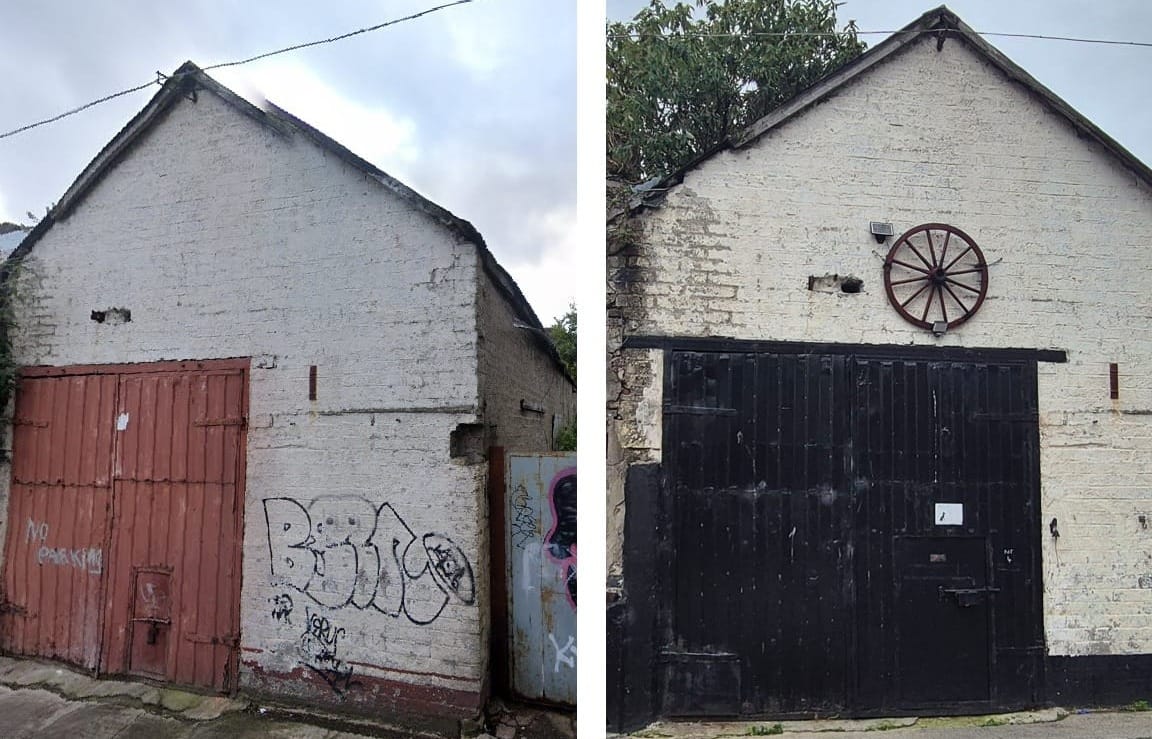
The front of 38 and 39 Bolton Street appears to be locked up airtight, but there have been some changes in recent years to the garage unit at the back, facing Henrietta Lane.
Above the garage door, there is what appears to be a sensor light, and above that, a wagon wheel has been fastened to the wall. Next to the door, a small old-fashioned bell with a pull string seems to do the job of a doorbell.
Those features were not there in 2022, according to images from the time.
There is also a faded “Beware of the dog” sign. Knock on the garage door, and a dog inside barks.
1A Henrietta Lane. Left: 2022 from Google Street View. Right: 2026 by Eoin Glackin.
Disappointment
O’Doherty, the Social Democrats councillor, who lives in the inner-city, says the rate of vacancy and dereliction in the area is staggering.
“You see every day on every walk that you do, like to the shops, to work, getting a coffee. It’s constant,” she says.
“You are bombarded with it every day, and you know, it's such a shame, and I think it's such a disservice to the area, really, that this is allowed to continue,” she says.
She said she was shocked when she learned these buildings in particular are council-owned.
Local authorities can be “quite constrained” in what powers they have in terms of dealing with the housing crisis, she says.
“Especially looking at the rejuvenation of Dublin city centre and the Dublin City Task Force and some of the work to be done on O'Connell Street and things like that, Dublin City Council’s hands are tied with respect to a lot of that,” she said. “A lot of that comes from central government in terms of funding and strategy.”
But when it comes to buildings that the council owns, she says: “This is a level of agency that they do have.”
“So, it's really disappointing that in these situations where Dublin City Council does have the capacity to, I suppose, kind of fight these bigger issues, they're not leading by example.”
For its most rundown properties, like those that it has CPO-ed from the derelict sites register, Dublin City Council officials have said that they can struggle to find the money to do them up. It's looking to sell some of those, now.
Meanwhile, the council does not seem to have suffered consequences, in the form of financial penalties, for the properties remaining vacant all these years.
Neither the property's addresses on Bolton Street, nor its address on Henrietta Lane, are listed on the council's vacant sites register or its derelict sites register – either of which would have come with financial penalties.
They also are not on a recent list of council-owned properties for which it owes Residential Zoned Land Tax (RZLT), because they are suitable for housing but have not been developed.
By July this year, 17,527 individuals were in homeless accommodation.
Still, after all these years, and all these efforts – by housing activists, the council, and Novas – the building on Bolton Street remains (mostly) empty, and time has taken its toll on the structure.
The chief executive’s written reply said that "demolition may ultimately be required as part of any future redevelopment proposal", although no final decision has been made.
O’Doherty, the councillor, says she acknowledges that the council is constrained in certain situations. “It must be very frustrating for them because their hands are tied by central government and by the department,” she said.
But this, she says, is one of the examples where that's not the case.
“I would really encourage them to really put a bit of weight behind this and try to get something moving because, like, there's huge success stories just down the road,” she says. “A few metres away you’ve got Capel Street.”
These streets are also a “gateway” into the city, she says. “Kind of your welcome into town.”
Louth County Council passed a motion calling for other local authorities – including Dublin City Council – to join it in pressuring the government to change national planning regulations.