"There is just a ridiculous overconcentration of short-term accommodation," in the Blackpitts and Newmarket Square area, says Sinn Féin Councillor Ciaran Ó Meachair.
Council gives nod to new apart-hotel in Blackpitts, to add to the 9,600 hotel beds within walking distance
"There is just a ridiculous overconcentration of short-term accommodation," in the Blackpitts and Newmarket Square area, says Sinn Féin Councillor Ciaran Ó Meachair.
Dublin City Council planners gave the green light earlier this week to a proposal to convert two office buildings in Blackpitts in Dublin 8 into a new 172-room aparthotel.
If built, the scheme would add to the roughly 9,600 hotel bed spaces (about 4,600 rooms) within a 1km radius of the site, according to figures in a reporton the concentration of hotels in the area, submitted with the planning application.
And, to the about 1,900 rooms in developments that have been granted planning permission but aren't yet built or are currently under construction, the report says.
Multiple observations sent in to the planning application, which was put in by Civic Projects One Partnership,point to the council’s stated commitment in the city development plan to avoid too many hotels in city neighbourhoods.
To ensure a balance between visitor accommodation and other uses – homes, social, culture, jobs – “there will be a general presumption against an overconcentration of hotels and aparthotels”, the council says in its City Development Plan 2022 to 2028,
And some of the observations, and local councillors, say that surely that threshold has been reached for the area around this site.
"There is just a ridiculous overconcentration of short-term accommodation" around Blackpitts and Newmarket Square, says Sinn Féin Councillor Ciaran Ó Meachair.
“This part of Dublin 8 is overrun with hotels, aparthotels, and luxury student accommodation that can double as tourist accommodation in the summer,” says Labour Councillor Darragh Moriarty. “We are crying out for decent residential development here.”
The developer's analysis disagrees, pointing to continued demand from tourists and business visitors and arguing that aparthotels are different from hotels also.
Part of the frustration is that, despite a commitment in the council's city development plan to look at trends in tourism accommodation in the city centre, council planners are yet to do up any report on that. They've never defined what overconcentration actually means.
No thanks
“The Liberties is a historic, lived-in community,” says one of the observation letters submitted to planners by multiple residents.
“The ongoing conversion of buildings into hotels is eroding residential stability, community cohesion [and] local services for residents,” it says.
Yes, says Ó Meachair, the Sinn Féin councillor, “The development of Dublin 8 epitomises what has gone wrong in Dublin.”
There is a finite amount of land in the city centre so each time a hotel is built, that is another site gone that could have been used to house people, he says.
“There is a total overconcentration of hotels, student accommodation and other short-term lets,” he says. “The community is being hollowed out.”
According to the report from the developer that analyses the concentration of hotels in the area, some of the 9,600 hotel bedspaces have been converted to emergency accommodation.
But that is exactly the problem, says Ó Meachair. Homes are being used for tourist accommodation while “people who should be living in homes are living in hotels”.
“The whole thing is totally upside down,” he says.
The council has a substantial number of homeless families from the Dublin 8 area, and there is severe overcrowding in social housing, says Ó Meachair. “Young people are looking at these buildings going up and realising there is no place for them in the city.”
“This seems to be the strategy for Dublin 8,” says Abaigeal Meek, of The Liberties SOS. “It's very much being facilitated.”
There are not enough homes for local people and the little land that is left is being used up for overpriced student accommodation and hotels, she says. “There is a relentless overconcentration."
Does the council’s commitment to curtail an overconcentration of hotels not apply to Dublin 8? she asks. “I’m always wondering what the story is with that.”
The developer's case
The two office buildings the developer wants to turn into an aparthotel, used to be "a hive of commercial activity", according to its planning report.
"However in recent years the attractiveness of this as a commercial location has significantly reduced and maybe of the buildings have remained unoccupied," it says. "The main office building in Fumbally Square is vacant as is much of the space in Fumbally Court with remaining occupiers in the process of relocating."
Hence the plan to convert the office buildings into something else.
The council planner's report says that, "The proposed change of use to aparthotel seeks to maximise the use of these existing buildings on site, rather than let these buildings remain unused. This is noted and understood."
It would be better to convert the office buildings to homes, said a resident in their submission to the planning application.
However, the developer notes that the site is zoned Z6 (enterprise and employment). The council planner's report, responding to the developer's says this does not allow for the development of homes on the site.
Even if the council rezoned the site, converting office buildings to homes can be tricky, and developer's architectural design statement doesn't address how feasible that would be in this case.
In any case, the current zoning seeks "to provide for the creation and protection of enterprise and facilitate opportunities for employment creation” and allows a hotel use, says the developer's hotel concentration report.
The city development plan seeks to promote Dublin as a tourist destination, says that report. And the capital has high hotel occupancy rates, of 91 percent it says.
"These figures place Dublin among the highest-performing hotel markets in major European cities and point to an ongoing structural undersupply of hotel accommodation in prime urban locations," it says
The report says that "there is a strong presence of accommodation providers in the core city centre area (ie beyond the 500m radius of this proposed development) with the immediate area of this proposed development showing limited provision".
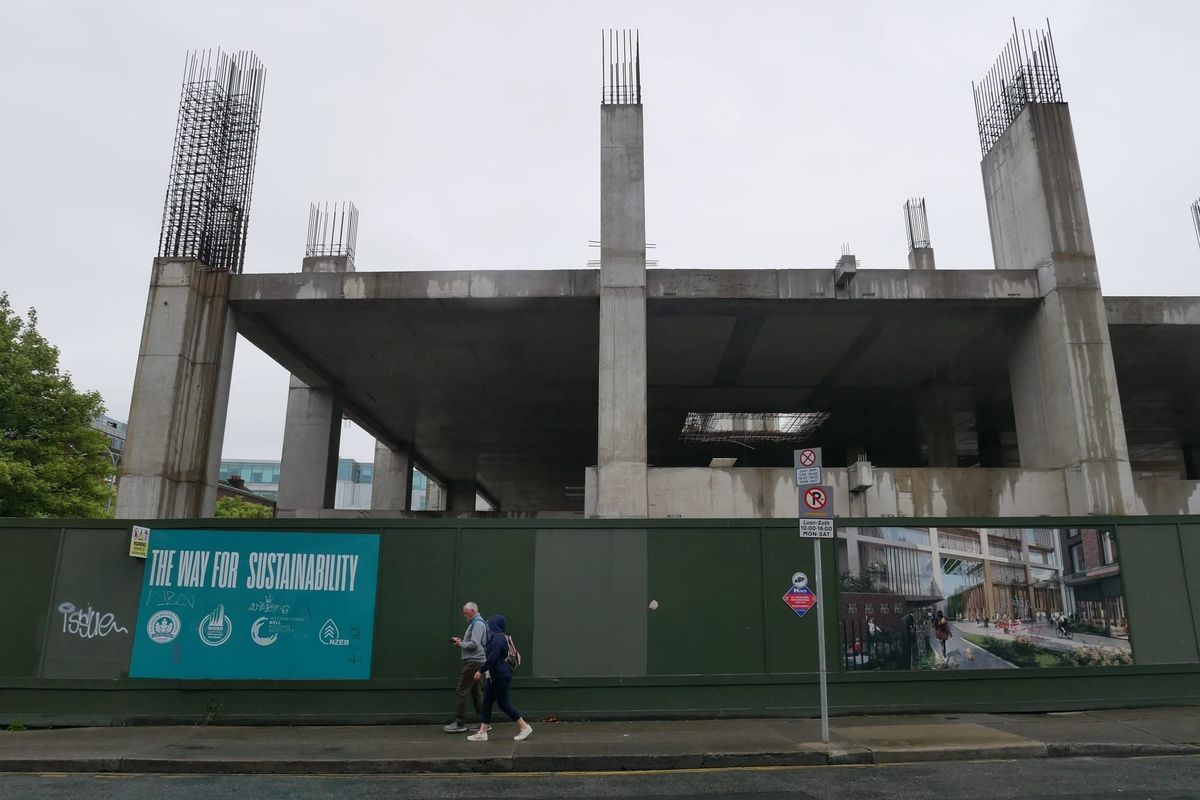
However, just nearby, there's a Premier Inn at Newmarket and a Maldron Hotel on Kevin Street. There's another now under construction next door to this new proposed aparthotel.
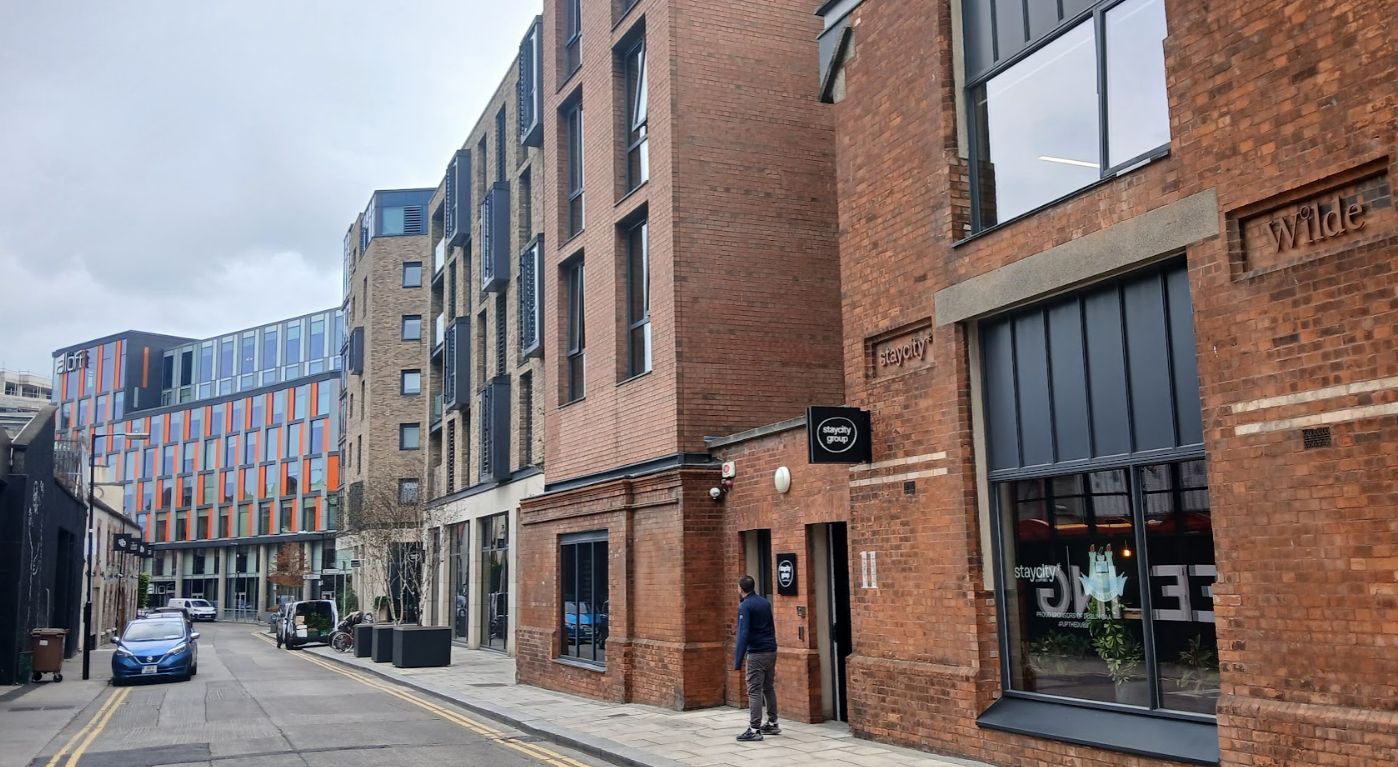
There's also a Staycity on Mill Street, as well as a lot of student accommodation in Newmarket and Blackpitts, which often operates as tourist accommodation during the summer.
StayCity on Mill Street. Photo by Sam Tranum.
"Given the presence of hotels, student accommodation and this proposed apart hotel, in the immediate area, in addition to the existing residential and commercial uses present, it is considered that this reflects the sites and immediate area’s central location and accessibility, rather than any imbalance in land-use," says the council planner's report.
"Having regard to prevailing demand conditions, the cumulative effect of permitted developments, and relevant policy objectives, it is considered that the level of existing hotel provision, together with new and expanding hotels, does not in this instance constitute overconcentration in planning terms," the planner found.
Still waiting
It is unclear exactly what "overconcentration" means, or how to measure it.
The council's development plan – drawn up four years ago – says that "Pending the outcome of an analysis of the supply and demand for tourism related accommodation in the Dublin City area (to be carried out by Dublin City Council), hotels and aparthotels will be considered on a case by case basis having regard to the location of the site and existing hotel provision in the area."
At the moment, the council assesses whether or not an area has an overconcentration of hotels by requiring the developer to draw up a report on what there already is around a site. Like the one Civic Projects One Partnership filed with this planning application.
Meanwhile, the analysis of supply and demand for tourist-related accommodation in the city, mentioned in the development plan, hasn't materialised yet.
In June, a council spokesperson said that: "Substantial work has been done by the Planning Dept in relation to demand, recent trends, supply and related issues."
"It is intended to complete this work using recently published reports including Fáilte Irelands ‘Tourist Accommodation Outlook – Irelands capacity and pipeline’ ( Dec 2025) which contains useful up-to date data to further the analysis," they said.
A request under the Freedom of Information Act, seeking internal correspondence relating to the study dating back to January 2025, didn't throw up many records.
There's an email in May 2025, between a planner at the consultancy Tom Phillips and a senior planner at the council planner saying the study was expected to be done by the end of 2025, subject to resources.
And a copy of the formal response to a question from Green Party Councillor Claire Byrne asking why the council was working with Failte Ireland on the study, when its remit is to support the provision of tourist accommodation.
Ó Meachair, the Sinn Féin councillor, said councillors have agreed to push for UNESCO intangible cultural status for the Liberties area and that he hopes that status could help to protect those families that have lived and worked in the area for generations.
Although, international research has thrown up mixed findings, when it comes to the impact of UNESCO heritage statuses on residential and commercial property prices – with some finding that it worsens affordability.
Ó Meachair says some council officials have indicated that that push for intangible heritage status doesn’t necessarily align with their strategy for the area. He would like to know the details of the council officials' vision for the area, he says.
“There is a huge disconnect in that people who are not elected are making decisions that are having a huge impact on people’s lives,” says Ó Meachair.
Moriarty, the Labour councillor, says councillors are working on rezoning land in an effort to curtail the spread of hotels and allow more residential development.
They recently rezoned sites that neighbour the ones in these applications, to Z10, a mixed-use zoning that allows for some residential development, he said. “We were too slow to act on these sites, which is very disappointing."
“I don’t think we do have a policy on displacement,” says Labour Councillor Darragh Moriarty. “But there probably should be something in light of the private rental market being so volatile and so precarious.”
But councillors wonder whether the new-ish Residential Zoned Land Tax will prompt Dublin City Council to build more homes – or just push it into selling off its lands.
Opposing the motion, Fine Gael Councillor Ted Leddy said he'd urge people to keep in the front of their thoughts people who are in danger of homelessness, who are homeless, or who are living at home with their parents in their 30s.