

Dublin City Council, again, bans poster to spare US president's feelings
Even a version which made no direct reference to Trump and removed his image, and simply read: “No welcome for warmongers” was turned down.
This week it published a tender, looking for contractors to install cycle lanes, upgrade footpaths and more.

Unlocking his bike from a fence in front of the Mace on Main Street in Finglas on Tuesday morning, Mateusz Mrozinski said he’d never heard of the council’s planned Finglas Village Improvement Scheme.
Sure, there’s lots of plans on the way for Finglas, Mrozinski said.
There’s the extension of the Luas from Broombridge north through Finglas to Charlestown, he said. That scheme got planning permission last October, and construction is due to start by 2029.
There’s the rezoning of 43 acres at the Jamestown Business Park a few years ago to allow for the construction of thousands of new homes, Mateusz said.
Planning applications for housing in that industrial estate have been filing in in recent months. Including one that went in a couple weeks ago for 715 new apartments and townhouses.
But the Finglas Village Improvement Scheme? Nope, Mrozinski hadn’t heard about that one.
This Dublin City Council plan has been in the works for years.
Councillors have heard about it for so long that at a meeting of the council’s North West Area Committee on 21 April, when a council manager said works were due to begin this summer, Social Democrats Councillor Mary Callaghan was dubious.
“You have no idea how many years we’ve been hearing that,” she told him.
But the project seems to be moving forward. The council yesterday published a tender seeking contractors to do the works.
The council’s Finglas Village Improvement Scheme is basically about rejigging the roads and footpaths to make them better for walking and cycling.
It’ll involve the segment of Seamus Ennis Road from its junction with North Road east to its junction with Clune Road. As well as Jamestown Road from the five-arm junction in the village south to Main Street.
“The area is currently dominated by traffic and generally unfriendly to users of sustainable transport,” according to a document included in the tender package. “The scheme seeks to improve the sense of place in the village centre and safety and access for all road users.”
The BusConnects rejig of the city’s bus network “will see additional services operating along McKee Avenue and Seamus Ennis Road and passing through the ‘five-arm’ junction which need to be accommodated”, it says.
“The cycling facilities along Seamus Ennis Road will also form part of a more strategic orbital cycling route between Finglas and St Anne’s Park,” it says. That’d be the Finglas to Killester scheme, which is at a very early stage of planning.
“The proposals will improve access to and from the proposed new Luas Finglas stop, west of the Village,” it says. The closest new stop is set for a site west of the Finglas Bypass, in front of the Youth Resource Centre on Mellowes Road.
And the changes will help prepare the area for an increase in population as more homes are built on sites in the Jamestown Business Park, the tender document says.
As part of the Finglas Village Improvement Scheme, the council is planning changes for the 135-metre bit of Jamestown Road stretching from where Mrozinski was standing at the Mace north to the five-arm junction.
First on the left along this road is the long-vacant Drake Inn, which Social Democrats TD Rory Hearne and Finglas Tidy Towns are petitioning Dublin City Council to take over via a compulsory purchase order.
On the right-hand side of the road is Finglas Village Centre, above which a developer is converting the former office building Raven House into 37 build-to-rent apartments.
After the council’s planned changes, this stretch of road would be mostly for people to walk and cycle on, although there’d still be local access by car to and from the businesses there.
There’d be a bollard at the north end so cars wouldn't be able to pass north into the five-arm junction.
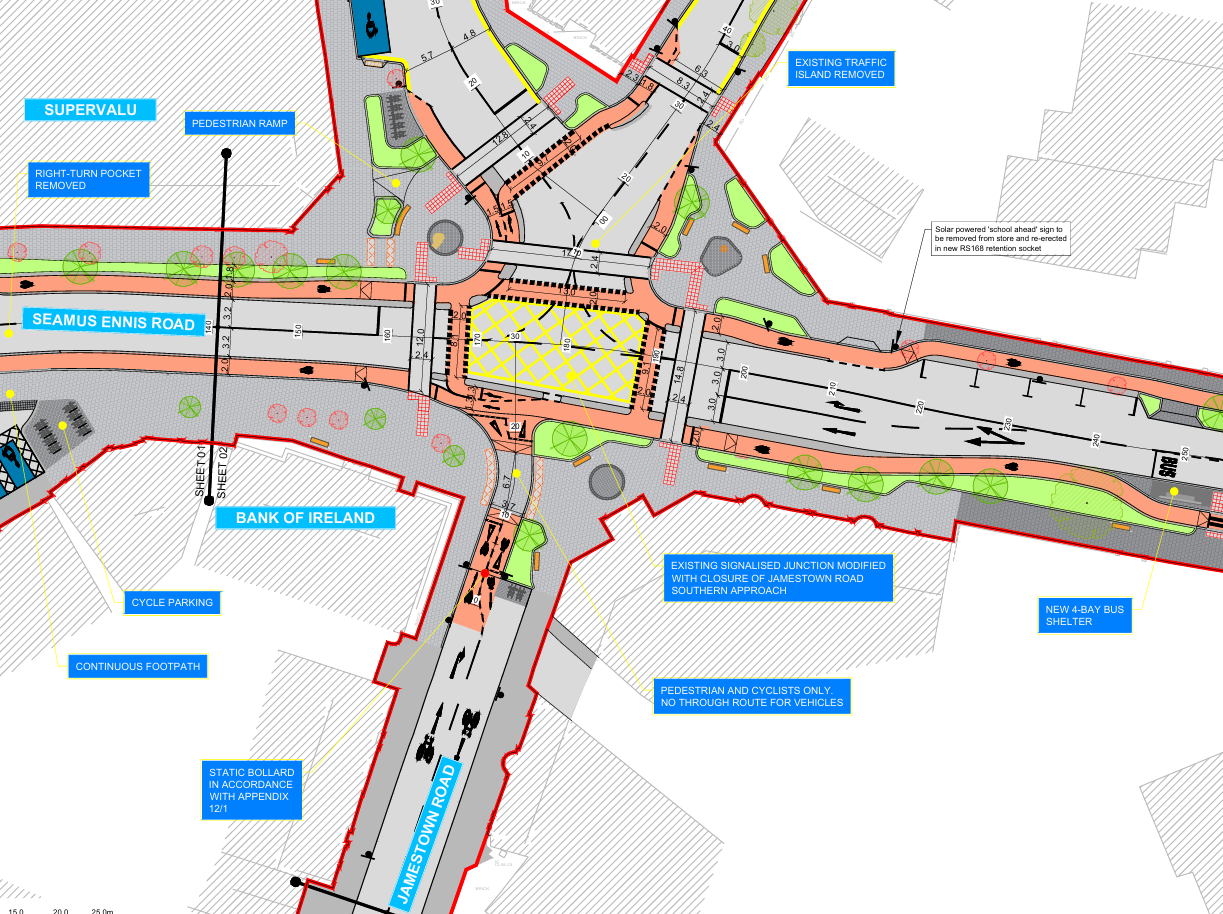
Turning the five-arm junction into a four-arm junction will make it quicker for everyone to get through in all directions, because there’d be “one less traffic signal phase”, council documents say.
It’d also mean pedestrians could walk more easily through the junction on the south side of Seamus Ennis Road, because there’d be no need to wait for a break in car traffic.
As for the stretch of Seamus Ennis Road between Clune Road and North Road, the plan is to have two lanes for people driving motor vehicles – one going east, one going west – and a footpath on either side of the roadway for people walking.
But the new addition would be two lanes – largely segregated from the car lanes by kerbs and planters – for people on bicycles, one running east, one running west, according to drawings in the tender package.
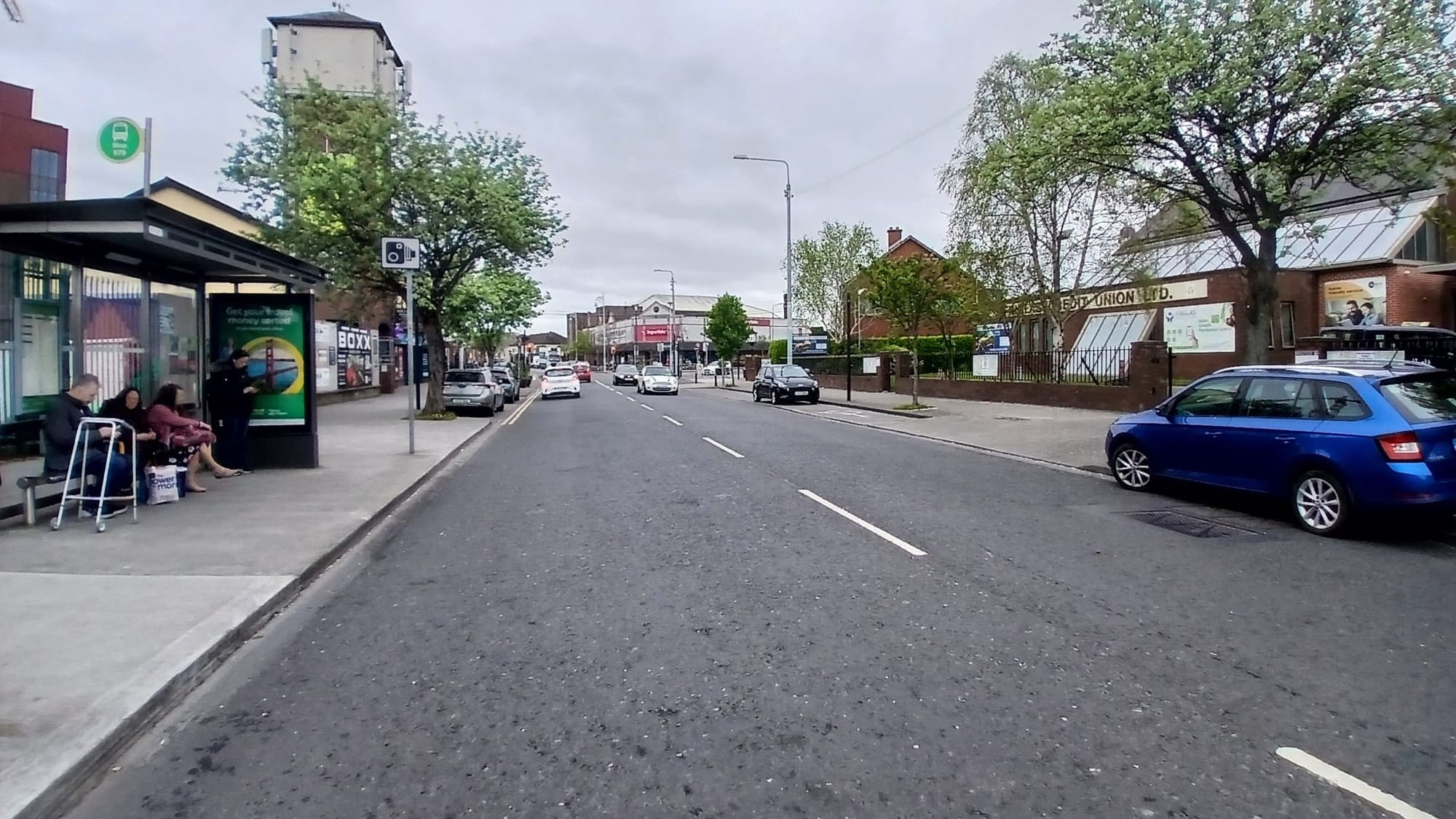
There are more than 170 off-street car parking spaces in Finglas Village, and 18 car parking spaces will be removed as part of these changes, according to the council.
What did Mrozinski think of these plans, once he learned about them? “They should have done it years ago,” he said Tuesday, stowing away his bike lock and getting ready to head out.
During a public consultation on this proposed scheme, “several submissions” suggested more pedestrianisation, according to a council report on the results.
“Proposals included the pedestrianisation of Main Street and Jamestown Road, creating a central village park, and implementing one-way routes for traffic,” the report said. But this “falls outside the scope of the current project”, it said.
Although the council has issued a tender for the Finglas Village Improvement Works Scheme, that tender says “this project is subject to funding”.
Local TD Paul McAuliffe, of Fianna Fáil, asked the Minister for Housing, Local Government and Heritage, his party colleague James Browne TD, about funding for the project last July in the Dáil.
Browne’s answer was that the project was to be co-funded by the council and the National Transport Authority (NTA).
For 2026, the NTA has allocated €1.5 million for the project.
As for the council's contribution, there’s money in its capital programme for the project, but there has been for the past six capital programmes and it still hasn’t been built.
But that line about the project being "subject to funding" is only there "because the project is required to undergo a final approval stage when a preferred tenderer has been identified and prior to award of contract, in line with project governance and oversight requirements", a council spokesperson said Wednesday.

Even a version which made no direct reference to Trump and removed his image, and simply read: “No welcome for warmongers” was turned down.

"As you can imagine, you've got 20 parking spaces, and we come along and say we're going to take out two of them or something like that to give spaces for people on bikes, it doesn't go down particularly well."

Louth County Council passed a motion calling for other local authorities – including Dublin City Council – to join it in pressuring the government to change national planning regulations.

“I don’t think we do have a policy on displacement,” says Labour Councillor Darragh Moriarty. “But there probably should be something in light of the private rental market being so volatile and so precarious.”