Dublin City Councillors say outreach about the major project has been to residents in the Fingal County Council area – leaving locals in affected city neighbourhoods, such as Finglas, without a proper voice.
On 16 April, Mélina Sharp got wind that an Immigration and Customs Enforcement (ICE) deportation flight from the United States sat in Shannon Airport to refuel.
She called Ennis Garda station, said Sharp, recently. “I asked, ‘Are you guys going to search it? It’s likely that there are people on it shackled.’”
The officer got “defensive”, she said. He kept asking her how she could possibly know that there was an ICE flight on the runway, said Sharp.
Sharp told him, she said, that there are groups like ShannonWatch and ICE flight trackers posting updates, and activists let each other know.
The officer sounded sceptical, like what she was saying was far-fetched, Sharp said. “You know, as if it were a miracle of science,” she said, laughing.
The cop finally put her on hold and forwarded the call to another department. A phone started ringing, and to her surprise, she said, someone did pick up.
She repeated her request. This time, the officer asked for her address, Sharp said. “And at that point, I asked, ‘Well, who am I speaking to?’”
She also asked for a PULSE number of her police report. The officer's tone shifted after that, Sharp said. He didn’t bring up anything about her address, again, she said.
But “he was hardly interested”, said Sharp. He gave Sharp a PULSE number, she said, reading it out.
Sharp is not alone in reporting stopovers.
John Lannon, CEO of migrants' rights non-profit Doras, has called the guards twice about ICE flights in Shannon, he said. Once in February and again on the same day Sharp called them. He has PULSE numbers, too.
In a recent joint letter to the Minister for Transport, Fianna Fáil’s Darragh O’Brien TD, and the Minister for Foreign Affairs, Fine Gael’s Helen McEntee TD, Amnesty International and Human Rights First pointed to ICE planes that had stopped in Shannon Airport “during at least five separate removal operations”.
“These included flights involving forced third country transfers of individuals to countries, such as South Sudan and Eswatini, where they have no ties to and where they have faced arbitrary and prolonged detention and other abuse,” the letter said.
Among other things, their letter asked whether the Irish government is taking steps “to assess whether any individual on board faces a real risk of serious harm if transferred, or to detect any other breaches”.
That’s what Sharp and Lannon were trying to get the government to do. So, do the guards have the power to step in?
While it might be much harder to search the plane as part of a criminal probe, they have the right to enter an aircraft to see what’s going on for safety and security reasons, said Dermot Walsh, an expert on Garda powers and procedures, and author of the book Walsh on Criminal Procedure.
A spokesperson for An Garda Síochána referred queries asking about citizens’ reports and whether it has the power to look into them to the Department of Justice and the Department of Foreign Affairs
A spokesperson for the Department of Justice said it doesn’t comment on Gardaí’s operations and referred questions to the Department of Transport.
Spokespeople for the Department of Transport and the Department of Foreign Affairs did not respond to queries sent last week.
ICE-capades in Shannon
That ICE has arrested or deported people who held green cards or other regular immigration statuses in the United States – sometimes for things like rebuking mass killing of Palestinians in Gaza – is well-documented.
Between October 2025 and this April, 29 people have already died in its custody, according to NPR. “Surpassing 2004's toll of 28, the previous record, according to government data.”
On 16 April, the same day Sharp called the guards about one of its deportation flights in Shannon, ICE announced the death of Aled Damien Carbonell-Betancourt in one of its detention centres in Miami, Florida, “pending immigration removal proceedings”.
He was a 27-year-old immigrant from Cuba.
“Carbonell-Betancourt died of a presumed suicide; however, the official cause of death remains under investigation,” said a press release on its website.
It calls him a “criminal”, but the news release only seems to allege that he’d been violent when approached for arrest, and doesn’t offer any details beyond that.
Less than 30 percent of the people ICE has arrested during its major operations in 2025 had been convicted of a crime,the New York Timesreported last year.
And a “very small share” of those have been convicted of violent crimes, its analysis of data obtained through a lawsuit and made public by the Deportation Data Project revealed.
The joint letter from Amnesty International and Human Rights First said that in January of this year, ICE had deported eight Palestinian men to the West Bank, dropping them off at a military checkpoint.
Its flight had made stops in Shannon and Sofia in Bulgaria. The plane touched down on Irish soil on the way back, once again, it said.
“The eight Palestinian men on board were shackled for the entire journey by their wrists and ankles,” it said, citing the Guardian.
Then again, in February, “aircraft N588AT took a second group of Palestinians from the United States to Tel Aviv’s Ben Gurion Airport, Israel”, it said. No one knows how many, according to the letter.
Sharp said she was troubled by reports like that.
She also became upset, she said, after hearing a story about how an airport maintenance worker had told someone about peering into one of those planes as it sat on the runway and seeing passengers lying on the ground “and other people walking across them”.
She’s not sure if it’s true, but that’s why she wants the guards to investigate.
“So you know, when we call Ennis Garda Station, and they just want to get rid of us. This is the reason we’re calling,” she said.
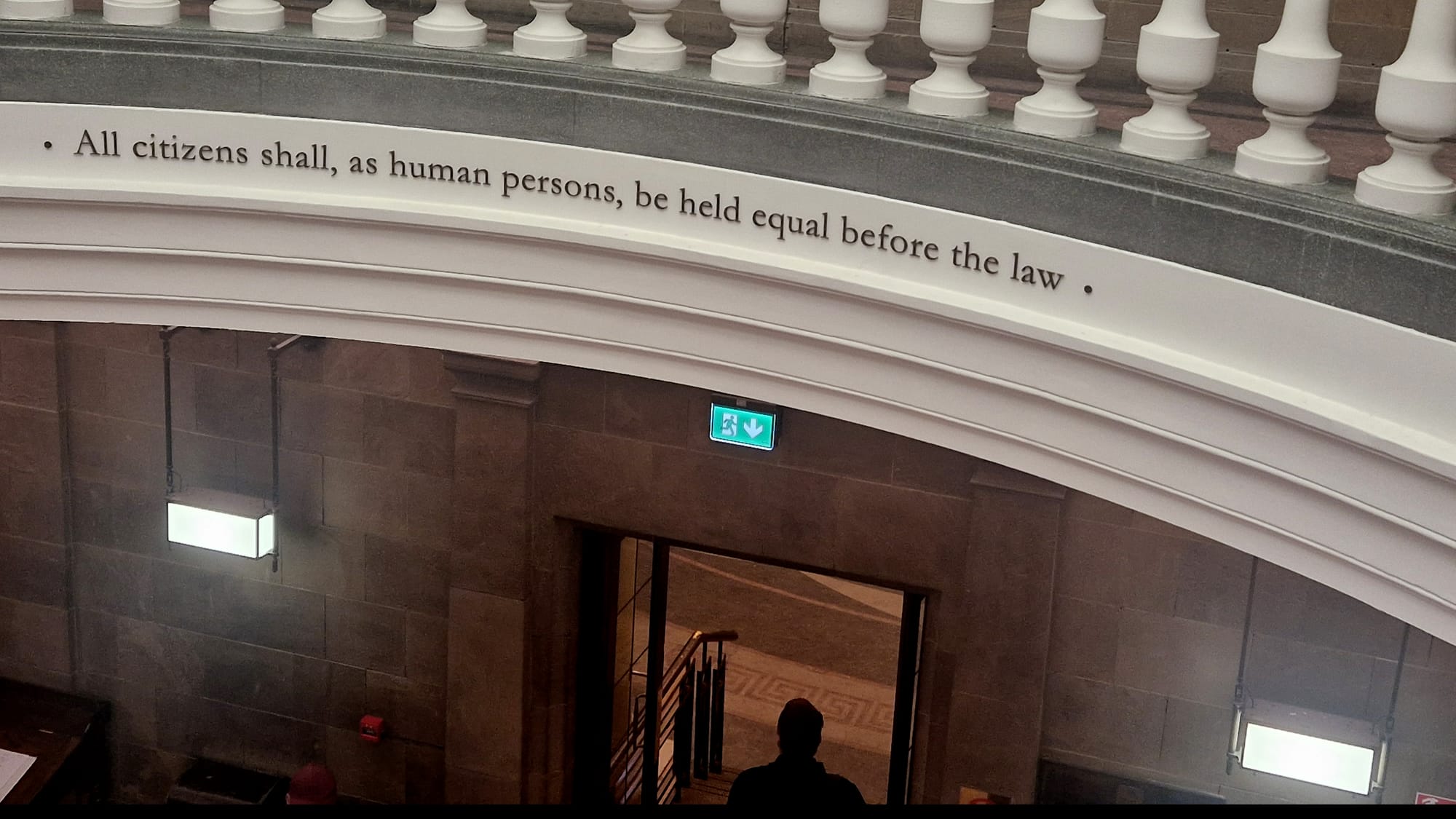
Words at the hallway of the Four Courts. Photo Shamim Malekmian.
When there is a will
Walsh, the expert on Garda powers and procedures, said what the guards can do in response to citizens’ requests to check ICE deportation flights depends on circumstances.
To kick off a criminal investigation, Gardaí should have “reasonable grounds” to suspect that a deportation involved an “arrestable offence”, he said.
Just the fact that an aircraft is – or someone believes that it is – being used to deport people wouldn’t be enough, Walsh said.
And they need to make a solid case before a District Court judge, who has the power to greenlight a search and issue a warrant, he said.
Cian Ó Concubhair, assistant professor of criminal justice at Maynooth University, said there are exceptions, too. Like, “if they believe the perpetrator might escape”.
But generally, the cops should have a good reason to believe that the deportation involves crimes like kidnapping, torture and sex trafficking and seek out a search warrant to probe it, said Walsh, the Garda powers academic.
Ó Concubhair said similar. Like if the way someone is being detained on the plane, even if lawfully, is cruel to the point that it violates Irish law, he said, “that would amount to torture potentially and assault”.
James Mehigan, barrister and criminologist at the University of Canterbury in New Zealand, said it’s plausible that Irish law has been breached on a deportation flight.
“But getting the evidence together sufficient to investigate and charge is not easy,” he said.
There are other ways for an officer to step onto the plane to have a look, though, said Walsh. “A member of the Garda has powers to enter and inspect an aircraft.”
That would normally involve checking whether its security and safety measures are up to code, based on standards set by the Department of Transport, if they exist, but probably “not wholly confined to that”, he said.
And it’s not just guards who can enter the plane, Walsh said. “Authorised officers of the Commission for Aviation Regulation and the Irish Aviation Authority also have sweeping powers of entry, inspection and information gathering,” he said.
Ó Concubhair said private airport police can also exercise duties similar to those of regular cops.
It’s worth pointing out, said Walsh the Garda powers expert, that all the civilian flights coming into Ireland from outside of the EU have to hand over a passenger sheet in advance to the Irish Passenger Information Unit – overseen by the Department of Justice.
“Arguably, this is a source that can alert the authorities to an issue as to the status of a passenger or passengers on the flight,” he said.
Buta spokesperson for the Department of Justice said it only collects advance passenger information “for border control purposes in relation to passengers who have booked seats on commercial flights”.
And any landing at Irish airports by private and commercial charters that are just “technical stops” and don’t involve dropping off or picking up passengers “do not require prior authorisation from the Department of Transport”.
Meanwhile, Patricia Stephenson, a Social Democrats senator and its spokesperson on foreign affairs, said the government should not help the US endanger people’s lives by sending them to places of peril.
“People have been deported to the West Bank,” she said.
Dublin City Councillors say outreach about the major project has been to residents in the Fingal County Council area – leaving locals in affected city neighbourhoods, such as Finglas, without a proper voice.
“I wouldn't necessarily say we're looking at a looming full automation, but a really, really drastic shakeup is definitely on the horizon,” says Jen Wayne of the Animation Workers of Ireland.