

As campaigns gear up in central Dublin, how sound is the voter register?
It isn’t hard to find people registered to the wrong addresses and zombie entries.
The Department of Housing was reviewing whether it was good value to develop them under public private partnership. It isn’t, it decided.

On Wednesday, councillors saw the latest iteration of designs for 171 social, affordable, and older-people’s homes in the heart of Cherry Orchard.
The proposals shown to the South Central Area Committee – which also include shop and community spaces and expanded childcare – haven’t really changed since they went out to public consultation.
Councillors said they are, on the whole, happy with them.
Next, they will be set before the full council for a final vote, as part of the council’s internal planning process.
But, along with about 1,700 other public homes across the city, there’s been a question mark over how they would be funded and built.
They had all been earmarked to be built under the government’s National Social Housing Public Private Partnership Programme.
Last June, Housing Minister James Browne, a Fianna Fáil TD, scrapped plans to deliver an upcoming bundle of social homes – known as Bundle 3 – that were to be built using the PPP model.
The model was too expensive, Browne said. Proposed homes were to cost almost €1.2 million each, although that included maintenance and management for 25 years as well as the build.
The department also paused future Bundles 4–7. It would review whether or not the model was too costly too, it said.
That review is over, said Gareth Rowan, a council senior executive officer, at the South Central Area Committee on Wednesday.
The department wrote to councils in the past week and confirmed it is scrapping all of the PPP projects, as they’re not viable, he said. “They reviewed the construction and financial costs associated with the PPP model.”
The Cherry Orchard project is to be delivered under a new faster process called the Dublin Home Building Programme, he said. Builders should be on site in the second quarter of next year, he said.
“I think this presentation we’ve seen today has the potential to be a game-changer for Cherry Orchard,” said Sinn Féin Councillor Daithi Doolan.
But he and others expressed frustration with the delays that had stemmed from the pursuit and reversal of the PPP model.
“We questioned the whole model of the PPPs,” said Doolan. “It was complicated, it was cumbersome.”
Darragh Moriarty, the Labour councillor, said he was deeply frustrated by any reannouncement of plans that were stopped when they were nearly shovel ready. “Is that an unfair reading of the situation?”
“I can understand the chamber’s frustration,” said Rowan. “This is literally in the last week that the local authorities were directed by the department of moving back to local authority-led on local authority land.”
There has been a loss of 12 to 14 months for sites with planning, he said.
The council just followed national policy on PPPs, said Rowan, outlining the way forward from here.
At the meeting, Gavin Smyth, a lead architect for the scheme with Seán Harrington Architects, ran again through plans for the site in the heart of Cherry Orchard, opposite St Ultan’s School.
Councillors asked questions on issues they have already raised.
Independent Councillor Vincent Jackson asked about the proposal to daylight a culvert that flows through the open space. “I know people were not happy with it being left exposed.”
It does look well, he said. “But obviously people are very worried with children and everything else like that.”
Rowan said that members of the housing committee recently went to Oscar Traynor Woods, where Dublin City Council recently launched a batch of affordable homes.
Residents spoke of how welcome the open culvert was there as a feature, he said.
“We maybe need to present that better going forward,” he said, as an illustration of how it will look and feel in Cherry Orchard. “We will remain engaged with the community.”
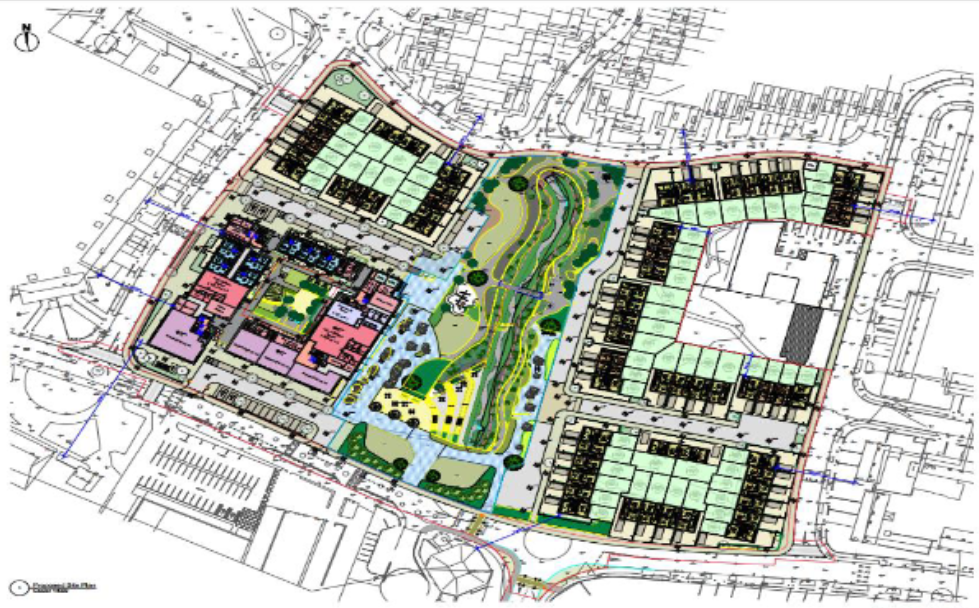
The other point of debate has been how many shops and facilities, and what kinds, will move into the new town centre.
The bog-standard shops don’t add to an area, he said. “I think in this instance we owe it to the people of Cherry Orchard to try and get it right. All too often we’ve gotten it very wrong over the years.”
Wanting social enterprise was a big element of the feedback, said Rowan. “We are open to social enterprise from the ground up being a key component of the future in this building.”
How premises are allocated is a reserved function, he said – meaning councillors, not council staff, get final sign-off on who gets to rent council buildings.
Staff would hope to put forward appropriate user groups for the town centre buildings to councillors, said Rowan.
Doolan, the Sinn Féin councillor, said he was glad to hear the commitment to exploring social enterprise.
“I’d be a strong advocate for that social enterprise to be some sort of model of food co-op,” he said.
 Lois Kapila
Food poverty in Cherry Orchard is five times the national average, he said. “If we have the potential to turn that around we should grab it with both hands and squeeze every ounce of potential out of it.”
Ray Cunningham, of the Green Party, said it was disappointing to see the same amount of retail space as in early designs.
The community has been clear that it needs more of that to function as a real town centre, he said. “So that is a disappointing element.”
Three Dublin City Council projects were in Bundle 3 of the Social Housing PPP Programme, which was scrapped.
One is for 68 homes in East Wall, another for 93 homes in Ballymun, and a third for 83 homes on Collins Avenue.
 Laoise Neylon
Those will now be delivered under a more straightforward “design and build” contract, as part of “Project Barrow”, with the help of the National Development Finance Agency, said Rowan, at the meeting.
“This will be three sites from Bundle 3 going on site this year,” he said.
They’ve another route planned for nine of the projects – those with planning in place or close to, for more than 1,200 homes – that were supposed to be built under bundles 4 to 7, he said.
Those also include homes at the Church of the Annunciation (110) and Wellmount Road (77) in Finglas, as well as on Collins Avenue (106) in Whitehall.
They also include the long-awaited homes at Croke Villas and Sackville Avenue in Ballybough (66), and on Stanley Street in Smithfield (167).
And, homes on vacant sites in Ballymun (277), the regeneration of Basin View in the Liberties (171) and the nearby site at Forbes Lane (108) – as well as the Cherry Orchard project.
For all these, the council is going to set up a new procurement vehicle, he said, called the Dublin Home Building Programme.
Homes built on these sites will be handed over to the council when built, and managed by the council, he said. “We want to streamline Housing’s approach to procurement.”
The plan is for a four-year procurement programme, to establish contractors to work with, he said.
By the end of the year, they plan to award contacts for four sites that were supposed to be part of the PPP programme. Every six months after that, they’ll go back out to the market with more sites, he said.
So, they won’t go out every time for each site to procurement, but more efficiently work under a procurement framework, he said.
Officials will update councillors on the housing committee on this home-building programme in May, he said.

It isn’t hard to find people registered to the wrong addresses and zombie entries.

While costs of basic items have risen, including snacks bought from the prison shop to fill long gaps between meals.

But there’s still no sign it’s going to reopen – and now the nearest one’s 3km away, on Parnell Street.

A €2 per bed per night tax could raise more than €17.5 million a year, according to a council analysis.