

Who will sit on the advisory board set to shape the future of Dublin city centre?
Seven areas of expertise should be represented, said a recent council report.
A masterplan for the area foresees up to 8,500 homes being built on the lands, as well as schools and sports and community facilities, and more.

Dublin city councillors agreed on Monday night to rezone 45ha of land in Glasnevin, taking in Dublin Industrial Estate.
The lands used to be Z6, for employment and enterprise. Now, they’re Z14, and so have become what is known as a Strategic Development and Regeneration Area (SDRA)
Along with the rezoning, councillors also voted to fasten in the Broombridge-Hamilton Masterplan for the estate and wider area, which covers 77ha, incorporating it into the city’s development plan.
By taking a “plan-led” approach, rather than just a straight rezoning, the council is trying to ensure sustainable development, said Malachy Bradley, deputy city planner, at the meeting.
The masterplan foresees up to 8,500 homes being built on the lands, as well as an educational campus with schools and sports and community facilities, and parks and transport interchanges.
Councillors’ questions just ahead of the vote coalesced around a few themes.
Fine Gael Councillor Gayle Ralph asked how the council would ensure that community infrastructure is built in parallel with the housing.
“In the past, we’ve seen large-scale residential developments proceed without timely delivery of community facilities,” she said.
Independent Councillor Nial Ring asked what the breakdown of homes would be – would they all be one- and two- beds, or would larger homes be part of the mix.
Fine Gael Councillor Colm O’Rourke asked how the council would ensure that any taking-in-charge process – through which the council takes over responsibility for infrastructure developers build such as roads and parks – would go more smoothly and faster than it has in nearby Pelletstown.
Green Party Councillor Feljin Jose asked how the council would ensure that it doesn’t end up in a situation where thousands of homes are built but the big public transport projects that would serve the area – such as the Luas Finglas and the Dart+ West upgrades – don’t progress.
Emer Uí Fhátharta, the acting city planner, said the move to rezone and masterplan the lands flowed partly from the new housing growth targets put forward by the Minister for Housing, Fianna Fáil’s James Browne TD.
(Although it has been on the list for possible rezoning for at least seven years.)
It was a significant milestone in adding to the land available for housing in the city, said Uí Fhátharta.
It could deliver up to 8,500 homes, she said, “while also facilitating the creation of a new sustainable community just 3km from the city centre”.
 Sean Finnan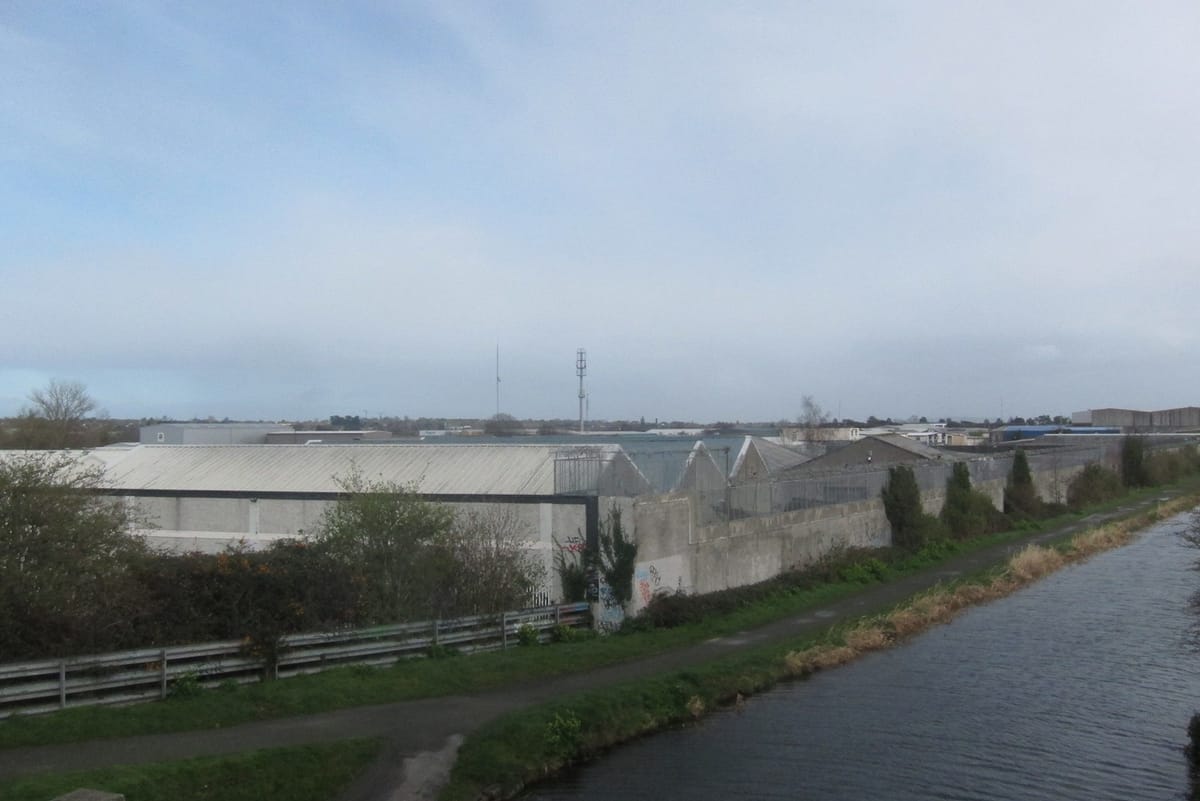
The masterplan and proposed variation had gone out to public consultation, said Bradley, deputy city planner, at the meeting.
Twenty-two members of the public, state agencies, and landowners wrote in.
Officials were now suggesting 11 amendments based on that feedback, Bradley said. They were mostly to add clarity, he said, and none were material changes which would need another round of consultation.
One of those changes was around education provision. The draft masterplan talked about a school.
In the agreed version, it’s now schools, plural, within an educational campus, alongside the commitment to continue to actively engage with the Department of Education and Youth on what provision is needed.
Councillors welcomed that.
“It’s great,” said Ralph, the Fine Gael councillor, but what safeguards are in place to make sure these new schools are actually built, so new demand won’t just fall on existing schools.
Uí Fhátharta, the acting city planner, said they’ll keep working really closely with the Department of Education on this.
Ralph had a similar question around sports and community facilities. “We can’t place any further pressure on already stretched facilities.”
So what concrete measures were in place to make sure that community facilities would be delivered in parallel with housing, asked Ralph.
Ralph highlighted a submission from Jim Brogan, on behalf of the Dublin GAA County Board, which had asked for playing pitches big enough for Gaelic games within the masterplan lands.
The response in the chief executive’s report on the consultation was that this would take too much room. There would be multi-use games areas in the park, and also shared community and school facilities, “to ensure flexibility and inclusivity”, said the report.
Also, the council is planning a sports audit of where more pitches are needed in the city, the report says.
Ralph said at the meeting that she understood the CEO’s refusal but the council does need to identify land in the wider area for a GAA pitch.
“In that context, I think it’s important that we identify some surrounding land immediately and safeguard it to try to accommodate future sporting and recreational facilities,” she said.
Sinn Féin Councillor Séamas McGrattan said that there are pitches in private ownership on the boundary of the masterplan area. The council should try to come to an arrangement to encourage the owners to share the use of them, he said.
Uí Fhátharta, the acting city planner, said – in response to a request for ongoing monitoring of the masterplan progress by the Lord Mayor, Fine Gael’s Ray McAdam – that they could commit to coming before the area committee to update on it regularly.
The chief executive’s report has said that the council will step in to ensure delivery of necessary facilities, said Uí Fhátharta.
Bradley, the deputy city planner, said the masterplan talks about the delivery of community facilities. Community-wide facilities are to be delivered by the council, with a mix of public and private funding, he said.
The facilities that are in the blocks would come under “CUO25”, a requirement in the development plan that a certain percentage of the area of buildings in SDRAs goes towards community, arts, and culture spaces, he said. These would involve private-led delivery and oversight by the council, he said.
By having a framework sketched out block by block, it makes sure there is a mix of uses across the masterplan, he said.
The masterplan sketches out blocks across the lands with heights that range from up to four storeys to up to nine storeys – with some corner sites highlighted as able to possibly go higher.
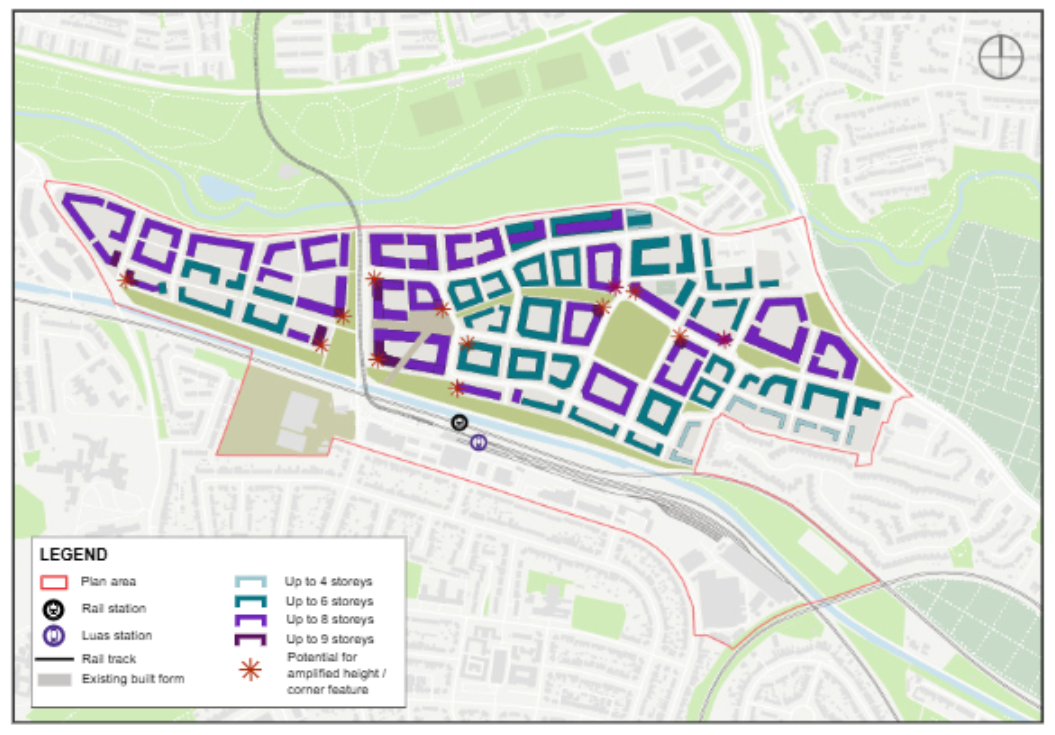
All in, the roughly 8,500 homes should equate to about 17,000 new residents.
At the meeting, independent Councillor Nial Ring asked what the breakdown of homes would be, given figures in documents.
Would they all be one- and two- beds, or would larger homes be part of the mix? He said. “I’m just worried that it’s not family-orientated.”
Uí Fhátharta said that density varied in different areas of the site. “We will absolutely ensure that there is the spectrum of housing units available.”
Bradley said that the population figure was just a standard calculation. The mix of tenure and mix of sizes of units is talked about in the masterplan, he said.
That says that “based on the background demographic and housing analysis carried out by Dublin City Council, this Masterplan strongly advocates for the minimal provision of one-bedroom or studio type units, with a greater emphasis on providing two-bed and on longer term family size accommodation to support community formation, stability and well-being”.
That provision is made, it notes, “within the mandatory requirements of Specific Planning Policy Requirement 1 (SPPR1)”. “In accordance with SPPR 1, this Masterplan does not prescribe a minimum requirement for any one bedroom or studio type units within the Masterplan,” it says.
 Lois Kapila
At the meeting, Tony Flynn, an assistant chief executive, said that the council would be examining what the housing need of the area is, in the context of its next Housing Delivery Action Plan.
Most lands within the masterplan area are held in private, rather than council, ownership, the masterplan notes.
About 3km west of the masterplan area is Pelletstown, where some estates have been built out for years yet the infrastructure such as roads, green spaces, lighting, isn’t yet under the control of the council.
So the council can’t respond to requests from residents for changes such as traffic calming or dropped kerbs to ensure those with disabilities can cross streets easily or build out public spaces.
 Sam Tranum
At Monday’s meeting, Fine Gael Councillor Colm O’Rourke asked how officials would ensure that a similar situation doesn’t play out once the Dublin Industrial Estate is developed.
“How do you foresee this?” he said.
Flynn said that they have learnt from previous large developments and have made a toolkit for developers to ensure a smooth transition for future taking in charge.
And what about the provision of public transport? asked Green Party Councillor Feljin Jose, when it came his time to speak.
“There’s lots of mention of Luas Finglas and Dart+ West in the masterplan,” said Jose.
But how can the council ensure that it doesn’t end up in a situation where thousands of homes are built but these big public transport projects don’t progress? he asked.
The Finglas Luas extension is facing delays due to legal challenges. While, the Dart+ West is still on the agenda.
But Jose said he doesn’t trust that the projects are safe from being shelved because of “whims”.
In west Dublin, the council has been moving forward with another masterplan and rezoning, of lands along Kylemore Way and Jamestown Road, only to have the national government announce that it wasn’t going to fund the Dart+ South West project – a piece of infrastructure key to the whole plan, which already has planning permission – until sometime past 2030.
“If we keep taking money away from these projects and delaying them, we’re just going to condemn people to slowly losing the will to live in gridlock,” Green Party Councillor Michael Pidgeon said in December about the delay.
 Sam Tranum
At the meeting on Monday, Jose opted not to suggest any changes to the plan for Glasnevin, for fear, he said, that it would be considered a material change and so require it all going out to public consultation again.
Uí Fhátharta, the acting city planner, said that she understands concerns about infrastructure, but they are further down the road to realising that than before. “In that we now have a permitted Luas. We now have a permitted Dart+.”
An Coimisiún Pleanála granted planniing permission in July 2024 for the Dart+ West project, and in October 2025 for the Luas extension from Broombridge to Charlestown.
The council would commit to looking, though, at how the infrastructure provision was coming along in general, as part of the review of the city’s Development Plan, which is to kick off soon, she said.
“We can come back and review how development is progressing and do we have to make amendments as part of our development plan review,” she said.

Seven areas of expertise should be represented, said a recent council report.

Children who live in homes run by private companies and charities are not included in the HIQA consultation because HIQA doesn’t inspect those services.

“There is just so much confusion,” says Sarah Lawless, who has been on the housing list for 20 years. “The whole system doesn’t make sense.”

It’s been six years since the area was listed as a priority for improved traffic management.