

Tusla says it's an offence to run an unregistered children’s home, but it places children in them anyways
So how does it square the circle?
But will funding follow to make possible these ambitions?

Dublin city councillors finally got sight earlier this week of roadmaps for how to “decarbonise” Ballymun, and Ringsend and Poolbeg – the two areas chosen for pilots on how to transition neighbourhoods to a zero carbon emissions future.
The reports were drawn up by Codema, the energy agency, in February 2024, after months of consultation with community groups.
At the 40-minute meeting of the council’s climate action committee on Wednesday, Green Party Councillor Claire Byrne said that it was great to see progress. But details around implementation were still fluffy, she said.
In Ringsend, which is part of the area she represents, the amount of time that’s passed since the council did community outreach for the project also means they are on the back foot, said Byrne.
“I do think we are losing support from the community, because it’s been such a drawn-out, protracted process,” she said.
Ringsend communities have been enthusiastic about what a “decarbonising zone” – as the initiative is called – would mean for them, she says. “But they’re losing hope, and they’re losing interest because the pace of progress has been incredibly slow.”
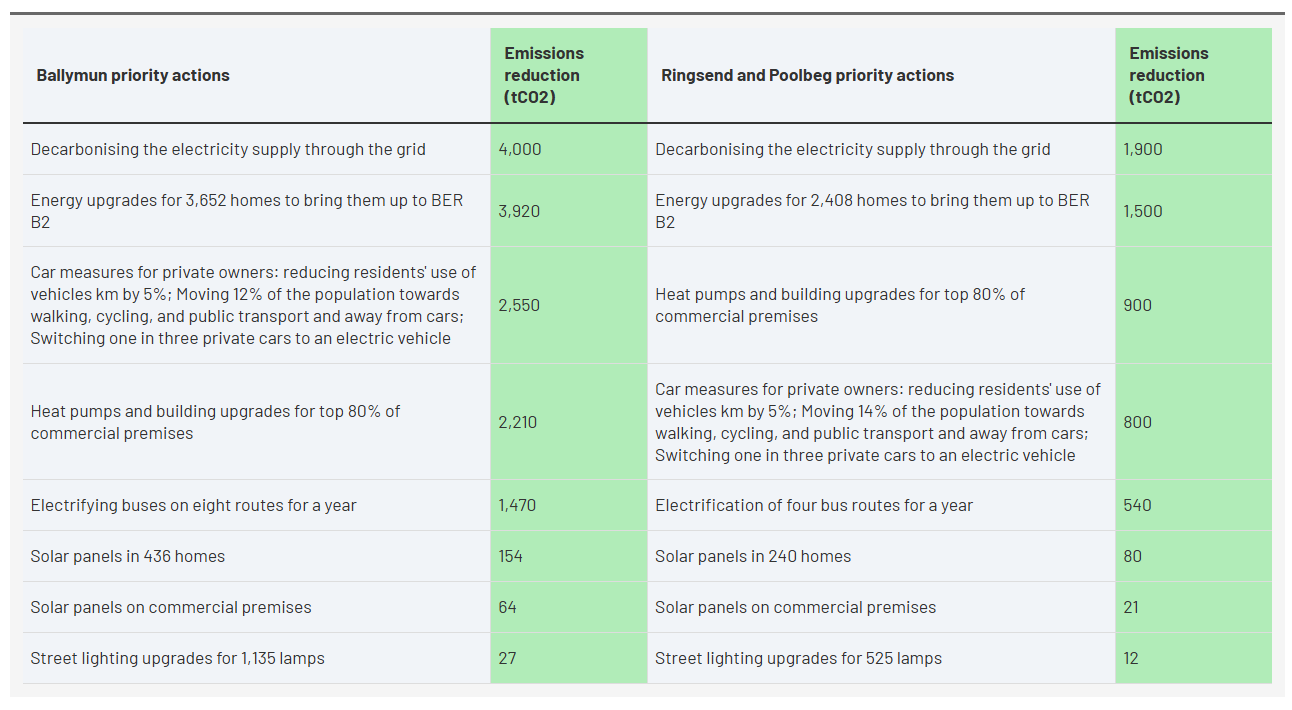
Retrofitting and solar panels for both homes and businesses featured high among steps in the two reports that need to be taken to reach emissions goals. So too, did finding ways to switch people to walking and cycling and moving to electric vehicles.
Community groups also had more specific asks, based on what they saw as local needs – such as expanding Buddy’s Farmers Market in Ballymun, and supporting the installation of solar panels on social housing in particular in Ringsend.
Dublin City Council hasn’t responded to queries as to why it took nearly two years to bring the plans before councillors for approval.
But at the committee meeting Wednesday, Darby Mullen, a senior executive engineer, said that it was important to highlight the risks and challenges with rolling out the proposals – chief among them being funding.
“Securing resources is always going to be a big issue,” he said.
The plans suggest it would take €275 million to roll-out the priority measures to decarbonise Ballymun, and €164 million to decarbonise Ringsend.
That’s not just from the council chipping in. But it’s still a lot of money, said Mullen.
Mullen said he had made the case before the Department of Climate’s Decarbonising Zone Advisory Group that this is a big task for councils to tackle on their own. But they haven’t got any extra funding from government so far, he says.
“We’ve been told that it is indirect funding,” said Mullen.
That would mean funding from the council’s stretched capital budget, and other already existing streams and projects – for initiatives such as public lighting upgrades, retrofitting grants. As well as liaising with other agencies which pay for stuff, such as the National Transport Authority on public transport and bus changes.
The Department of Climate, Energy and Environment didn’t address a query sent on Wednesday, asking why there had been no additional funding allocated for the decarbonising zones.
Nor queries on what funding streams they expected councils to tap, and how the decarbonising zones would be different to outside the zones without the resources to carry out extra activities.
But a spokesperson said that the department would be making an announcement about funding next week.
Decarbonising zones as a concept were planted in the Climate Action and Low Carbon Development (Amendment) Act 2021.
Each zone is, the Codema reports say, “a test bed of innovation and a demonstration site of what is possible in relation to decarbonisation and climate action at a local level”.
And targets for cutting emissions in each zone have to align with national climate targets for cutting greenhouse gas emissions by 51 percent by 2030, and reaching net-zero no later than 2050.
For Ballymun, taking into account population growth, that means slashing emissions by 21,820 tCO2 by 2030, says the report for the northern suburb.
That’s out of a total of roughly 35,000 tCO2 emitted in 2018 .
For Ringsend – not counting pollution from big national industrial infrastructure on the peninsula – it means cutting emissions by 8,780 tCO2 by 2030. That’s out of a total of 14,591 tCO2e in 2018.
Codema’s analyses show where most emissions have been flowing from.
In Ballymun, it breaks down emissions as coming from transport (39 percent), energy use in homes (35 percent), and commercial businesses (18 percent).
In Ringsend and Poolbeg, it breaks down as coming from energy use in homes (39 percent), transport (37 percent), and the commercial sector (18 percent).
Although, the report says, activities in the peninsula are actually responsible for the most emissions, and “the actual commercial and industrial emissions of that small area would be significantly higher if some of the critical infrastructure that need bespoke analysis were accounted for”.
That meant facilities such as the ESB Poolbeg Generating Station, the Dublin Bay Power Plant, the Poolbeg Incinerator, and the Ringsend Wastewater Treatment Plant.
They produce high carbon emissions, says the report, but are of high importance given they supply a wide area. Influencing their emissions would be hard with local measures, the report says.
“These infrastructures usually have their own carbon emissions reduction targets,” it says – such as the EU Emissions Trading System or specific regulation as is the case for the wastewater plant.
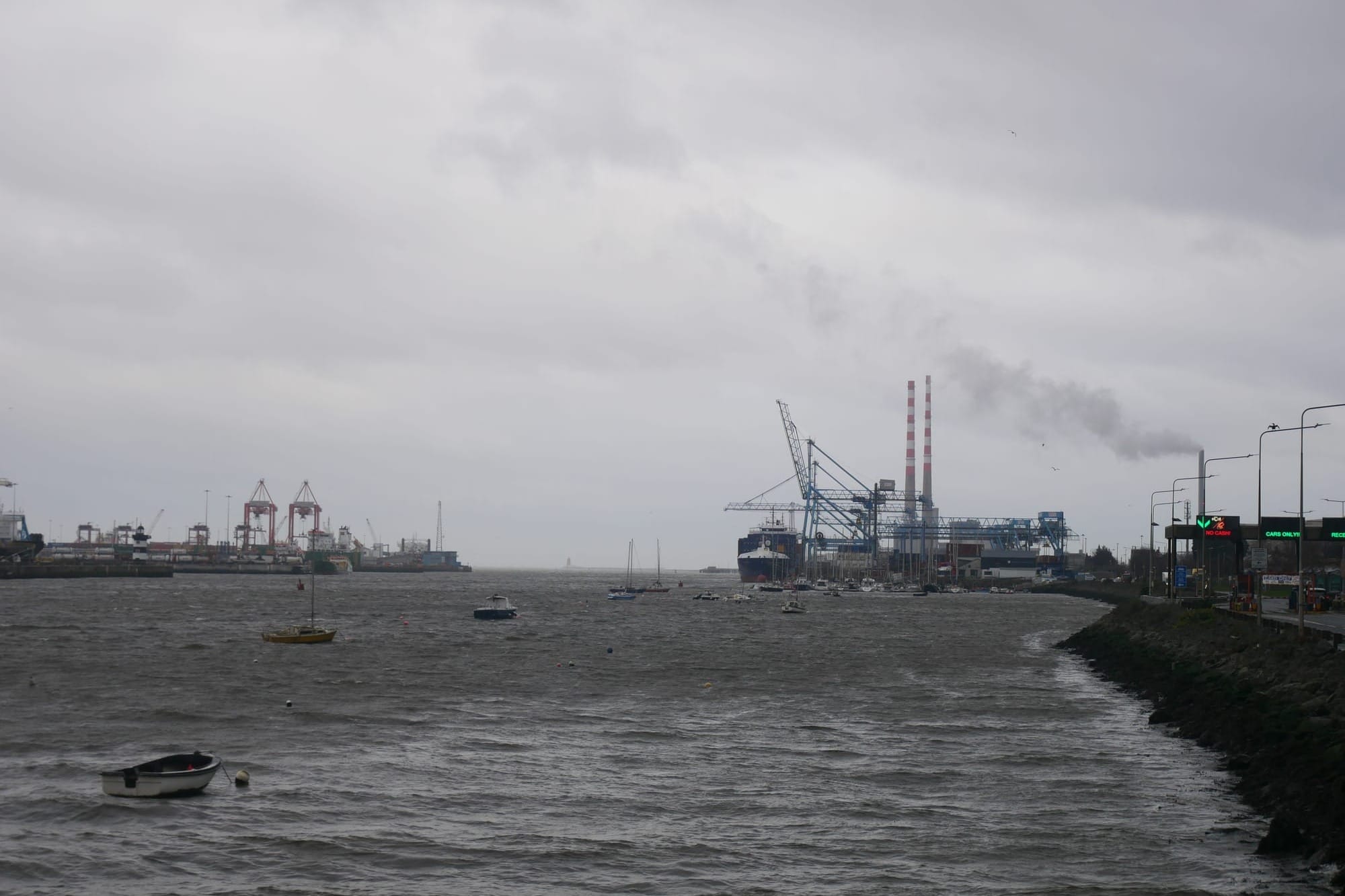
On Thursday morning, John O’Neill was wheeling a bicycle with a full basket along a path to the south of the Tom Clarke Bridge.
His hood was pulled up against the relentless spits of rain. Behind him, the sea was choppy.
At the mention of decarbonising Ringsend, he gestures to the bridge. It’s basically a car park, he says.
Bumper-to-bumper traffic, and massive trucks rumbling their way to the Poolbeg incinerator from all over Ireland. He stood and counted them once, surveying the number plates for clues of where they were driven from.
“There was one going over that bridge every 20 seconds,” he says. “What is green about that?”
Traffic over the bridge, and the air pollution it spews out, was one of most frequent issues raised during community consultation, says the Codema report for the neighbourhood.
And also, fears of flooding, a lack of facilities meaning people have to travel for basic services, and future development meaning existing services will come under further strain.
In Ballymun, meanwhile, residents’ concerns focused on road safety given the heavy traffic that cuts through its main road, poor accessibility for those who use wheelchairs, and the lack of community spaces to gather, more green spaces, and problem littering.
Both reports lay out the changes that, when totted up, could lift the neighbourhoods to reach emissions targets.
Some of the changes fall under national bodies – such as electrifying the energy grid and ensuring public transport links.
Others fall largely under the remit of the council, private households, or commercial businesses – such as a 20 percent shift in Ringsend from fossil-fuel heavy goods vehicles to electric vehicles.
At the climate committee meeting, Fine Gael Councillor Declan Flanagan, the committee’s chair, asked one question, on how progress would be tracked. “Just the outputs, and the measurements, measuring the success?”
Mullen, the engineer presenting the reports, said that they knew the 2018 emissions, so could meter off from that.
Byrne, the Green Party councillor, asked for a breakdown of what Codema was responsible for, and running with, and what would be done by the council. It was confusing, she said.
She could see Mullen leading on it, and mention of a wider council team, she said. “But I feel that this project has fallen between two stools a lot.”
Codema set up a once-a-week clinic on Thursdays in the Ringsend and Irishtown Community Centre, late last year.
People can book an appointment for the “Raytown Energy Dock” to go in and get advice on energy upgrades. It runs out of a small room upstairs in the centre.
But local councillors haven’t been told anything about that – or the wider REGEN project that the agency has been running, said Byrne.
REGEN is an EU-funded programme, running from January 2024 through December 2027, which is aimed at “exploring innovative pathways” to decarbonise European neighbourhoods, including Ringsend.
“It would be really beneficial if they invited us down and let us know what they are doing,” said Byrne.
Later by phone, Byrne said she was still frustrated with the pace of progress and the resourcing of decarbonising zones.
The current city development plan for 2022–2028 commits to setting up a decarbonizing zone in each of the 11 local electoral areas across the city, she says.
“And we haven’t even got these ones off the ground yet,” she said.

So how does it square the circle?

But while the numbers of foxes in cities has been steadily creeping upwards, is it a problem or, if humans respond right, a boon?

Richard Shakespeare recently held a closed-doors briefing for councillors, giving them a presentation that was watermarked so they could be caught if they shared it.

Council officials want to keep renting it for about the next five years to the wastewater plant operators.