

“It’s giving colonialism”: Ireland still owes rent to dukes and earls
Although, even though the OPW lists these rents as payable, some of the named beneficiaries say they haven't been getting them.
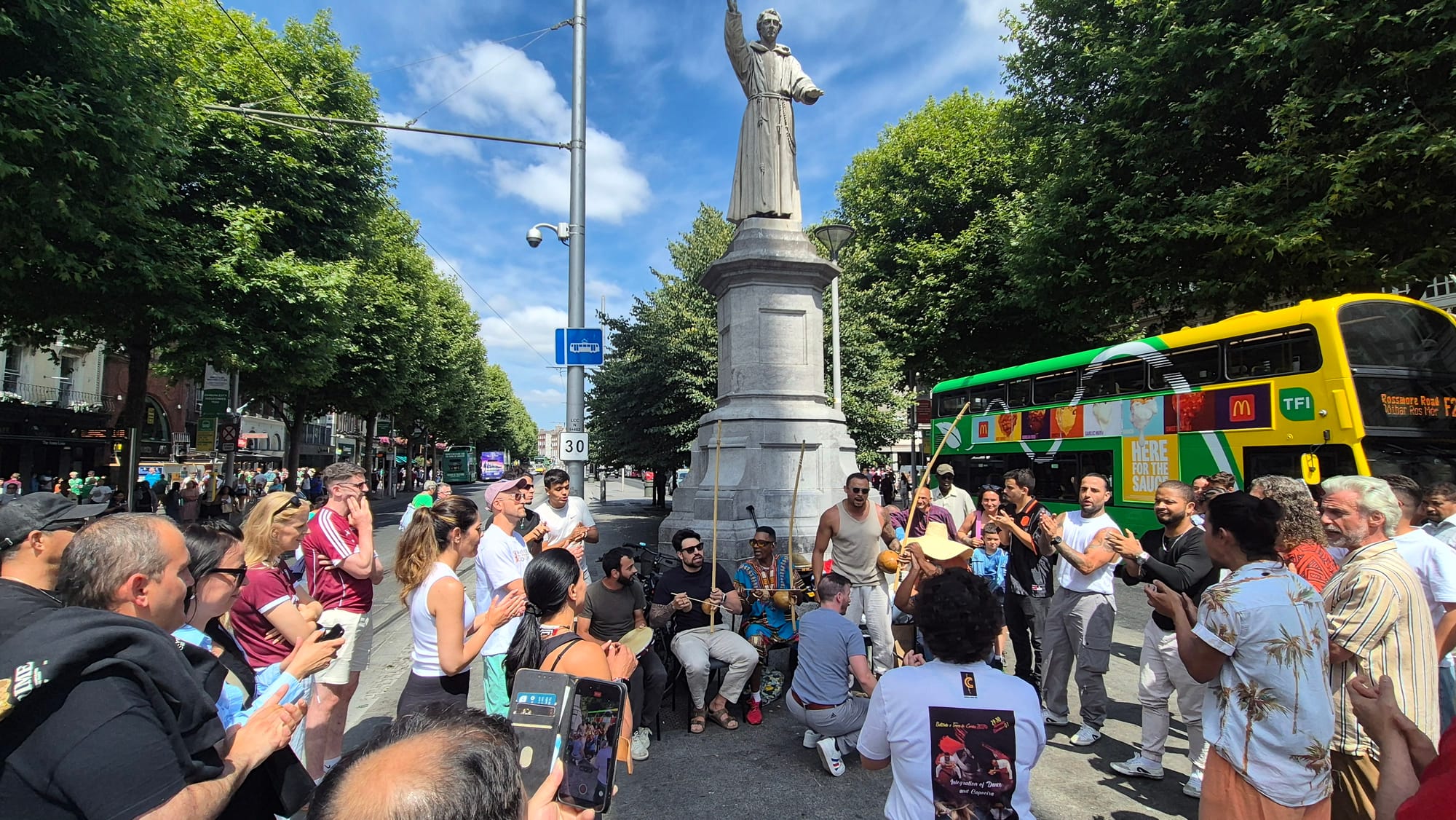
The last few weeks, beneath the statue of Father Mathew, behind the Spire, groups of capoeristas have been practising their Brazillian martial art and game.

Midday on Sunday, O’Connell Street hums as people in Limerick and Galway jerseys wander in droves, getting ready for the All-Ireland Senior Hurling final show-down in Croke Park starting at 3pm.
Beneath the statue of Father Mathew, behind the Spire, another battle is brewing.
Five men sit in a row, each with a musical instrument.
On either end, one beats a tambourine, another pounds a hand drum called an atabaque. In between them, three others play bow-like instruments called berimbaus.
As they hammer out a steady, march-like rhythm, one chants “Me dá meu dinheiro!” – to which the growing crowd around them answer “Me dá meu dinheiro, valentão!”
“Literally, it’s about asking for what is rightfully yours, but in capoeira, it also reminds us to respect the art, honour its traditions, and not take advantage of it or of the people who live it,” says Wesley “Tatu” Corrêa.
Corrêa and those assembled by the feet of Father Mathew are capoeiristas, practitioners of the Brazillian martial art and game, capoeira.
For the last few weeks, since the heatwave took hold of the city, Corrêa and friends have been taking their capoeira training sessions out of Erin College on North Great George's Street, where they are usually held, to the open-air of O’Connell Street.
And, on Sunday, there were capoeristas dropping in unexpectedly from different clubs and counties, and some from no clubs at all, just to play.
As the curious crowd around them continues to grow, so does the intensity of the music and the movement.
"Troca a guerra pela paz, Troca a raiva pelo amor," one musician chants. It means, “Replace war with peace. Replace anger with love."
The crowd answers, "Só não troca a capoeira, Que nunca me abandonou.”
That translates to, "But never replace capoeira, because it has never abandoned me.”
It reflects what capoeira means to him, says Corrêa. "It speaks about peace, love, resilience, and how capoeira has guided me throughout my life," he says.
The rhythm of the music dictates the pace of the game that is about to be played, says Marc McEntegart, from Dublin, who has been practicing capoeira since 2006.
So, is it a game, or a fight?
“It’s a game, it’s a fight, it’s a dance, it’s a lot of things,” he says.
They chose this particular spot because, in the statue, Father Mathew is holding a pose – one hand raised to the sky, the other extended waist-high to his front – that resembles a ritual position that capoeiristas take before a bout, McEntegart says. “It lets people know you want a friendly fight.”
Eventually, two people emerge from the crowd that has formed a semi-circle around the musicians.
They both crouch, facing each other, in front of the musicians, before exploding into an acrobatic display with kicks, sweeps, and headbutts – but with little to no physical contact.
To the untrained eye, it’s an extravagant, entertaining dance.
But, says McEntegart, when you know what you’re looking at, the combat is clear.
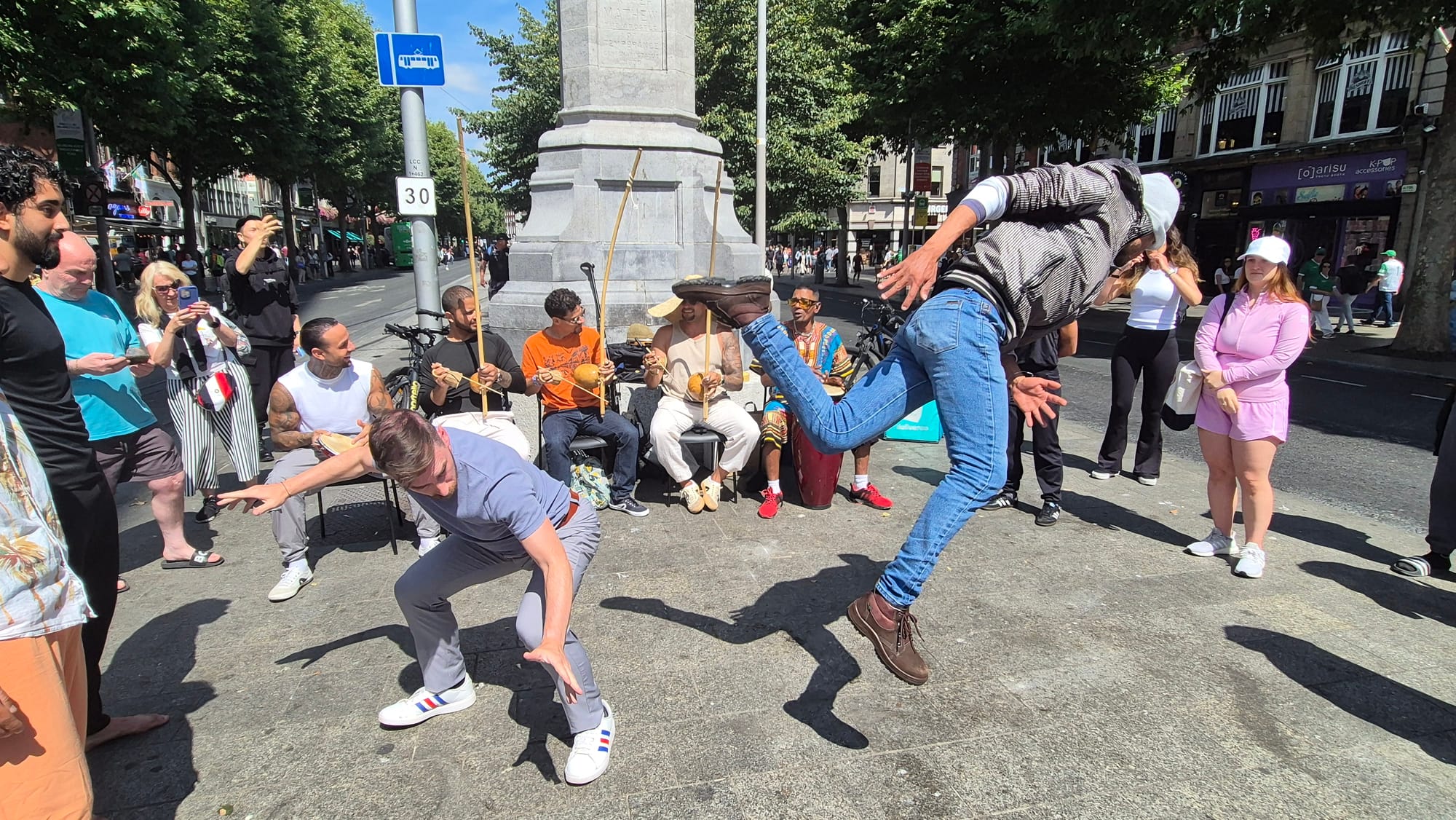
While some of the dozen or so capoeiristas who assembled for the workout are Irish, many are from Brazil.
Like, Corrêa, a lifelong practitioner, who moved to Ireland in 2016.
He was first trained at the age of four by his father, Nelcino, he says.
He remembers his father, a metalworker and mechanical engineer, would bring him to work as they couldn’t afford childcare.
"Whenever he had a break, we would train capoeira together," he says. "Those are some of my earliest and happiest memories of capoeira."
That’s where his nickname “Tatu” came from, he says.
It’s Portuguese for armadillo, which Corrêa would resemble as he hid under his father’s work desk to avoid the boss, he says.
In capoeira, everyone ends up with a nickname, says McEntegart, who came to be called “Superman” among his Brazilian training partners.
“I just have dark hair and blue eyes, and in my twenties, I did some writing work, so they put it all together and got to Clark/Superman,” he says.
It can happen as easy as that, he says.
“At some point someone nicknames you and they just stick, and then before you know it, it's been 10 years and you know a guy called ‘The Boy’ and you don't know why they call him ‘The Boy’, because he's 50 and that’s just the way it is,” he says.
A report published by the Jesuit Centre for Faith and Justice in October, Faith-Based Communities in the North-East Inner City, argues that faith-based groups in the city's north side, rather than keeping immigrant communities siloed, can actually be vital in helping new-arrivals integrate into Irish society.
These congregations act as lifelines for thousands of residents – many of them immigrants – providing everything from language classes and food support to emotional and spiritual care, the report says.
Faith communities, the report explains, often become the “first port of call” for new arrivals seeking information on how to navigate any and all sections of officialdom, language help, or companionship.
They facilitate access to healthcare, education, and trusted networks of connections for those learning to navigate their new environment.
For some Brazilians in Dublin, the same can be said for capoeira, says Corrêa, who also works as a social support worker.
He often guides his capoeira students on practical things like getting a PPS number, navigating visa issues, or sometimes even helping them in managing alcohol and substance use, he says.
For others, capoeira is just great fun, and a link to the culture they left behind.
Silvana Gotardi, who was getting stuck in on Sunday against McEntegart and others, trained as a teenager but eventually, she says, study, work and life got in the way.
When she moved to Ireland a few years ago, she was drawn back to it.
“I thought I didn't have the time to train, but then when you start training, you figure out the time,” she says, laughing.
Likewise, for Raphael Lopez, when he moved to Dublin seven years ago, the first thing he did was search out somewhere to train capoeira, he says.
A Google search led him to Corrêa. He is now Corrêa’s “right hand” in Dublin, Corrêa says.
So, while the O’Connell Street sessions have attracted a lot of experienced capoeiristas, has there been any negative attention?
Not at all, says McEntegart.
At one stage, a woman sat down among the musicians and started trying to referee the match unfolding in front of her, all in good fun, he says.
Other times, youngsters have passed a few smart comments, but when asked if they wanted to get involved, they usually decline.
One who did get involved, completely off-the-cuff, ended up displaying some surprising gymnastic ability, he says. “He was really extremely capable.”
Ultimately, says Corrêa, the point in taking the session to O’Connell Street, aside from enjoying the heat, is to promote the art itself.
For him, he says, capoeira was life-saving in more ways than one – and he wants to share its possibilities with anyone he can.
Coming from a rough neighbourhood in Brazil, it offered him a positive path, he says.
At the age of 14, he set up what he calls his “first social project” in his uncle’s garage, training other youngsters, helping them to stay off the same bad road he had been tempted by himself.
Later, it helped him out of the occasional scrape when he was working as security in bars.
“I’d sweep guys to the floor and hold them,” he says. “I didn't need to punch the face or traumatise people – I just needed to distract and control them.”
That act of distraction is a big part of the combat aspect to a capoeira match, he says.
“That's the fun, and that's the challenge. I need to distract you,” he says.
How do you distract your opponent in capoeira?
“Dancing. I use my tongue, smiling, doing the back flip, handstands, the performance, the performance makes you distracted, and then when you forgot about me, then I see the chance to get you,” Corrêa says.
At its core, says McEntegart, the game is about bravado.
“You're introducing these opportunities for someone to sweep you or to headbutt you or to knock you down,” he says.
“The goal is to play as close to that fire as you can, like to give people these opportunities and then reverse them or take them away, or to offset a certain balance.
“All those air movements and small acrobatics are about kind of setting the table for the person and saying like, ‘I'm so confident that you can't sweep me here that I'm going to do a handstand, I'm going to do a backflip’, whatever it is,” he says.
Monday 3 August is Capoeirista Day, celebrating the history of the martial art, which was originally developed among enslaved people from African in Brazil and made illegal for decades from 1890 before its eventual decriminalisation in the 1930s.
The capoeiristas will be back on O’Connell Street at 1pm that day to dance, play, fight and mark the occasion.
Capoeira sits alongside hurling, uilleann piping and Irish harping on UNESCO’s Representative List of the Intangible Cultural Heritage of Humanity.
Funded by the Local Democracy Reporting Scheme.

Although, even though the OPW lists these rents as payable, some of the named beneficiaries say they haven't been getting them.

They're set to back the creation of a special purpose vehicle he's been picked to head, which is meant to play a major role in regenerating the city centre – but how major is in dispute.

Social tenants who live in the private Liberties complex Grand Canal Harbour say they're not allowed to use many of the common facilities there.

Gone is the hardman shtick, the macho bravado once associated with hip hop, rapper and producer Michael Ward, who goes by Mickzart. “We’re after something true.”