The tender document for the design says the framework has a maximum estimated value of €7.5 million. It also gives a tentative construction estimate of €25 million.
Social tenants, including children, are often locked out of communal areas in their complexes. Would it help if they were represented at the OMCs' meetings?
It only crossed his mind recently, said Paul Mulville, a Social Democrats councillor on Fingal County Council.
For Monday's monthly meeting of the council, “I was gonna ask the manager about, you know, what the plan is,” he said by phone on Friday afternoon.
Mulville was talking about how he’d recently noticed that the council’s last “Migrant Integration and Social Cohesion Strategy” – which covered a period between 2019 and 2024 – is out of date. And he hadn’t heard anything about a new one.
Fingal County Council is not alone in lacking a concrete plan for helping residents settle in. The Dublin City Council has worked without one for almost five years.
That’s how long the national government has gone without an integration roadmap, too. The city council has said it has been waiting for the nationwide plan to drop before rolling out its own.
Last week, when Sinn Féin TD Matt Carthy asked the Department of Justice whether there is a plan for “managing work and education visas” to keep immigration numbers “sustainable”, he got an update on the nationwide integration strategy.
Colm Brophy, Fine Gael TD and a junior minister at the Department of Justice, told Carthy that civil servants aim to publish a “migration and integration strategy” later this year. In his reply, Brophy focused on the migration part of the strategy and said little about the integration part.
He said the strategy's scope will be broad, including things like “labour market needs, legal pathways, international education and planning for public service provision including housing, amongst other issues relating to migration”.
Though back in January, Jim O'Callaghan Fianna Fáil's Minister for Justice, told the Dáil that various cohorts, including immigrant communities had been surveyed about their views as part of ongoing work on the policy document.
Mulville, the Fingal county councillor, said he had thought that since the current government hasn’t had a sympathetic stance on immigration, integration might have fallen to the bottom of its list of priorities – and that dulled enthusiasm for local authorities too.
Meanwhile, James Humphreys, Labour Party councillor in Fingal, said it’s better to draw up a “work programme” for integration that details action plans, won’t expire and doesn’t rely on short-lived policy papers.
He said the council can ask members of the Fingal Integration Forums to weigh in on drawing one up. “I much prefer that the council invest their time and effort into delivering work programmes”.
A spokesperson for Fingal County Council didn’t explicitly say what the status of a new integration strategy is.
But they said that “Integration from day one” is at the heart of its continuing work as the council waits to align itself with “the National Migration and Integration Strategy once it is published”.
In the meantime, “our team is actively delivering inclusion, cohesion and participation initiatives and services through existing structures”.
Things like maintaining its community integration forums “to identify issues, coordinate supports and develop local responses to integration challenges”, the spokesperson said.
You ask me to get along
At a council meeting on Monday, Mulville, the Social Democrats councillor, did ask the chief executive, AnnMarie Farrelly, about the integration strategy.
His question went unanswered at the meeting. Mulville said in a text on Tuesday morning that he'd sent an email asking for a reply, though.
The council’s 2025 annual report said it had completed its review of the past integration strategy in May of that year.
It lists other integration actions from 2025. Among these, it held 123 clinics at refugee and asylum centres; its integration forums met six times; and “[three] Fingal Talks events took place, attracting 50 participants”, said the report.
Both Mulville and Humphreys said events like Fingal’s annual Africa Day – a celebration of African culture and heritage – are always pretty fun.
But Mulville said that without an action plan, integration work can be ad hoc and scrappy.
It’s crucial to ramp up efforts as support from the national government diminishes,Mulville said. He points to how it has pared back accommodation support for Ukrainian refugees.
Irene Igiebor, a community well-being worker in Fingal working with marginalised communities, said that, based on her experience, the biggest challenge for settling is the struggle to learn the English language.
And when people lose their accommodation, they drift away, lose access to their familiar local English classes. They have to start over with a new class in another area, she said. And she does help people link up.
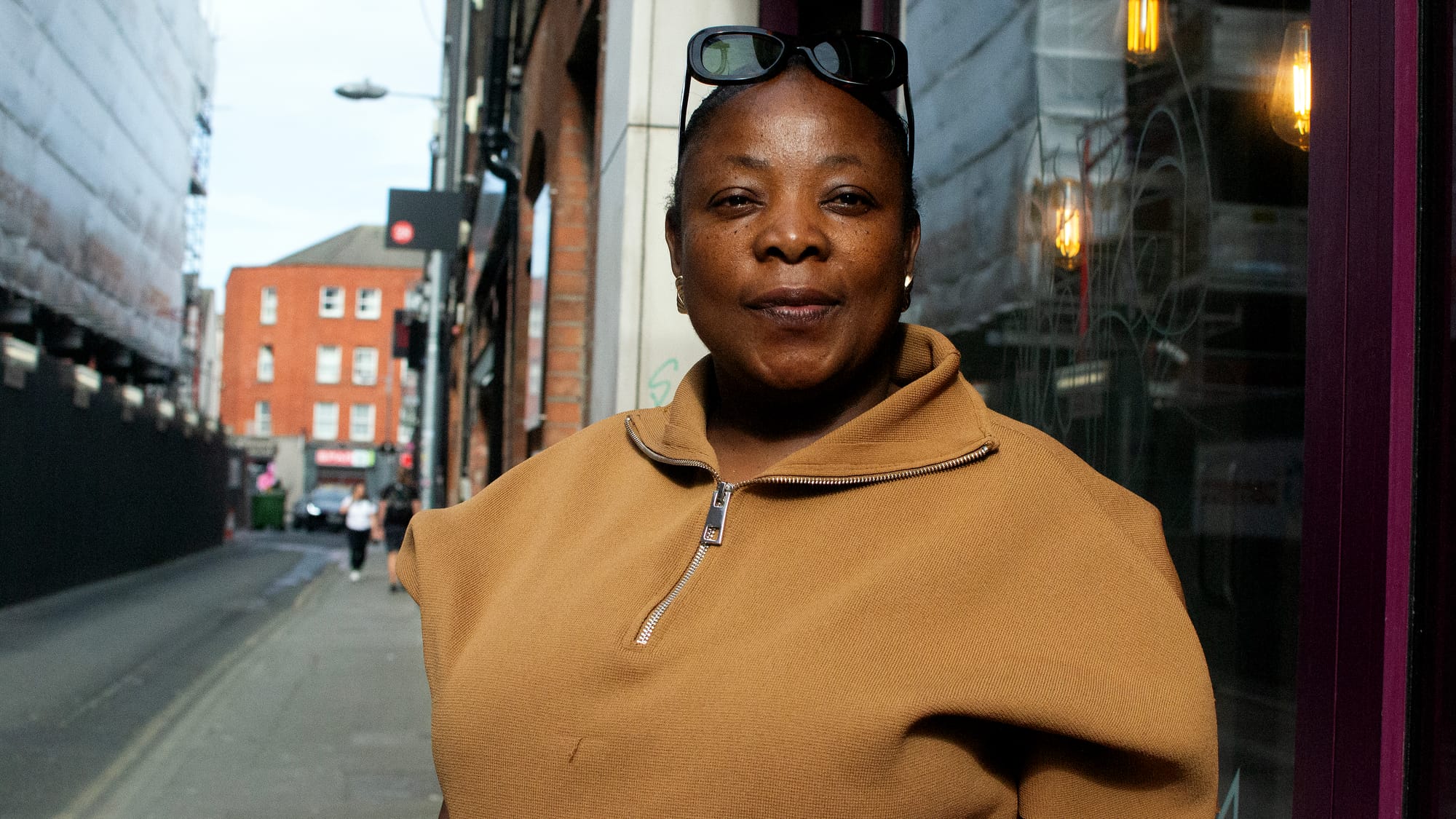
Irene Igiebor. Photo by Shamim Malekmian.
But if someone ends up grappling with homelessness, their chances of attending a different class dive, even if learning English was an important goal to them, said Igiebor.
“If they’re homeless, they don’t have the stability to achieve their goals,” she said.
A spokesperson for Fingal County Council did not address a query about how it helps deliver free English-language courses at the moment.
Know who needs you
Balbriggan Integration Forum is a volunteer body that focuses on fostering active citizenship of local immigrants, according to its website,
Aoife Leahy, one of its workers, said there are different courses available locally. She sends an example of one delivered by Dublin College in Balbriggan and Swords, which is right now accepting applications for conversational English classes starting in September.
The issue, Leahy said, is getting the word out about them and not missing enrolment periods. Staff at the council’s integration office and other units are pretty supportive of their work, she said.
Their biggest challenge, she said, is that volunteers can only put in so much work. And they give so much already, said Leahy.
But ultimately, they all have day jobs that they care about and “there are never enough hours in the day”, said Leahy.
Igiebor, the community link worker, said it is crucial to nail down a policy document that charts the map of tangible integration goals and lays out a plan for meeting them.
“Once you have your mapping, you know where you’re going; you know who needs you,” she said.
Lauren Fernandes noticed menus and flyers all over with the same sterile look, and thought: what if she could help out small businesses which can't afford creative work, usually?
"He's a local lad here from Carpenterstown, he's a local schoolteacher," said Fine Gael Councillor Ted Leddy, who proposed the motion. "A mural or something like that would be very appropriate."