

New film documents Dubliners’ resistance to subordination of social life to profit
“The market is a monster,” says filmmaker James Redmond. “It turns living spaces into dead space.”
At the Cast Foundry, Antoine Daure is working on his series Trap, aiming to create 10 to 15 variants for a future exhibition.

On a recent Saturday, Antoine Daure walked through the Cast Foundry in the Liberties, talking about Trap, his latest series of sculptures.
The artist, who works at Cast, has been casting both his own and other artists’ pieces there since 2021, and he moves with ease among the foundry’s rows of scattered molds, welding equipment and half-finished forms.
Walking into a storage area, he picks up a shiny metal device. It’s one of the five pieces he’s completed so far for the Trap series.
Like the others, it’s a version of a mechanical rat trap, but slicker, flashier, and more complex than any you’d find in a shop.
It is a solid, perforated metal form with bold geometric patterns cut into its sides and top, resting on two small bases.
Daure continues to walk through the rooms, and into the workshop where he casts – a vast space filled with maquettes and the bitter smell of burnt bronze.
From a top shelf, he carefully pulls down another trap, this one being a complex, cage-like structure of polished metal rods surrounding an inner box, which has two tall vertical posts extending upward from its top surface.
“This is not finished, I need to weld it,” he says. “There is a complex mechanism, it’s a nightmare to balance the weights.”
After moving all the components into place, Daure inserts a pen into the trap to simulate the movement of the rat. This releases a guillotine-like steel plate, which clangs down.
Daure says he aims to build a total of 10 to 15 traps for an exhibition, to be held in a location still to be decided.
Sculptor Anna Campbell, who has been working at Cast with Daure for three years, says she’s uneasy with the idea of trapping animals, but is still fascinated by his rat traps. “I like the quirkiness of it all,” she says.
Campbell, who has been working as a sculptor for several decades, says it’s great to see the fresh perspective brought to Ireland by Daure, who is from France.
“We are quite closed and insular, can be isolated and inward-looking,” she says. “When you see Antoine and other young artists, they bring a bit of fresh air.”
Daure says he’s been an artist since he was little. “My father is a chocolate maker and when I was young I made sculptures in chocolate,” he says.
The inspiration from his rat traps came from a girl Daure studied with in school, he says.
“She had a lot of rats in her house,” he says. “She bought a rat’s trap in the shop and it was so complex that we felt like it’s art.”
From there, he decided to make his own versions – each one unique – and he poured his time and energy into it.
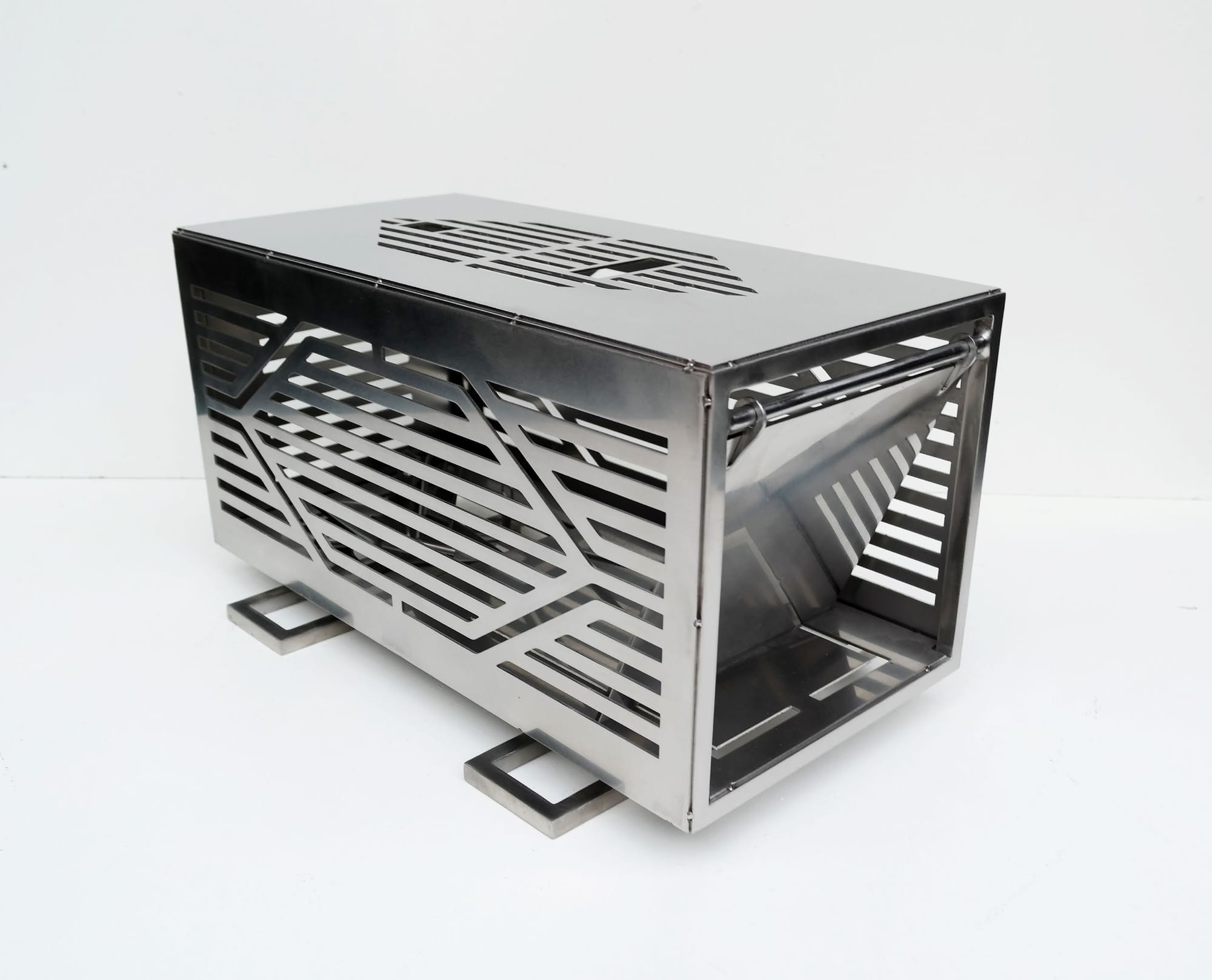
“I like this idea of taking a lot of time for design, to find the right balance” he says. “For what – you know? – for nothing, just to cut the rats. It’s a bit mad, a bit crazy.”
Daure says he is fascinated by the idea of making something only humans would normally spend a lot of time on.
“Sometimes they do things with no sense, like [putting together] a puzzle. They spend maybe one month making it – for what? This [the rat traps] is my puzzle” he adds, smiling.
Daure seems unsure what he’s trying to arouse in the viewer with his traps.
“Sometimes you need an object to find a solution to a problem, and this is a good one. But it’s still an object, it’s for the big rats in New York, in Paris,” he says.
When picturing the person who would buy one of his works, he wonders “where would he put it – in the living room?”
Campbell says Daure’s rat traps jerk the senses. “Why is this beautiful piece of sculpture, beautifully finished, beautifully polished, actually very dangerous looking?”
Daure has been working with the theatre- and cinematic idea of hors-champ throughout his career, he says.
“When they kill someone, the camera doesn’t show exactly the scene, but you know what happens – maybe you have the shadow and your brain understands,” he says.
His work doesn’t show violence directly, but he makes objects that can be violent.
In the foundry, Daure examines a prototype for another project he is planning: the Claw.
“It’s about never win[ning],” he says. “You know the game where you always put the money in the machine, but you never win anything, it’s just a fucking android.”
He moves closer to a metallic, three-legged structure. “It looks like the big spiders of Louise Bourgeois, maybe on a chair,” he says, giving an insight on his inspiration.
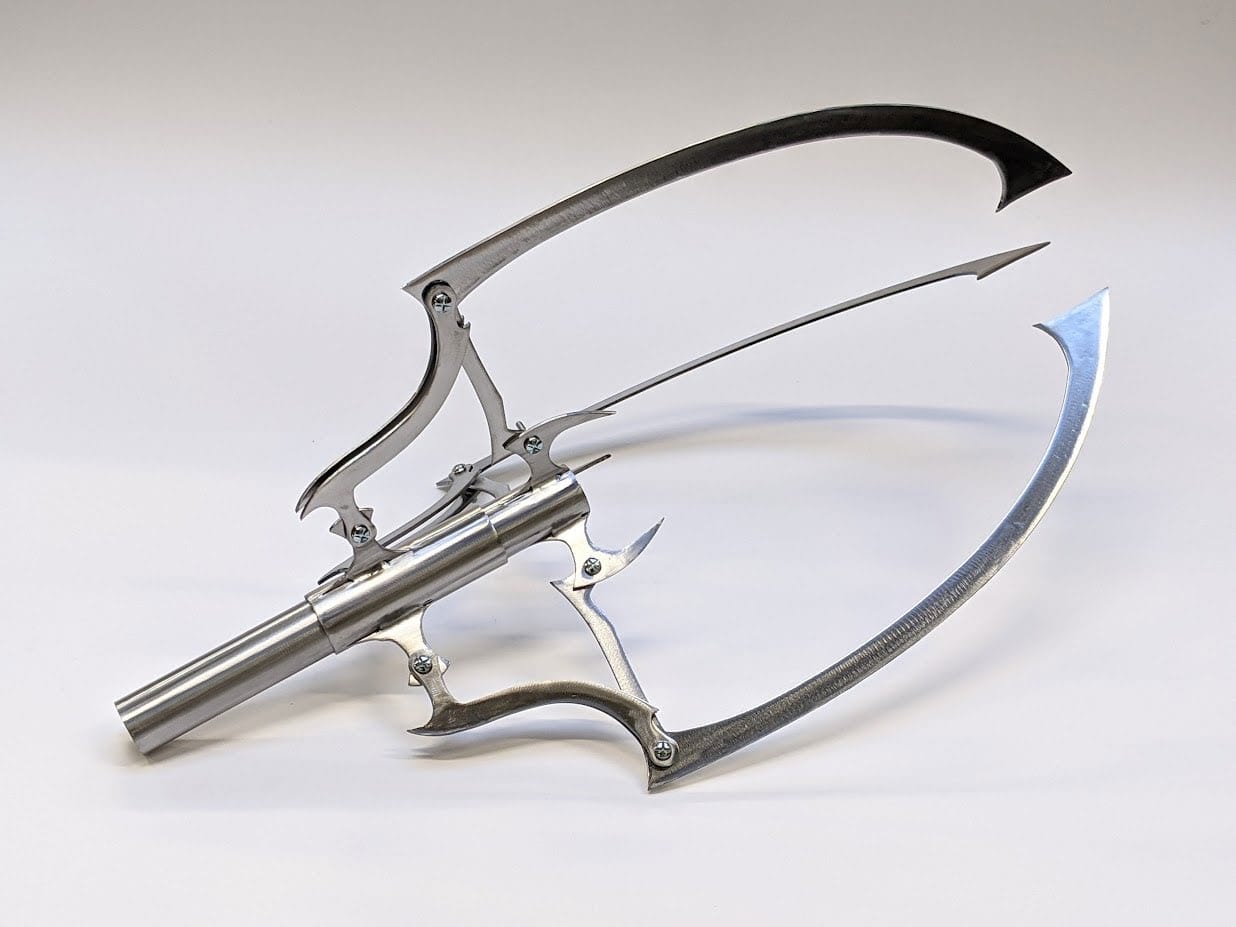
Standing nearby, Campbell asks Daure whether he lets an idea evolve, or whether he follows it rigidly from start to finish.
Daure says he needs to plan everything. When a project is not fully thought-through at the beginning, he is unhappy, he says.
“If I give the plan to someone else, they can reproduce exactly the same thing,” he says.
Daure says he uses computer programmes like AutoCAD to draw his ideas.
“If the file is not good, you pay extra money for them to fix it,” he says. “Sometimes they reply that the file is not precise, so you lose time.”
The company has other work to do, so it can take up to three months just to get something laser cut, Daure says.
Daure used to paint, but in art school he had to choose between that and sculpture.
He said painting felt “too real” and that he had started it mainly “to know the rules”.
But metal sculpture is expensive. At Cast, artists who work there get the materials for their personal work at a discount, Campbell says.
“A lot of artists of Antoine's age cannot afford to work in bronze. He has been very lucky,” she adds.
“He is so young and he can get so much cast in bronze, but also in aluminum,” Anna says. “He has the facilities here to do it.”
“His work is completely original from everybody that's in Dublin,” she says. “I haven't seen any work like his in Ireland, which is good because we need a shakeup.”
Daure says he tries not to worry too much about what people think about his art.
Speaking about how the audience responds to his work, he says, “If you ask what people think all the time, you stop and make nothing. You have to just keep going”
He would rather have a few people dislike his work than have everyone like it. “It’s good that people have an opinion,” he says.
Daure is now searching for the right venue to present his Traps and is working on new pieces. “The world of science and biology really attracts me,” he says.

“The market is a monster,” says filmmaker James Redmond. “It turns living spaces into dead space.”

Diane Duane’s early days writing fan fiction have led to a remarkable career as a novelist, comic writer and screen writer.

“Their songs are a veritable Lollapalooza of unflashy guitar play, stark aesthetics, gentle melodies, interlocking guy-girl vocal harmonies, and the spirit of Fugazi.”

"If it sounds silly, it is. But it’s also charming, heartfelt, moving and much else."