

Councillors back renewed focus on serious anti-social behaviour in council complexes
“We know there are issues,” said Dublin City Council Assistant Chief Executive Mick Mulhern, at a recent housing committee meeting.
One outstanding question, though, is whether any of the sites it identifies will be earmarked for Traveller accommodation.

Dublin City Council has been assessing more than 120 sites in the city as it plots out how to extend and expand its current pipeline of public housing, a council official said on Tuesday.
Of those sites, 95 of them – covering 60 hectares – are council-owned, said Fiona Craven, a council official who works on housing.
She showed councillors on the housing committee an interactive and layered map that she and colleagues are working on, as they whittle down which sites to prioritise when, in the years to come.
It shows land being assessed by the council, sites in development, and whether they are state-owned or not – as well as existing social-housing complexes.
Councillors on the committee said that they welcomed the proactive work and the planning.
One outstanding question though is whether the land-mapping and assessment exercise will also help in the long search for suitable land for Traveller-specific accommodation in the city.
Council officials said five years ago that there was an urgent need to build more, and that the only barrier was finding the land.
In February 2021, councillors held a special meeting focused on the lack of progress in building new Traveller-specific accommodation in the city.
Finding land was the only barrier to constructing more, said then head of housing Brendan Kenny at the time.
“We need to look at more radical ways of dealing with that and we are up for that,” he told councillors. “We need to do more.”
But when the national Office of the Planning Regulator asked the council to designate specific sites for Traveller accommodation in its development plan for 2022 to 2028, the council’s chief executive at the time, Owen Keegan, batted aside that request.
If the council allocated sites, it would restrict where Traveller homes could be built, said Keegan’s response.
And not much has happened on building more Traveller housing on fresh sites since then, said Shay L’Estrange, coordinator of the Ballyfermot Traveller Action Project.
L’Estrange hasn’t heard of any specific sites being suggested for new Traveller housing, he said Tuesday. “They haven’t come back with any more since.”
Dublin City Council hasn’t responded to a query sent on Tuesday asking whether any part of the land assessment has looked at, or will look at, sites’ suitability for Traveller accommodation.
Dublin City Council currently has about 17,200 social and affordable homes at various stages of development on lands across the city.
But that pipeline peters out towards the end of this decade, according to the figures Craven presented to members of the council’s housing committee on Tuesday.
The council expected to finish about 3,500 homes this year, 4,100 next year, and 2,600 in 2028 – and then the numbers fall off significantly. “From 2029 onwards, the project completions drop off,” Craven said.
So the council needs to get more projects started, she said.
Mapping and land assessment is a way to get the most out of council lands, she said.
The mapping shows what sites the council already has. But also, the council plans to buy new sites on which homes can be delivered in the next five years, she said – and potentially sell off sites it doesn’t need.
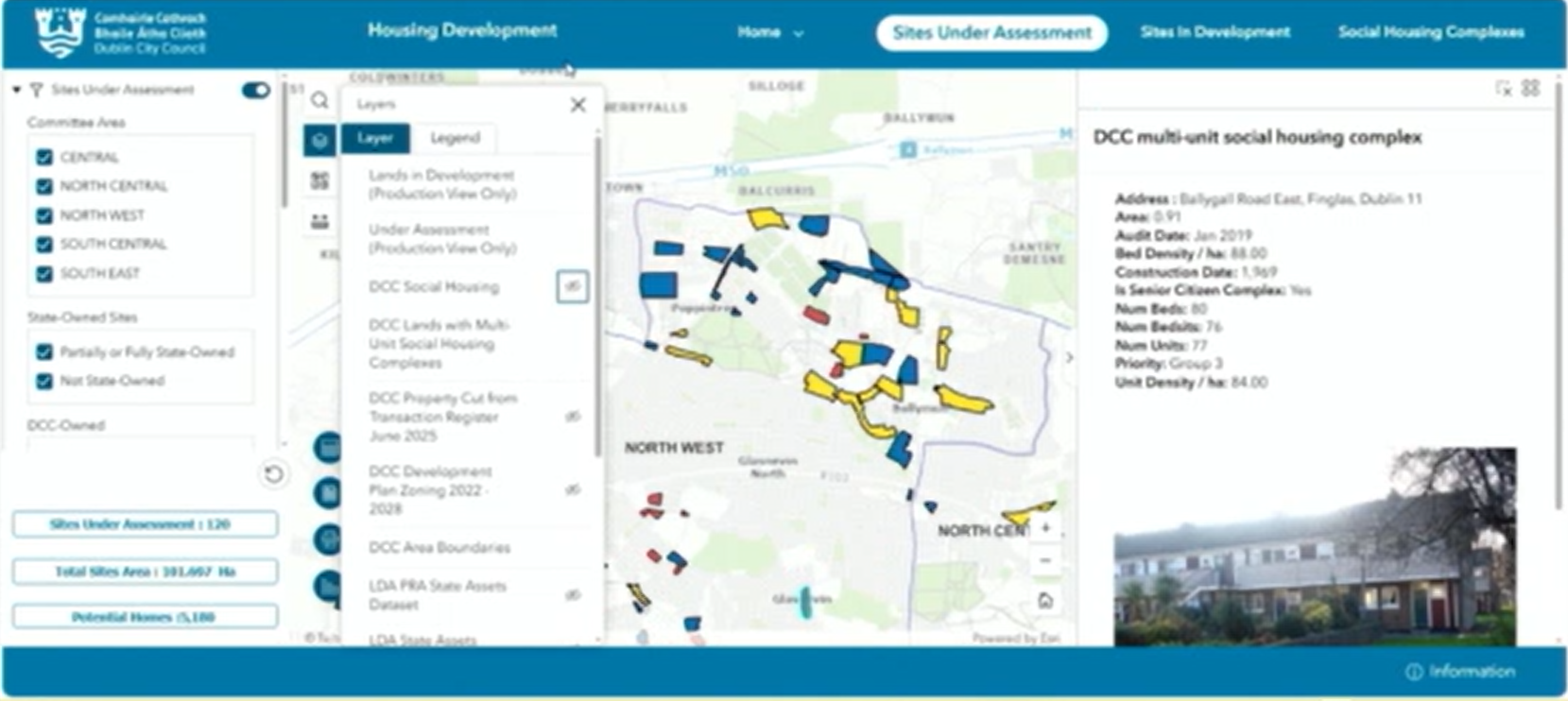
Council staff have looked at all sites in the council area, she said: council-owned, state-owned, and private. “Basically, we’ve just looked at every area around the city,” Craven said.
At the moment, the 120 sites – covering 101 hectares – that are under assessment have the potential for more than 5,000 homes, she said.
Council staff looked at those 120 sites at a high level, she said. “We did a kind of high-level assessment, looking at the requirement of the site, the typography of the site, the viability of the site for development.”
Of those, 17 sites have been assessed as not suitable for development, she said. They may be small, at a junction, overlap with planned transport infrastructure, or be green spaces for example.
All the remaining sites have all been given a score, she said.
The council has judged 27 “high-priority”, and plans to do detailed feasibility assessments on them first, she said. “When these are complete, we’ll move onto the medium priority.”
“There’s a lot of, kind of, assumptions made about sites that we want to kind of challenge and address,” she said, “and make sure all the facts and the barriers to development on a site are fully assessed.”
So far, they have started on feasibility studies for 13 sites, she said, with potential for 2,300 homes. “That we can add to the housing supply programme.”
“Those figures look really good,” said Cieran Perry, an independent councillor, at the meeting.
Particularly, that only 17 of the 120 sites assessed look not to be viable for development at this stage, he said.
On Tuesday afternoon, L’Estrange, of Ballyfermot Traveller Action Project, said he remembers when the council’s then-head of Traveller accommodation, Patrick Teehan, gave a presentation in July 2021 on the council’s search for new lands for Traveller homes.
It was months after the February all-hands meeting, to spur action on Traveller housing.
But the presentation that came before the Local Traveller Accommodation Consultative Committee was basically a list of sites that the council had looked at and deemed inappropriate, he said.
The reasons varied: because they were sports fields, or near the M50, or by noisy railway lines, the presentation said.
Most of the sites that the council is looking at are ones it owns, said Craven, at the housing committee meeting Tuesday.
But it also expects to make up to 10 applications to the Housing Agency for funding to buy sites, under the Land Acquisition Fund, she said.
The council has approval from the Housing Agency to buy one site already, Craven said.
That’s a piece of land at Rivermount Cottages at Ballyboggan Road, which is next to a council plot. “So that’s good news, and some progress there.”
Perry, the independent councillor, said he really welcomed private lands being bought for development.
“To what extent can we continue to use that fund?” said Pat Dunne, another independent councillor, of the Land Acquisition Fund.
Does it cost the council? Dunne asked.
It doesn’t, Craven said.
The Housing Agency is keen to work with the council on it, she said, and the process is efficient and the costs are all covered for the council.
Craven said the council’s mapping exercise has also shown where it may be better to sell sites that are difficult to develop.
Money from any sales of such sites would pay for aspects of housing development that aren’t covered by council funding, she said.
Perry said that he wasn’t necessarily against selling sites, but was cautious about it – given what had happened with some in the past, he said.
During past council terms, the sale of council lands – in particular leveraging their value by setting aside bits for market-rate homes to help fund amenities or the public homes – has been a point of considerable friction.
After the 2019 local elections, the coalition of parties that got together to run the council produced a paper they called the “Dublin Agreement”, a kind of council version of a programme for government.
In that document, councillors said they would “reject any selling off of publicly owned land to private developers within the city boundaries” unless there was a clear benefit to the council that outweighed what would be foregone.
At the committee meeting on Tuesday, Craven said the council does plan to publish its map of sites in development – the land where homes are planned or being built already – once all that data is accurate.
But it probably won’t publish which sites are being assessed for development, she said.
Council officials plan to draw up a high-level report in April that goes into greater detail on the scorings for priority, and the first feasibility studies, she said.
Craven said the council welcomes input from the public and the committee on sites that should be assessed.

In a council survey, only 62 percent of centre members said they’d travel to its new location.

Schools don’t advertise vacancies on platforms the Department of Employment requires for its work permit process for those from outside the EEA.

The area is in need of a lot of maintenance, says Michael Ingle of the Grand Canal Residents Association.

There’s DJ nights, comedy open-mic nights, musical performances. And plans for board games and movie nights.