

“It’s giving colonialism”: Ireland still owes rent to dukes and earls
Although, even though the OPW lists these rents as payable, some of the named beneficiaries say they haven't been getting them.
"There are no current plans or active discussions taking place for automation ... of Luas, heavy rail, DART or buses in Dublin," according to a Department of Transport spokesperson. But these kinds of changes are creeping across the world.

In a conference room on the eleventh floor of Liberty Hall on Monday morning, a couple dozen drivers of buses, trains and trams, and SIPTU union officials, gathered for a seminar about the automation of public transport.
"In the past five or six years there's been an explosion of autonomous vehicles all over the world," said Stephen Millane, SIPTU Dublin Bus representative, giving a presentation from the front of the room.
He went through examples of robotaxis in San Francisco and autonomous buses across cities in China. He showed a video entitled "China’s Next‑Gen Buses That HUMILIATE Western Transport Tech".
And then he moved closer and closer to Dublin, highlighting similar developments in Hamburg (shuttle buses), Oslo (shuttle buses), London (taxis), and Belfast (shuttle buses).
"It's very, very close to here and it's only a short step before it could be introduced in the Republic of Ireland," Millane said. Perhaps first in MetroLink.
Millane explained that "automated" can mean a lot of different things – there are scales. The one for things that run on rails goes from zero to four. The plan is for MetroLink to be "fully automated", level four.
In a 2020 report from Transport Infrastructure Ireland (TII), a section on the benefits of automation says, "Computers are better at driving trains than humans".
And it includes a table showing how automation can be used to reduce the number of people required to run the system, and thus the staff costs.
Staff account for about 48 percent of the costs of running public transport, said Greg Ennis, SIPTU's deputy general secretary.
It's only a matter of time before other parts of Dublin's transport system get automated, Millane and other speakers at the event said.
"It's not something that's going to happen 10, 20, 30 years from now – it's a real thing that's going to affect good, well-paid jobs imminently," said SIPTU transport sector organiser John Murphy.
"What do we do about this as a trade union?" asked Ennis, SIPTU deputy general secretary. "We're not going to be able to stop it, but we need retraining with teeth."
As well as regulation of autonomous vehicles that protect workers, passengers and the public, he said.
Eleven floors down, five would-be bus passengers are waiting at stops on the footpath.
The last bus on the 27 route hasn't showed up on schedule and some are frustrated, and have settled in for a long wait for the next one.
One guy is looking from a text on his phone confirming a doctor's appointment time, to the digital sign at the bus stop with timings for the next buses.
Ghost buses have been reported on the 27, 27A and 27B routes hundreds of times via noshowbus.ie, since we set up the tracker in late 2024.
It's not just these routes either. Routes across Dublin are plagued by cancelled buses and no-show buses, and the National Transport Authority has said that staff shortages are often one of the causes.
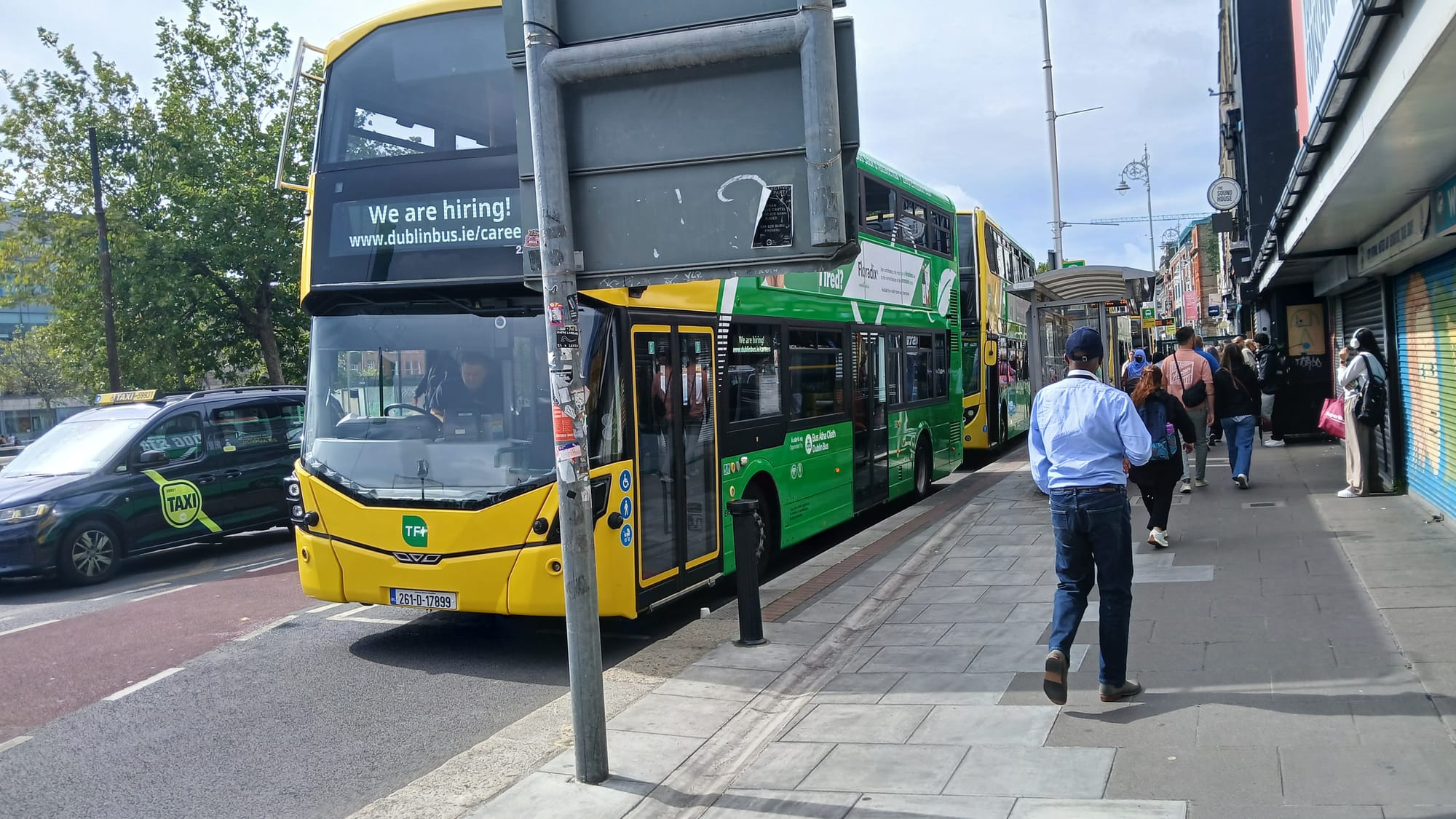
When a bus is cancelled and doesn't run – because a driver called in sick, or whatever – but the company operating that bus doesn’t take it off the real-time passenger information system (RTPI), which feeds data to the digital displays at bus stops, and the apps, so the bus appears to be on its way but never shows, then that is a ghost bus.
Apps like TFI Live “cannot display a service as cancelled if it has not received the appropriate cancellation message from the operator and as a result it reverts to showing the timetabled time that the bus is due to arrive at a stop”, Eamon Ryan said, when he was Minister for Transport.
Of course, a bus service that does not involve drivers could not be sent off kilter by a driver not showing up, or a driver showing up late.
At the seminar in Liberty Hall, when Millane asked participants what the benefits to automation of public transport might be from a user's perspective, reliability was one of the first mentioned.
But taking the drivers out of buses, trains and trams in the city would have negative effects too, says Sinéad Cuthbert, who was waiting for her bus on Eden Quay that same day. Her first thought is safety, she said.
"With no driver, no human on the bus, my worry would be for women, for children, for vulnerable users," Cuthbert said. "The driver is a very valuable person."
They can be a friendly face for older people who might not see many others in a day, she said. They can help if someone needs it. They can respond to unexpected situations better than automated systems.
And, of course, they are people, who need jobs, and – often – have others who depend on them having jobs, several attendees at the SIPTU seminar said.
"The potential benefits from our perspective would be a very very short list," said Ennis, the deputy general secretary. "AI is moving into transport at a very rapid rate and it's coming for our jobs."
The state regulates and controls transport in a variety of ways.
For example, when it comes to the prospect of fully automated robotaxis plying the streets of Dublin without human drivers, the state will decide whether to allow them.
And it even decides whether to allow lower levels of automation in vehicles, such as Tesla's "full self driving" driver-assistance software – which sits at level 2 automation.
The National Standards Authority of Ireland (NSAI) is "engaged in technical and administrative activities in relation to an application involving advanced driver assistance systems, including functionality described as 'full self-driving (supervised)'", Minister for Enterprise Peter Burke, a Fine Gael TD, said in June.
For buses and the Luas, the National Transport Authority (NTA) awards contracts to operators – Dublin Bus, Go Ahead Ireland, and KeolisAmey – to run those services, which specify how they should run them.
Through similar arrangements, the state controls the way Bus Éireann, the Dart and rail services operate.
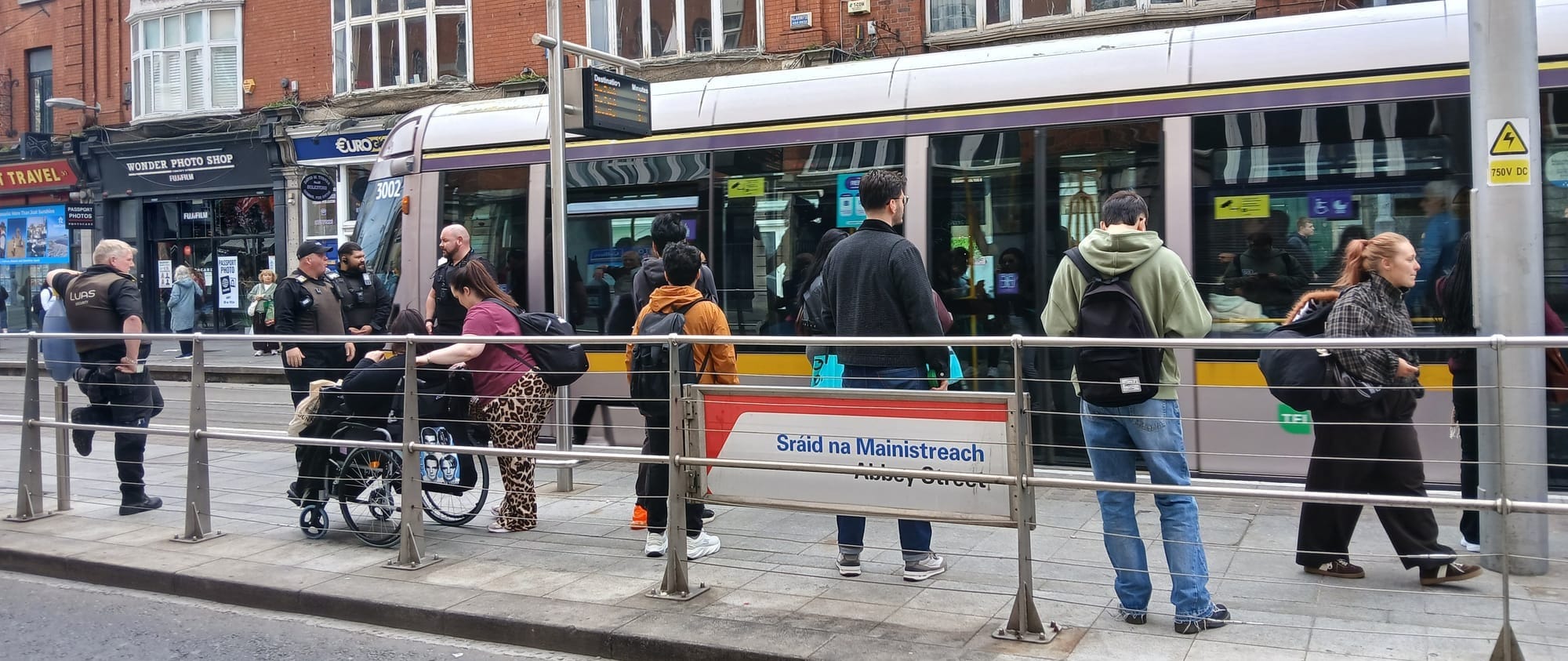
It is unclear exactly what the government's strategy will be, in terms of allowing automation of any of these types of transport. What level of automation will it allow, how soon, with what human oversight?
In 2020, the Department of Transport ran a public consultation on "connected and autonomous mobility in road transport".
It was "seeking to develop a new cross-Government national strategy which will set out the steps to be taken over the coming years to facilitate the development and deployment of connected and autonomous mobility in Ireland," it said.
"This public consultation, led by the Department, marks the first key stage in this process, with a view to the strategy being issued by Autumn of next year," the 2020 document said.
That National Strategy for Connected and Automated Vehicles is "well advanced and it is expected to be published later this year", a Department of Transport spokesperson said on Tuesday.
It'll have a particular focus on connected and automated vehicles/mobility on roads, the spokesperson said. And on "laying the groundwork for the safe testing, piloting and trialling of connected and automated vehicle technologies".
"After publication, further work is likely to be necessary on preparation for higher levels of automation beyond Level 2 and discussions with stakeholders are envisaged before the trialling or deployment of any such automated vehicles or systems," the spokesperson said.
For the moment, "there are no current plans or active discussions taking place for automation (i.e. driverless operation) of Luas, heavy rail, DART or buses in Dublin". And "there have been no approaches to the Department to launch" robotaxi "services in Ireland".
A spokesperson for the National Transport Authority said there are no plans to automate "rail-based public transport in the foreseeable future". "Luas lines are considered open systems and therefore technology is not mature enough to fully automate their operation," she said.
"ETCS [European Train Control System] Level 1 is being implemented nationally with the TPS [Train Protection System] National Rollout programme on Irish Rail network, but it cannot be considered full automation as it does not replace the train driver but supports them in avoiding over speeding and signals passed at danger," she said.
Whenever it arrives, though, the introduction of automation into public transport shouldn't be done without the consent of the unions, said Adrian Kane, another SIPTU deputy general secretary, at the seminar on Monday.
And any newly automated systems should still be overseen by humans, Kane said.
Maybe something like what's happened with aviation, said Millane, who was leading the seminar – where planes are highly automated, but pilots are still there overseeing their operations.
For the people who oversee these systems, the working conditions can be an improvement, said Philip Freeman, the European Transport Workers' Federation's policy officer for urban transport and mobility, who was at the seminar.
In a pilot project in Finland, people still supervise the operations of the automated buses, by remote, Freeman said.
Rather than going out on the roads in the cold and driving the buses, they stay in an office, where there's a toilet nearby, and "they're not going to be punched or spit at", he said.
But the number who'd be needed to oversee automated systems would be smaller than the number needed now, speakers agreed.
So the union should push for retraining for people who lose their jobs, and also push to elongate the transition period during which humans are phased out of these jobs, said Ennis.
"A bus or a train driver can't just become an AI engineer tomorrow," he said.
In pushing for these goals, the union should carefully consider its communications strategy, said Ethel Buckley, another SIPTU deputy general secretary.
It should not assume it has the public's support in resisting automation, Buckley said. "We don't want to appear to be just protecting our jobs, or to be luddites," she said.

Although, even though the OPW lists these rents as payable, some of the named beneficiaries say they haven't been getting them.

They're set to back the creation of a special purpose vehicle he's been picked to head, which is meant to play a major role in regenerating the city centre – but how major is in dispute.

Social tenants who live in the private Liberties complex Grand Canal Harbour say they're not allowed to use many of the common facilities there.

Gone is the hardman shtick, the macho bravado once associated with hip hop, rapper and producer Michael Ward, who goes by Mickzart. “We’re after something true.”