

Things To Do: Praise public infrastructure, dwell on digital photography, talk shop
Our latest recommendations, and community noticeboard listings.
But the asking rent for the empty market space at the bottom of The Eight Building in the Liberties is €66,000 a year.

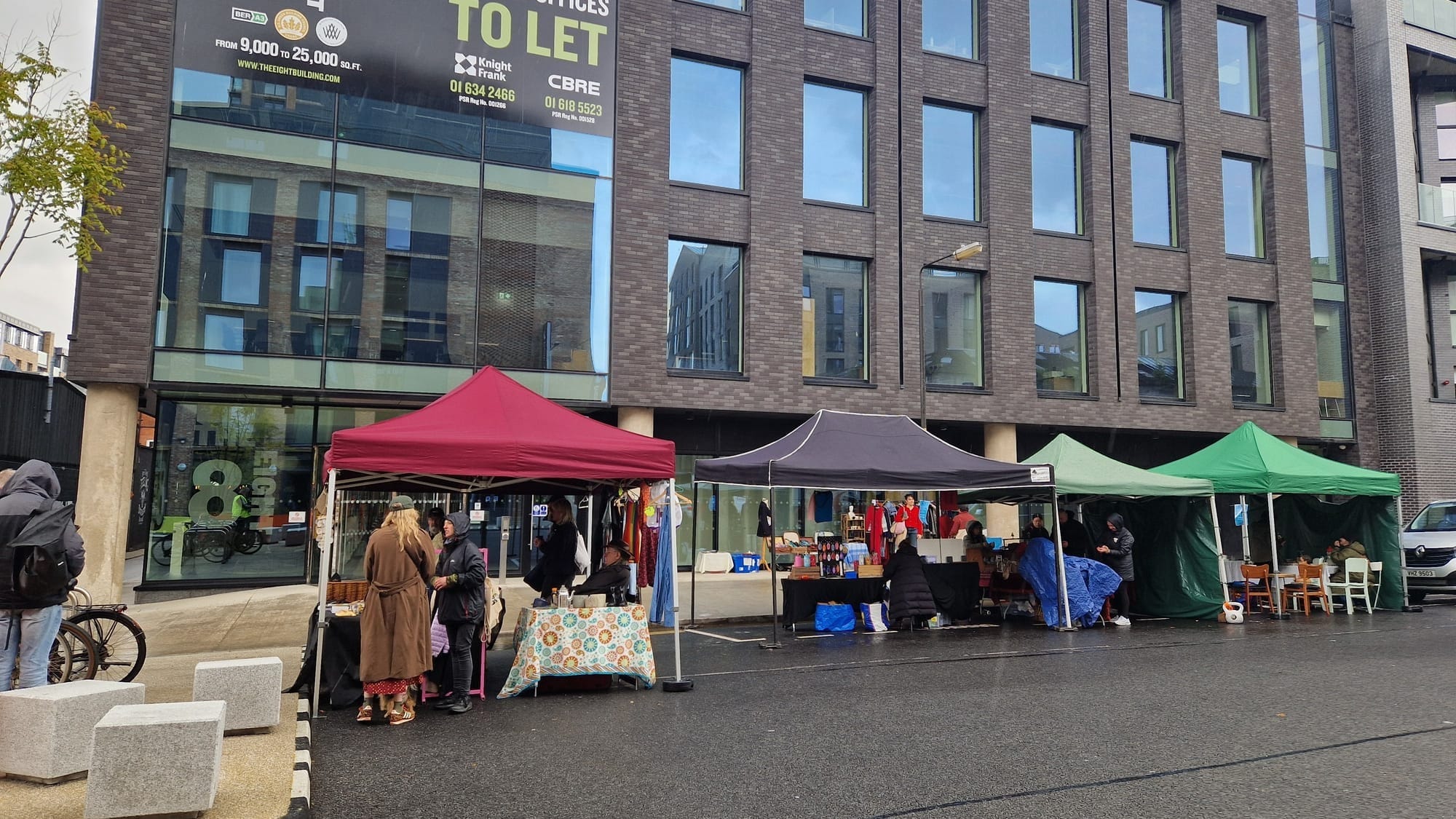
Ian Dowling is into his second summer running the revived Newmarket Flea in the Liberties, he says.
He is stretching out the market season.
It ran through June, July and August last year, he said, and this year, it’s from May at least through September. “And we’re probably going to do October as well.”
They are amping up vendors, too. They had 34 stalls this month and hope to have 40 in June, he said.
So, the market now stretches further west along Newmarket Square, to outside The Eight Building – where the ground floor has planning permission as an indoor market space but remains empty.
The irony is, essentially, that stallholders are left staring into darkened windows, said Dowling.
And what Dowling – an antiques trader and markets-lover, who also runs the business Rare Irish Stuff – would really want, he says, is to be able to rent that indoor space so that the monthly market can run year round.
But his overtures to the leasing agent for Patrizia, the German fund that owns it, were at first ignored and later – when he put forward an opener offer for what he could pay – rebuffed, he said.
It’s frustrating, he says, because this could be the best market in Dublin if they had that space. “It would put that building on the map. It would make it a cultural HQ of Dublin.”
Other businesses around the square have chipped in to help with the outdoor market roll-out, funding gazebos. Teeling Distillery also lets visitors use the toilets, he said.
The markets are good for everybody, he says – most importantly for the community, which funds and investors have themselves marketed aggressively in their own promotional materials for real-estate projects in the neighbourhood.
“You can feel it here on market day,” he said.
Yes, sellers make a few quid and people go home with a little treasure, he says. “But the value is really the sense of community that it brings about.”
The history of markets in Newmarket makes the empty space at the bottom of The Eight Building particularly resonant.
But the dynamic of stagnant vacancy on the ground-floor of tall buildings isn’t new. Across the city, there are empty creches, community spaces, and even a mill museum.
The Department of Housing hasn’t responded to queries about whether it is looking at changes to planning laws to force landlords to drop rents, so that community and commercial spaces are rented out.
But it needs a kind of approach that recognises that certain spaces within towns and cities serve deep social, cultural and community functions, and aren’t just financial assets, said Dowling.
Perhaps, along the lines of new measures in the United Kingdom, whereby local authorities can auction off leases in vacant commercial properties left vacant for more than one year.
Dowling says he still hopes there is room for a partnership with Patrizia, he says.
“It also feels damaging from a placemaking and streetscape perspective to see a regenerated square with its intended community use sitting boarded up and inaccessible,” he said.
Dowling said he is the kind of person who just gets along, paddling his own canoe.
But he cares deeply about markets and the market heritage of Newmarket, he says.
So, he took note in October 2024, when Patrizia put in an unsuccessful planning application to change the use of the indoor market space at the bottom of the office building, and put in “convenience retail”.
Dowling put in a submission to the proposal, opposing the switch.
He asked Patrizia’s letting agent about the terms to rent out the space, he said, and later got in touch directly with Patrizia’s head of investment management in Ireland, David Egan, too.
The proposed rent was €10 per square foot, which worked out at around €66,000 per annum for the space, said Dowling – which was benchmarked off leisure, storage and warehouse rents in the city.
But those aren’t the same as a community market, he said. “It’s like apples and oranges.”
On top of that, there were requirements around audited accounts, deposits, fit-out expectations, he said.
Dowling says he thinks he could find a way to meet many of the conditions. But he can’t offer as much as the €66,000 annual rent, he said. No community market could, he said.
So the price tag undermines the use, he said.
“The market hall was intended to form part of the social and community element of the development, rather than simply another conventional profit-driven retail unit”, he said.
“You’re putting it on par with a seven day a week commercial operation that has nothing to do with markets,” he said.
Dowling offered much less, he says. Because they wouldn’t be using the space most of the time, including weekdays, so as not to disrupt office workers above – which he got the impression was a big consideration.
Egan, head of investment management in Ireland for Patrizia, said by email that they were approached by a Dublin-based market operator last year.
“But that operator was only offering to pay a nominal rent for his business to occupy the premises,” he said.
Patrizia would still be delighted to see the space occupied and operated by a suitable operator, he said, and continues to seek a tenant.
“However, I’m sure you can appreciate that such an operator must meet certain standards, which is the norm for any commercial real estate lease,” he said.
Stephen Coyne, the council’s economic development officer in the South West Inner City, said that he thinks that neither Patrizia nor Dowling are being unreasonable.
The old flea and food markets at Newmarket were possible because of the peppercorn rents, which were possible because of the scrappy old buildings and future redevelopment, said Coyne.
Now, it’s a purpose-built market space, and occupying and fitting that out is just more than a community market can cover, he said.
Patrizia has an expectation for the rent and Dowling has a proposal at a certain price point, he said. “They just don’t match.”
Dowling said that reasonable rent for a community market should have been priced in, when Patrizia bought the building.
“Patrizia bought that building knowing that the market hall, that the planning for the market hall had to be delivered upon and the council and the community expected that,” he said.
Dowling has been reading up on promises made back in September 2017, he said earlier this week.
Looking back on how Martin Creedon, then a big landowner through the Newmarket Partnership, had promised there would be more market space than before, after the square’s redevelopment.
And how the indoor market space would be versatile, with doors that open out onto the square, merging with any market there.
It would be flexible enough to host a rotating cast of markets – a fish market, vintage clothes, jewellery maybe, Creedon had said.
Dowling spent some time drawing up a pitch for Patriza, which he submitted, he says.
An architect diagrammed out how he could use the space, with 45 stalls. He costed a fit-out, with a toilet.
He put together a pitch for how the indoor market would create a year-round cultural destination, to add to the seasonal outdoor stalls.
It would bring all kinds of extra benefits, he wrote in the document – helping small independent traders, bringing footfall and spending to other local businesses around the square, and strengthening community cohesion.
It would also bring community goodwill and buzz for Patrizia, he wrote.
After all, a post on Patrizia’s website talks about “slotting in Dublin’s coolest neighbourhood” with the Eight Building, said Dowling, on Wednesday.
“Nestled in an area teeming with food, drink, nightlife and culture, its digital and sustainable capabilities state the case for ticking the community spirit, resilience and sustainability ‘coolness reference points’,” the post reads.
Said Dowling: “They’re leveraging that to attract tenants into their office space.”
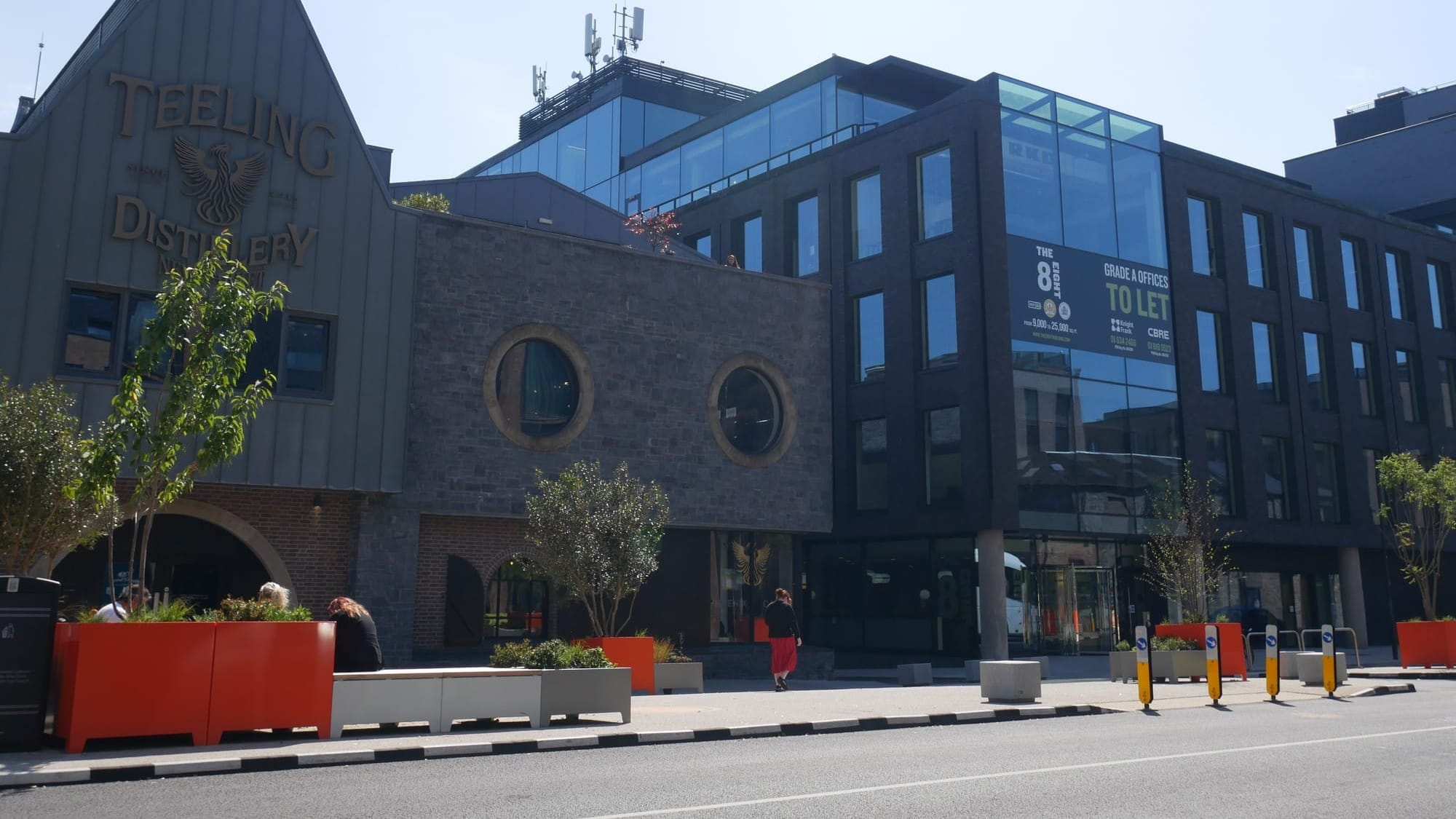
Patrizia is a publicly listed German property investment company with around €56 billion in assets under management.
Patrizia’s company reports also talk about its commitment to sustainable cities and communities, and support for the United Nation’s sustainable development goals.
Patrizia “aims to fulfill the human need for community when investing or developing assets”, one report says.
Egan, Patrizia’s head of investment management, says that the development already adds to the neighbourhood.
“The Eight Building, including the market unit, is contributing to the recent regeneration and increased activity in Newmarket Square,” he said.
The building is now 65 percent occupied, providing local jobs, and bringing hundreds of office workers to the area who support local businesses, he said. “We look forward to seeing the market unit in operation once a suitable operator is secured.”
“What can be done when things are part of planning permission and are granted on the basis of planning permission and then they are being priced out of it?” asked Social Democrats TD Jen Cummins in the Dáil in March, during a topical issues debate.
Her Dublin constituents have been raising the loss of an indoor market at Newmarket with her for two years, she said, “and people are really angry”.
Fianna Fáil TD Robert Troy, minister of state for finance, commented on the rent: “That is excessive by any stretch of the imagination for someone to conduct a market.”
“It is clear to me that what the developer is trying to do is to be able to go back to Dublin City Council and say there is no demand for a community market, but if you price something so high you will not get a demand,” said Troy.
She should tell Dublin City Council, he said.
Cummins, on the phone on Thursday, said that she has followed up to ask with the minister about the way forward in these situations.
She would like to see Dublin City Council take a stronger approach towards its planning enforcement, she says.
But she isn’t really sure if there is a current mechanism in planning to force the stand-off at Newmarket towards a resolution, she said.
Across Dublin 8, developers have put up big new buildings, and the ground floors are left vacant for ages, she said.
Leaving them long-term vacant shouldn’t be possible, she said. “There needs to be a tax or levy on the vacancy that actually has teeth. That actually makes a difference.”
Cummins’ clinics are filled with two groups, she says.
People in dire housing situations and people asking about community spaces, while all units lie vacant, she said. “It makes no sense.”
One lever the council has is to set as a planning condition the phasing by which a space has to be occupied – so apartments can’t be filled until a ground-floor space is leased out and in use, for example. But its past enforcement of such provisions has been poor.
Another lever is setting the commercial rates that owners pay to the council on vacant properties. The council used to give a discount when a commercial space was empty – but it hasn’t done that since the 2023 budget.
Renting the ground floor for less than it would get if it were a Spar or a gym may lead to the building being worth less on paper, if it is valued with those rent-rolls in mind.
But the market use was already there from the start of the project, clearly, in planning, says Dowling.
Dowling says that a recent approach – still in its early days in the UK – of granting powers to councils to auction long-vacant private spaces on high streets to local businesses and community groups could be interesting to mirror.
Make CIC, a social enterprise, has found that the existence of these powers has brought more landlords of vacant spaces to the table, according to a post by its regeneration innovation co-ordinator, Louise Cross.
They have also found that there can be a lack of demand for some spaces from tenants, and that providing fit-out grants – rather than shopfront improvement grants – can also help to get them back in use, she wrote.
But giving councils in Ireland the power to auction long-vacant spaces would take longer-term and bigger changes to the law.
Dowling said he is still hopeful Patrizia might reopen the conversation, and understand the market as a prize.
He is only looking for what was promised to the community, he said. “That’s all that we’re looking for. They’ve done extremely well out of the Liberties.”

The owner of Grand Canal Harbour shouldn't have installed the barriers, the council had said. But it decided they could have them for three years.

With their eyes on three sites, Fingal County Councillors agreed to write to the Minister for Housing to ask him to change the rules.

"We comply with the statutory requirements in maintaining a register, and there is no requirement to have it up online," City Planner Emer Uí Fhátharta said at a meeting last week.

"I think it's a slap in the face of inclusivity, of diversity of this city, if we can move to develop nearly 5,000 units and we can not even develop one new site of Traveller accommodation," said one councillor.