

Maybe people shouldn't be able to collect social welfare at GPO, Arnotts lobbies
The company behind the Henry Street department store raised the idea with the man in charge of the regeneration of the city centre, returns show.
It all started with a birthday gift from her son of two grape vines.

When Mary Llewellyn opened a box posted by her son on her sixtieth birthday and saw two grape vines, she was a bit stunned.
One was a red grape, a zinfandel, and the other was a white, a vitis vinifera muscat.
Llewellyn lives in a house just metres from the buzzing traffic of Collins Avenue.
“I thought, what in the name of God does he think I'm going to do with this?” she says. “Like, I grow roses, what does he think, I'm going to grow wine?”
But, she figured, why not plant them. See what happens.
Little did she know that her terraced house in Donnycarney would soon become her own personal winery.
Nor could she have known that her newfound hobby would lead to a lost relative coming into her life – united by their common passion for wine making.
Her front garden is south-facing, so it gets plenty of sun, she says, looking out on her vineyard on Wednesday, early evening.
First, she erected a wooden pergola for her fledgling vines and waited to see what came.
She learned quickly that growing grapes isn’t straightforward, she says.
Early on, the vines looked a bit barren, she says, so she planted some sweet peas next to them, to bring some colourful flowers in the summer.
“My French friend came for a visit, and she said, ‘You do not plant legumes and grapes, my God, there will be too much nitrogen in the soil. Stop, stop, stop!’” Llewellyn recalls.
She had no grapes to harvest that first September.
The following summer was extremely dry, so she gave her new vineyard a good watering, she says.
Bad news then followed when a Spanish friend came to visit.
She says her friend told her: “You don't think we're hanging out the side of mountains watering grapes, do you? They find their own level; they find their own water. Don't, don't, don't!”
Llewellyn discovered that she had drowned her grapes.
The third year, she did as she had been told by her French and Spanish advisors and left them alone.
“I totally ignored them and they thrived, absolutely thrived,” she says.
Soon, her single pergola was not enough, so she put up a second – and, eventually, a third. She thinks a fourth may be soon needed.
In her cupboards are buckets, demi jars, pipes, bottles and other trinkets she uses in her wine making.
It’s a scientific process, but she says she wings a lot of it.
Wine makers have a gadget that measures the sugar levels of the grapes, so they know when they are perfectly ripe and ready to harvest, she says.
She doesn’t bother with one.
She was told early on by someone that you should harvest your grapes around September, after the first frost of the season, she says.
“But I have found that if you wait till after the first frost, the birds will eat the hole out of them and they’d be gone,” she says.
So, as soon as she sees the birds attacking them, she knows they are sweet enough, she says.
“I'll take them in, put them into the freezer to make sure they’ve got their first frost,” she says.
She isn’t too sure if her method is precisely correct by other wine makers' standards, but it works for her, she says.
Llewellyn says that all her life, hers was the only Llewellyn family in Ireland that they knew of.
“Like I was a midwife in the Rotunda, and I'd be delivering somebody's baby, and they might look up at your name badge, and they'd say, ‘Oh, are you related to Catherine or Theresa?’ [her sisters] because the name was just not usual here at all,” she says.
Then one day, at the weekend market in St Anne’s Park, a friend of hers noticed some fruit-based products labelled as Llewellyn’s.
They asked the seller, David Llewellyn, who makes wine professionally from his own vineyard in Lusk, if he was anything to Mary from Donnycarney, “because she makes this kind of stuff as well”, she says.
The two Llewellyns eventually made contact with each other, out of curiosity.
Mary says she asked him had they anything to do with each other, and David wasn’t sure.
So, they did some digging through the family tree and discovered that the pair share a great-grandfather.
They have since become pals, says David, sharing their love for wine making.
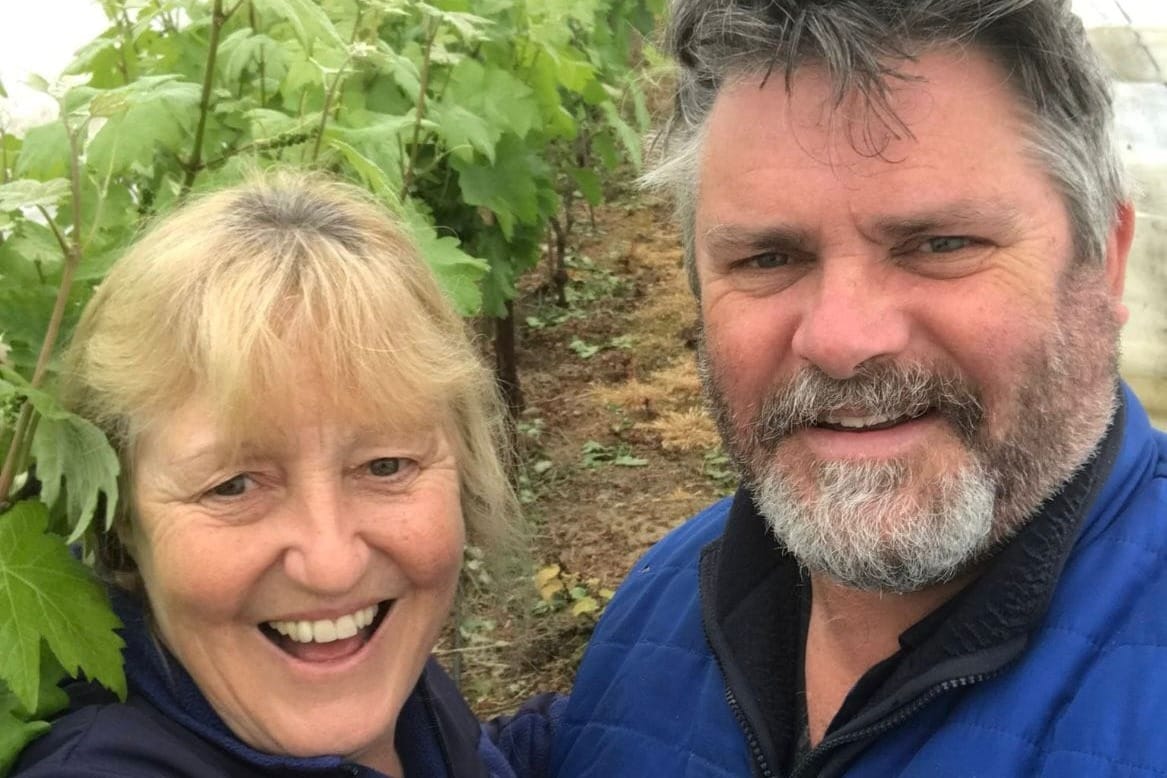
“It was just funny that she had this really keen interest in growing grapes, and found out that she has a relative that's actually doing it professionally, you know, just down the road from her,” he says.
Mary recalls attending a wine event in Trinity College last year with David.
“It was all wine influencers, wine connoisseurs, wine masters, wine cellar people,” she says.
There, she accepted her own wine title, she says. “I am a hobbyist,” she says, laughing.
“People were asking things that I didn't even understand the question, never mind the answer,” she says.
She heard people asking each other how much “dosage” a particular wine has – “do-sage”, pronounced in a posh, French way, she says.
Turns out it refers to how much sugar a wine has in it, she learned in real time among Ireland’s finest wine professionals.
“Then they’d say, ‘Oh, we give it a very small dosage’, and I'm going, ‘What's very small? Is it an ounce? Is it a pound of sugar? I don't know!’” she says.
David continues to give his relative advice, she says, and she’s always keen to learn more.
She remembers opening a bottle of what she thought was her homemade rosé for friends at a party.
Someone commented, “Oh, we have sparkling rosé.”
Llewellyn says she thought, “What? That’s not meant to be sparkling. That’s a problem!”
Turns out she had bottled it before it was fully fermented, so it carried on fermenting in the bottle, she says.
David told her he had once done something similar, and the bottle ended up exploding.
“I had carried that bottle in my suitcase to Jersey, over to my son,” she says, “and I thought, ‘What if that had exploded on the plane!?’”
Unlike David, Mary Llewellyn doesn’t sell her wine – it’s only for friends and family, she says.
Her wine is bottled at home and adorned with labels paying tribute to old Donnycarney, she says.
The labels for both her red and white were designed by her friend Stephen Browne.
Collins Avenue was once known as Puckstown Lane, she says. So, her red label features a goat.
The white label features a drawing of her own front door and vineyard.
“It's a talking point, it's brilliant, and I love it, and I get tremendous pleasure out of all of it,” she says.
Funded by the Local Democracy Reporting Scheme.

“It's extremely disappointing to hear once again that the children have been left short, and it's disappointing given the incredible work that the youth workers in the country do for us.”

But the planning application for the Oscar Traynor Woods development, where it's to be located, envisioned the "minimisation of night-time lighting" to avoid disrupting local wildlife too much.

The tender document for the design says the framework has a maximum estimated value of €7.5 million. It also gives a tentative construction estimate of €25 million.

The current owner recently got planning permission to knock the old pub, and build 10 homes on the site.