Lauren Fernandes noticed menus and flyers all over with the same sterile look, and thought: what if she could help out small businesses which can't afford creative work, usually?
It would use extra heat from the Poolbeg rubbish incinerator to warm water and send it through pipes underground, into buildings in the city, to keep homes and offices cosy without burning additional fossil fuels.
To counter AI, an illustrator in Balbriggan offers to draw posters for barter
Lauren Fernandes noticed menus and flyers all over with the same sterile look, and thought: what if she could help out small businesses which can't afford creative work, usually?
Lauren Fernandes snuck into her backyard, having convinced her dogs, Oscar and Pepper, not to trot along.
After introducing a senior long-haired cat, who thrust her head forward for pets, she made her way to a small cabin.
Fernandes, who’d pulled back her blue hair into ponytails, wore jeans and a crocheted cardigan over a black top.
She’s got a few Simpsons tattoos. She loves The Simpsons, she said.
The cabin, with its shelves adorned with action figures, colourful yarn balls and children’s books that Fernandes has illustrated, serves as both a studio and a place to unwind, she said.
She is a mum to two small girls and works as a carer for autistic people, Fernandes said.
“I’ve always been drawing. As much as I'd love it to be my full-time career, it’s just not,” she said, smiling.
Art remains her side hustle and something she will never stop making, though, Fernandes said.
Recently, Fernandes, who lives in Balbriggan, was strolling past shops and cafés on High Street, she said.
Suddenly, it hit her. Her favourite ice-cream store had used AI to create display posters. “And I noticed my favourite café using it,” she said.
That’s happening all over Dublin. Posters, menus and flyers, all bearing an identical sterile look.
Fernandes thought, wouldn’t it be great “if I could get, like, a free meal for the family if I just drew them that poster?” she said.
She posted the offer on her local Facebook group. It got lots of positive responses, she said.
But so far, no one has reached out for the swap, Fernandes said last Wednesday.
Her idea is just one of the ways that some artists are navigating the dawn of AI. Some artists call for regulation to save their jobs as they knew them.
Others, like some businesses, have opted out and shunned its use as a stand-in for artists and designers. All while the AI cloud looms large.
Back to barter
The reason Fernandes has turned to community bartering is that those small businesses using AI may not have the budget for commissioning art anyway, she said.
Even before the rise of AI, “they would have done like MS Paint or something else like Canva or something”, Fernandes said.
“I was like, what can I actually do to kind of like help these people because I think it’s bad for their business as well,” she said.
Her offer is not extended to big businesses who can definitely afford human-made art, though, she said.
“I've seen a lot of like big, big, multi-million businesses using it, and that is completely unacceptable,” said Fernandes.
Even Fingal County Council has used it. Earlier this year, an AI-made photo appeared in its social media ads for a new summer market.
She’d draw for “the lady down the road who just opened her nail salon or, you know, the man who's just started his carpet cleaning business,” Fernandes said.
Like some other illustrators, Fernandes is worried about the devaluation of artistic skill by AI.
“If I was a child and I was growing up and my dream was to illustrate, my dream was to create, and I'm seeing this, what message does that send? It's a dream crusher,” she said.
She is also concerned that a day may come when she is accused of using AI.
“When I'm so against it, but that's probably going to happen because it's going to keep getting smarter,” she said.
She points to instances of people being accused of using AI to write already – how it is weaponised and used to divide.
She also nurses concerns about the environmental toll of AI use – how much water it swallows, said Fernandes. “I don’t really see the point of making AI images at the cost of, like, water.”
Opting out
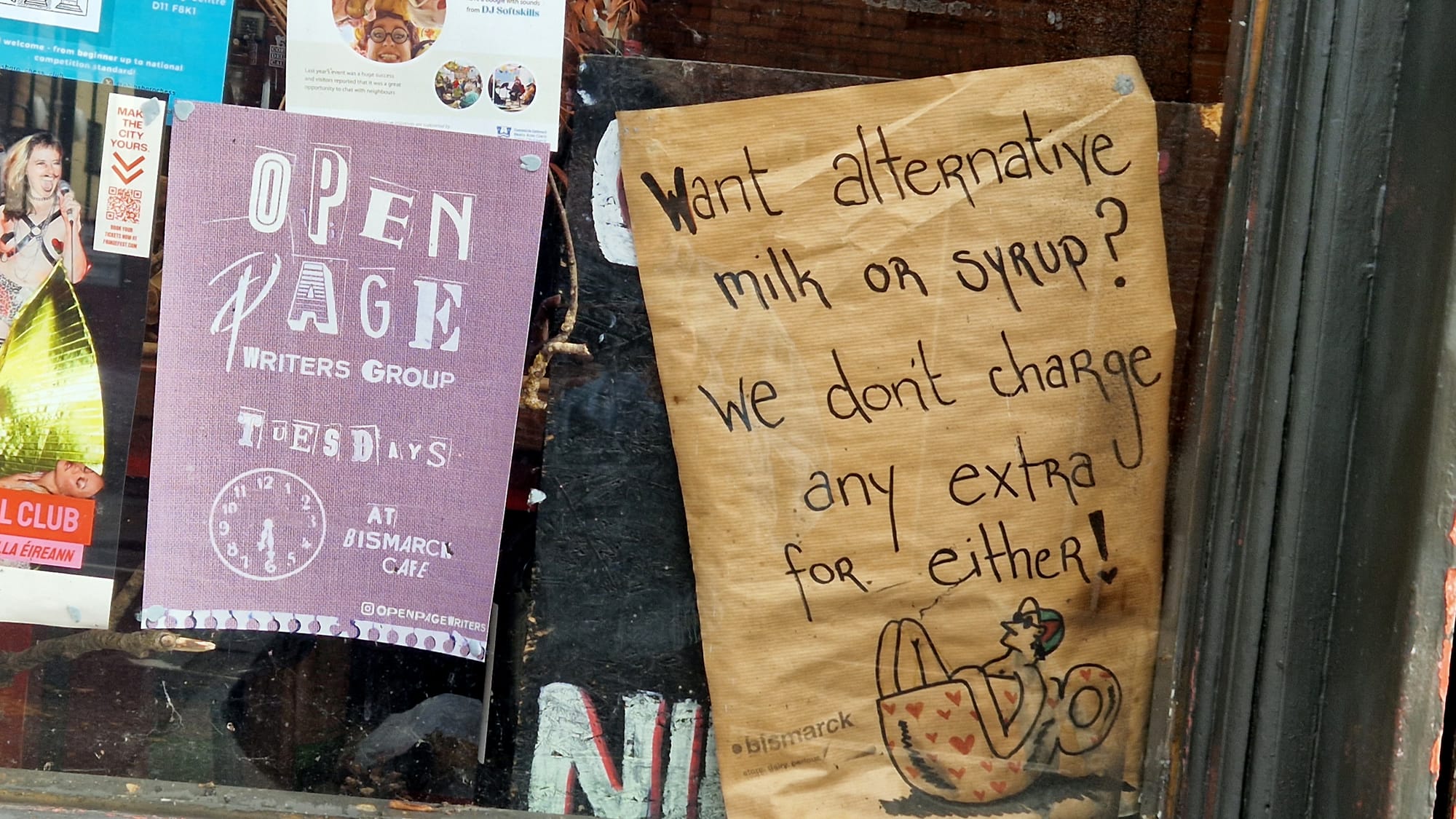
Some businesses have not opted for AI posters, showcasing old-school ones on their windows.
On Aughrim Street last week, a man wearing sunglasses, bathing in an oversized cup dotted with small hearts, is drawn on a piece of brown paper and stuck by the window of Bismarck café.
“Want alternative milk or syrup? We don’t charge anything extra either!” says a handwritten note above the drawing. The dot for the exclamation mark is a heart.
Others have sworn off using AI posters, sharing Fernandes’s concerns about its impact on our planet.
Thomas House, the bar and music venue on Thomas Street, recently made a public announcement aimed at bands who want to gig there.
“So for the future (literally) we’re not accepting AI posters or flyers for the pub,” it said.
Relying on “some earth killing app” is not the way, the notice said.
Gareth Cummins, co-owner and manager of Thomas House, said that until about a year ago they rarely got any AI-generated posters.
And when they slowly started dripping in, they still flew under the radar, Cummins said.
“We couldn’t tell the difference,” he said, by phone on Tuesday morning. They reckoned it was a weird style, said Cummins.
“They were just these stupid pictures of people with guitars and the people would have six or seven fingers, and the guitars would have four strings,” he said.
Then, they learned about the planetary cost of AI and data centres, he said.
“Yes it has been used here before but consider this the start of the end of it,” said The Thomas House’s public missive.
It also became embarrassing to feature them given the proximity of the Thomas House to the National College of Art and Design (NCAD), he said.
“We got a bunch of artists who were friends, who’d drink in the bar,” Cummins said.
If bands need help putting together a poster for their gig, they’re happy to help, he said.
Just a collage of photos downloaded from the internet sharpened with Photoshop is good enough, Cummins said.
Some small bands like Puddin’, a “bimbo synth punk band” from Dublin city, and others have been using hand-drawn posters to advertise their gigs.
Even though he has stopped using AI-generated posters, Cummins, the manager of The Thomas House, sees them everywhere and gets annoyed, he said.
“I live in rural Wicklow and every bar and restaurant and café down here has AI posters in the windows,” he said.
And he’s not under any illusions. He doesn't think AI will just peter out. It’s great if it helps with things like medical research and the like, Cummins said.
But wasting energy just to have it spit out a poster is not right, he said.
“I just hope it doesn’t become a crutch that humanity leans on. I hope it’s used as a tool and not the be-all, end-all,” said Cummins.
Fernandes, the illustrator in Balbriggan, said she thinks most people are growing tired of seeing AI posters everywhere. It’s not just artists like her, she said.
She hopes that getting the word out would nudge some business owners to take part in her community bartering plan, Fernandes said.
To partake, you can contact Fernandes at Laurenmoorebird@hotmail.com or on Instagram @laurenfernandesart.
"He's a local lad here from Carpenterstown, he's a local schoolteacher," said Fine Gael Councillor Ted Leddy, who proposed the motion. "A mural or something like that would be very appropriate."
It would be a bypass to the Station Road, and consist of a road, cycleway and footpath, according to a petition that was launched by the campaign on 27 July.
Peaking plants such as these are needed to replace dirtier coal, gas and peat – and balance out the fluctuating supply from renewables on the grid, says Ireland's climate action plan.