But a spokesperson for the charity said the position articulated by its deputy chief operations officer at a council meeting recently is not its current policy.
Dublin City Council should review its decision to stop spraying weeds in gutters and pavement cracks with the controversial weedkiller glyphosate, said two councillors last week.
It should bring the results, and alternative options, back to councillors, said Fianna Fáil Councillor Rory Hogan and Fine Gael Councillor David Coffey in a motion at the Mobility and Public Realm Strategic Policy Committee.
Weeds along roads and footpaths don’t look good, he said, and natural weedkillers are so costly. “We used to cover the entire road network with glyphosate.”
He tied the need to revisit the issue to the idea of a visitor levy, which the council has been pushing to be allowed to introduce as a revenue stream.
“I feel that if we want to tax tourists we need to be able to follow that up with proper maintenance on our cityscape,” said Hogan.
At the meeting, Derek Dixon, a council senior engineer, said the council decided to shift away from glyphosate because of evidence that exposure to the chemical causes cancer.
The changeover to the natural weedkiller did result in more weeds, he said. “It most certainly did but that is because we were working within the parameters as set down in the herbicide policy.”
But the policy is also in line with the council’s biodiversity strategy, he said.
That move was made eight years ago, said the written response to Hogan and Coffey’s motion. Now, council workers mostly use glyphosate just for invasive species, it says.
The motion to review that approach was put to a vote by Green Party Councillor Janet Horner, the committee chair. Most councillors rejected it.
There may be mixed evidence as to whether glyphosate causes cancer in people, said Horner later on the phone. But it is certainly toxic and harmful to biodiversity, she said.
“It's all part of the wider thing of how we care for the scant bit of nature we have in the city,” said Horner, “and using really toxic things, on the occasional bits of greenery that pop up here and there, is not a good idea.”
Hogan, the Fianna Fáil councillor, said he still wants the council to review the policy.
Glyphosate has been assessed by the European Food Safety Authority, which said it “did not identify any critical areas of concern in relation to the risk it poses to humans, animals and the environment”.
Says Hogan: “If it is safe enough to eat, it should be okay for footpaths.”
The authority has been criticised for the extent of industry influence on past analysis though, and is currently reviewing more recent research which reinforces the finding that glyphosate is probably carcinogenic to humans.
Science and industry
Debate and lobbying around the safety of glyphosate has been fierce for more than a decade, following the World Health Organisation’s finding in March 2015 – after a review of 1,000 studies – that it is “probably carcinogenic to humans”.
Not long after that, the European Food Safety Authority said it had found there wasn’t sufficient evidence for that.
But the authority later came under scrutiny for how the report it based this on had lifted chunks of its health risk assessment verbatim from the glyphosate industry’s renewal application.
In 2022, the European Chemicals Agency repeated its previous assessment that classifying glyphosate as a carcinogen was “not justified”, but that it could cause serious eye damage and was toxic to aquatic life.
In 2023, the European Food Safety Authority again confirmed glyphosate’s existing classification, and the European Commission renewed its approval for use.
More recently, the Global Glysophate Study by researchers with the Ramazzini Institute in Bologna found that low doses of the weedkiller causes multiple cancers in rats. The evidence supports the WHO’s findings in 2015, the researchers have said.
The European Commission has asked the European Food Safety Authority and the European Chemicals Agency to engage with the researchers and evaluate the data in the study. That is underway.
As well as the debate around glyphosate as a carcinogen, the European Environment Agency has warned about the environmental impact.
“Widespread pesticide use is a major source of pollution — contaminating water, soil and air, driving biodiversity loss, and leading to pest resistance,” says the agency on its website.
The council’s alternative
Since council workers started to use natural weedkillers, such as the vinegar-based solution it currently uses, it cannot treat all roads as it used to, said Dixon, at the council meeting on 11 February.
Now, the council sprays the natural weedkiller on the lesser-used roads in housing estates, he said. It treats the main roads through brushing, he said.
Back when it used glyphosate, the council could treat all the roads and laneways in the city for about €250,000 per year, he said.
Nowadays, the council splashes around €1 million a year for a vinegar-based solution, and cannot treat all the roads, said Dixon.
The council is currently tendering for providers, said Dixon, and he hopes to get costs down. If they do, they will treat more roads, he said.
At the meeting, Hogan said he wasn’t happy with the official response to the motion because it didn’t outline alternative options or examine the financial or environmental trade-offs. “It doesn’t actually engage in a review of the policy.”
Later, by phone, he said that he wants the council to consider limited use of glyphosate as part of the mix, while keeping natural weedkillers too.
Wicklow County Council uses the chemical in a controlled manner, he said, and keeps a record of how much they use. “A balanced approach can be taken. But the longer we leave it, the worse the roads get.”
The current weedkiller isn’t killing the roots of the weeds – so they multiply, he says.
Hogan says he is aware that there are conflicting scientific reports about whether glyphosate can cause cancer.
“I have faith in the Food Safety Authority and I think we should follow their guidance,” he said.
“We need to follow the evidence base,” he said. “It’s not that we had made up our minds that we wanted to bring it back, but we wanted a discussion.”
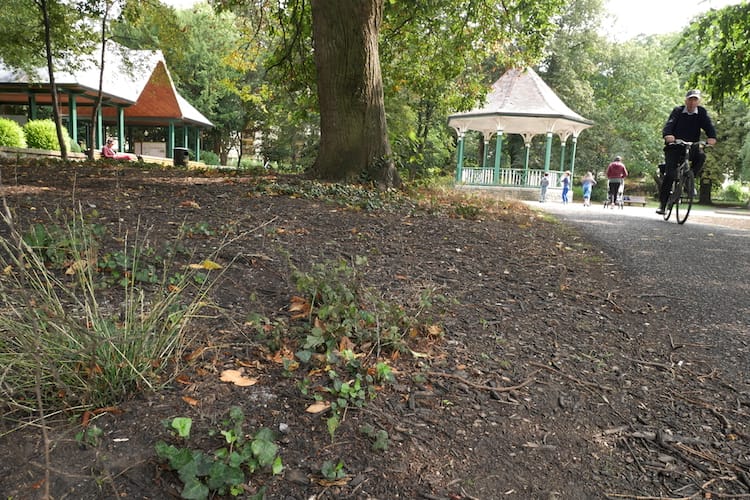
If the council wants to introduce a tourist tax, it needs to scrub up the city, said Hogan, and that means tackling the growing weeds on roads and pathways.
The “tourist tax” is a small fee imposed by councils on visitors, which is often added to the bill for accommodation. Councils have been pushing central government to empower them to introduce it.
Hogan wouldn’t want glyphosate used in parks, he said. “Definitely not. Parks should support biodiversity and wildlife,” he said.
Horner, the Green Party councillor, said she understands that some residents don’t like looking at weeds. “It does irritate people. I do appreciate that.”
While there may be a debate around whether it is carcinogenic, she said there is no question that chemicals used on roads enter the water system and can harm soil, bees, animals and biodiversity.
She doesn’t think the council should consider reintroducing a potentially toxic chemical, which is bad for wildlife and biodiversity, and could even harm pets, she said.
“Glyphosate was a particularly brutal approach,” said Horner. “Now we are taking a softer approach, and that means that weeds grow back quicker.”
Dublin City Council can still use glyphosate where necessary within its own estates and for invasive species, said Horner.
“There is currently no plan to return to the use of ‘glyphosate’ based herbicide for the treatment of weeds,” says the council's response to the motion.
And, due to the cost of alternatives, it is not currently possible to treat the entire road network in the city, it says.
“We will have to tolerate and accept that there will be some weeds on the city’s streets in the coming years, until such time that a comparable alternative to ‘glyphosate’ based herbicide is developed,” says the report.
But a spokesperson for the charity said the position articulated by its deputy chief operations officer at a council meeting recently is not its current policy.
A spokesperson for the board said it redacted accounts that weren’t “evidence-based” and had not tried to “hide or trivialise the scale of any crisis”.