

Tusla says it's an offence to run an unregistered children’s home, but it places children in them anyways
So how does it square the circle?
Their story started in a Walkinstown hall.

Many documentaries about Phil Lynott have been made through the years, said poet and activist Michael O’Flanagan, on Wednesday evening.
But usually, they featured international rock stars who had met him fleetingly, just a couple of times, he said.
They didn’t draw on people who grew up with him. People who went to school with him, or would see him down the local shops.
“That's probably the thing that people really would like to know,” O’Flanagan said.
Seated in front of him, around the event room in Richmond Barracks in Inchicore, were about 50 people.
They listened closely, as O’Flanagan recalled his youth with the Thin Lizzy frontman – and revealed some of the original film footage and photos he had taken of the rock legend in the 1960s.
O’Flanagan is a “heritage activist”, said Francis Thackaberry, chairperson of the Kilmainham & Inchicore Heritage Group, earlier to the crowd.
“He’s involved in heritage issues and trying to preserve the heritage of this area for many years,” said Thackaberry.
Among his projects, said Thackaberry, O’Flanagan has worked on preserving and restoring Kilmainham Mill for public use.
He also credited O’Flanagan with helping to bring the building they were all in at that moment into public use.
It had been a British Army Barracks. Then, a school – St Michael’s CBS. Now, the council-run complex hosts the library and regular events.
Wednesday’s event was yet another preservation project for the Dublin artist. But not of a building this time, but memories of a friend.
The talk was really a commemoration, said O’Flanagan. “A celebration of Philip Lynott, one of the biggest rock stars in history.”
On the big screen, a digital projector flashed up grainy warm 8mm camera footage.
Four skinny, well-dressed young lads appear and strut, pose, mess-fight. They were the Black Eagles, Lynott’s first band.
The line-up boasted Lynott on lead vocals, Danny Smith on bass, Alan Sinclair on lead guitar, and future Thin Lizzy drummer Brian Downey.
Guitarist Frankie Smith had been in the band. But by the time they shot this footage, he had “run off with his girlfriend” and was no longer a member, O’Flanagan said.
O’Flanagan met Lynott when they were in their early teens, he says.
The Black Eagles were playing a gig in Moeran Hall in Walkinstown – as they did on the regular. He was in the crowd, taking photographs on his father’s Rolleiflex camera.
O’Flanagan lights up. His father was adoring and bonkers in equal measure, he says, letting his teenage son gad around town with his expensive camera. “Very few people even had cameras in them days.”
After the Moeran Hall set, Lynott approached O’Flanagan. He asked if he could see the photos.
O’Flanagan was happy to oblige. He called over to Lynott’s granny’s house in Crumlin, where the late-musician grew up, the following week to show him the pictures.
They became close friends.
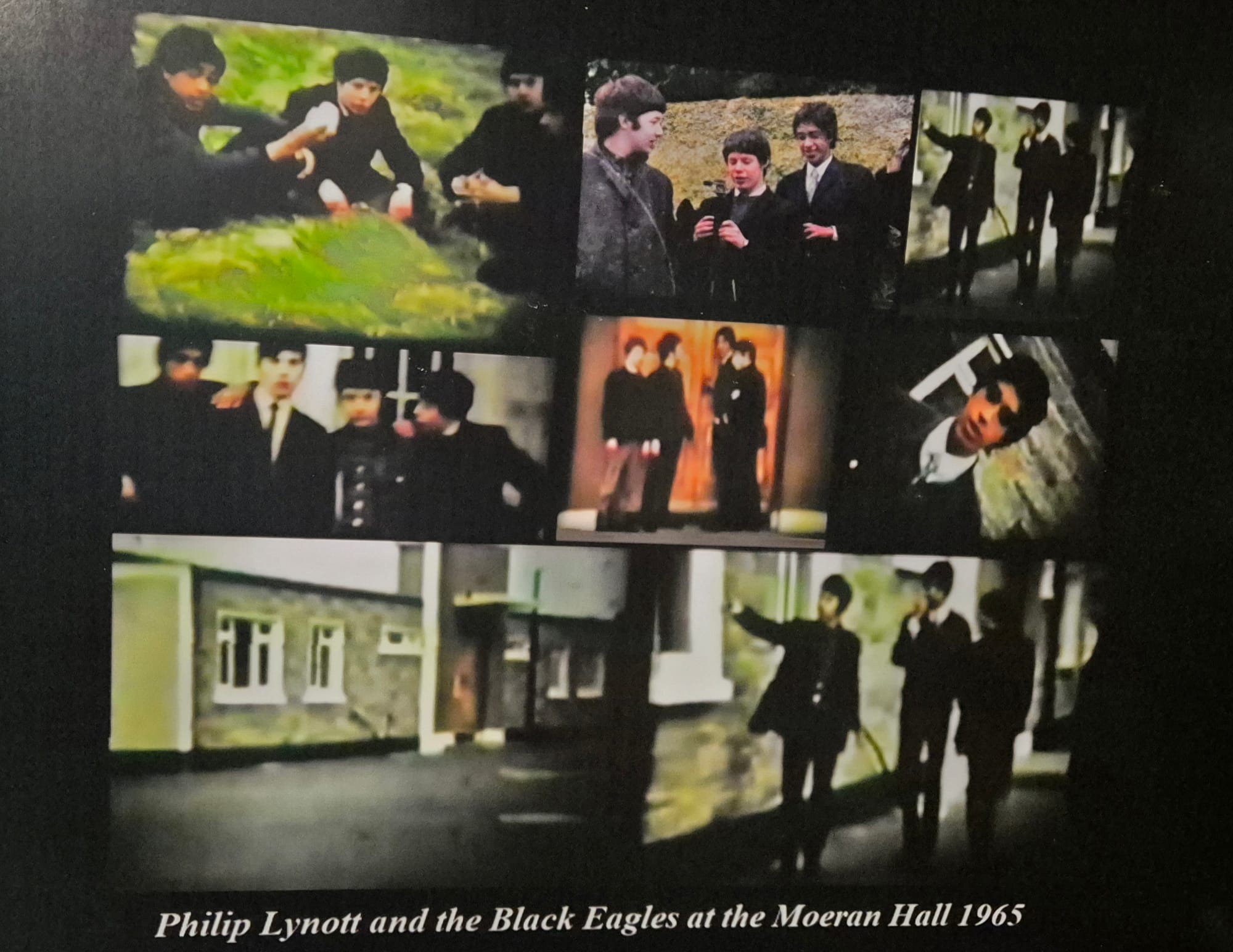
O’Flanagan would regularly take promo photos and video footage of the Black Eagles, and later Skid Row – the band which Lynott originally sang vocals with, alongside Bernard Cheevers on lead guitar, Noel Bridgeman on drums, and bandleader Brush Shiels on bass.
Before their first film shoot, Lynott asked if it would be shot in colour or black and white, O’Flanagan says.
Colour, said O’Flanagan. To which Lynott jokingly replied: “I come out better in black and white.”
O’Flanagan says he remembers the kick that Lynott got when young kids would remark, “Look mammy, there’s a black man,” when he was on the bus.
There were few black people in Dublin in those days, O’Flanagan said. “He absolutely loved it.”
On the big screen, the shot cuts away to ripples in a puddle. Then to the lads, messing again.
The puddle shot wasn’t his idea, says O’Flanagan.
It was Lynott’s, he says, suggested as a way for the audience to know that it was transitioning from one scene to the next. O’Flanagan says it hadn’t occurred to him.
“We were making it up as we went along,” he said. “Tricking around Crumlin village.”
In another scene, Lynott is foraging. “He used to go up the hill to pick blackberries.”
The film footage that O’Flanagan took would often be played as a backdrop in the music venues when the band would play, he says.
Dancehalls didn’t have lighting rigs back then, he says. Video footage thrown on a wall was the nearest to a light show they had.
People in the crowd would get a thrill from seeing the footage, shot around their own hometown. “You never saw where you were from on television.”
As O’Flanagan poured out anecdotes, he asked others to share their memories too.
Elena Green saw Thin Lizzy in the National Stadium so many times, she said. There was nothing like it, she said.
She remembers the final time, just before she left Dublin for many years to live in England. Lynott played a song on his own, acoustically, during the encore. She hadn’t heard it before.
The song was called Dublin.
“And at sea with flowing hair I'd think of Dublin // Of Grafton Street and Derby Square and those of whom I care // and you, in Dublin.”
Green says the song and performance lingered in her mind – through all the years she spent away and to this day.
Another man remembered meeting Lynott at a bus stop on Fleet Street. “We all gathered around him.”
He seemed shy, the same audience member added.
O’Flanagan talked about what he was like to hang out with.
“Everybody else would be giving their opinion, and showing off,” he said. “He used to sit back. He didn’t dominate the conversation or anything like that. It’s a little hard to describe.”
When Lynott got on stage though, he said, he became a whole other animal.
In between his own film footage, photos and stories, O’Flanagan played clips of Thin Lizzy performing.
During the brooding epic The Sun Goes Down, whispers swept the crowd.
“He was something else.”
“They’re some lyrics.”
“What a man.”
Had he made the footage available to Lynott’s children? He had, said O’Flanagan – and to anyone who wanted it.
“I never wanted money or anything. I just want it to be seen,” he said.
And, if he didn’t do something with the various films, they would end up thrown in a skip by his own children one day, he said jokingly.
He has donated the original film reels to the Irish Film Institute, he says, so they can store and preserve them.
A fortnight ago, O’Flanagan brought his films and stories back to Moeran Hall in Walkinstown, where some of the clips were shot over 60 years ago.
But the tour isn’t over.
He has been invited to give the presentation again soon in the Glen of Aherlow, the pub in Inchicore– but is waiting for the date.
Funded by the Local Democracy Reporting Scheme.

So how does it square the circle?

The council closed the pool after its roof was damaged in Storm Darragh in December 2024. In January, it put out a tender to fix the roof.

But while the numbers of foxes in cities has been steadily creeping upwards, is it a problem or, if humans respond right, a boon?

Richard Shakespeare recently held a closed-doors briefing for councillors, giving them a presentation that was watermarked so they could be caught if they shared it.