

Maybe people shouldn't be able to collect social welfare at GPO, Arnotts lobbies
The company behind the Henry Street department store raised the idea with the man in charge of the regeneration of the city centre, returns show.
And possibly setting up a council-owned, not-for-profit childcare delivery company.

A draft plan published recently envisions Dublin City Council getting more involved in trying to ensure empty creche spaces in apartment complexes get filled with actual working, not-for-profit creches.
At last week's meeting of the council's planning committee, Social Democrats Councillor Cian Farrell presented the results of six months of work on the issue by himself and others.
"Childcare is one of the foundations of a functioning city," Farrell said. It's important for kids, for their parents, for businesses, for communities, he said.
Families in the city struggle to find places, and, even if they can find them, struggle to afford them, he said.
"I think we all know it, and we hear about it on the doors," he said. "If we cannot provide childcare to our citizens, we cannot retain families or sustain our workforce."
The draft plan that the council's Childcare Provision and Infrastructure Working Group produced is not meant to solve the entire childcare crisis, Farrell said.
"This report is not meant to be a panacea, or an overall intervention by Dublin City Council taking on childcare," Farrell said.
"We do not have national responsibility for policy, for funding, for 101 other things, that we know don't make the childcare sector operate in way that we want," he said.
Instead, it's meant to use powers the council has, as well as a new funding stream from the Department of Children, to try to make a difference, starting small, he said.
If the effort works well on a small scale, the plan also includes possible more ambitious futures.
"Together, DCC and the Department can create additional childcare supply in publicly linked buildings, operated by not-for-profit providers, in communities where new places are needed most," the report says.
The Planning and Urban Regeneration Strategic Policy Committee (SPC) backed the report, giving general approval to the policy direction.
Farrell said the plan would now go, for further consideration, to the Community, Gaeilge, Sport, Arts and Culture Strategic Policy Committee in July, "and hopefully the full council at the beginning of September" .
Planning rules require a developer to include a creche space big enough for the number of children expected to live in an apartment complex. There's a formula.
There are at least two problems with this approach.
First, this ends up forcing developers to deliver some creche spaces that are too small for an operator to actually use, said architect Johnny McKenna, a planning committee member, at last week's meeting.
"Unless you're talking about a scheme of about 500 to 600 homes, you end up with a creche of about 300 square metres, which in our experience is not viable to run a creche," said McKenna.
"That, I believe is why we see a lot of grey boxes just sitting empty because no operator can take them on," McKenna said.
This is an issue that's reportedly being worked on at the national level, and not something the council can solve on its own.
But even if the childcare space the developer delivers is big enough to run a financially viable creche in, turning it from a grey box to a workable space can be pricey.
And if the council wants to get not-for-profit operator in to run a creche in a space, that operator might not have the cash to pay for the fit-out.
That's where the plan presented at last week's committee meeting sees an opportunity for the council to step in and help.
The working group identified five childcare spaces on the way as part of planned or under-construction housing projects, and recommended that the council choose one of these as a pilot to try to help fill it with a working childcare service.
The possibilities include spots in housing projects the council is delivering on its own, or in with the Land Development Agency (LDA).
These are the Donore Project on the former St Teresa's Gardens site in Dublin 8, Bluebell Waterways, An Droichead Órga on Emmet Road in Inchicore, Cherry Orchard Point, and a project in Ballymun.
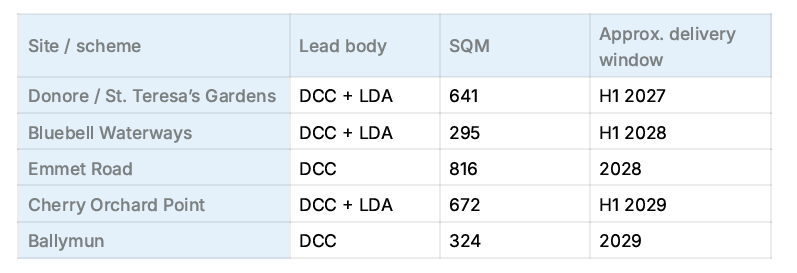
Whichever one of these the council were to choose as a pilot, the plan would be to apply to the Department of Children's State-led Capital Programme to pay to fit-out the grey box with floors, interior walls, lights, toilets, and all the other bits needed before it could be a working childcare facility.
Of course, there is a lot of competition for that money.
The department is only planning to fund a limited number of projects this year, according to its press release about the new €135 million fund: "Up to eight buildings will be selected for investment this year."
Minister for Children Norma Foley, a Fianna Fáil TD, said on 3 June on RTÉ 1's Drivetime that "There's funding for eight this year, there will be more done the following year, and more the year after," Foley said.
By email on Tuesday, a spokesperson for the Department of Children said the €135 million "will be made available between 2026 and 2030".
"The Department has received project proposals from a number of sources since the programme was launched which, along with projects which the Department was aware of prior to the programme launching, includes over 90 potential projects across the country," they said.
If the council can get some of that funding, though, and use it to fit-out a space in one of the DCC or DCC/LDA housing projects, the next step will be to bring in a not-for-profit operator to run a creche in it, the plan says.
Why a not-for-profit? "A lot of the government policy, while welcome, a lot of it is subsidy-based, so we're ultimately subsidising a private sector that is later extracting those profits," said Farrell at the meeting last week, "and not actually creating new childcare spaces or true affordability".
Committee member Aidan Sweeney, head of infrastructure and environmental sustainability at business group Ibec, took issue with this aspect of the report.
It "is a little bit lopsided in terms of how it's being presented," Sweeney said. "I would suggest that the fact is that the private sector providers are providing a much-needed service for anybody right now due to the actual shortage of places and the critical role of childcare."
Farrell said he agreed that private childcare providers are a "much needed and much welcomed, valued service", and recognised that some of the smaller ones are under financial stress, and struggling with all the admin associated with meeting regulations.
"But I think, from our intervention, it has to be community nonprofit or kind of public-gain-facing," he said.
The biggest risk to the shortish-term plan, is "the constrained capacity of the non-profit sector to run these operations in a sustainable manner", the report says.
So the report also suggests the council look at creating a "DCC-owned, arm's length childcare delivery company".
"This would be a not-for-profit public-interest company, with DCC as the sole shareholder or member, independent governance, professional management and a clear social purpose," it says.
The council has started other companies to deliver services. Farrell, at the meeting, named Swan Leisure, Dublin City Council Culture Company, and Codema, the energy agency. The report also mentions the planned city centre regeneration special purpose vehicle (SPV).
The report suggests that the DCC Childcare Delivery Company could operate childcare services in DCC-owned buildings; centralise finance, HR, compliance, governance, and quality assurance; and more.
"This option should only proceed following a full feasibility study and business case," the report says.
This would be an attempt to apply a lesson the working group learned from looking at the non-profit StarBright childcare chain: it's hard to run a viable one-off non-profit creche, but a small chain with shared back-office services can make more sense.
"StartBright matters because it demonstrates that scale is not only a private chain advantage. Scale can also be used in a community-based, not-for-profit, values-led model," the report says.
Another option for a more ambitious approach would be to create a new company like this that's co-owned or jointly governed by the council and the Department of Children, the report says.
Would the department be interested in that? "The Department understands that the report has yet to be finalised and approved by the Council and no formal proposal has been made to the Department in respect of any possible joint venture," the department spokesperson said.
However, "As always, the Department is happy to consider any proposal from a wide variety of applicants to advance state led provision," they said.
At the meeting, Labour Councillor Dermot Lacey said that overall, "I welcome this approach".
But, Lacey said, "my only reservation is I would be – the option that I would least favour is the one that involves the partnering".
"In my experience, both the department and Tusla intervene but don't help, interfere but don't help," he said. "So they should be servants, not decision makers, in my opinion."
For her part, City Planner Emer Uí Fhátharta said that she'd only received the report the night before, and would give more detailed feedback later.
"But I guess, I would also hope that anything that comes forward is agile to the needs of the community that there may be a period in the next 10-15 years where those creche spaces are actually, the demand for them goes down and that those spaces can evolve to become alternative community spaces rather than being lost to the community in general," she said.
The committee agreed to back the report and its position that "childcare should be treated as social and community infrastructure within DCC's existing functions".
Actual concrete steps, like setting up a new council-owned company, might come further down the line. "Any such decisions would require separate legal, budgetary, procurement, executive and reserved function processes," the report says.

The company behind the Henry Street department store raised the idea with the man in charge of the regeneration of the city centre, returns show.

It's been in place on buses in Waterford since July, and is due to be rolled out now nationwide – including on Go Ahead's Naas-based Dublin commuter services this past weekend.

"His inability to work will have a direct impact on the provision of the medical services and our ability to maintain adequate staffing and patient care,” reads a letter from the Rotunda to the Department of Justice.

"Please note, I am only looking for the restitution of €2.75 – the fare cost."