The vigil followed the deaths of Philip and Kim English and their sons, Callum, 12, and Jayden, nine, who were killed in an arson attack on their Waterford home on 13 October.
A council manager has said that after improved flood defences and a new water main are put in at the Clontarf Promenade "would seem like a perfect opportunity to reimagine the area".
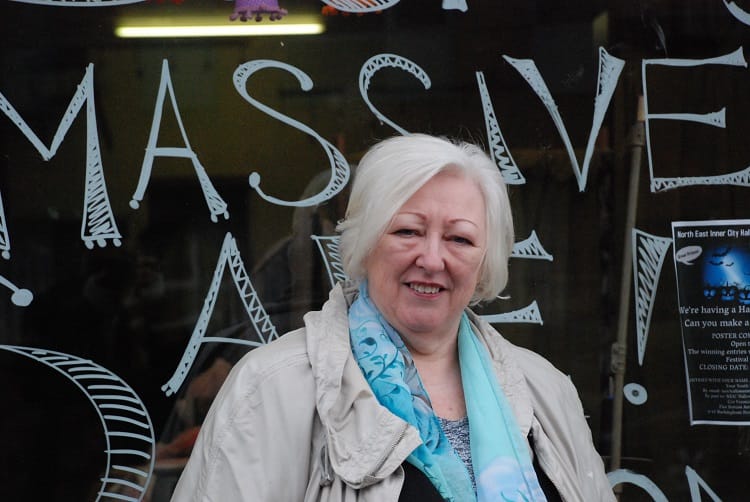
That’s why Bernie Walsh is on the hunt for a new premises. Her shop, Busy Bees, on Summerhill Parade, is due to close by Christmas.
It’s twelve years since Walsh opened up, catering for locals in need of hem alterations, trousers taken up, or sewing advice.
On a recent Monday morning in the shop, Walsh was chatting with Yvonne Kavanagh. Beside them, by the window, were three sewing machines, stacks of fabric and measuring tapes. To the back, refurbished couches waited for buyers.
Walsh says Busy Bees in Summerhill is a spin-off branch of her Sunflower Recycling outfit in East Wall.
It operates on a peppercorn rent but the owner of the building that Busy Bees is in is selling up. That means finding a new space not only for Walsh, but also for all the other women, like Kavanagh, who use the shop as a space to learn new skills and upcycle old clothes.
“Really what they [the girls] need is somewhere they can train people, do sewing, have a meeting space,” says Walsh. “A creative co-op is what I’m calling it.”
Stitch and Sew
What used to be a row of shops down Summerhill Parade is now apartments, so the footfall is no longer there, says Walsh. But she has a plan.
Her idea is to find a new spot, ideally nearby, and open up a space where any skill can be put to use – where Kavanagh and other women will still do their sewing and stitching, but also new crafts are welcome.
Anybody would be able to walk in off the street, make something on the sewing machines, and sell what they have made in the shop. Some of the money would be pocketed as profit, and some help cover the rent.
It would be like now, but bigger. “You need a retail unit in an area where it’s not too expensive and it has good footfall,” says Walsh. “I think the Five Lamps would be great.”
“I’d make a lovely window, a design window,” says Kavanagh.
The possibilities are endless, says Walsh. “Most people are thinking about it as a women’s thing. It could of course be mixed.”
“Oh, I had two men in asking about learning to sew,” says Kavanagh. “There you go.”
One of the difficulties with setting up a co-op is that banks aren’t usually keen to lend to them, said Walsh.
“It’s hard for people to move from the black economy into the formal economy when the overheads are so high,” she says. “You have to become a limited company for the bank to accept you. They don’t like the fact that there’s not one person responsible.”
Still, they’re determined that what Walsh has already named Stitchin’ & Bewitchin’ will get off the ground.
Upcycle, Upsell
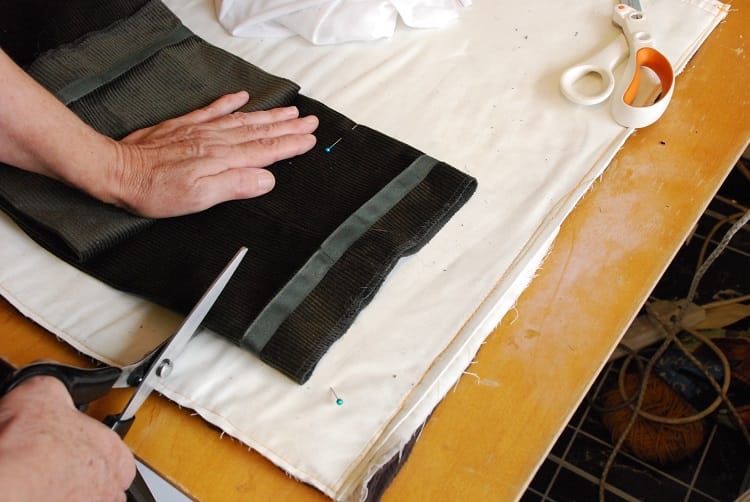
“I want to use all the materials from old clothes and make them into patchwork, bags, cushions, but also one of my main objectives is that every one of them would be different,” says Kavanagh, taking the leg up on a pair of corduroy trousers.
“And also, another thing I want to do is that if somebody has a lovely jacket that they don’t want to throw out I can turn that into something.”
The ambition is there, says Walsh, but they have only four weeks left in Summerhill to find a new place.
When Busy Bees first opened, business was great. Walsh opened a second premises on Bridgefoot Street, but the recession meant that had to close.
It’s not all bad news either though, she says. “A lot of people started doing upcycling themselves at home,” says Walsh. “They’d be coming in to us, asking me, ‘Now what could I do with that? How can I change this?’”
If they do set up something new, it will be a place where people can come for that kind of advice and more of a communal space, she says.
“It’s about effecting change, both environmentally and socially, while you’re involved in this stuff,” says Walsh. “The economics isn’t the main thing.”
Yet it’s essential to keeping the enterprise going, and Walsh knows that might be tricky. The Local Enterprise Office grants for social enterprises are small, she says.
People who want to create a business based on upcycling can struggle, says Maeve Thornberry, network coordinator for Community Reuse Network Ireland, of which Walsh is a founding member.
There are the challenges of how to market what is made, and how to get the name out, said Thornberry. “You’re competing with new, cheap stuff.”
Thornberry says that it is labour-intensive, too, and there are the usual challenges of rents and rates. “There can be a lot of costs involved in doing what they do.”
Walsh and Kavanagh are ready to innovate, though. They want a sewing cafe for Stitchin’ and Bewitchin, along with sewing, knitting, upcycling, and decoupage classes.
“What always springs to my mind is the men’s sheds,” says Walsh. “It’s something like that but with a retail element. It’s something that brings people together, draws people in and creates a bit of community spirit, which is badly needed around here.”
Ireland is the place they started school, joined sports clubs – yet their parents worry about how changes to citizenship eligibility may haunt their future.
While tenant complaints about the e-bike, and also noise, were referred to in the notice to quit, that was to illustrate the breakdown between the occupants at the property, said the landlord's agent to the tenant.