

Across the city, parents snatch their kids out of the way of red-light-breaking drivers
Despite years of talk, a promised national strategy on red-light cameras is yet to be published – let alone implemented.
Despite years of talk, a promised national strategy on red-light cameras is yet to be published – let alone implemented.

It’s Wednesday morning, at the junction of Collins Avenue and Malahide Road.
A driver in a flatbed truck coming from the city centre direction rolls straight through the red light on Malahide Road.
The driver turns left up Collins Avenue, straight through a pedestrian crossing, as the green man turns amber.
This happens around all arms of that busy junction, constantly, says Fiona Murphy, a teacher at Our Lady of Consolation National School, on Collins Avenue.
So much so that the students decided to take a stand themselves in January.
They held a protest at the junction, which is a minute or two walk from their school gates, pleading with drivers to slow down and obey traffic lights.
Previously, they’d got their hands on a speed gun, and clocked drivers bombing past the school at 80 kilometres per hour, in a 50-kilometre zone, Murphy said.
“They speed up to make the lights,” she said. Often, whether they make the lights or not, they keep going – over pedestrian crossings, she said.
The problem of drivers breaking red lights at pedestrian crossings is widespread, and gardaí can’t be everywhere to catch them. Even if they wanted to, which an April 2025 independent review of roads policing suggested not all gardaí do.
“Some Gardaí working in Roads Policing – a minority, but nonetheless a noticeable one – are unproductive and appear to be demotivated and unconcerned with doing an effective, professional job,” the report found.
So, for some, the great hope for tackling the situation has been the installation of cameras at red lights to automatically read drivers’ licence plates and send them fines and penalty points.
However, despite years of talk, there’s no prospect of red-light cameras with automatic number plate recognition (ANPR) being rolled out anytime soon.
The latest promised report on the issue, the National Safety Camera Enforcement Strategy, once promised by the end of 2024, still has not been published – much less implemented.
Motorists running red lights and over pedestrian crossings is a problem for communities all across Dublin, regular reports to CollisionTracker.ie suggest.
Rosalind Kelly and her nine-year-old daughter were almost hit while on a pedestrian crossing in Inchicore village on a wet and rainy day this month, she said Wednesday.
First, one car slowly rolled over the crossing, breaking a red, Kelly said. “That car then blocked the field of vision for another car to even see us.”
The driver of that Audi SUV ran the light at a high speed, she said.
Kelly had to snatch her daughter back suddenly, when she realised it flying through the light and crossing, oblivious to her child.
“He was actually going to knock my daughter down,” she says. “I was shaking with rage.”
On Harold’s Cross Road, near the new Harold’s Cross Educate Together National School earlier this month, Aoife McGough briefly thought the worst.
The pedestrian light was still green, and her three children were halfway across the road on their scooters.
Suddenly, McGough realised a car was flying towards the crossing.
“I saw the car coming and screamed at my children to stop scooting, which thankfully they did,” she said on Wednesday.
The car then sped through without slowing, she says.
“My 11-year-old crosses at these lights on her own sometimes,” McGough says. “I don't think she would have known that the car was not going to stop if I hadn't been there.”
Motor vehicles are obviously the most dangerous red-light breakers, but they aren’t the only ones.
Three years ago, when one of her kids was five, she was knocked down by a cyclist, who was flying through a pedestrian crossing despite a red light.
“The pedestrian light went green. We crossed. He didn't stop, knocked her down, and she ended up in hospital with a broken thumb,” she recalls.
Earlier this month, Labour TD Ivana Bacik and Labour Councillor Fiona Connelly went down to observe the situation near the school on a weekday morning, Bacik said Thursday.
“In a short five-minute period, we observed three different individual drivers breaking the green light for pedestrians while children were crossing or about to cross at this clearly marked pedestrian crossing,” Bacik said.
“We are seeking urgent action from Dublin City Council and Gardaí to address the risks and provide for stronger road safety measures to create a safer environment for all in the Harold’s Cross area," she said.
Across the city, a culture of carelessness has grown among Dublin motorists, says Kelly, the mother in Inchicore. And it terrifies her.
“Dealing with red-light running is genuinely a daily occurrence,” she says.
In January, the reality of red-light running reached a tragic conclusion in the case of 16-year-old Grace Lynch.
Grace was killed when a scrambler bike ploughed past a red-light and struck her as she was walking along a pedestrian crossing in Finglas.
Her father, Martin Lynch, doesn’t think that a red-light camera would have stopped the man who killed his daughter that night.
Still, a culture that accepts red-light running has evolved, and that may have eventually played into the death of his child, he said by phone on Thursday.
“We still watch it happen every day,” he says
While there doesn’t seem to be any simple solutions to the problem, Lynch says the lack of garda enforcement on the roads is stark.
“Big thing for me is, there’s not enough traffic cops on the road. Nothing to stop people,” he says. “It’s absolutely pathetic at the moment.”
There’s no good reason, in his view, why red-light cameras can't be rolled out, if even in known danger spots, like around schools, he says.
Kelly walks and cycles, but her wife drives, she says.
When they are all out in the car together, she’ll play a game with her daughter: they count how many drivers are on their phones.
Her daughter will often spot people actually watching TV shows on their phones, as they slowly roll along busy traffic.
Others will be texting with their heads tilted down to their phones, driving at speed.
“You wouldn’t believe how many we can spot even on a 10-minute stretch,” she says.
The point of the game is not just to pass time on a family drive, however.
For Kelly, it’s a way to imprint upon her daughter that you simply cannot rely on the person behind the wheel to be paying attention to what’s going on around them.
“I don’t want to terrify her, but she has to know,” she said.
Along with the level of distraction, the level of aggression that drivers have on the road seems to have escalated in recent years, she says.
Recently, when her wife slowed during an amber, just as it was going to turn red, a car behind started beeping repeatedly.
“She stopped, and this driver was apoplectic behind us that we had stopped,” Kelly said.
“On two occasions, we've had cars pull out from behind us to overtake us and go through a red light,” she says.
The reality, she says, is that many drivers do not fear being caught and punished for breaking red lights.
“Something has to change,” Kelly says. “People are going to be killed who don’t need to be killed.”
 Sam Tranum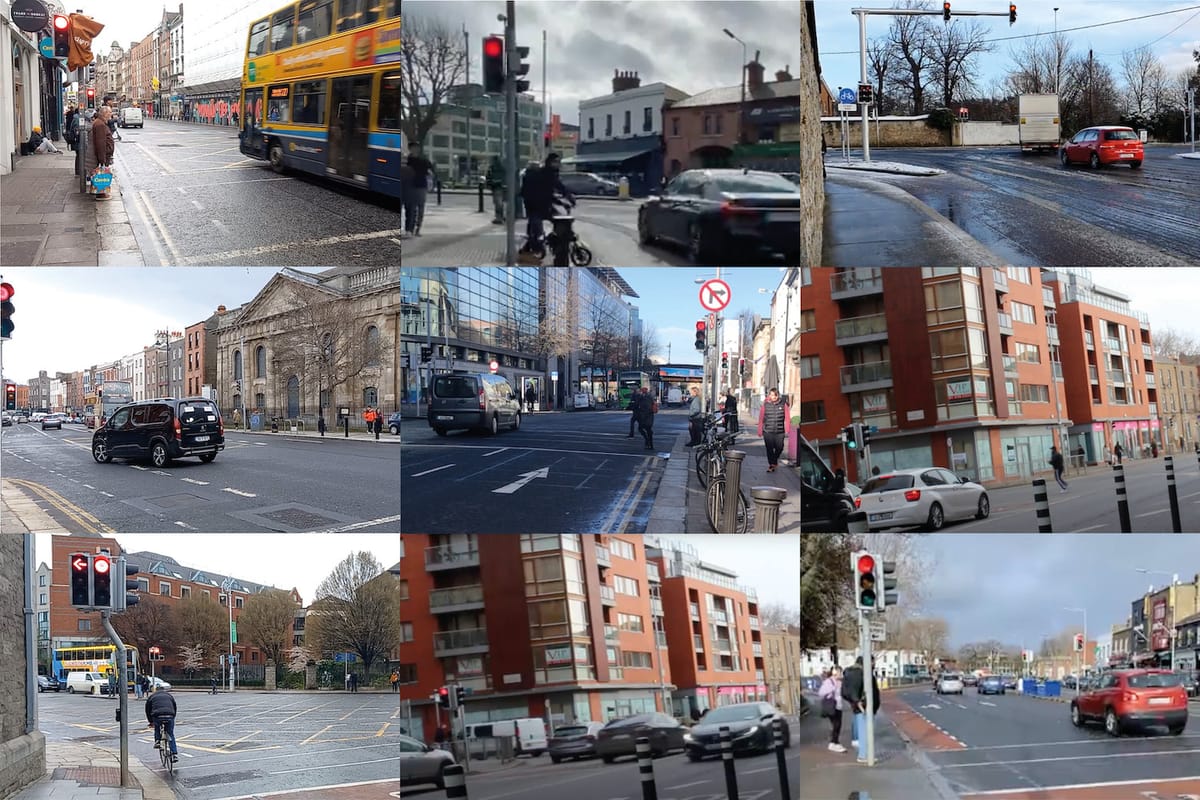
Rolling out red-light cameras in Dublin is something that’s been in the works for years.
A 2015 press release from the National Transport Authority (NTA) announced the installation of “Ireland’s first automated Red Light Camera System”.
Put in at the Blackhall Place/Benburb Street junction in Smithfield, it was meant to prevent collisions between cars breaking red lights, and the Luas.
“The system captures images of motorists breaking red lights, their licence plate numbers and other data allowing An Garda Siochána to pursue offenders under the Road Traffic Acts,” the press release says.
However, that installation was just an 18-month pilot project, Hugh Creegan, the NTA’s deputy chief executive, wrote in a 2020 email released under the Freedom of Information Act to Green Party TD Neasa Hourigan.
“The larger permanent operation has to be publicly advertised for tendering purposes,” he wrote.
The next year, 2021, the government’s road safety strategy for 2021–2024 “phase 1 action plan” included a plan to “Further develop camera-based enforcement by the Gardaí, including at junctions and for management of bus/ cycle lanes” by Q4 2022.
The NTA took the lead on making it happen, an NTA spokesperson said.
“While a pilot installation was undertaken a few years ago at Blackhall Place on the Luas Red line, it has been recognised that tendering for equipment and services for just one or two isolated junctions would not provide a system that would be scalable,” the NTA spokesperson said.
So the government has established a working group. “The NTA has been requested to Chair a Working Group to assess and make recommendations in relation to the further extension of camera-based enforcement,” the spokesperson said.
In addition to the NTA, that working group included the Department of Transport, the Gardaí, Transport Infrastructure Ireland (TII) and the County and City Management Association, the spokesperson said.
“It is expected that the Working Group will conclude its work and bring forward recommendations for consideration in the second half of 2023,” they said.
That working group reported back, but that only spawned another effort, this time headed by TII, to think about the issue, and make even more recommendations, in the form of a National Safety Camera Enforcement Strategy.
"This strategy will outline the structure, funding and partnership and governance arrangements associated with the management and implementation of camera enforcement in Ireland and is expected to be finalised before the end of 2024," said Fianna Fáil TD Jack Chambers in the Dáil in May of that year, when he was Minister of State at the Department of Transport.
But it wasn't finalised before the end of 2024.
In the meantime, in November of that year, there was a general election, and a new government was formed. Its programme for government, Securing Ireland's Future, includes a commitment to increase the use of cameras to improve road safety.
By the end of 2025, the National Safety Camera Enforcement Strategy still had not been published.
Seán Canney, an independent TD, and Minister of State in the Department of Transport, said in the Dáíl in December that it was still in the works.
"Work on the Strategy is progressing and is now at an advanced stage," he said. "My Department is working closely with all road safety stakeholders including the NTA [National Transport Authority], TII, RSA [Road safety Authority] and An Garda Síochána on how best to implement the Strategy.”
On 18 March, the strategy was still not done. "I expect to publish this Strategy shortly," Canney told the Dáil.
Funded by the Local Democracy Reporting Scheme.

For a start, it shouldn’t allow for up to 15 storeys over the road from the bungalows of Labre Park, says the coordinator of Ballyfermot Travellers Action Project.

Some residents in the north inner-city are worried about how the new line will impact them, as their homes are very close to the tracks.

In 2024, 29 percent of housing applications to councils across the country – for 5,626 households – were closed due to the applicant’s failure to communicate.

But while the concerns have piled up, the way forward is less clear.