

“It’s giving colonialism”: Ireland still owes rent to dukes and earls
Although, even though the OPW lists these rents as payable, some of the named beneficiaries say they haven't been getting them.
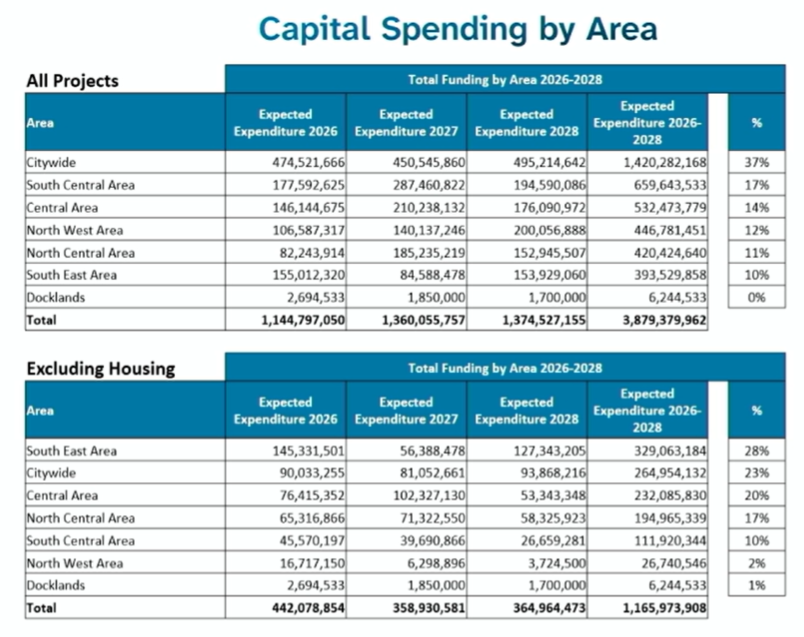
The area has been allocated just 2 percent of the pot of capital funding – not including housing – over the next three years.

Ballymun and Finglas have been allocated just 2 percent of the city’s capital spend on projects outside of housing, over the next three years.
The two areas – which make up Dublin City Council’s North West Area – have a smaller population than the other four council administrative areas.
But even accounting for that, the North West Area sits firmly at the bottom of the allocation for areas in the council’s capital programme which runs from 2026 to 2028.
At the top is the South East Area.
That stretch of the city – which covers local electoral areas Kimmage-Rathmines, Pembroke, and South-East Inner City – is to get 28 percent of the same pot over that period.
Councillors disagree on the degree to which the stark difference is down to poorer areas getting less care than wealthier ones – or if that’s overly simplistic.
At Monday’s monthly meeting of the full council – the bulk of which was given over to discussion of the city’s capital programme – Social Democrats Councillor Mary Callaghan said the difference was distressing.
“It is absolutely not acceptable,” said Callaghan, who represents the North West Area.
Independent Councillor John Lyons – who said that the North Central Area which he represents, was also underallocated and had been in the past – gave his take on why the gap exists.
“There are more powerful interests, there are our own unconscious biases,” he said, “which means that areas that have communities of severe disadvantage don’t get the same time and attention as more affluent areas.”
Richard Shakespeare, the council’s chief executive, said he didn’t deny the gap. “Yep, in terms of investment, the North West doesn’t do well. I don’t know why.”
“It’s nothing conscious from me,” he said, and it is something they can review. “It could be just a throwback from projects that just keep rolling on.”
On the phone on Tuesday, Labour Party Councillor Dermot Lacey, who represents Pembroke, in the South East Area, said that it’s way too simple to just look at figures by area and draw conclusions from those.
He doesn’t divide the city like that, he said, and doesn’t think that people outside the council chamber do either.
Projects may sit just over the border of administrative areas, he said, or areas may have seen a lot of past investment or look from high-up to be wealthy but have pockets of lower-income communities.
“You have to look at the context,” said Lacey.
Callaghan, though, said she was still grappling with how an area that has been so neglected historically, with so much deprivation, gets so little.
“I’m trying to get my head around it and trying to work it out,” she said. “But why is it that my area is particularly left behind?”
At Monday’s meeting meanwhile, several councillors complained about how the whole plan is drawn up anyway at the moment at least – by officials under Shakespeare, with no formal way for councillors to feed in.
 Lois Kapila
On Monday evening, Enda Currid, the council’s head of management accounting, broke down how much each of the council’s five areas is expected to get from capital funding, with figures including the housing spend and without.
He also broke out the Docklands as its own area, and citywide projects which capture spend on sprawling infrastructure such as footpaths and roads, he said.
Big projects can also skew spending by area, said Currid at the meeting, as he caveated the figures.
Take the renovation of the Fruit and Vegetable Market, the new library at Parnell Square, and the redevelopment of Dalymount Park, he said.
“While the spend is being part of the Central Area, they are projects that deliver a citywide benefit,” he said.
At the meeting, Callaghan, the Social Democrats councillor, said the small amount of funding to the North West Area is “horrific”.
Many projects listed in the capital programme for the area have been on it for several years, she said. Like the Finglas village improvement scheme. “It’s always next year, next year, next year,” she said.
The scheme aims to improve pedestrian, cycling and public transport infrastructure in Finglas and make the village more of a destination. It is currently at the “detailed design” stage.
On the phone later, Callaghan said she gets lots of calls around making Finglas’ Main Street look good. Somewhere people can hang out and meet, she said.
“At the moment, a lot of complaints you get is that it is takeaways and nail salons,” she said. And, more recently, gambling shops too.
Other urban villages in Dublin can be so bustling, she said. “It really is not fair that such a big population don’t have that basic nicety that the rest of the city seems to have.”
Callaghan said there has been a lot of work over the years to really improve playgrounds and parks in the area.
“But there’s still a great need in the community,” she said. The playground in Tolka Valley Park desperately needs attention, she said.
Councillors have asked for skateparks and facilities for youth, in particular, to keep them occupied. “We’ve always been asking. I don’t know what is going on.”
Said Callaghan: “When I saw that 2 percent last night, I was just really really saddened and shocked.”
Finglas is also supposed to benefit from the Finglas Luas project in the coming years.
That has planning permission – but not the funding yet. The central government has work only starting on that in 2029 in its sectoral investment plan for transport.
Meanwhile, over in Ballymun, the future of the Ballymun shopping centre site is still being worked out after many false dawns.
In July 2024, a council spokesperson said that it had opened negotiations with the Land Development Agency about the future of part of the site.
On Tuesday, a spokesperson for the LDA said that it “is progressing plans to submit a Large-Scale Residential Development planning application for the development of affordable housing at the Ballymun Shopping Centre site”.
The LDA has started “early-stage pre-planning engagement” with Dublin City Council and this will continue in the coming months, they said.
Once population at the time of the last census is taken into account, the rankings of areas by funding for capital projects, aside from housing, does change a bit.
At the bottom is still the North West Area (€475 per capita) and the top is still the South East Area (€2,208 per capita).
But second is the North Central Area (€1,965 per capita), followed by the Central Area (€1,684 per capita) then the South Central Area (€1,198 per capita), suggest figures.
But it wasn’t just councillors for the North West of the city who raised concerns about the distribution of funding. Some drilled into areas within areas, or made other comparisons.
Green Party Councillor Janet Horner, who represents the North Inner-City, in the Central Area, said: “We don’t want to see equal division of where capital investment is spent.”
But she is curious as to the northside and southside division, as road upkeep seems quite southside-heavy, she said.
The council’s project at College Green is fantastic, she said, but it is going to exacerbate the inequality in the quality of public realm between the northside and the southside. “We need to invest more in the northside as well.”
Fine Gael Councillor Declan Flanagan, meanwhile, asked what is in the programme for Santry – in his North Central Area. There have been tens of thousands of apartments built in the area, but not the community amenities to support all that, he said.
Councillors have asked for a community centre, co-working spaces, or a training centre for youth of the area, which aligns with talk of 15-minute cities, he said. “I would like to see some enterprise in that Shanowen area.”
“It can’t just be large apartments with no facilities,” he said.
Council assistant chief executive Anthony Flynn said they are looking to put in place some sort of plan for the Santry area, and are engaging with the local community on that.
Fianna Fáil Councillor Daryl Barron, meanwhile, said that it didn’t look to him as if there was enough, in particular, for Belmayne and Clongriffin. “My area is being left behind.”
Shakespeare said the council is still waiting for feedback from the central government on funding for North Fringe, under the National Development Plan.
The capital programme was largely welcomed by councillors. But running through the lengthy debate were also complaints about the way in which the whole budget for big projects is put together.
People have to recognise that the capital budget represents preferences of the executive, said Lacey, the Labour Party councillor.
That wasn’t a criticism of officials, he said. “But it’s recognition of the process that we’re in.”
At the moment, council officials hold the power to set the capital programme. So when it came before councillors on Monday, it was for “noting” – for councillors to acknowledge that they have seen it.
It’s not the way to adopt a capital budget, in this way with relatively brief, minutes-long speeches from councillors, said Lacey.
It should be discussed at a special meeting, and it should be first discussed at strategic policy committees and area committees, he said.
“I don’t disagree with a word you said, funnily enough,” said Shakespeare, to Lacey.
That said, many of the projects included in the programme do stem from what councillors have said at those committees, and staff put them in, said Shakespeare.
He isn’t the type of chief executive who wants it all his own way, he said.
Changes to the split of powers between council civil servants, and elected councillors have been under consideration by the central government’s Local Democracy Taskforce.
On 4 March, that taskforce’s report on local government reform was handed over to Housing Minister James Browne, of Fianna Fáil, and Minister of State for Local Government John Cummins, of Fine Gael.
A plan based on its recommendations would go before the government in the coming weeks, said a statement at the time. A spokesperson for the Department of Housing said the same on Tuesday, in response to queries.
Later on the phone, Callaghan said that however the capital programme may be done going forward, it needs to take into account deprivation, and proposed population growth, for different areas.
There should also be some fairness over time, she said. “There should be a general balancing across different areas.”
At the council meeting Monday, Shakespeare said he expects that the process around setting the capital programme will change as a result of the recommendations of the local democracy taskforce – and involve a larger role for councillors.
“But until it’s published, who knows?” he said.

Although, even though the OPW lists these rents as payable, some of the named beneficiaries say they haven't been getting them.

They're set to back the creation of a special purpose vehicle he's been picked to head, which is meant to play a major role in regenerating the city centre – but how major is in dispute.

Social tenants who live in the private Liberties complex Grand Canal Harbour say they're not allowed to use many of the common facilities there.

Gone is the hardman shtick, the macho bravado once associated with hip hop, rapper and producer Michael Ward, who goes by Mickzart. “We’re after something true.”