

“It’s giving colonialism”: Ireland still owes rent to dukes and earls
Although, even though the OPW lists these rents as payable, some of the named beneficiaries say they haven't been getting them.
Where, and how, should the council spend its money?

Attendance at the weekly staff meeting at Bleeper's office in central Dublin was lower than usual on Friday.
Eight people sat in orange chairs in a small conference room with the shade drawn so a projector's image would be sharp and clear on the white wall, as chief executive Hugh Cooney went through tasks and metrics.
Several others, though, were off at a warehouse in Inchicore, unpacking some of the 750 new electric bicycles Bleeper is adding – doubling the size of its fleet of shared bikes across the city and suburbs.
"There's five bikes in each cardboard box, so they need to unpack them, put the pedals on, and do an inspection," said Cooney, sitting behind his desk in his office after the meeting.
As well as expanding, Bleeper is one of the companies that'd like to get the next contract – due to go to tender next year – to run Dublin City Council's bikeshare scheme, Dublin Bikes, which has until now been operated by the company JC Decaux.
Of course, Bleeper is not the only company that might want it. JC Decaux, Lyft and Lime have also shown interest, Green Party Councillor Janet Horner, chair of the council's transport committee, said on Monday.
But if Bleeper did win the contract, wouldn't its own current network be competing against the Dublin Bikes network it got the contract to operate?
No, that's not the plan, says Cooney, sitting behind his desk in his office across Bridge Street from the Brazen Head pub on Friday.
He has a different vision for the future of Dublin Bikes, than what has come before – just as other company owners are putting their own ideas forward, too.
The Dublin Bikes scheme was launched in 2009, and has 1,600 bikes, which users can pick up from or park at 115 dedicated stations, according to a May council report.
The scheme has been confined largely to inside the canals, despite repeated requests from councillors and residents to expand it further. This would require changes to the council's contract with JC Decaux, council managers said.
Dublin Bikes moving across the city over the course of one day. Visualisation by Willy Simon.
In 2018, Bleeper launched its own service, and another company, Moby, launched a bikeshare service in the city in early 2020.
They filled in gaps where Dublin Bikes wouldn't go. And brought in slick smartphone apps for their bikeshare offerings.
Part of the reason they could expand to new areas is that they don't use dedicated bike stations or "docks", like Dublin Bikes does.
Instead, users can use their apps to find a bike at a public bike stand, pedal to where they want to go, and look in the app to see where there's a stand they can lock the bike to, and leave it.
Since these services require less infrastructure than Dublin Bikes, they are more flexible, and can add bikes where they see demand.
So at the moment, there are three services, with three apps, and pricing structures, and types of bikes, for users to navigate.
Dublin City Council controls all bikesharing in the city, through its contract to run Dublin Bikes, and also by licensing "station-less" bikeshare operators Bleeper and Moby.
The council is not one thing or one person, and its various cubbyholes have not finished deliberating on what the future of bikesharing in the city might look like.
Early-ish signs point toward an expanded scheme like the current Dublin Bikes, with dedicated stations, and far more bikes than the current version.
But with the council owning more of the infrastructure, which is now owned by JC Decaux.
"DCC believe that in a new bike share scheme the city council should own the bike stations and potentially the bikes themselves with a model where there is an operational, maintenance and upgrade contractor appointed," said the May report from senior executive engineer Jennifer McGrath.
"It is intended there would be one operator across the City and that there is a combination of classic (non-powered) bikes and e-bikes with a fleet or around 4,000 bikes," it said.
So that's from the executive side of the council. The other side of the council is the 63 councillors, whose job when it comes to the bikeshare programme, is setting out a high-level strategy or vision.
The transport council's committee – formally, the Mobility and Public Realm Strategic Policy Committee – held a workshop, out of public view, about the future of Dublin Bikes, back in April.
"The elected members are involved in setting the aspiration, but we don't... we're not overseeing the actual contract," Horner, the committee's chair, said Monday.
She said she'd like the council's bikeshare scheme to continue to use docks. "I think the the station bikes are important because I think there's sort of a reliability of knowing where they are," she said.
Jason Cullen, spokesperson for Dublin Commuter Coalition, who also sits on the transport committee, said similar.
A lot of people have consistent travel patterns, "So, if people know that they have a dock, a couple minutes walk, they know it's usually well serviced, they can go every day and take their bike," he said.
Bike stations can also charge electric bikes, potentially, which would be less complicated – once set up – than keeping stationless electric bikes running.
At the moment, Bleeper keeps a bunch of batteries charging in their headquarters, monitors battery levels remotely in all its electric bikes on the road, and then staff go out and replace batteries that get low with fresh ones.
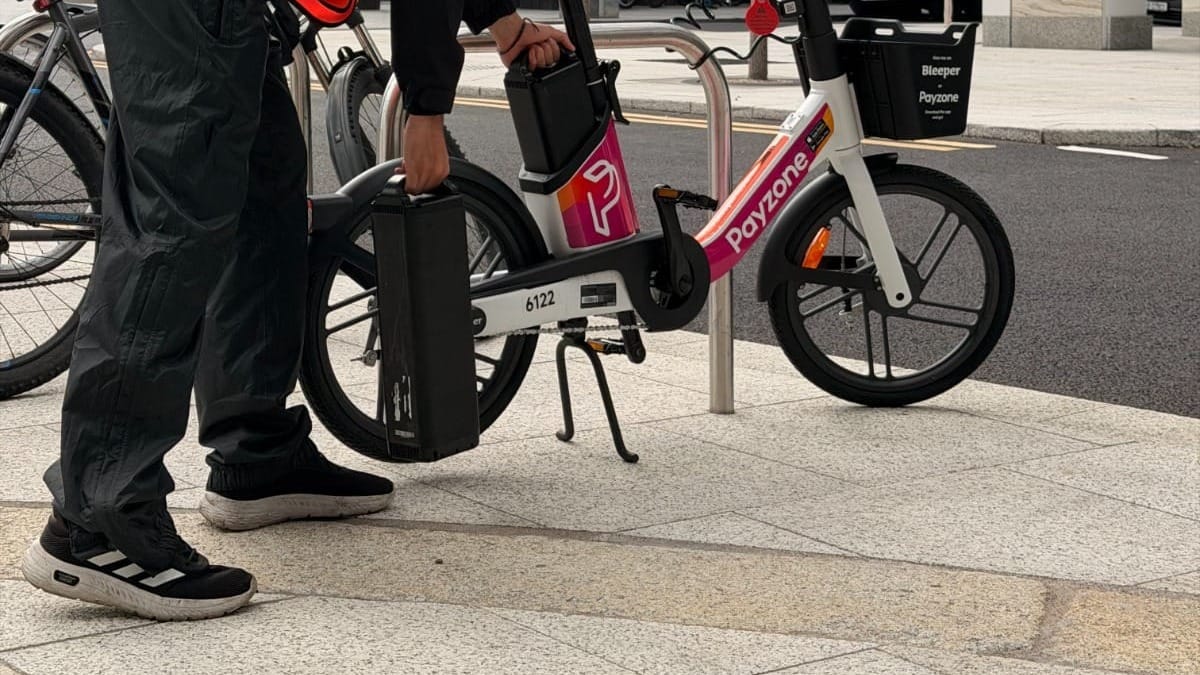
Cooney, chief executive at Bleeper, said that his vision for the future of bikesharing in Dublin is different. It's a version with less infrastructure, and more competition.
In the city centre, there could be some council-owned bike-docking stations – like the current Dublin Bikes ones, but they could be used by multiple companies' customers.
Further out, users could get bikes from, and drop them at, public bike stands, as they do with Bleeper and Moby bikes now. That way, it would be easier for providers to add spots, or take them away, depending on customer demand.
Sitting in his office, on a screen behind his desk, Cooney shows the dashboard available to him, on which he can see where people were when they opened the Bleeper app, whether they then hired a bike, and from where, and where they later parked it.
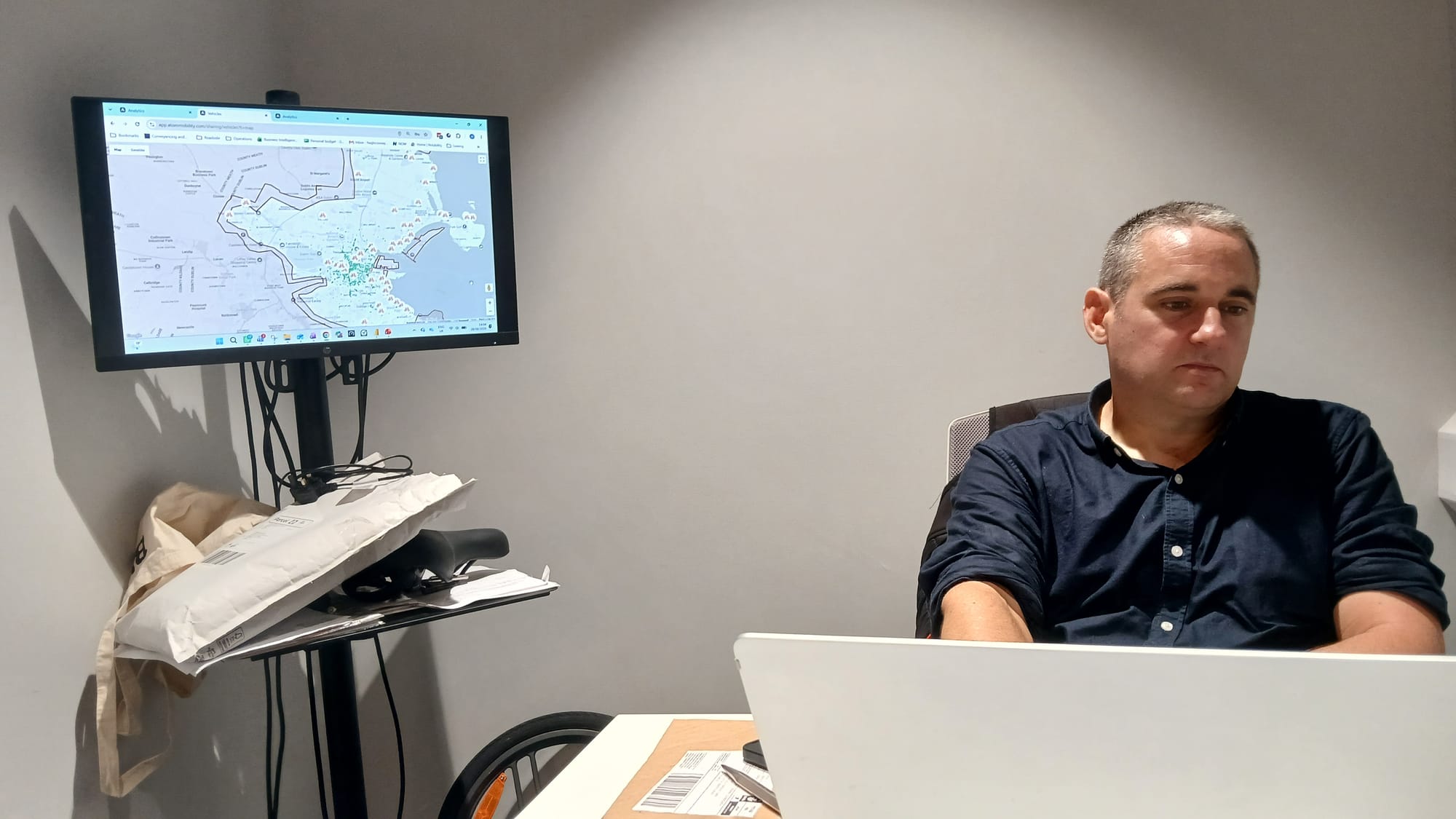
Bleeper staff spend time rebalancing bikes, to ensure there's the right number – enough, but not too many – in bike racks designated as parking spots, Cooney says.
However, if bikesharing in the city were left to the private market, the cost of using a shared bike in the city would rise significantly.
At the moment Dublin Bikes costs just €35 a year for a subscription, and then the first 30 minutes of each ride are free. Bleeper and Moby are more expensive.
The solution? The council could subsidise the costs of these services down to whatever price point they wanted to offer the public, Cooney said. It could also add conditions about what areas the companies had to serve, he said.
This approach would be a lot cheaper for the council than paying for the installation of loads of new bike stations across the city to replace the current aging ones, the purchase of thousands of bikes, and the signing of a contract for an operator, said Thomas O'Connell, the chief executive of Moby.
"You know, if you watch what's gone on in a lot of other markets in in Europe – and we operate there – there's a lot of questions being asked of why a city would put taxpayers money towards a bike share scheme when the private market can fund it," O'Connell said.
It's not a question of whether the council is going to provide a not-for profit bikeshare scheme as a public service, or outsource it to a private company which takes a profit and then provides the service, says Cooney.
"It was already outsourced," Cooney says. Instead, the council is looking at what model of outsourcing it wants to choose, he says.
The council could spend the money it saved in the bike-sharing programme on "bike library" or "social leasing" schemes, to get more people buying and riding their own bikes, said O'Connell, of Moby.
If the fundamental goal of bikeshare schemes is to get people to switch from driving cars, to riding bikes, then such schemes are very effective, he said.
In these schemes, someone might get a bike for free, or at low cost, to try out. Maybe a fancy ebike, maybe an electric cargo bike.
The hope is that they will find it suits them, and buy one in the end. Bleeper works with companies in Dublin to offer such schemes to their employees, and Cooney said about 50 percent of people who try, buy.
The council executive's report talks about "one operator" for the Dublin Bikes scheme.
Cooney talked about the council owning the stations, but multiple companies operating bikes that could be parked in them.
Horner said she didn't think the members of the transport committee, as a group, had a very strong view on whether there should be one operator or multiple operators for the Dublin Bikes scheme.
"As I recall from our conversation, it wasn't necessarily one that we came down heavily on," she said on Monday.
"It was like, look, if you can get better value for money, a better offering from for the customers, one way or another, it's not one that is, is like total make or break for us," she said.
But "I think a preference has been indicated by elected members to have multiple providers" of bikeshare schemes in the city, Horner said. "So keep Moby and Bleeper and get a new provider for the stationed ones."
However, Lyft, one of the companies interested in the Dublin Bikes contract, has in other cities preferred to be the exclusive provider of bikeshare services there, said O'Connell and Cooney.
The company sued the San Francisco Municipal Transportation Agency in 2019, saying the SFMTA had breached its contract when it went out looking for applications from potential stationless bikeshare operators.
The two sides settled, and Lyft kept a monopoly, which it maintains still.
"Yeah, I just think the idea of Lyft is creating a monopoly, and we all know what happens when there's a monopoly, I don't think the customer will win," said O'Connell, chief executive of Moby.
Would Lyft be looking for a monopoly, if it were to come to Dublin?
A spokesperson for the company, which says it operates 55 bikeshare schemes across 14 countries, did not answer that question directly in an email response on Monday.
“Lyft has been engaging with various Dublin stakeholders to learn about their needs for the next generation of the dublinbikes program,” the spokesperson said.
“We believe there is a real opportunity for Dublin to think ambitiously about what comes next and what a modern, city-wide bike-share network could look like for Dublin and Dubliners,” they said.
"We have a proven track record of replacing ageing systems with best-in-class charging stations, pedal bikes and ebikes, including Barcelona, where ridership grew by over 50% after our equipment was introduced," they said.
It's not clear what JC Decaux's vision would be for the future of the Dublin Bikes scheme, or bikesharing in the city more broadly. When asked, a spokesperson declined to comment.
"Unfortunately we are not in a position to answer your questions at this point as we are waiting for DCC to decide how they want to move forward with the procurement process," they said.
So far, the council has been talking to bikeshare companies, to figure out what is possible, and what the operators would want to get out of a potential deal, before issuing a tender for the next Dublin Bikes contract.
For example, Lyft visited Dublin last year to demonstrate their bikes for councillors, The Journal reported at the time. And Cooney said Friday that Bleeper had invited councillors to drop into their HQ, in the coming days.
Eventually, council managers, presumably taking councillors' high-level vision into account, will put out a tender telling companies what they want, and asking those that are interested for bids. The hope is to have the new contract in place within about 12 months, Horner said.
“It’s going to be an interesting 12 months waiting to see what the council is going to do about Dublin Bikes,” said Cooney.
Horner said she didn’t think the council had been getting enough input from the public on what people who live in Dublin want the future of Dublin Bikes to look like.
“They've gone to market, and they've gone to us as elected reps,” she said. “But the council hasn't really put out the feelers to the public on it.”
So the Green Party has organised a public meeting on the issue for 7pm, 9 September, at the Academy Plaza Hotel.
Questions that came up for discussion at the committee’s workshop in April included: should the scheme be limited to people over 18 years of age? Should helmets be required?
Also, said Cullen, of Dublin Commuter Coalition, how can Dublin City Council's scheme operate across local authority borders, so a person could get a bike in town, and ride it out to Seapoint – which is in Dún Laoghaire-Rathdown County Council's area –for a swim of an evening, then leave it there and take the Dart home?
In the meantime, there’s a more immediate problem to deal with.
There’s already a shortage of bike parking at certain locations in the city at certain times of day – big transport hubs, and parts of the city centre where lots of people go to work.
And Bleeper doubling its fleet is likely to make that problem worse.
“There isn't enough space in the city to cope with both the growth in private bikes and bikeshare bikes, and more space needs to be allocated to it,” said Cooney, of Bleeper. “Cycling is becoming a victim of its own success.”
O’Connell, from Moby, said that his company had written to the council “a few times for more bike stands”.
“I think definitely, as the operator adding more bikes, there needs to be – definitely in the high demand areas – more bike stands,” he said.
The council has been putting in more bike parking, said Horner, the chair of the transport committee.
“We are expanding, but I think the major crunch points are around public transport hubs and certain parts of the sort of central shopping district,” she said.

Although, even though the OPW lists these rents as payable, some of the named beneficiaries say they haven't been getting them.

They're set to back the creation of a special purpose vehicle he's been picked to head, which is meant to play a major role in regenerating the city centre – but how major is in dispute.

Social tenants who live in the private Liberties complex Grand Canal Harbour say they're not allowed to use many of the common facilities there.

Gone is the hardman shtick, the macho bravado once associated with hip hop, rapper and producer Michael Ward, who goes by Mickzart. “We’re after something true.”