

Eight years ago, government made it easier to turn old shops and offices into homes. How's it panning out?
More than 10 percent of the notified homes turned into, it seems, holiday lets.
Officials point to money, government grant rules – and GDPR.

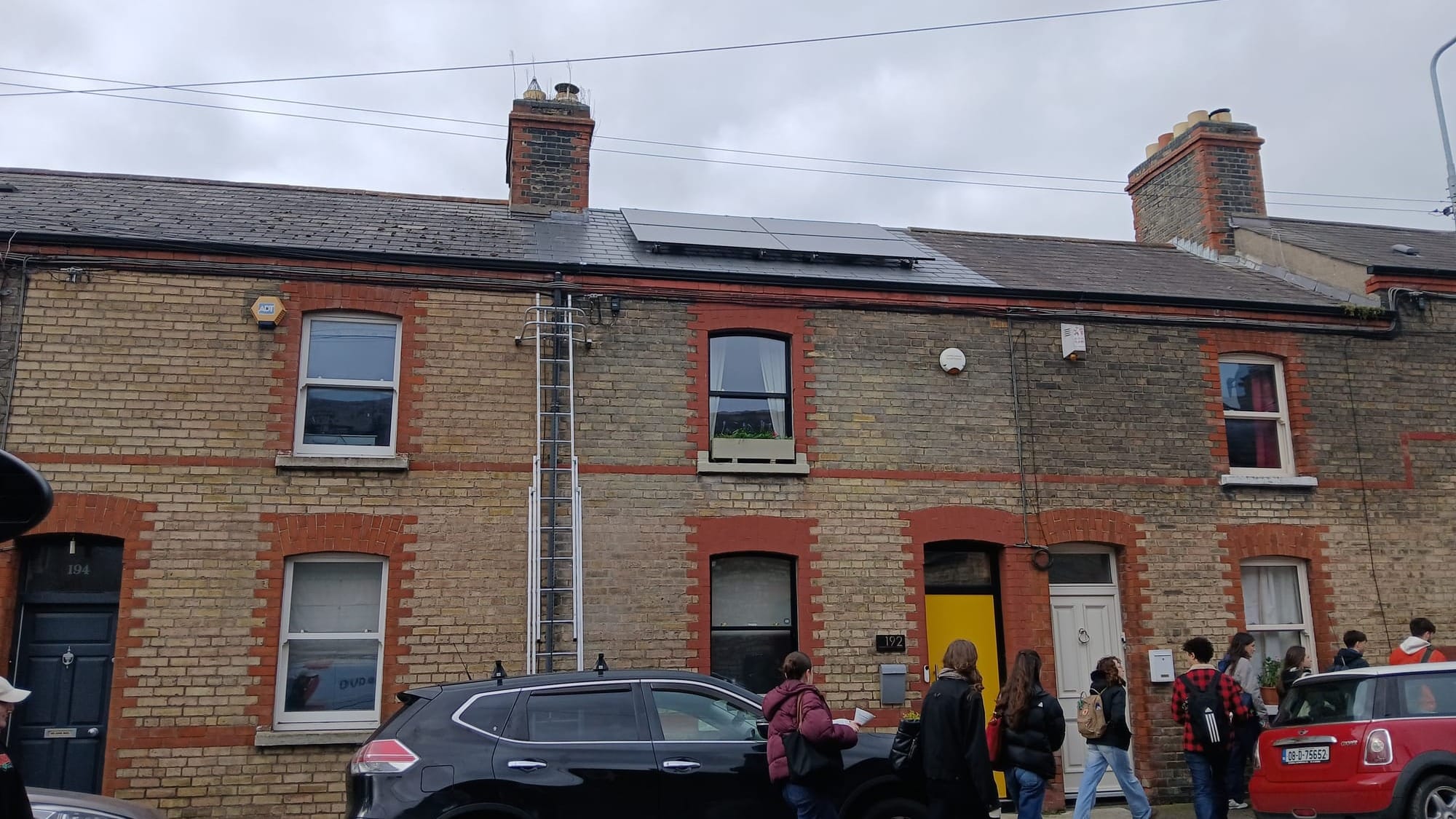
Dublin City Council should chart out a real plan to roll-out solar panels for its tenants to tackle fuel poverty, said Social Democrats councillors this week.
The council has a programme to retrofit social housing. But many low-income social tenants still live in cold and draughty conditions, plagued by damp and fears of rising energy costs.
“We have a bit of time before winter comes when people are really going to start facing difficulty,” said Social Democrats Councillor Mary Callaghan, at a meeting of the council’s housing committee on Monday.
“We want to see if there's anything that the council can do to fast-track in terms of making life easier for people this winter,” she said.
A motion, put forward by party councillors, called for a clear implementation plan for this to be published within 12 months.
Low-income and energy-poor households should be up first, said Callaghan. Solar panels could save households €500 a year on electricity bills, says the motion.
At the meeting though, council housing manager Mick Mulhern said that the council doesn’t have the money to install solar panels. It is rolling out its retrofitting programme, getting to around 500 homes each year, he said.
That retrofitting includes new windows and doors, improved ventilation, heat pumps which cost around €20,000 each, said the council’s written response.
Shane Colclough, the CEO of Energy Expertise Ltd and a chartered engineer, said he is not sure that the prioritisation is right.
Solar panels are a fast, cheap and effective way to get immediate savings on energy bills, says Colclough, a renewable energy expert.
More insulation, plugging drafts and decent windows are essential works, he says, but solar panels at the moment are cheaper and more effective way to impact bills than heat pumps. “For me, installing solar panels is a quick win.”
Callaghan, the Social Democrats councillor, says she thinks “plug-in solar” could also help council tenants in old flat complexes, who have been largely left behind in the council’s energy retrofitting programme.
Ossian Smyth, the Green Party’s climate spokesperson, says the same. “They are good for tenants and apartment dwellers who generally get left out of climate-change measures.”
You can’t just plug in the panels and go, in Ireland, even though millions of other EU residents use them, picking them up in supermarkets and installing themselves.
Smyth says he has been assured by experts that plug-in solar panels are safe. He has ordered them for his own balcony, he says.
To roll out solar panels across 25,000 to 30,000 social homes would likely cost the council between €195 million and €230 million, says the Social Democrats' motion.
“If you are looking for a big, quick hit, probably it is easier to do it with PV [photovoltaic solar],” says Colclough, who recently completed a PhD in renewable energy and has researched social housing retrofitting.
The retrofitting should still go ahead, too, he says. “You shouldn’t forget that by upgrading the energy efficiency in the homes, that is a never-ending gift as the comfort is increased for the lifetime of the building.”
And, every house is different, he says.
But if he had to choose between heat pumps and solar panels, he would usually choose the solar panels, he says. “If it were me, I’d go for the quick win.”
“Everything else being equal, if you swap out a heat pump for a gas boiler, in a house that is suitable for both, you won’t save that much because electricity is so much more expensive than gas,” says Colclough.
The European Commission’s energy directorate says that in countries where electricity is more than three times the cost of gas, heating with a gas boiler can shake out cheaper than a heat pump.
In Ireland, electricity has been about three times more expensive than gas, show figures from the Sustainable Energy Authority of Ireland.
Solar panels can also be installed in a day, and the householder starts saving money instantly, says Colclough.
Dublin City Council is to spend €73.9 million on energy efficiency in social homes over the coming three years, shows the capital budget.
Current retrofits are guided by department rules, says the response issued to the Social Democrats councillors.
Homes must be insulated to a standard for a heat pump, it says.
For detached and semi-detached homes smaller than 55sqm, the standard is a bit lower – and in that case the department does recommend some solar, it says, but it has to be funded from the allocation for heat pumps.
The council spends €20,000 to install a heat pump in each home and gets a grant of €16,000 from the government, so they already have to stump up to cover that gap, says the response.
There’s no money for solar on top from that pot, they said. And, they haven’t done many homes smaller than 55sqm anyway.
Mulhern, the council housing manager, said it cannot just decide to spend the money in a different way, even if the solar panels are cheaper.
“The installation of solar PV remains under consideration going forward, subject to the feasibility of installation and Departmental funding for same,” says the council’s written response to the Social Democrats’ motion.
The Social Democrats motion also calls on the council to provide solar panels for those tenants who need them the most first.
Louise Bayliss, head of social justice and policy with St Vincent Depaul, says that as electricity costs rise, the real value of supports for households in fuel poverty falls.
The fuel allowance is €35 per week in winter. That buys far less electricity than it did five years ago, she said. “The increasing electricity price is eroding those as meaningful supports.”
Government should consider ways to target energy supports to those people with the lowest energy ratings, says Bayliss, as they have the highest fuel costs.
The council’s written response to the Social Democrats motion, however, says that it cannot target support to tenants who need them most first.
One reason it gives is GDPR. “In order to prioritise low-income and energy-poor households, we would need to obtain certain information on our tenants, which are GDPR issues,” it says.
The General Data Protection Regulation does not prevent public bodies from processing information. It just requires that information be processed for the intended purpose.
At the meeting, Mulhern also said that picking out those most in need would reduce efficiency.
“We do about 500 homes a year,” he said. “Where we get our efficiencies is where we go into an area, and do an area. It’s completely inefficient to pick properties in different parts of the city.”
Later on the phone, Callaghan, the Social Democrats councillor, said the rollout of the councils' retrofitting and insulation programme is “disappointingly slow”.
Dublin City Council has upgraded more than 10,000 homes so far, according to the council's response to the motion.
Mulhern, the manager, said that they are doing 500 homes a year at the moment.
The council should offer more solutions for tenants in old run-down flat complexes, Callaghan says. It could provide plug-in solar panels for balconies, she said.
Smyth, the Green Party’s climate spokesperson, has been calling for the government to make plug-in solar panels – those already certified in other EU countries – legal for households to buy and install themselves.
“You just hang them on your balcony and plug them in,” says Smyth by phone on Thursday.
They can help to power ordinary household appliances for free at times when the sun is shining, he says, making them the ultimate sustainable form of energy.
Most governments support “don’t reach tenants and don’t reach people who live in apartments”, he says. The council absolutely should provide its tenants in social housing flat complexes with plug-in solar panels, he says.
In February, Green Party TD Roderic O’Gorman asked the Minister for the Environment, Fianna Fáil TD Darragh O’Brien, when plug-in solar will be permitted in Ireland, without professional installation.
Officials in the Department of the Environment ran a consultation starting in September 2024, said O’Brien.
“Broadly speaking, responses to the optional provision to promote plug-in mini solar systems were negative,” said O’Brien.
“Concerns arose where such mini systems could be purchased and installed, but do not meet the required manufacturing, installation, or operational standards,” he said.
Smyth says he has consulted experts, including university professors, who assured him that there is no relevant difference between electrical systems in Ireland and Germany.
Two million people in Germany is a sufficient pilot, he says. “The Germans are not wild people who take massive risks,” says Smyth.
He is not waiting for the go-ahead, he says, and has ordered panels for his own balcony already.

More than 10 percent of the notified homes turned into, it seems, holiday lets.

An Post has been struggling to find a new contractor in the area, said its spokesperson on Monday. “Even finding a suitable premises has been a huge issue.”

“Any organisation that does not rigorously enforce Garda vetting for every adult working with children is failing in its fundamental duty of care," says Terry Dignan, of the Children's Residential and Aftercare Voluntary Association.

Reviving 114 to 116 Capel Street is part of the council’s wider effort to meet recommendations around tackling vacancy made by the Dublin City Taskforce, a council spokesperson said.