

Maybe people shouldn't be able to collect social welfare at GPO, Arnotts lobbies
The company behind the Henry Street department store raised the idea with the man in charge of the regeneration of the city centre, returns show.
Woodturners share what they know, says Cathal Ryan, chair of the East Central Chapter of the Irish Woodturner’s Guild. It’s why the guild exists.

The hall quietens as Kieran Reynolds starts to talk.
He has demoed at the chapter for a couple of years, he says, mic-ed up with a rig that is hooked around his ears.
In the past, he’s gone for gimmicks, off-beat items, he says. Today, he is reflective.
“I kind of want to go back to what I love in woodturning,” said Reynolds, a woodwork teacher by day at a secondary school in Crumlin.
Back to the time he first saw a natural-edge bowl, he says, and paused on it and thought: “How in God’s name did the person do that?”
When Reynolds started to turn, it got to him, he says, working a tree branch into a smooth shiny bowl with a flat top. “You’re almost twisting the soul of the wood.”
A natural-edge bowl seemed the answer to that, he says, still letting nature have its say – and so that is what he plans to demo today.
He holds a bowl he made earlier. It is fluted, not round and he passes it between his two hands as he talks.
He shows it to the audience bowlside up, and side on.
It’s carved of golden yew, always found, never bought, with an outer band of yellow sapwood – and a thin rim of rough bark.
It’s that bark that he loves, he says. “You all know when you look at that, that that comes from a branch.”
Reynolds hands the bowl to one of the men sat in front of him to pass around.
There are four rows of seats set out for today’s seminar, filled by members of the East Central Chapter of the Irish Woodturners’ Guild.
The chapter meets at 2pm on the second Saturday of every month, at the Santry Scout Den in Beaumont.
It’s a big hall used for all sorts, with one wall covered with climbing holds, and “save the bees” posters taped to another – and today, a big lathe on wheels and cameras and screens.
Woodturners share, says Cathal Ryan, chair of the chapter, later during a break just outside in the sunshine. “You don’t get that with a lot of good crafts.”
People want to be top dog, says Chris Hayes, standing opposite, his hand on a walking stick to steady himself. “A professional once said to his pupil, ‘I’ve taught you all you know, but not all I know.’”
That’s what happens sometimes, he says.
Well, making a living off something, you need to keep an edge, says Ryan. But “not many people are making a living off wood-turning”.
Joe O’Neill pipes up. “There is! The toolmakers!” he says, with a grin.
The origins of the Irish Woodturners’ Guild make it different, says Ryan. It was set up to spread the craft, to bring scattered enthusiasts together to grow.
From its earliest days in 1983, it welcomed all. Beginners and pros.
And gradually, affiliated chapters spread across the island of Ireland, from the 1980s through the 2000s, from Cork to Down. Today, there are 18 chapters.
The East Central Chapter first met in 2005, says Hayes, who helped get it going.
It branched off from the South Dublin group in Templeogue, he says. “It got very crowded.”
The chapter had 10 members at first, says Hayes. That’s the minimum for an affiliated chapter. It’s more than double that now.
It’s been up and down. Covid knocked them back, Hayes said. Their members are older, he says, so they sadly lost several during the pandemic.
Membership is rising again now, though. “It’s grown like anything in the last year or two,” he said.
More women and younger folks would really be welcome, says Kevin McLaughlin, another chapter member. The room skews grey, but there are young turners too, he says.
Since its earliest days, members of the Irish Woodturners’ Guild have brought in demonstrators to learn from – and shared their own skills overseas.
Early seminars brought in names such as American artist David Ellsworth and British craftsman Ray Key, says a history of its first 25 years. Irish co-founder Liam O’Neill, meanwhile, went to lecture in Utah.
Ireland has a long history of utilitarian turning. But, with the exchanges, artistic turning has grown in recent decades too, the history book says.
Seminars with demos have stayed at its heart.
Last month, the East Central Chapter was visited by Emma Cook, the Tiny Turner. A wood artist from Yorkshire, her works are splashed with colour.
Coming up is a seminar led by Tom Windross, from Waterford, who is already known already for his elemental bowls and burnish.
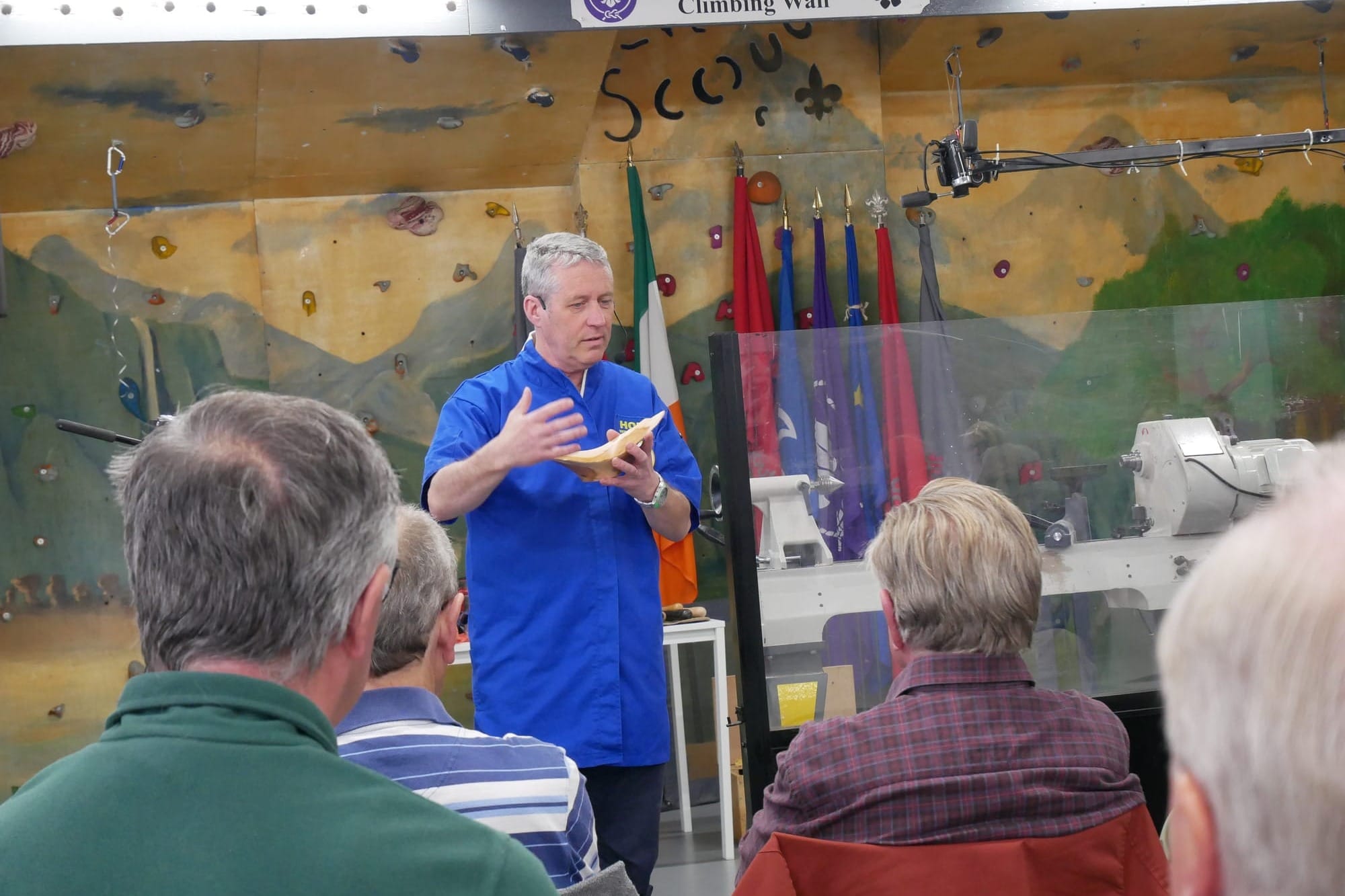
On Saturday, at the front of the hall, Reynolds narrates all that he does. How he measures the log. How he takes note of a small burr.
“Can you see on the camera there?” he says, angling the branch.
There are two big television screens on poles, set up to one side. One shows a view of the lathe from above, the other side on.
Reynolds locks the branch on the lathe.
He swings the wood around to check the balance, and that each end is the same height, grazing the log against the tips of his fingers.
There’s talk of tools too. The ⅜-inch bulb gouge is his favourite, he says, but the ½-inch is good for roughing out the wood.
He turns on the lathe. He starts it slow. “Step away,” he says, stepping back. He crouches a little, down to lathe-height.
“Who’s in line?” he says, with a laugh, looking through the plastic sheet to the audience. Who would get hit if the wood flies off that way.
The wood clicks as he starts to take the corners off. He’s using a push cut, he says. “I have the chisel nice and low.”
Watching on, the audience throws out questions.
“Have you ever actually had a reaction to yew?” Cathal Ryan calls out from the side. His arms folded, casual.
“No,” said Reynolds, looking up for a moment. But “laburnam, yes”. He would wear a mask, working with both, he says.
Which stays better on the piece, winter bark or summer bark? asked McLaughlin.
Winter bark sticks better, says Reynolds. Gathered when the cambium layer is harder and the sap isn’t flowing.
Bit by bit, Reynolds speeds up the lathe. He tucks the gouge close to his body, the handle at his waist. It gives more control that way, he says.
Reynolds watches the silhouette. The click of the wood becomes a hum, and the thin bowl’s edges turn to air as it spins.
“I can go in now, and start taking the centre out of that,” says Reynolds, after almost an hour of demonstration.
He adjusts the lathe. Gets a smaller gouge and gently starts to carve out the walls.
Moments later, the edge of the bowl snaps. The audience groans.
“That’s what you don’t do,” says Reynolds, stepping back. “Anyway, right.”
He rallies quickly though, and moves on to explain how to finish the bowl’s base. He had just caught the pith, he says, the soft spongy core. “These things happen.”
A while back, Des Harborne made a chess set for his sister’s husband, says Harborne, another founder of the chapter. It took months.
“She gave me a year’s notice, thanks be to God,” says Harborne, during the coffee break. “I only had it ready about a week before his birthday.”
Jim Cashin makes modest objects, he says, pulling two pens from his pocket. “I have a very small lathe.”
They’re rosewood perhaps, he says. He can’t quite remember. “The pens make presents, gifts,” says Cashin.
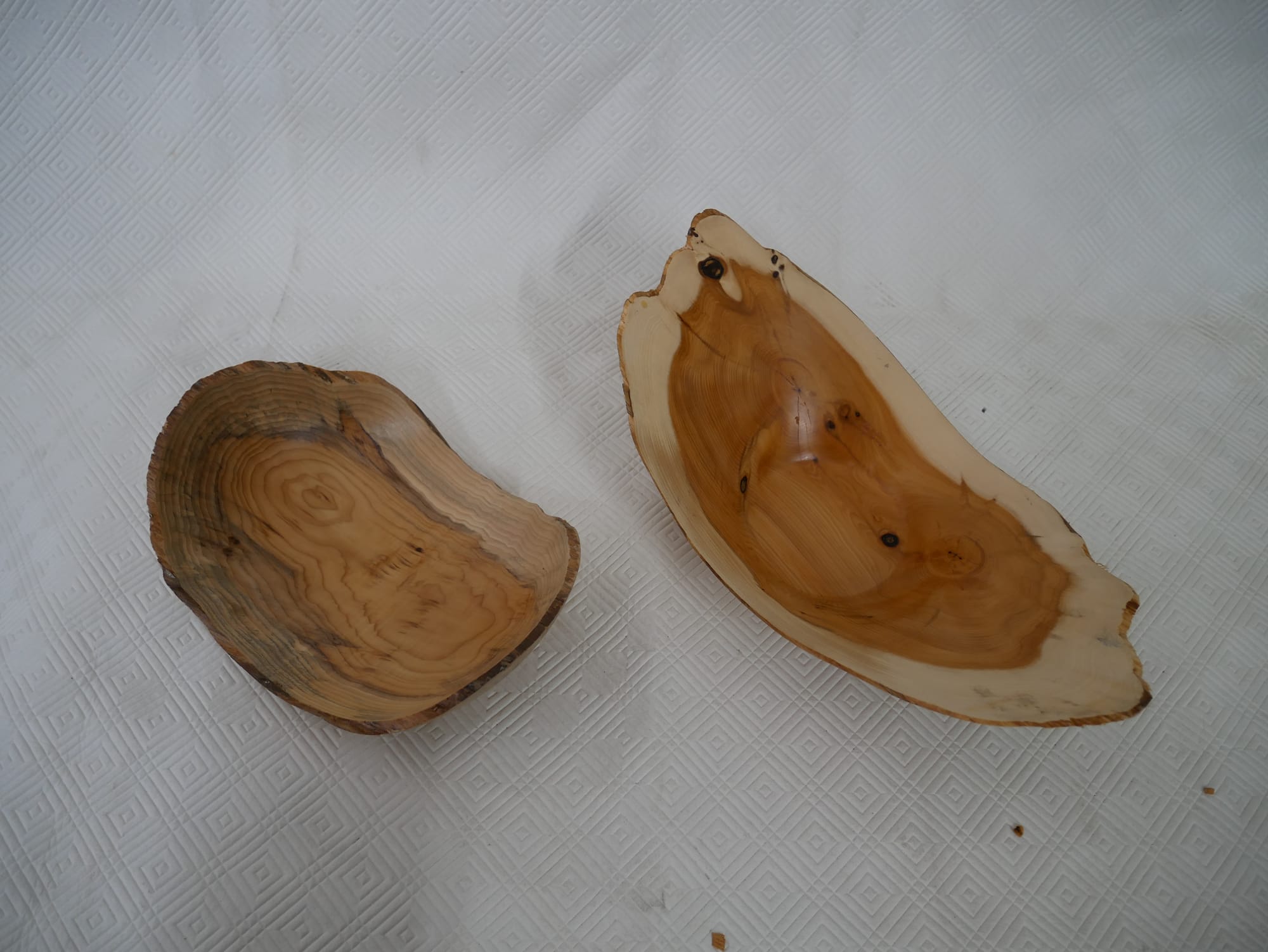
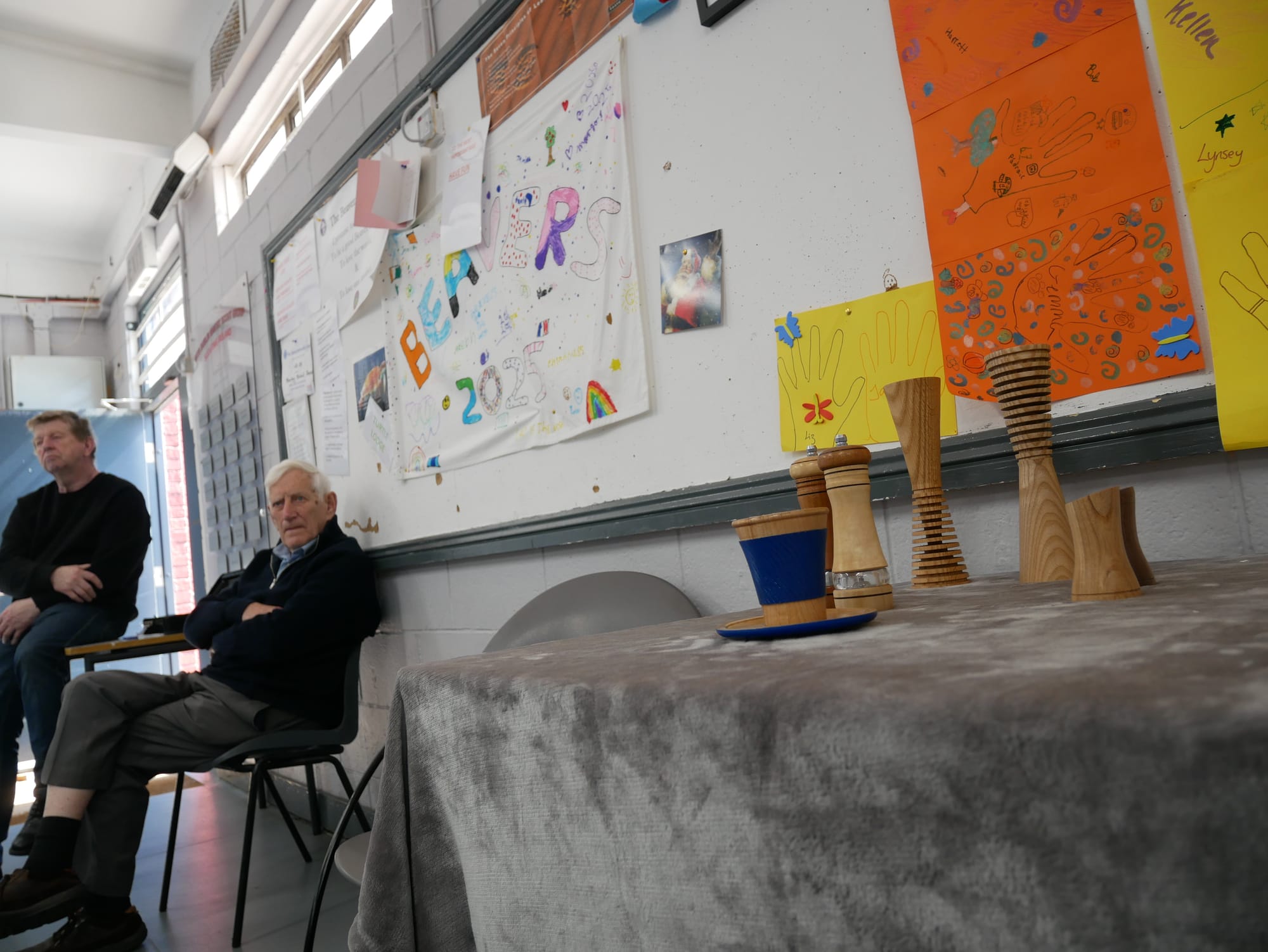
Natural bowls; and the competition table. Photos by Lois KapilaKiKieK
Beside Cashin, on a table, are entries to the chapter’s monthly competition.
There are two tall candlesticks with ridges, and a small cup and saucer with ribbons of blue, and a wooden tulip in a vase.
Each competition has a theme. This month is a contrasting pair. June is a gavel and block.
When the break ends, members drift back to their seats. Reynolds – who is seminar coordinator for the national guild too – is again at the front of the hall.
He is telling people about a bursary opportunity. It’s not meant for professionals, so don’t rule yourself out, says Reynolds.
It’s for anybody who has a vision for stepping up their craft, he says. “You’re looking at, you want to move yourself forward somehow.”

The musician says her new album, Draw the Outline, brought her “great solace and peace in writing it. I hope it can do the same for whoever needs it.”

Ross McClean’s new documentary is playing on Saturday as part of the Irish Film Institute’s Documentary Festival 2026.

She didn’t expect to become "Facebook famous" at 61. “It's gas. I don’t like front-of-house,” she says, “keep the head down.”

But viewers seeking a beat-by-beat summation of jazz musician Bill Evans’ career will be disappointed by Grant Gee’s film, which is not meant to be a biopic.