

What to do with the horses of Darndale?
Grazing in public parks means other uses are being pushed out, and adding momentum to calls for an equine centre and stable club to properly support horse culture in the area.
This is “a relatable, moving and hopeful portrait of a group that disintegrated in a very un-rock ‘n’ roll way”. And then gets another chance.

It’s the mid-1980s and in the bordertown of Bailieboro, Co. Cavan there’s not much for a teen boy to do beyond eat chips, sneak drinks and get into fights.
Four school friends – Justin Kelly, David Meagher, Noel Larkin and Paddy Glackin – raging against their one-horse town existence, form a band, the Panic Merchants.
From there, they dream of fame, fortune, bright lights, big city. But it doesn’t quite turn out like that, as we see in the new film Once We Were Punks.
Justin Kelly, the Panic Merchants’ vocalist and lyricist was the son of disgraced Army Captain James Kelly who was at the centre of the Arms Crisis of 1970.
Captain Kelly was tried for trying to illegally import arms for the Provisional IRA, a scandal that led to the dismissal of then cabinet ministers Charles Haughey and Neil Blaney.
Although he was eventually acquitted, the fallout meant a big move for the Kelly family away from Dublin to quiet Bailieboro.
Much of the fire and vitriol in the band’s lyrics came from Justin grappling with his father’s treatment by the state.
Channelling these feelings into music comes off as somewhat accidental. Like all great teenage bands, the group came together by happenstance and cajoling: “You’ll play the drums, doesn’t matter that you don’t have a kit.”
Once We Were Punks is a relatable, moving and hopeful portrait of a group that disintegrated in a very un-rock ‘n’ roll way.
Life happened for the boys. Careers, family and travel. The Panic Merchants faded away before they could burn up.
This was not a case of almost famous, or could-have-beens or has-beens because they never were.
Early sequences in the film plot the band’s formation, blink-and-you’ll-miss-it rise, and parting of ways.
Kelly and Meagher, on vocals and guitar, are the most serious about the band. But by their own admission, they weren’t all that serious about it.
The consensus from all members of the Panic Merchants, and their family members, is that it was a fun time but ultimately the talent and drive wasn’t there.
Their last official gig was at Meagher’s wedding. A suitable end to a dream that got overtaken by other more tangible dreams and desires.
Kelly reads over some of his old lyrics with much embarrassment and some nostalgia. The lyrics are the sort you’d find in the margins of foolscap journals.
Raw and unashamed. A kid’s idea of adulthood. Seeing Kelly now in his fifties reading the thoughts of his past self is quietly moving.
The film’s director, Frank Shouldice (The Man Who Wanted to Fly) closes in on the stirring of memories within his subject. The camera moves in on Kelly's face, as if to catch him by surprise and capture the space between his fully formed thoughts.
Glimpsing that place where raw emotion comes through, the rapid blinking of an eye, the welling of a tear, almost imperceptible. There and gone again, but caught in the swivel and zoom of the camera before a cut brings us back to the ’80s, or further along in the film’s present concerns.
When Kelly and Meagher reconnect at a funeral 25 years after the band parted ways they have a jam for old time’s sake. Playing the old songs feels good. There might be something here for them.
What could have been a once-off reminiscence becomes a new lease on life as the band reforms through the magic of email.
They swap lyrics, vocal lines and music. Writing new songs in bits and pieces. The DIY spirit of their punk beginnings hasn’t been lost.
Somewhat improbably, the years between iterations of the group, now called The Sons of Southern Ulster, have worked in their favour.
Meagher is an accomplished musician and amateur producer. Kelly, sheepish as he is about his past lyrics, writes now with one foot in the past.
Kelly mines the life and times they had in Bailieboro in songs that filter the thoughts of a young man through the lived experience of the subsequent years. The raw emotion is there, and so is that vitriol, but with a new perspective and gravitas.
In one song, “They Say I Live in the Past”, Kelly sings that he’s “dedicated himself to history”. He is a folk-punk historian shouting his way through space and place and memories of bordertown living.
Kelly doesn’t really sing his lyrics. He belts out melodies here and there but with a strain in his voice. Mainly the stories and vignettes of local characters and situations from his youth are delivered in a sharp and snappy spoken-word style.
Carrying a notebook on stage he looks like one of the alternative comedy set or a slam poet as he recalls sticky bar room floors, local widowers, and the boot factory where most of the characters will work “all [their] fucking life”.
The Sons of Southern Ulster generate buzz with independent releases and one song “Fear my Scorn” (“Do not fear my fist but fear my scorn/My silence my disdain/The howling mob that brays and points shall haunt you every day”) catches the attention of producers and promoters alike.
Here is another chance, maybe a first chance, at greatness. The band reunites, coming from home and away to play a gig at Whelan’s in Dublin. There’s disagreement between the bandmates as to whether or not they’ve played Whelan’s before. But the gig feels much more like a first lap than a victory tour.
David Allen, the booker at Whelan’s, is sceptical. The Sons themselves have doubts as well. Their songwriting process, as captured by Shouldice and his crew, is studio-led, cut and paste; they're not a live band at all. They were barely a live band 25 years ago.
We sit in on practice sessions in the run-up to the concert.
The atmosphere is surprisingly chill. The bandmates all get along and frustrations don’t spill over into rows.
The expected drama of egos and walkouts never comes. These are men who enjoy one another’s company. An ever-present multipack of Tayto in the rehearsal space really sells the ambling amiable vibe that the band has going.
Once We Were Punks is a much more grounded film than The Man Who Wanted to Fly, but the director still manages to show off some excellent highflying camerawork.
As the gig approaches, practice sessions stretch on into the night. The steel shed rehearsal space is the only building lit up for miles, glowing warmly in the night. The camera rises and flows with the music sounding out into the quiet country air.
That same cinematic treatment is carried over to the gig itself.
Shouldice employs all the concert-film tricks. Frequent shots of the audience, embedded footage from behind heads. We see people head banging and swaying to the songs. It’s a packed house.
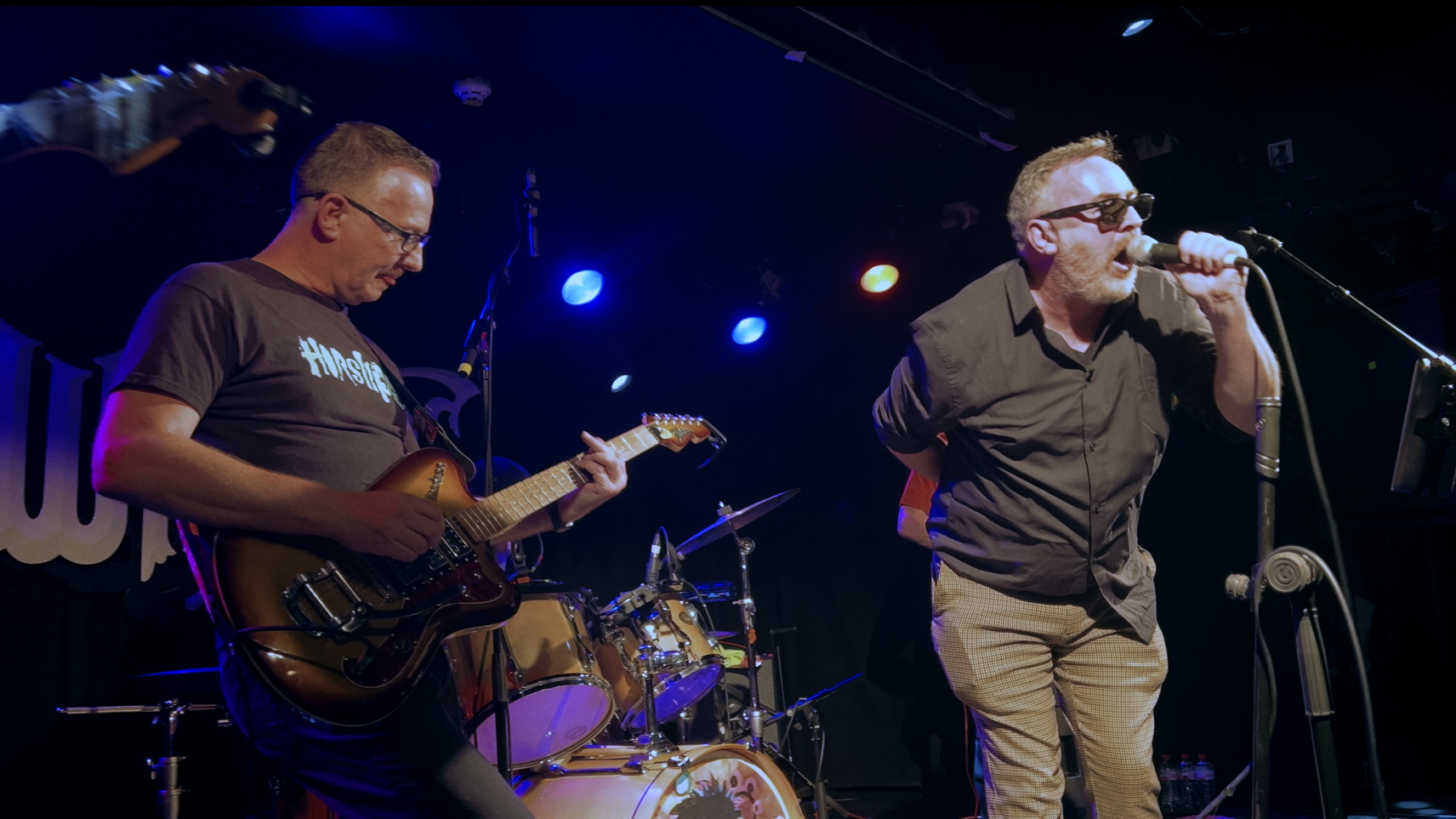
And despite some last-minute drama with a sore throat, The Sons of Southern Ulster play a gig that is worth waiting their whole lives for.
It struck me when watching the gig that Kelly, Meagher, Larkin and Glackin are working a spell on the audience. The songs are rich in local detail but not nostalgia.
Overstuffed with the sounds and sights and smells of their youth. They meet the past head-on. Grappling with the same feelings that Justin and the band felt as teens, they rewrite and write new meaning into these experiences.
Not missing these places or things necessarily, but longing to be those people again, the way they were.
Only, you watch the performance, the rehearsals and the interactions among The Sons of Southern Ulster and you see they are those kids, whether they realise it or not.
Once We Were Punks is due to be in cinemas from 15 May.

The chapel on the ground floor is too small for a theatre “but it's the kind of place where you could have recitals, a piano player or string quartet”, says Diego Fasciati, the executive director.

The musician says her new album, Draw the Outline, brought her “great solace and peace in writing it. I hope it can do the same for whoever needs it.”

Ross McClean’s new documentary is playing on Saturday as part of the Irish Film Institute’s Documentary Festival 2026.

She didn’t expect to become "Facebook famous" at 61. “It's gas. I don’t like front-of-house,” she says, “keep the head down.”