

Start of construction at Guinness Quarter is near, says developer – as it seeks tweaks to planning permission
Proposed changes include dropping three-bedroom homes, in favour of more smaller ones in the block of future social housing.
Both Francie Conway and Hugh Buckley have been teaching at the legendary institute since its opening chords in 1989.

On Wednesday morning, in the arts block of Ballyfermot College of Further Education (BCFE), Francie Conway sits in his classroom – the furthest one from the front door.
It is here that the famous “Rock School” has operated from for the last 37 years. But this month, the last of the original staff are standing down.
Outside Conway’s door, a sign reads: “Please keep the noise/sound to an acceptable level.”
“I don’t think I’ve ever noticed that,” says Conway, chuckling in his distinct gravelly voice.
Also in the room is Andrei Yolkeen, a second-year student. He is going through one of Yolkeen’s own songs.
The bridge, or “middle eight”, needs some work, Yolkeen had said. Conway agreed to chat through it with him.
Conway points to “(Everything I Do) I Do It for You” by Bryan Adams as a reference point for a great bridge – helped along by Mutt Lange’s production, Conway says.
The pair chat about the impact a good bridge can have, how it can change the point of view for the listener – and how the old Tin Pan Alley songwriters would use them.
Conway looks over Yolkeen’s lyrics. “There’s a song in there,” he says, encouragingly.
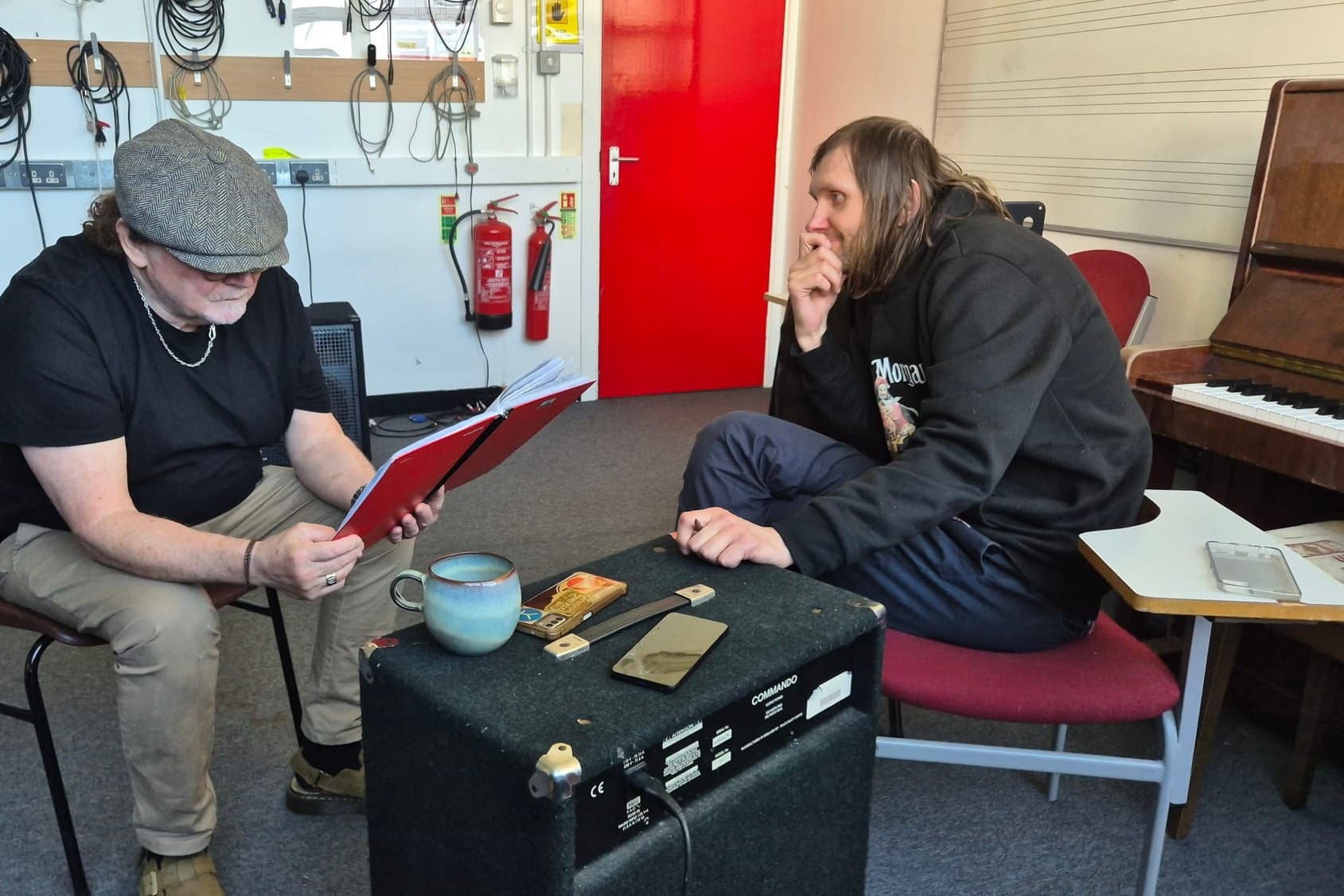
This meeting of teacher and student may be Conway’s last in the hallowed halls of the Ballyfermot Rock School, where he has taught the songwriting modules since the course started in 1989.
Both he and Hugh Buckley – another ’89 original – gave their final full classes last month. From here, it’s just the wind-down with assignment corrections and formalities.
They were the last two remaining from the first crop of teachers.
It’s a big change, says Buckley, sat in the room where he has taught courses like guitar, improvisation, and music theory, among others, down the years.
But at the age of 67, it’s the right time to say goodbye, he says.
“The great thing is, almost no matter where I go, I meet a former student. It’s amazing,” says Buckley, a well-known jazz guitarist.
In 1989, the then-principal of BCFE, Jerome Morrissey, came up with the idea of a first-of-its-kind course in Ireland, said Conway.
It would teach students the ins-and-outs of the music business, as well as contemporary music performance and songwriting.
Working with Keith Donald, the popular music officer at the Arts Council, the pair hammered out what was needed. Soon after, says Conway, the Rock School was born.
Conway had been living in London where his label and publishers were based.
He came home to Ireland still basking in a successful career as a songwriter, he said. “I had a few hit records, some covers under my belt, a good publishing contract, good record contracts.”
When he got the call asking to get involved in the Rock School, he wasn’t quite sure, he says. “I thought, ‘Is this a joke?’”
He said he would help out for three weeks, but that was it.
“Then I met the team. I met Hugh Buckley, I met Matt Kelleghan, I met bassist Tommy Moore. I mean, these incredible guys,” he said. It suddenly felt so exciting, he said.
In the 1980s, so many bands would move to London, and break up soon after, when they didn’t “make it”, says Conway.
They didn’t realise there was also Germany, Holland, Sweden, he says. “All these huge markets to try out. The course was going to arm them with what they needed to know.”
Kelleghan was a drummer, and known for his work with Moving Hearts, the folk-rock supergroup.
He would teach drums and act as course administrator, the head honcho.
Kelleghan stepped down from his role in the college a few years back, he said by phone on Thursday. “I was there from the start, and it was a big, huge undertaking.”
Graduates of the Rock School now receive a Level 6 Higher National Diploma in Music. But to be accredited took research and module preparations, he said.
Kelleghan fondly remembers a shopping spree to buy the Rock School’s first back line – amps, a PA system, mixers, instruments.
“Jerome had the cheque book. I was there saying, ‘I’ll have that. I’ll have that JC 120 Roland amp,’” he said. “It was great.”
Like Conway, Buckley thought he was only giving the course a small dig-out as it got off the ground. He didn’t imagine he would be there 37 years later, he said.
He started off teaching just one hour a week on music theory, he says.
His own curve had started as a rock guitarist, until in his twenties he began to drift into jazz, and so had to teach himself theory as he went along, he says.
Suddenly, he was teaching to others what he had been teaching himself.
His responsibilities soon grew into teaching the guitar class – and other courses, too.
He was still an active touring musician at the time. The college management was cool with that, he says.
“They were accepting of the fact that their teaching staff were also still working musicians,” he says.
Looking back now, Buckley says the biggest challenge and the biggest joy was realising that you have to approach education differently with each person, he says.
“Not everybody internalizes stuff in the same way,” says Buckley, “that might be the biggest lesson of the whole experience of teaching.”
For Conway, the steadiness of the teaching gig became a blessing. His own touring career came to a sudden halt in the early 1990s.
His son Rory was badly affected by meningitis at the age of two, and continues to need care, says Conway.
Not being able to venture out into the world of live music as much anymore, he relished that live music was now coming to him, he says.
For both, being a part of, and helping to build a whole new community of musos, was the great thrill.
From day one, says Kelleghan, the greatest excitement came from seeing the students they had walking through the door.
For singer-songwriter Damien Dempsey, the Rock School altered the course of his life, he says.
He was accepted after playing a song to Conway at the interview, he says. “And then acknowledged for my original style of songwriting and encouraged to keep going in the style I was writing in.”
That really helped him in his formative years, he says.
Conway taught him about the structure and formation and goal of songwriting and songs, he says. “That they can give people hope and validation and connection that helps people through life.”
Conway says that the aim was to help students get out of their own way.
To help them to be true to their own voice and instincts, he said. “The class here in Ballyer has always been about trying to find the individual.”
In Buckley’s class, Dempsey learned scales, warm-ups and theory that opened up the fretboard, he says. “Like a can opener.”
Buckley showed his students how to look at music mathematically, says Dempsey. “You can see chords and notes in your mind in a third dimension, that makes a guitar’s fretboard into a nirvana.”
Buckley is a Kilbarrack man, said Dempsey, “which is the next parish over from me and was a tear-away in his youth as I was myself”.
“But he thankfully channelled his wild energy, as did I, into something bigger and more beautiful than us,” said Dempsey.
He was inspired by him, he said, as a person and as a musician. “His majestic playing and kindness and wisdom that he passed onto me, and his fun and slagging.”
One formative moment was a concert for pupils, organised by the college staff, in the Baggot Inn.
Dempsey sang his song “Rollercoaster” and, for the first time, he says, heard the room sing one of his choruses back to him.
“It was like a lightbulb moment,” he says. “I thought, ‘I’m going to get people singing all the time, as one. Communal singing. As one big living, breathing organism – just singing all our cares away’.”
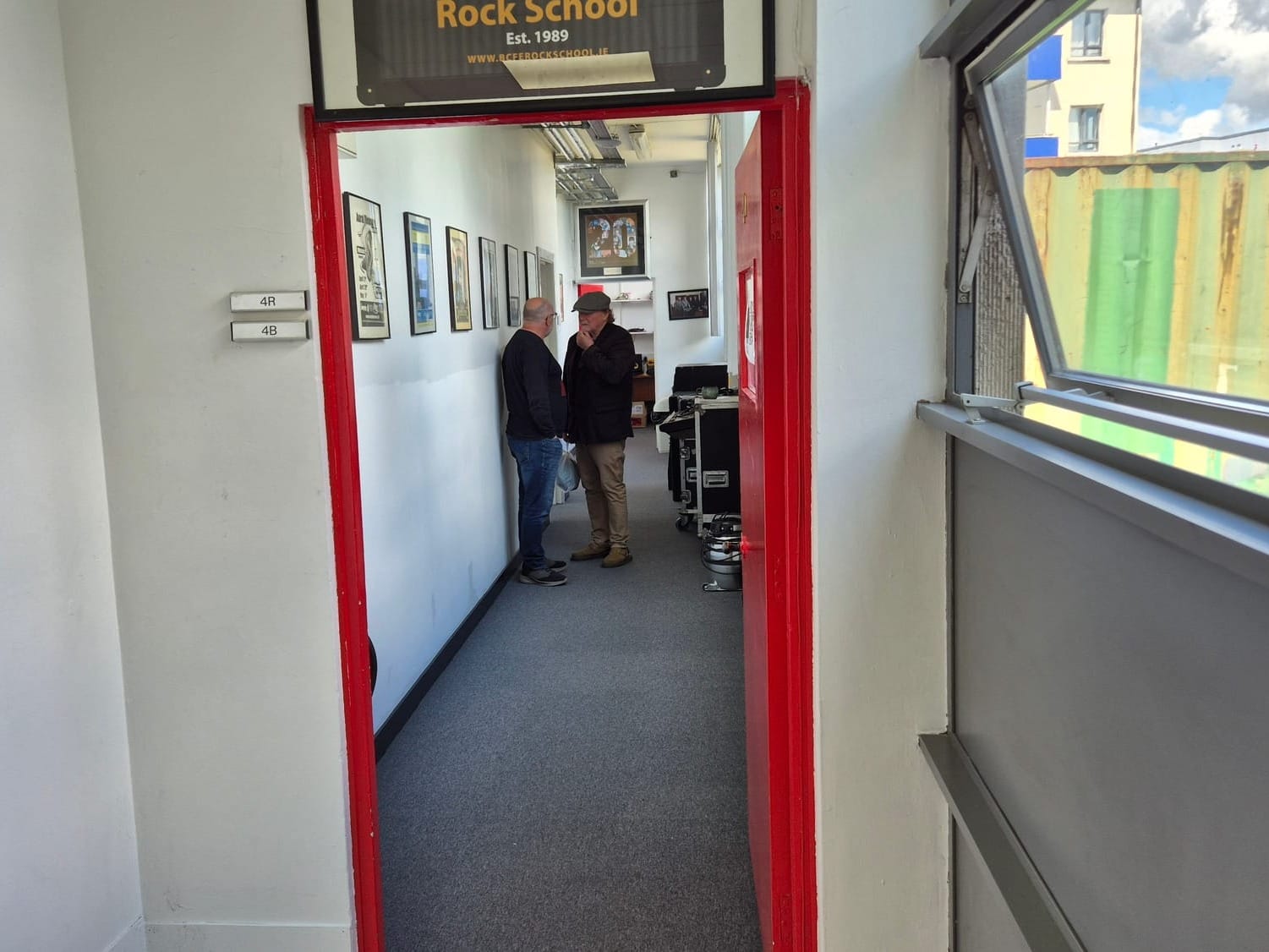
Looking out the window just outside his classroom, Conway points to the boundary wall.
He remembers spotting a young Fiach Moriarty – the songwriter known for his solo work and as a guitarist with ALDOC and Horslips – hop over the college wall and leg it for class.
Moriarty lived next door to the college. He couldn’t see himself going anywhere else, he said on Wednesday – much to his mother’s initial dismay, as he had been accepted to study history at Trinity College.
Like Dempsey, the Rock School slowly brought him out of his shell. “I don’t think I spoke to anybody the first two weeks.”
There were so many artist and performer types with bold personalities, he said. “I come from a place where big characters are seen with suspicion.”
But devoid of any pretension themselves, the staff all made him feel at ease, he says. “They were just older versions of what we were going to become.”
It wasn’t just the formal lectures, said Moriarty.
Listening to staff stories – the successes, the mistakes, how they learned from them, how to work with other people – was an incredible education in itself, he says.
After getting over his early shyness, Moriarty says, the Rock School is where he found his tribe.
And, where he met his wife, musician Clara Hutchinson. They were students together. Now, they’re parents, raising two daughters in Carlow.
Jennifer Healy remembers being encouraged by Conway to perform an original song in class, she says.
Now also a music teacher, Healy has toured with the Orchestral ABBA Experience, sang at the Eurovision with Nicky Byrne in 2016, and fronts the event band Poplife.
“I had never played one of my own for anyone before and in my mind it was very basic pop compared to the shoe-gazer songs from the other students,” she says.
She told Conway that, she says. “He just simply said, ‘Well, we know that pop sells! So nothing wrong with pop once it’s good!’ Which gave me the confidence to perform it.”
She had just turned 17 years old when she joined the Rock School, she said. “The only performance experience I had was musical theatre shows with the Billie Barry Stage School.”
Buckley, she says, encouraged her love for “all things ear training”, which she carries with her now as a music teacher herself, a choirmaster, and as an arranger of vocal harmonies in studio sessions.
“He was such a passionate teacher and always had a smile on his face,” she says. “I still see him at gigs and he somehow still remembers me and always asks me what I’m up to.”
Eamon Brady took over as course administrator from Matt Kelleghan around 2015, he says.
The departure of the last two originals is a big milestone, he said on Thursday by phone. “The last two from that original foundational year, 1989. It's kind of amazing.”
The school has changed, of course, over the last 37 years, said Brady. But Buckley and Conway have been a big part of those changes as well, he said.
Brady says he remains in touch with some of the other college legends who have stood down over the years.
People like Kelleghan and Pete Holidai, the punk rock icon of the Radiators from Space, who taught the music business modules for decades.
Buckley and Conway have each left a mark that will be felt for some time, he said.
“There's a lot left behind them in the members of the staff that they have influenced and that they have taught as well,” said Brady.
And while retirement from teaching approaches, the music won’t stop, both say.
Conway is putting the last touches to an album, one he has worked on closely with Matt Kelleghan for three years, he says.
The new record, It’s Not Rocket Science, releases in August.
Buckley is ready to get out and play live internationally more, and to focus again on his compositions.
“I love travel, I love food, I love music,” he says. “If you combine them, I’m very happy.”
Funded by the Local Democracy Reporting Scheme.

“They’ve no money for windows, but they’ve how much to fill this field with even more apartments and houses?” says Charlene Paget, in Darndale.

Changes to the timeline are particularly sensitive because of wider concerns about a lack of council investment in the north-west of the city.

Once known as "Bolton House", and later the "Bolt Hostel", the building has a troubled history.

She didn’t expect to become "Facebook famous" at 61. “It's gas. I don’t like front-of-house,” she says, “keep the head down.”