The tender document for the design says the framework has a maximum estimated value of €7.5 million. It also gives a tentative construction estimate of €25 million.
Social tenants, including children, are often locked out of communal areas in their complexes. Would it help if they were represented at the OMCs' meetings?
The handwritten note is weighed down with two house keys. “Help us find a home. We just need a safe space,” it reads.
It’s one of dozens of messages, and trinkets, and household bits and bobs that make up Alison Byrne’s Shrine to the Housing Gods.
There is a wine bottle and glass, a chicken baster, a clock, a teddy bear, a screwdriver, and a houseplant.
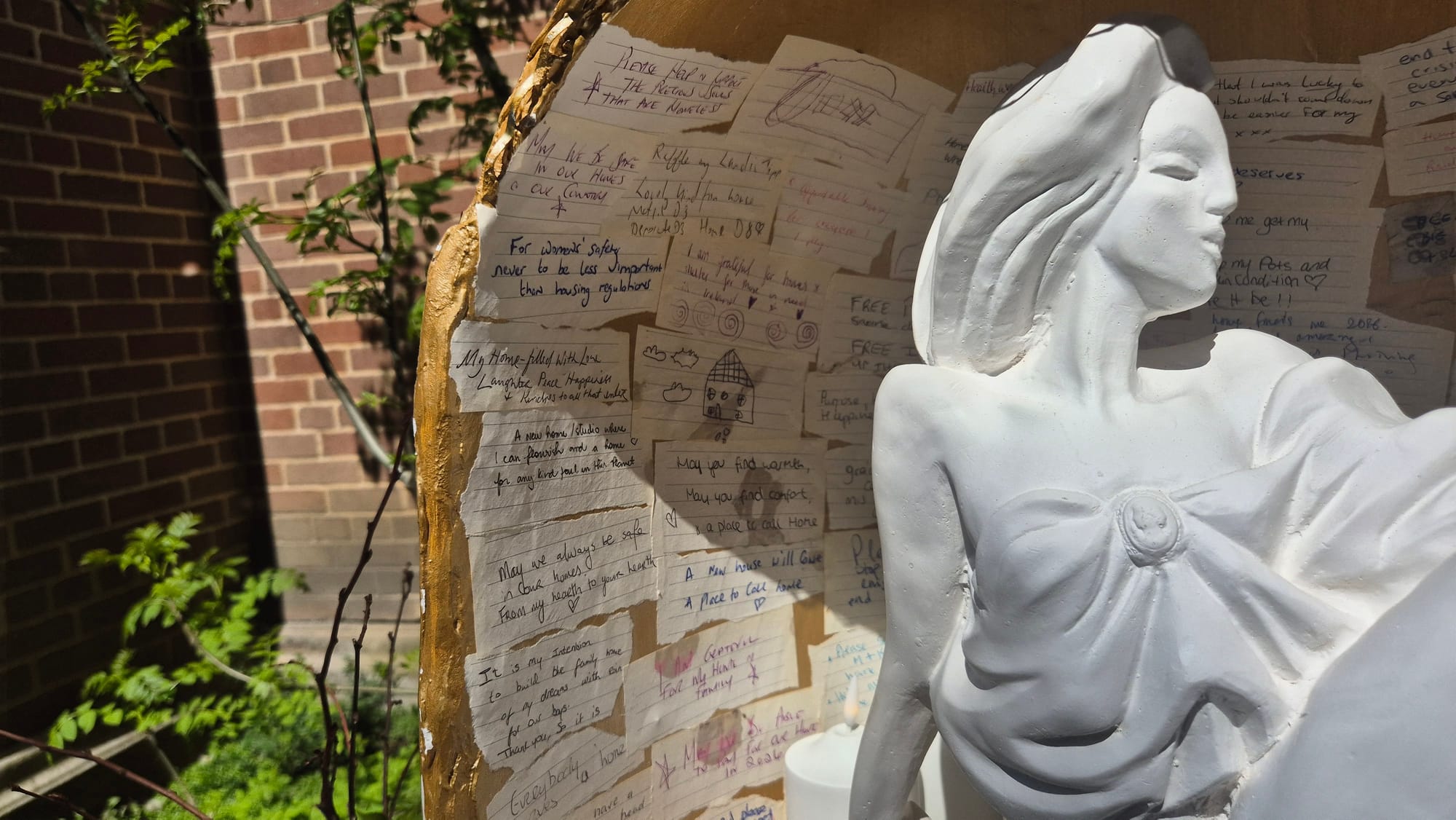
Sitting over it all is a Lady on the Rock statue – Byrne’s chosen housing deity.
Byrne, the award-winning glass artist behind WildBird Studios, was showcasing her latest work outside Phibsborough Library on Saturday morning.
It was part of Phizzfest 2026, the local community and arts festival.
“Feels sometimes like we’ve a housing devil in this country, not a god,” says Tom Davis, a pilgrim to the shrine.
At the age of 26, Davis says he is one of the only people he knows who isn’t living at home with parents and hasn’t emigrated.
“We've had about five leaving parties in the last month,” says Davis.
He rents in Phibsborough with his girlfriend and fellow pilgrim, Aoife Newman. Between them both, they can just about afford to share, they say.
It is tiny, rundown, and overpriced, they say. But they feel like “the lucky ones”, says Davis.
For most in their own age group and above, they say, there is just no hope that they’ll ever afford to own their own home – when renting gobbles up so much of their income.
Byrne, the artist, is 40 years old, and she says she has already tried the emigration thing – and it doesn’t seem that long ago.
She left Ireland during the recession in the early 2010s to live and practice in the United Kingdom, she says.
When she saw the Irish economy starting to recover, she moved back home to her parents’ house and started to grow her business.
It went from strength to strength. But rents did, too.
She was back with her parents for eight years, she says, and currently rents with two younger cousins in their twenties.
To hear young people today – just as they did just 15 years ago – saying they see no way to build the life they want here, is heartbreaking, she says.
The shrine
The shrine started with a chicken baster, says Byrne, which she would take with her to house viewings for luck.
She would get excited again and again, she says. But always be outbid.
“I have a witchy woo-woo friend, and she was like, ‘Buy something for your future house,’” she says.
As a fan of a roast dinner, the baster seemed the trick, she says. “Roasts, they're like a real kind of home thing.”
She wondered what people thought of her, she says. “Looking at me clutching a chicken baster, walking around the house. And I just laughed at the absurdity like, ‘What am I actually doing?’”
But she discovered that others also had rituals for their home-hunts.
One person would bury a coin in the garden, she says.
Another would splash holy water on the corner stones of the house they were after.
One person, she was told, would relieve themselves – number one! – on the land when the coast was clear.
“I didn't go that far, but I sucked up some river water that was beside one of the houses with my chicken baster and flung it at the house,” she says, “because why not?”
The idea for the shrine, a grotto like those to the Virgin Mary found around Ireland, grew in her mind, she says.
Her studio at the time was in The Liberties. She would pass the famous Lady on the Rock statues in windows regularly.
“So, I thought, she's a perfect deity to work with,” says Byrne.
Scattered in front of the Lady on the Rock are other offerings, from Byrne and other pilgrims.
“I started collecting bits and pieces that I thought represented needing a home or what you can't have if you're in a rented home,” says Byrne.
The drinks are on the house(s of the Oireachtas). Photo by Eoin Glackin
A teddy bear for being able to have a family and raise children somewhere safe and secure.
A booklet of paint colour samples for those who dream of being allowed to decorate their own spaces.
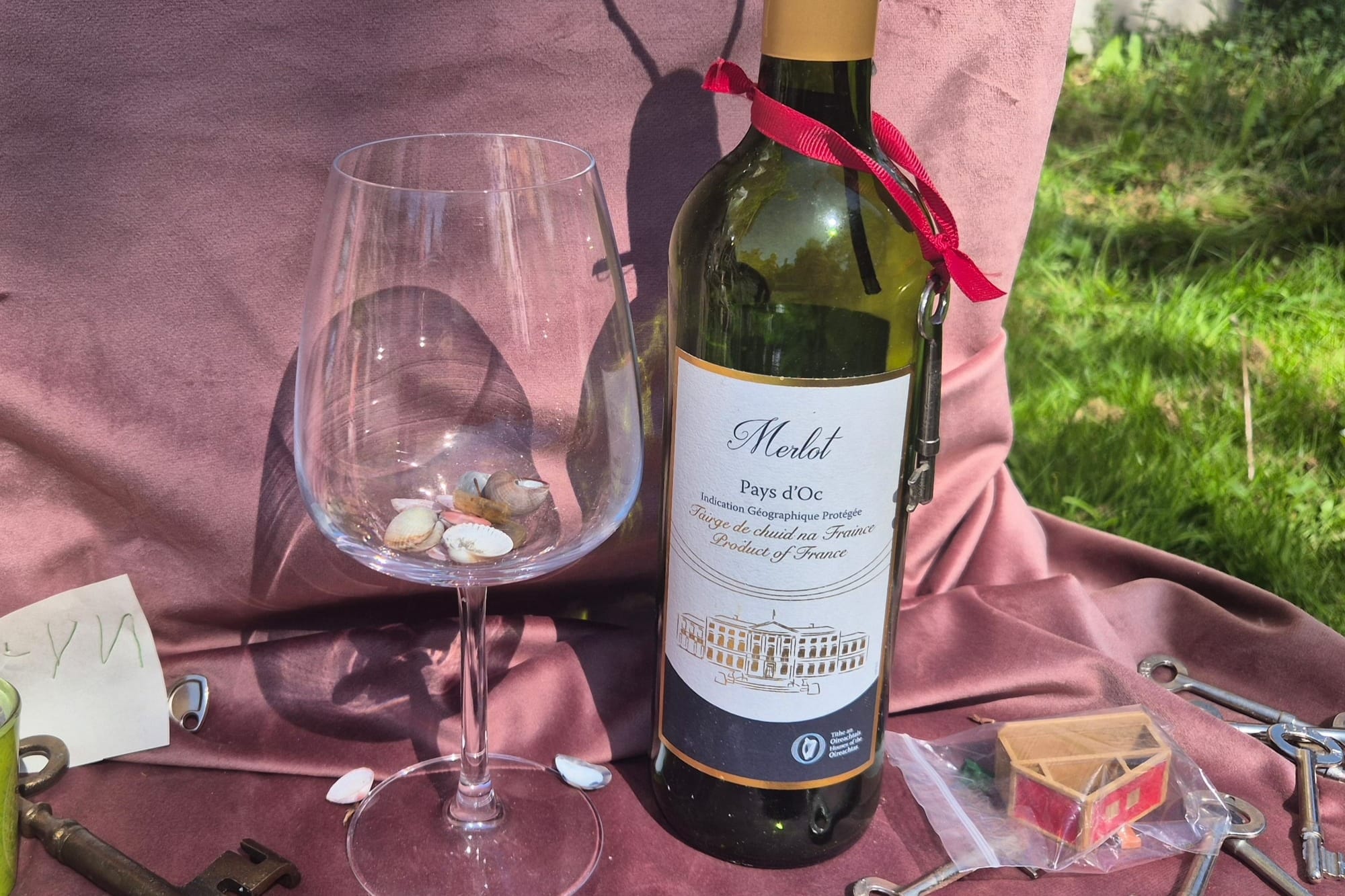
A wine glass and bottle for the dinner parties that people want to have but can’t.
She got her hands on a bottle from the Houses of the Oireachtas, branded as such.
“I just thought, they have their own brand of wine, and I don't have a house to have a bottle of wine in,” she says. “It's just, it's so bizarre.”
Elsewhere, a mantlepiece clock represents running out of time.
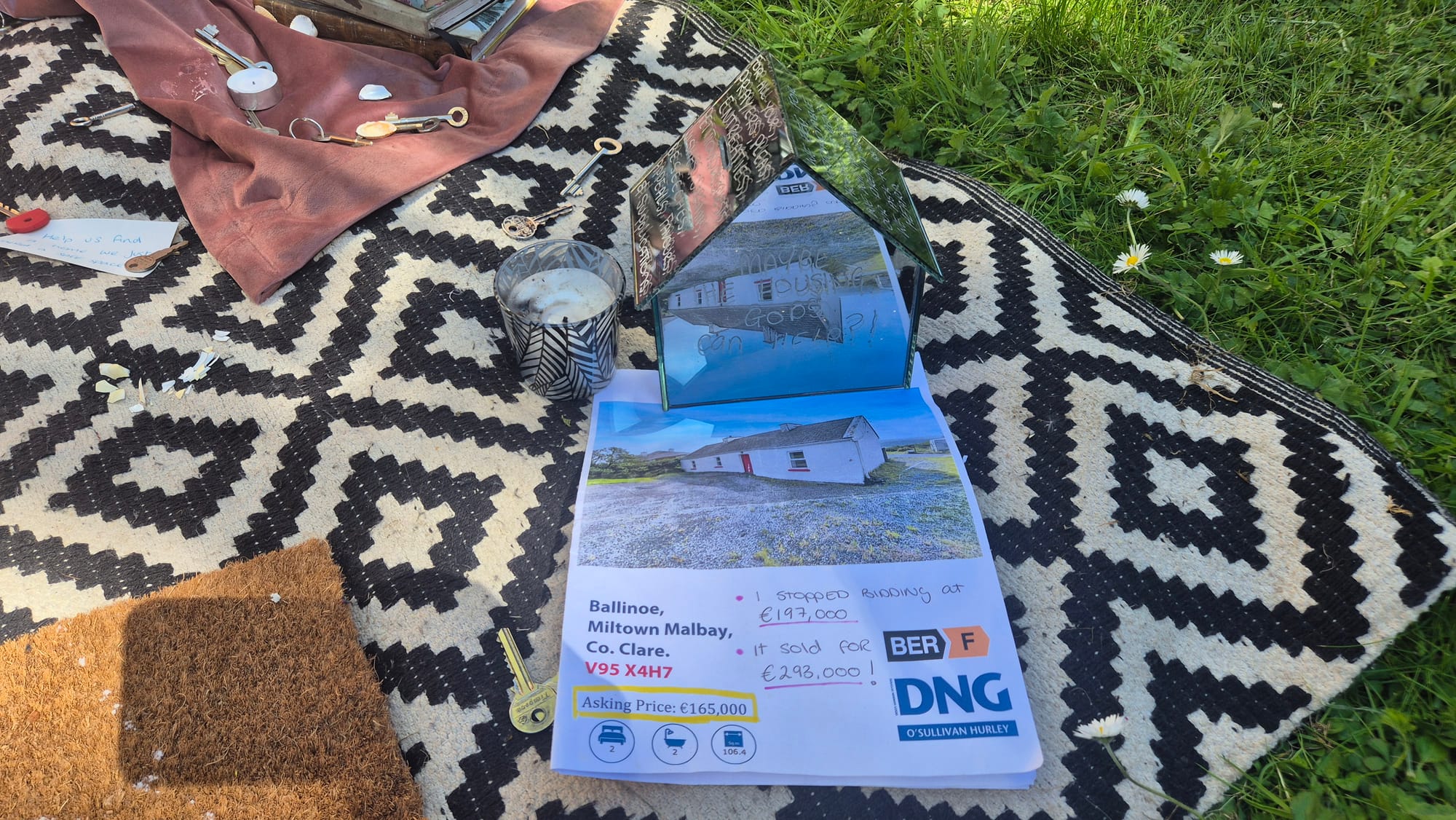
As a symbol of the disappointment that people, like her, face in getting constantly outbid and seeing dreams evaporate, there is a print-off of a house listing in Miltown Malbay in Co. Clare.
The asking price was €165,000.
She stopped bidding at €197,000.
The property sold for €293,000.
Other people have left other trinkets: keys, coins, precious stones, feathers, acorns, shells, and candles.
They have left notes, too, asking the housing gods to look favourably upon them.
“It is my intention to build the family home of my dreams with Eoin, for our boys. Thank you, so it is,” says one.
“For women’s safety never to be less important than housing regulations,” says another.
Across from it, one says, “Ready to receive my home and child x.”
Words written on a small glass house read: “We beg for affordable houses and rents. We will manifest our dream homes. We ask to be heard.”
Byrne stands over her creation, “People have left artwork as well, and some little kids have drawn little houses,” she says. “And that breaks my heart.”
This shouldn’t be normal
Shrine pilgrims Tom Davis and Aoife Newman say they’re regularly perplexed by the “property porn” TV programmes that never seem to be off the air.
There's a bizarre mentality with older people who like shows like RTÉ’s, Cheap Irish Homes, says Newman.
“Where they bring a young person, a young couple around to look at these dilapidated houses in the middle of nowhere, and they're like, ‘You can buy it, and it's only, €250,000,” she says.
“And you’re watching like, ‘It doesn’t have a roof, what are you talking about?’” she adds.
Davis says it bugs him that people he knows who have been able to move out, including themselves, have to almost celebrate getting to live in overpriced run-down places.
“This shouldn’t be normal,” he says.
Byrne, the artist, agrees. “Our baseline for what's okay has completely warped.”
A previous project of hers dealt with hidden homelessness. She interviewed people who were themselves hidden homeless and a through-line emerged across the conversations.
She named it the “guilt of resentment”, she says.
“Like everyone was saying how privileged they were to be able to live with their parents,” she says. “Yet they felt guilty for being angry about the situation.”
Byrne is one of those prospective buyers who has decided to go the route seen on Cheap Irish Homes. She went sale agreed on a derelict house in Co. Clare, about 18 months ago.
The rural house had previously been passed around through handshakes, so getting the paperwork sorted has dragged the process on.
She lives with the worry now that it will fall through, she says, and she’ll be back to square one.
But she is optimistic for the life that may be waiting for her out west, she says, despite being “generationally Dublin”.
“I’ve no family outside the Pale,” she says.
She made a checklist of things she wanted to gain if she is to leave Dublin.
One was to be near the seaside and another was to find a creative community. Lisdoonvarna in West Clare ticks both boxes, she says.
While her own housing journey rambles on, Byrne says the true cost of this crisis continues to be untold.
It has impacted everyone, she says. “It's just not sustainable for a population to be under this much stress all of the time.”
Ultimately, she says, with her Shrine to the Housing Gods, she hopes to remind people that they aren’t alone in this madness.
The tender document for the design says the framework has a maximum estimated value of €7.5 million. It also gives a tentative construction estimate of €25 million.
Social tenants, including children, are often locked out of communal areas in their complexes. Would it help if they were represented at the OMCs' meetings?