

Tusla says it's an offence to run an unregistered children’s home, but it places children in them anyways
So how does it square the circle?
A motion from a Dublin city councillor suggests they do.

Last August, independent Councillor Malachy Steenson added a motion to the agenda of Dublin City Council – which has yet to be debated, but has been moving up the list towards its day in the chamber – calling for gardaí to be given “effective martial arts skills”.
Steenson said by phone recently that he was concerned by a video of an arrest on O’Connell Street that saw four or five gardaí required to successfully restrain and cuff one individual.
“They should be able to immediately deal with these situations,” he said.
Steenson’s posts and shares online suggest he is steeped in a social-media milieu in which it is common to assert that Dublin is crime-ridden, and to connect this to immigration. Others who focus on similar themes also say Gardaí can’t cope.
Although, there’s a huge gulf between levels of fear of Dublin city centre, and levels of crime, according to last autumn’s City Centre Crime Victim Survey.
And international research has ruled out an association between immigration or ethnicity and crime.
In any case, Steenson’s motion hits these familiar notes, unsupported by evidence.
Gardaí meanwhile say social media commentary around videos of arrests can often be based on misunderstandings of Garda training and tactics.
Sergeant Andrew Carmody, who teaches self-defence in the Garda college, says that students at Templemore already get training in martial arts.
In the first of three 12-week phases that student gardaí undergo, they receive 10 two-hour self-defence classes, says Carmody.
The training is based on a martial art called Taiho-jutsu, in which Carmody holds a black belt.
It’s a Japanese art, taught to police officers there, which focuses on arresting techniques.
It’s an old style of martial arts that stems from Samurai sword fighting, but has been adapted to modern times, taking the sword out of it –replacing it with a baton, and empty-hand techniques like joint locks, Carmody says.
“There isn't going to be any ninjas coming out of this school, not after 20 hours, which is fair enough,” he says.
When students arrive, some may have expert-level martial arts training already, while others “have never been shouted at”, he says. “So, you’re aiming for the middle. You have to be conscious of that.”
The students are taught de-escalation techniques, disengagement techniques, distraction techniques, and “break falls” – essentially falling as safely as possible, if thrown to the ground.
Beyond martial arts, the students are also taught how to use pepper spray and batons.
When training on use of the baton, students come up against one of their instructors dressed in a bright red padded suit, resembling a lobster.
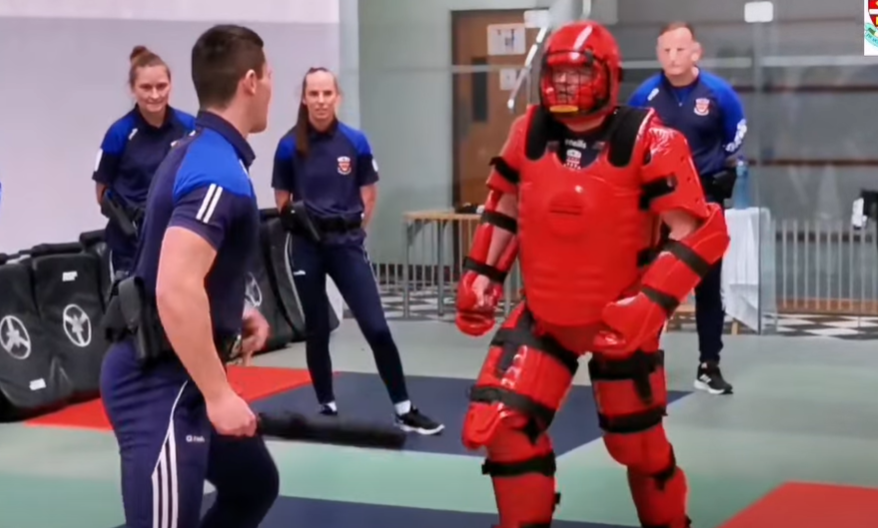
The padding allows the students to get a sense of striking with force, in a safe, controlled environment.
Students will have five or six three-hour sessions with the red suit, running through various scenarios, he says.
There's also “manual handling” training, which is learning how to lift someone out of a situation, like a protest. “That’s under the proviso that there’s no risk of assault to us.”
There is also training on “cell entry and extraction” and “cell movement”, he says.
“That's how to get a non-cooperative person into a cell safely, and how to place them in the cell and take the cuffs off them and extract yourself from the cell safely,” he says.
Similar to the viral videos referenced in Steenson’s motion, it requires three or four members, says Carmody.
“It reduces the risk of injury to the person that is restrained and reduces the risk of injury to the members that are doing it,” he says.
There is a common misunderstanding in terms of what the intention of the gardaí is when placing someone under arrest, says Carmody.
Steenson’s motion says “a number of arrest videos circulating show that the Garda involved are incapable of quickly subduing these individuals and arresting them”.
But officers generally try to restrain the person, while inflicting as little harm to them as possible and while keeping the arresting officers safe, Carmody says.
When people see videos of several gardaí struggling to restrain someone who is resisting, the narrative online can be that the hapless officers didn’t know what they’re doing, he says.
It would take fewer bodies to subdue the person, if they were to use their batons, but that’s not what they want to do, he says.
Steenson says he hopes the videos he refers to in his motion aren’t showing gardaí afraid to use necessary force, because they’re afraid of repercussions from Fiosrú, the Garda ombudsman.
That shouldn’t be the case, says Carmody.
While gardaí will team up in greater numbers to restrain a non-compliant person in as safe a manner as possible, they are allowed to employ a “graduated response” when necessary, he says.
This goes up to and including lethal force, he says.
“You deal with what you think is appropriate. And if you have to go up, you go up. And if you have to come down, you come down the force levels,” he says.
Carmody says he doesn’t think that martial arts training should be broadened out to include something like Krav Maga, the system famously associated with the Israeli Defence Forces.
That’s military stuff, designed to do as much damage as possible, he says. “Our aim is to successfully complete our goal with the least amount of force necessary.”
Of course, all this training and plans for a graduated response are one thing, but situations get complicated in real life.
For example, Paul Comerford remembers one night when he was a serving member of An Garda Síochána in Dublin city, and got a call out to a domestic dispute.
When he and his garda partner arrived, there was a man switching between efforts to kick the front door in and put a wheelie bin through the window.
When his patrol car pulled up, the woman opened the door. The man then made a run to get in.
“There was no way we could let him in the house. I ran to get between him and the door,” Comerford, now retired from An Garda Síochána, said by phone on Tuesday.
Comerford reckons the man was around 6 foot 4, 18 stone and “solid”. While he himself is 5 foot 10 and 14.5 stone.
“I reached up, grabbed his collar and pulled him down on top of me and held on for dear life on the ground,” he says.
When the other garda tried to handcuff the man, his wrists were too big for the cuffs, so he used pepper spray.
“Which meant he had to spray me too, due to my proximity. I got a mouthful and was vomiting but couldn't let go. It felt like an eternity waiting for assistance but was only a few minutes as it's the city centre and assistance comes quickly there,” he says.
When the Armed Response Unit arrived, they had to use two sets of cable ties to restrain him and it took six men to do it, he says.
This, says Comerford, shows that it's only through weight of numbers that an adult can be restrained effectively when they are actively resisting – without the use of an incapacitant like a spray or taser.
As for whether more training in the Garda college is the answer, he doesn’t think so, he says.
“It doesn't matter what level of training you have. Unless you're physically able to dominate somebody, it just doesn't apply,” Comerford says.
“You will literally just roll around on the ground for 25 minutes, and it's down to whoever's the fittest ultimately, in the end, as to who wins,” he says.
But the best strategy is to avoid that situation in the first place, if possible, says Carmody.
He says that he regularly tells his students in Templemore that the best two weapons they’ll leave the college with will be their brain and their mouth.
“Use them first, and you mightn’t have to use anything else,” he says.
Funded by the Local Democracy Reporting Scheme.

The council closed the pool after its roof was damaged in Storm Darragh in December 2024. In January, it put out a tender to fix the roof.

It isn’t creating any problems, said a council spokesperson. Some councillors aren’t too sure.

The walls are stacked with games. Familiar ones like Catan, and Dungeons and Dragons, and less familiar ones such as Calico, Sushi Go, and Cascadia.

“We’re losing a lot of [it],” said Mary Tubridy, an established Dublin ecologist, “and the chances are, we'll be losing more of it.”