

“It’s giving colonialism”: Ireland still owes rent to dukes and earls
Although, even though the OPW lists these rents as payable, some of the named beneficiaries say they haven't been getting them.
They're still thinking about the best way forward, and that might be improving the current system rather than replacing it, said Alan Dillon, Minister of State with responsibility for the Circular Economy.

The government last week opposed a bill to overhaul how bin collections are done, in an effort to keep streets cleaner and prices down.
It's still considering the results of a study of the idea commissioned in 2024 and finished in May, said Alan Dillon, a Fine Gael TD, and Minister of State with responsibility for the Circular Economy.
The issue: whether to continue with the current free-market approach to bin collection by private companies, or make changes to allow councils to take more control of the process, hiring companies to cover certain areas, under certain contractual conditions.
The bill was proposed by Labour TD for Dublin Central Marie Sherlock, and during the debate on it in the Dáil last Thursday.
"I introduced this Bill because I do not believe the issue of litter and dumping on our streets, particularly in the communities I represent, where the issue of litter has existed for many years, is hopeless," Sherlock said. "I do believe change can be made."
"Inspiration can be taken from many European cities that have got their systems right," she said. "They have underground collection systems, compactors in their communities and innovative solutions. The way our system is set up ultimately does not allow for that investment, and I believe we need to change that."
Mark Ward, Sinn Féin TD for Dublin Mid-West, Gary Gannon, Social Democrats TD for Dublin Central, Roderic O'Gorman, Green Party TD for Dublin West, and Paul McAuliffe, Fianna Fáil TD for Dublin North-West spoke in favour of it.
However, Dillon, Fine Gael TD for Mayo, and Minister of State, said the government would not be supporting Sherlock's bill. "This is not about resisting reform, nor is it about defending the status quo. It is about ensuring that reform is informed by evidence," Dillon said.
There've been a series of reports already published on the issue.
In 2023, Dublin City Council commissioned one from the Institute of Public Administration (IPA), which looked at what would be involved in the council taking back more control of bin collection (new legislation).
Then in 2024, two reports – from the Oireachtas Joint Committee on Environment and from the Taoiseach's Taskforce for Dublin – recommended councils get back control over bin collection.
In response, later that same year, Minister of State Ossian Smyth, a Green Party TD, asked Department of Environment officials to commission another study. That's the one Dillon said he's waiting for.
It was "to explore the feasibility, potential benefits and risks associated with transitioning our waste collection system from its current competitive licensing system to a franchise tendering system for local authority areas or regions", a department spokesperson said at the time.
"The timeline for completion of such a comprehensive study could be up to 12 months with appropriate procurement," she said.
At the time, Conor Walsh, secretary of the Irish Waste Management Association, said the IWMA "opposed “competitive tendering or franchise bidding for household waste collection”. This would reduce competition in the market, Walsh said.
As part of the process of putting together this additional study, the Department of Environment ran a public consultation in 2025, soliciting views on a potential change.
It is unclear, however, who voiced their opinions via this consultation, or what those were, as the department declined to release those submissions under the Freedom of Information Act.
This is in contrast to the approach of, say, Fingal County Council, which publishes submissions it gets in response to public consultations right on its website.
In any case, whatever happened behind the scenes, about 20 months later, in May of this year, Dillon, said that "The study has recently concluded and its recommendations are currently under consideration."
There are no plans to take action on those recommendations this year, he said last Thursday in the Dáil.
"The recommendations arising from that work will be considered as part of the updated waste action plan for a circular economy and the implementation of Ireland's second whole-of-government circular economy strategy in 2027," he said.
Before 2000, Dublin City Council collected bins, but households didn’t pay a separate charge for that.
When the council brought in bin charges, there were protests and loads of people refused to pay them.
Then government policy allowed private operators to begin collecting waste alongside local authorities, in many cases offering lower charges to attract customers, according to the report on the issue from the IPA.
In 2008, the four Dublin local authorities got together and made an amendment to the waste management plan for the region, meant “to ensure that waste could only be collected by councils or contractors appointed by them”, the report says.
Panda Waste Services took the four councils to court, which found that what the councils were doing was contrary to the Competition Act 2002. Now that the councils were charging households, they were “undertakings” operating in a market – and what they were doing was anti-competitive.
“Following on from this decision, local authorities around the country began the process of exiting domestic waste collection entirely, leaving it to operators in the private sector,” the report says.
Dublin City Council left the household waste collection market in 2012, according to a report by the council on the prospect of re-entering it.
Today, any company that gets a waste collection permit from the National Waste Collection Permit Office (NWCPO) can come to Dublin and offer its service to households.
The council does not have control over the waste-collection companies, or how they operate in the city.
However, things have changed since Panda won its case, Sherlock said in the Dáil last Thursday.
The councils lost "because of EU competition law, but we believe the game-changer now is the 2014 EU concessions directive, which allows for tendering by a state, or an agency of the state, for services of general economic interest or general public interest, of which we believe waste is one", she said.
Dublin city councillors backed a cross-party motion in July 2019 that the council should reclaim control over bin collection.
Those who spoke in favour of it talked about multiple trucks clamouring down the same streets, challenges with illegal dumping, bins not being collected, and work practices, among other problems.
Councillors set up a subcommittee to look at how to push that forward. That subcommittee, led by Sinn Féin Councillor Daithí Doolan, commissioned the report from the IPA that was released in 2023.
Among the report’s conclusions: if the council is going to get control of waste management in the city again – and either 1) pick up the bins itself, or 2) tender for a company or companies to do that – the Oireachtas will have to pass legislation to allow that to happen, legally.
However, the last coalition's 2020 programme for government made no reference to changing the bin-collection system, and neither does this current coalition's January 2025 programme.
In April 2025, Brian McHugh, the chair of the Competition and Consumer Protection Commission (CCPC), wrote an op-ed saying that, "Having a choice of providers is usually a sign of a healthy and well-functioning market."
"However, domestic waste collection is not a typical market. Some markets work much more efficiently when there is a single provider," McHugh wrote.
"The current market structure will never properly deliver for the Irish public," he wrote. "A policy change is long overdue."
The bill from Sherlock, the Labour TD, who is not in government, is primarily meant to replace the current system of "competition in the market" to a system of "competition for the market".
This would let Dublin City Council put out a tender for a company to provide bin-collection services for all of Dublin city, or multiple tenders for different parts.
That could make it easier to install communal underground bins, or above-ground compactors, which might be useful in the inner-city, where people put out their rubbish in bags, which critters often rip to shreds on bin day, spreading debris around the streets.
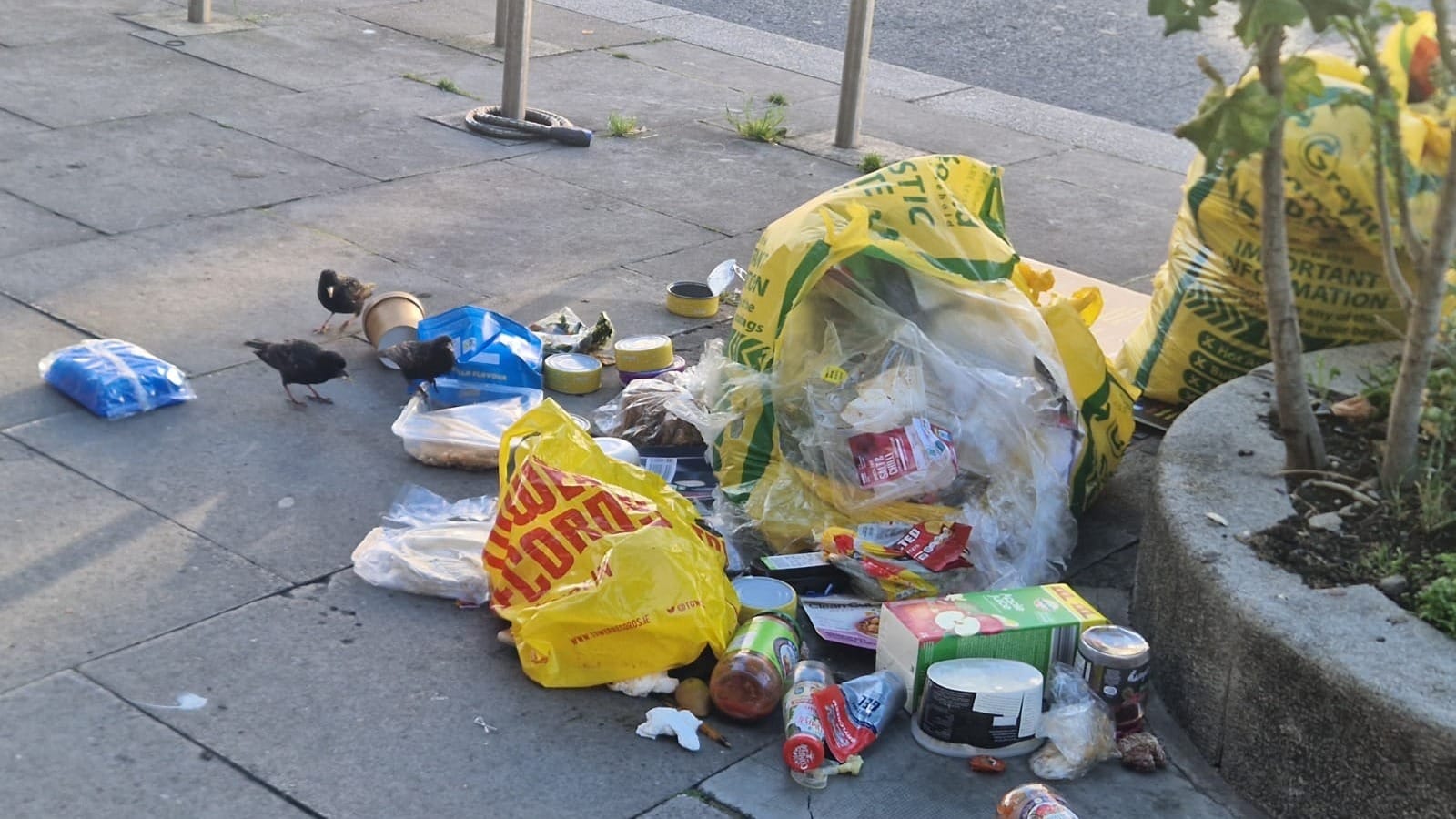
But where many residents do not want to switch to bins to solve this problem, citing their small houses and lack of bin-storage space, and the increase in costs involved in the change, among other issues.
 Michael Lanigan
At the moment, one of the obstacles to putting in these communal systems, which are available in other European countries, is that when multiple companies have customers in an area – how would they split payments, and which company would empty the communal bin or compactor?
In the north inner-city, "when it came to the residential areas, I understand the council tried to negotiate with the bin collectors on the roll-out of shared collection systems, but to no avail", Sherlock said. Having just one company operating in an area could help solve this problem.
In addition to helping with that problem, a council hiring a company to provide bin-collection service in a particular area could also include conditions in those contracts, for pricing, for conditions for workers, for picking up illegally dumped rubbish, for example.
At the moment, prices for bin collection have been rising, Sherlock said. And "many of the private bin companies are effectively creaming profits from bin collection, with local authorities having to spend millions", she said.
The bin companies service the customers who pay, the council has to pick up after the customers who don't pay, and instead illegally dump their rubbish on the street.
Ward, the Sinn Féin TD, spoke in support of the bill. "The process of returning waste management to public control can begin with having one company per local authority," he said.
"A single bin operator per local authority would reduce the number of bin trucks on streets and should reduce the incidence of illegal dumping," he said. "This would lead to a decrease in prices, which could be set out in the tendering process."
O'Gorman, the Green Party TD, also spoke in support of it. "The solution is to rationalise the current system, put local authorities back at the centre of waste management processes and use this to get a better handle on pricing and illegal dumping through contracts that are right for each specific area," he said.
McAuliffe said he wanted to see the bill continue to committee stage. He said that the Dáil should "enable local councillors to make decisions to put in place waste solutions that suit their areas".
"We should be allowing Dublin City Council, if its elected representatives so choose, to establish both competition for the market and its own bin service if it so wishes," he said.
However, McAuliffe also said he worried about what would happen if one company won all the contracts to collect bins all four Dublin council areas – would the other bin companies go out of business? Would there be any companies left to bid against the big winner the next time the contracts came up for tender?
For his part, during Thursday's debate, Dillon, the Minister of State, said he recognised "concerns relating to affordability, service quality, consistency of provision and illegal dumping".
However, he said it would be premature to pass the bill before the latest study on the issue is complete, he said.
"The Bill assumes that replacing competition in the market with competition for the market will resolve many of the challenges facing household waste collection. However, that should not be taken as a given," Dillon said.
"Better outcomes may be achieved by improving the operation of the current system rather than replacing it entirely," he said.
Another part of Sherlock's bill would also provide for a scheme for the waiver of household waste collection charges on grounds of personal hardship.
And it would enable local authorities to make provision by bye-laws making it the responsibility of landlords to ensure their tenants have bin contracts.
Dublin City Council has been working to identify people living in the north inner-city who do not have bin contracts, either because they don't know it's their responsibility, or because they can't afford it.
 Laoise Neylon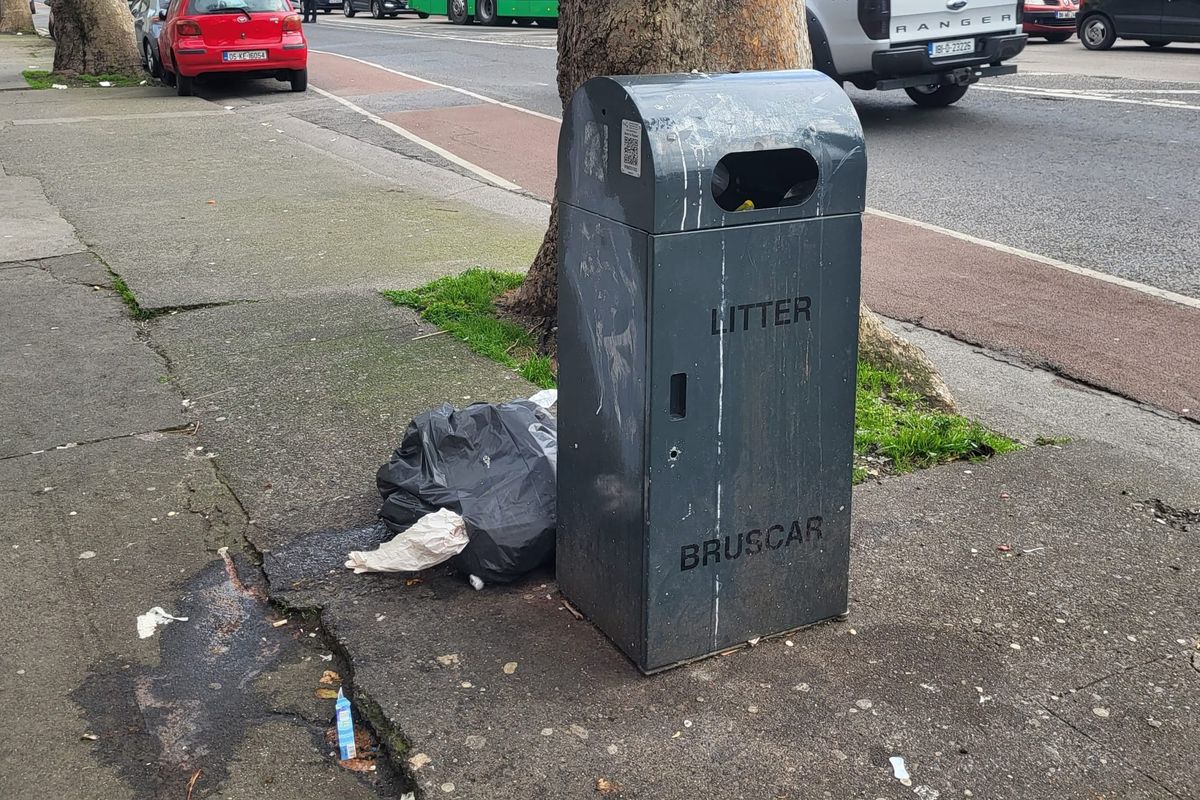
Often, this results in people illegally dumping their rubbish on the street, for the critters to tear into, and the council to clean up.
But, in the Dáil on Thursday, Dillon said making these changes would violate the "polluter pays principle".
"This is a fundamental principle of European environmental law. It reflects the principle that those who generate waste should bear the costs associated with its management and that pricing signals should encourage waste prevention, reuse and recycling," he said.
The government recognises that people face real financial hardship, he said. "The question is how support should be provided."
"Waste charges are designed to recover the cost of providing the service while encouraging environmentally responsible behaviour," he said. "Introducing mandatory waivers through waste collection permits risks weakening those incentives."
Sherlock said she was disappointed that the government would not support her bill.
"If it is not going to accept our ideas, it [the government] should bring forward its own ideas but we did not hear any of those," Sherlock said.
The Dáil did not vote on the bill on Thursday. "The division will be taken after the recess in September," said the Ceann Comhairle, Verona Murphy.
"The Minister of State has the summer to change his mind," said McAuliffe, the Fianna Fáil TD.

Although, even though the OPW lists these rents as payable, some of the named beneficiaries say they haven't been getting them.

They're set to back the creation of a special purpose vehicle he's been picked to head, which is meant to play a major role in regenerating the city centre – but how major is in dispute.

Social tenants who live in the private Liberties complex Grand Canal Harbour say they're not allowed to use many of the common facilities there.

Gone is the hardman shtick, the macho bravado once associated with hip hop, rapper and producer Michael Ward, who goes by Mickzart. “We’re after something true.”