

Ruling sheds a small light on opaque intel-gathering on some citizenship seekers
An Garda Síochána “has developed strong links with other security services, particularly those with whom the State shares common threats to national security”, it says.
The battle between decaying infrastructure and thriving nature fascinates Maya Brezing, she says.

Maya Brezing ducked into a doorway on Essex Gate in Temple Bar to avoid the tail end of downpour that soaked the city on Saturday morning.
The rain subsided momentarily just after 11am as the artist strolled across the wet cobbled street to peek inside the steel fences that surrounded 13 and 14 Exchange Street Lower, an overgrown, vacant lot.
Once, it was the site of a single-storey premises, according to a 2003 planning application. But as Brezing paid it a visit, it was little more than its foundations, with these serving as a pit for squashed cans, mucky plastic bags, odd shoes, and a tattered sleeping bag.
The weeds were growing over the fences, which had previously hosted two protest murals, Somebody’s Child and Disband the Artane Band by the independent councillor and artist Mannix Flynn.
Dublin City Council took ownership of the site in March 2021, with its compulsory purchase order confirmed by An Bord Pleanála in September 2024, a council spokesperson said on Tuesday. “Future use and development of the site is still under consideration.”
It’s the kind of sight in the city that attracts Brezing’s attention whenever she’s out on a walk, she said. “Any sort of space like this. Really overgrown. It’s kind of nature taking over and taking back the city.”
A lot of the time, when she’s painting or creating a piece through print, sites like this serve as a starting-point for almost post-apocalyptic, ecological science fiction works; stills from the not-so-distant future where nature is reclaiming urban space, she says. “It’s maybe imaginatory. Collage-y. Using my imagination and proposing these spaces.”
Essex Gate became one of her most recent subjects, from which she extrapolated a vision from the near future.
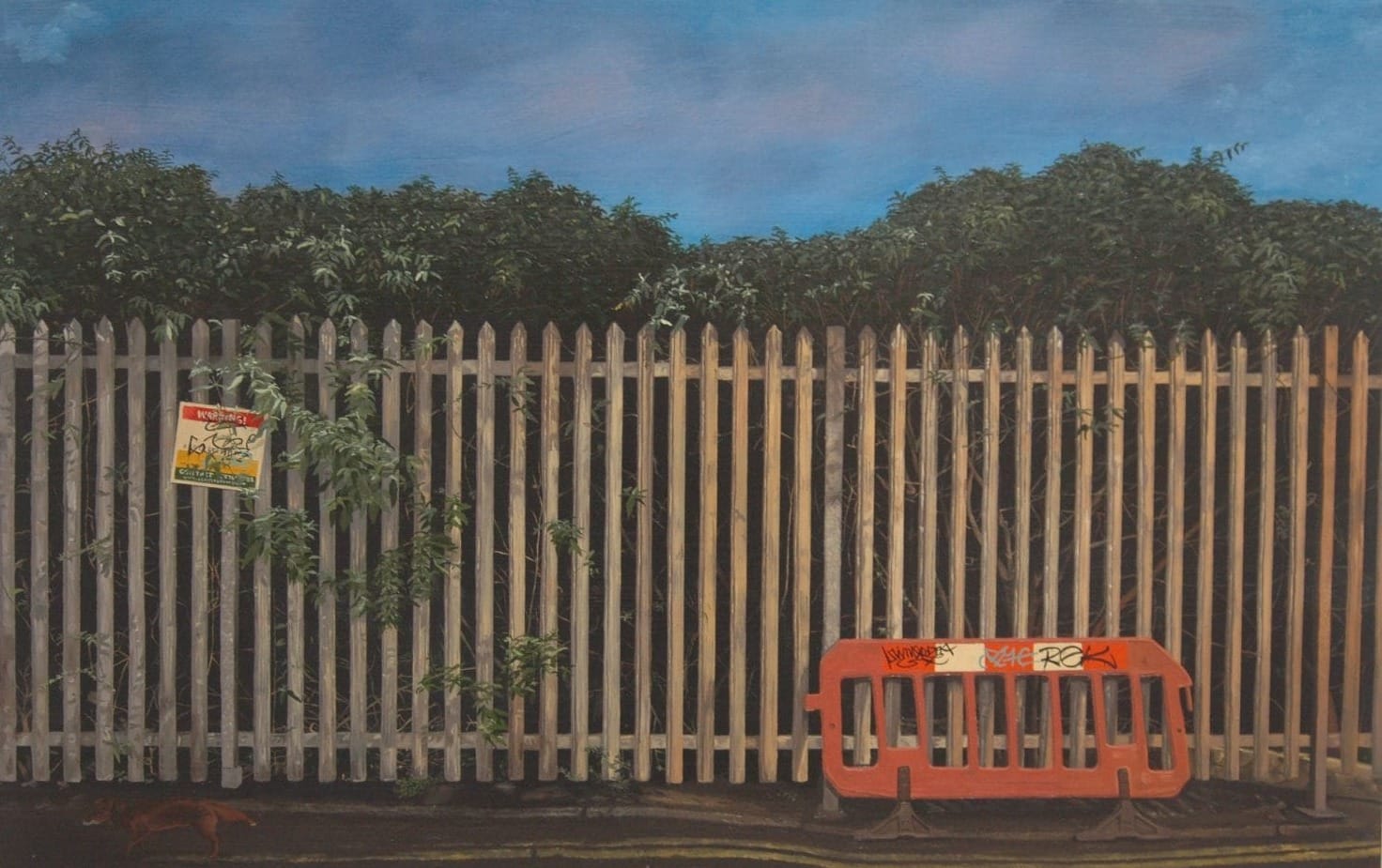
Her version of the site took its fencing and the weeds, a graffiti-strewn warning sign and an orange plastic barrier, and added a fox, while stripping away the surrounding buildings.
In the place of the surrounding apartment blocks, and the mural painted on the side of the Gaiety School of Acting, instructing passers by to “Take a new look! Old City”, she inserted a blue sky, darkening near sundown, and filled with silvery clouds.
Below it, the only sign of life was a fox scuttling along some double yellow lines.
Earth Incarcerated was the title Brezing gave the oil painting, which is currently hanging in the Royal Hibernian Academy of Arts as part of its annual Hennessy Craig & Homan Potterton Awards.
Regeneration and the flourishing of different species is something she likes to depict, she says. “Cities being taken over by trees and plants. New ecosystems get created.”
“We get little glimpses of those worlds all around us here,” she says. “Places like this where we see what the world might look like without any more human intervention.”
As the rain made a return late on Saturday morning, Brezing retreated into Rumi, a nearby cafe that steadily started to fill up with punters eager to stay dry and warm.
She grew up in Balbriggan, she said over a cup of hot chocolate.
And there were a few sights in the locale that fuelled her imagination like a burnt-out, derelict hotel a few kilometres north of the Fingal-Meath border in Julianstown, she says. “But it gets harder and harder to go into places like that. They’re really boarding them up quite well.”
Still, the very fact that they are harder to access is what makes them more appealing, she says.
A lot of the images that inspire her come when she’s not actively searching them out, she says. “If it’s a place like the hotel, I’d spend a good few hours there. Most of the time, I’d just be taking photos in passing.”
It’s the train journey between Balbriggan and the city centre that really captivated her, she says. “In college, when I was working, it could take more than an hour to get into town.”
Commuters can entertain themselves with their phones or they can look out the window, she says. “I like looking out the window, going from a town to a rural place to town.”
Whizzing by on the train, you’re watching natural and urban landscapes blur together and overlap, she says.
While her most recent works on show in the RHA are oil paintings, her background is primarily in print-making, studying fine art print in National College of Art and Design, she says. “Etching, screen prints, I was making my own handmade paper as well.
It’s a practical instance of the themes of environmentalism in her work, she says. “There’s so much waste in printmaking. Newspaper that goes through the press and is thrown out every time. It’s crazy, so I’d set up a collection box in the studio, get everyone to put their used newsprint in there.”
Creating her own paper added an extra dimension to the subject matter she likes to dwell on, she says. “It's the natural deckled edges of the paper. It’s unpredictable, tactile.”
As her body of work grew, she would expand her practice into sculpture, attaching prints of bushy clumps of weeds or crumbling buildings to found objects, like burnt-out, rotting wooden planks.
“I guess I’m a bit of a magpie,” she says. “I’m constantly collecting objects anywhere I go. I love things that have a history: wood, metal, plastic.”
Often, her desire is to look into an apocalyptic place, she says. “I love post-apocalyptic movies. Bleak, but hopeful. Like The Last of Us. It’s bleak, but the series is also quite gorgeous.”
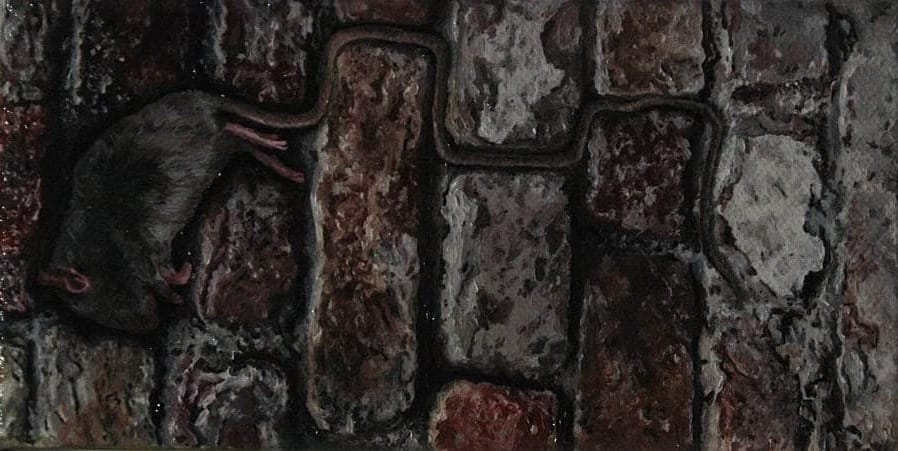
Another of her works, Mouse Trap II, almost borrows from The Last of Us imagery of the cordyceps fungus growing from infected humans along roadways.
The small oil painting depicts a mouse lying, possibly dead, possibly sleeping, on a brick wall, with an unusually elongated tail winding around the brickwork.
That came from a house in Smithfield that was being demolished, she says. “I actually went in and saw a tree root growing in one of the walls. The roots were following the brick. It was amazing. But it didn’t make for a good photo.”
So she replaced the root with a mouse instead, she says.
This battle between decaying infrastructure and thriving nature is something that compels her enough that she would happily spend the rest of her career dwelling on it, she says.
“I could run with it for a long time,” she says. “It’s not just like a concept that I’m interested in. I guess it’s just me.”

Paul MacCormaic says he hopes the works inspire an interest and pride in nearby sights, passed by everyday.

“I'm having to be the guy telling the audience about it,” he said referring to a sex scene, “While acting it out. While playing the man and the woman.”

The event was part of a growing clown culture in Dublin, said performer Francis Breen.

The inspiration? "I was like, Oh my God, what's happening with my life?” says founder Sarah Ó Tuama. “Like, is this what being an adult is? It's so boring.”