

New film documents Dubliners’ resistance to subordination of social life to profit
“The market is a monster,” says filmmaker James Redmond. “It turns living spaces into dead space.”
“The market is a monster,” says filmmaker James Redmond. “It turns living spaces into dead space.”

Displace: The Battle for Dublin could have been a never-ending story, filmmaker James Redmond said, as he stood in front of a silver screen at its premiere on the third day of the Dublin International Film Festival.
“Every day, something surfaced to fit the lens of the project,” he said, reading a short speech off his phone to the crowd of cinemagoers who had gathered in the Light House Cinema’s screen one at lunchtime on Sunday 22 February.
The film could have featured any number of recent events, like the residents in Spencer Dock who, in October, were served with eviction notices, or in January, the Complex art centre on Arran Street East was closed, he said.
None of these events was a once-off, he said. “They expose something structural. The subordination of social life to profit.”
“The market is a monster,” he said. “It turns living spaces into dead space.”
Shot over the course of four years, the black and white feature-length documentary tied together a broad range of events, including the attempted eviction of residents in Rathmines’ Tramco building, the campaign to save outdoors the market on Moore Street, the closure of Richmond Road Studios in Fairview, and the decay of the Iveagh Market on Francis Street.
At the heart of the film was the concept of a “right to the city”, an idea conceived of by the French philosopher Henri Lefebvre, he said. “The right to the city means ordinary people shaping the spaces they inhabit, not investors treating them as playgrounds.”
Weaving more than 50 interviews together with on-the-ground reporting from protests and public meetings, the film follows a variety of organisations and individuals who comprise a wider movement in the city demanding housing and community space, he said on Monday while sipping a coffee in the cafe over Chapters bookshop on Parnell Street.
It is a look – through a wide range of stories – at how people, the state and investors are in contest to define space, he said. “I call them vignettes. But they are all windows into how this issue penetrates people's lives in different ways.”
Redmond began the four-year process of shooting Displace when, in October 2021, Marron Estates Ltd applied to Dublin City Council to redevelop the Cobblestone Pub as a hotel.
The protest, which saw members of the folk music community carry a coffin to the council’s offices, became a lighting rod of sorts, he said on Monday afternoon. “You could see how all of these things gelled together. A mix of republicans, punks, trad musicians, all blending together simply because a venue they hold to their heart was in danger of being displaced.”
The attempted redevelopment of the Cobblestone, and the swift backlash to that summed up neatly the politics of urban space, he said. But, he says, when thinking about how to capture that on screen, “I was a bit jaundiced with representations of the issue as cranes versus creatives.”
So, instead, he wove together a narrative that begins at the procession-like protest up in Smithfield and culminates in a tea party held on the site of the former St Michael’s Estate in Inchicore ahead of the council’s long-awaited redevelopment of the land as 578 social and cost-rental apartments, he said.
“It’s the heart of darkness, which has been going on for 20 years. It’s insane how long it laid fallow and how much money was wasted in the interim,” he said.
Once he started on the ground outside the Cobblestone, different, but related issues – protests and events – kept popping up, like the ongoing campaign to protect the market down on Moore Street, he said. “The more you looked at it, the more these examples of displacements you could find.”
In the process of creating the film, he was drawing on works like Peter Lennon’s 1967 documentary, The Rocky Road to Dublin, a reflection on the culture and values of Irish society in the mid-20th century, and the city symphony, a 1920s film genre that took as its subject the development of urban centres, he says. “They are films that try to tell a story in a given day.”
Luke McManus’ 2022 film, North Circular, which examines the culture and history of the North Circular Road, operates in a similar vein, he says. “And I had, like these seagull motifs where they’re almost moving around the city on your behalf, flying around by seagull.”
While exploring the arts, Redmond paid a visit to the site of the former Tivoli Theatre, now a Staycity aparthotel where artists Eve Woods and Aoife Ward were organising satirical walking tours of the Liberties, highlighting new hotel developments, student accommodation and disappearing historic sites.
“We were really the comic relief in the middle of the film,” Woods says.
Alongside their walking tours, Redmond also filmed the opening of their exhibition Con:Temporary Quarters, staged in August 2023, and using its venue, an incomplete cultural venue within the Staycity aparthotel building, as the subject of its satire.
The film captures the feeling of being in an eternal battle, says Woods, noting that Redmond came to interview them in the summer of 2023. “It feels like ages ago, we did that, and yet nothing has changed.”
A spokesperson for Staycity, on Tuesday said that a “fitout of Tivoli is underway now”, and that they will be making an announcement soon regarding their plans for the space.
Redmond didn’t necessarily have a list of items that he was seeking to capture on his own cinematic journey, but he wanted to capture examples of certain things, like evictions.
Redmond said, as he documented this cinematic journey through the city, he also wanted to be able to acknowledge the activism of community groups connected to the now-demolished St. Michael’s Estate in Inchicore, he said. “The resistance that they practice isn’t really recognised enough in the sense that holding ground in a space is the most radical thing you can do.”
In April 2025, former residents of St Michael’s Estate held an outdoor tea party ahead of the long-awaited start of the construction of its replacement, the new housing complex An Droichead Órga, to swap memories and discuss the future.
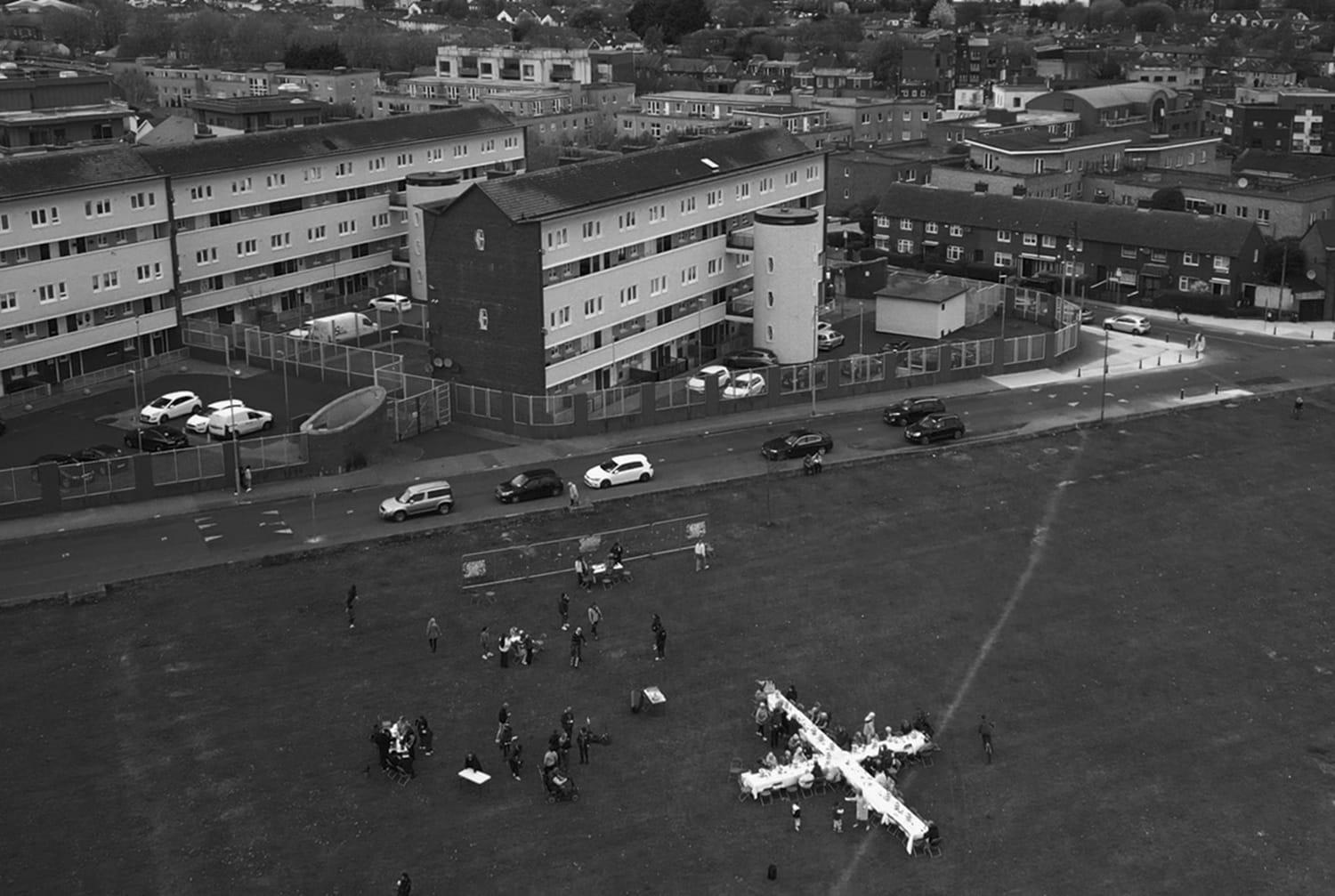
It was an example of how local groups used art or something as simple as a tea party to bring the community together, he said. “And just the visuality of it was like a blessing to the heavens.”
It echoed a scene from Lennon’s Rocky Road to Dublin, in which hundreds of school children in Ballyfermot run alongside the film crew as they drive through the neighbourhood, Redmond said.
In his own film, a few kids chased Redmond’s camera as it was fixed to a drone that rises over the green where the former housing estate stood while locals had gathered for the tea party, with its tables covered in white cloth, and organised in a cross shape.
Now that Displace has had its premiere, it will begin to hit the film festival circuit, but Reddy’s hope is that at some point, it can be screened in St. Michael’s, he says.
“What has influenced me the most here is how cinema can bring people together,” he says. “It sounds naive, but it’s to bring people together in an organising fashion.”

“Their songs are a veritable Lollapalooza of unflashy guitar play, stark aesthetics, gentle melodies, interlocking guy-girl vocal harmonies, and the spirit of Fugazi.”

"If it sounds silly, it is. But it’s also charming, heartfelt, moving and much else."

The battle between decaying infrastructure and thriving nature fascinates Maya Brezing, she says.

Paul MacCormaic says he hopes the works inspire an interest and pride in nearby sights, passed by everyday.