
Minister plans to make it much tougher for Ukrainian refugees to become Irish citizens
Andrii Stepanov says some people don’t want to return to what was once their home, and is now Russian territory. “Why are they pushing us to Russia?”
"We're kind of slagging ourselves, calling ourselves The Watchers."

At 4pm on Friday, local historian and tour guide James Madigan looked out over the construction site in the Liberties where the Molyneux Hotel is set to rise up.
He comes to this view point regularly to take photos, to track the changes at the construction site.
See how the hue of the “golden hour” illuminates neighboring social housing flats? he asks. That will be gone when the eight-storey hotel towers over the block, he says.
This vantage point won’t be the same, he said, with its views of the Poolbeg Chimneys, the Spire, Dublin Castle, and John’s Lane Church.
As well as the Molyneux Hotel, which is under construction already, there’s another – the Vicar Street Hotel – with planning permission just east of it.
Down below are the focal points of his photography routine, and that of his peers: the pit of mud on the corner of Molyneux Yard and Engine Ally, and the grotto beside St Catherine's Church.
It’s not just him, says Madigan, a whole bunch of people have been documenting the construction.
"We're kind of slagging ourselves, calling ourselves The Watchers,” says Sinn Féin TD Máire Devine, who has also been involved in documenting the changes on the site.
“We've been watching, kind of, goings on, and it's on a weekly basis,” Devine said.
“Some of us, we meet there, or some of us go up and take pictures, usually at the end of every week, just to see and to keep a record,” she says.
Already their records have had an impact.
One of the complaints The Watchers have made is that a wall they say is part of the grotto – a protected structure – has been damaged by construction.
The issue becomes clear focusing on the stone wall perpendicular to the grotto, which the company removed and replaced with a temporary wall.
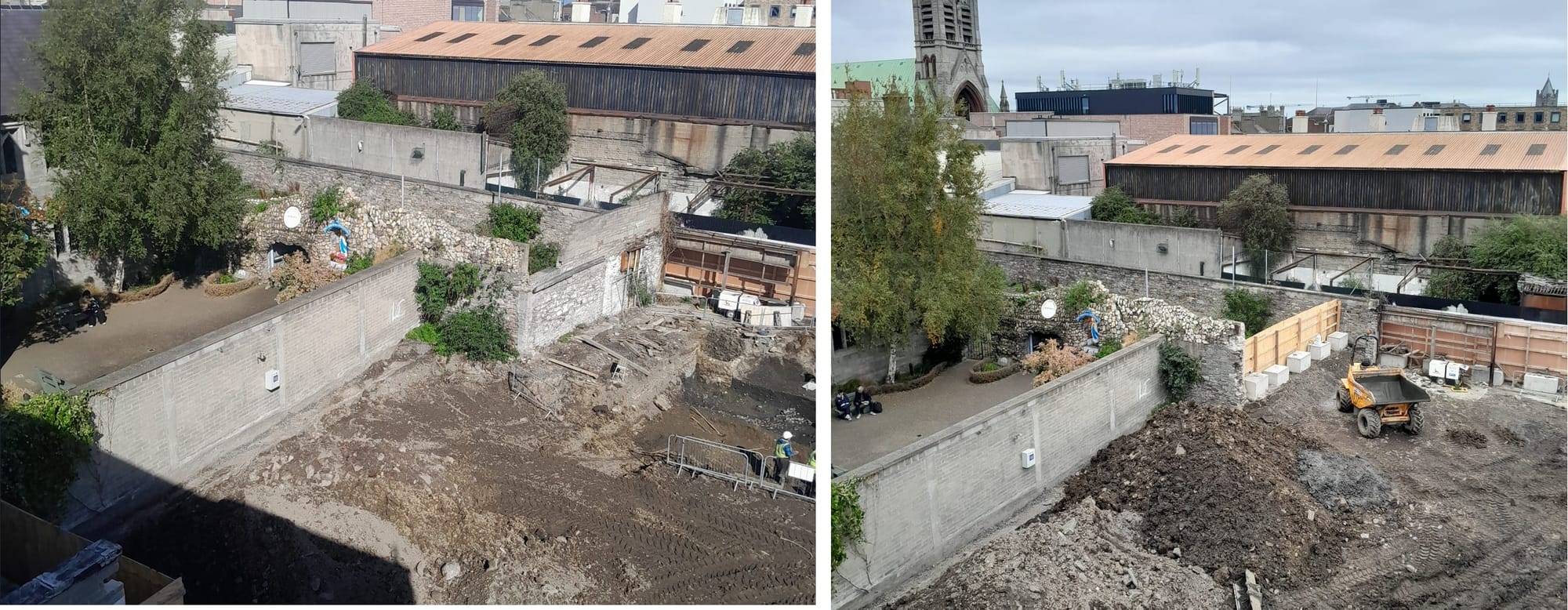
Dublin City Council opened a planning enforcement investigation, as it normally does when it receives complaints.
“The Enforcement case concerned remains under active investigation,” a council spokesperson said on Tuesday.
“Dublin City Council is continuing to engage with the developer to ensure that the wall concerned is reinstated in due course to an agreed form and specification,” they said.
Devine got an update from the council too.
It said that a Planning Enforcement inspector visited the site during the week of 22 December. “He has reported that there is a gap in the capping stone,” the update said.
“There is no further work to place on the site until February 2026 and the Inspector will visit the site again at that time,” the update to Devine said.
Meanwhile, Madigan continues to take photos twice a week – and sends them out to a list of people he thinks should see them.
In some photos, he captured walls that had been underground, but were uncovered during construction on the site.
They have since been removed, Madigan said. Sometimes archaeology is just about recording things, not preserving them, he said.
As part of the hotel’s planning permission, the council set a condition that the developer arrange an archaeological assessment of the site.
That assessment says “The site itself does not contain any known archaeological monuments or remains”, but that the risk of encountering “archaeological material on the site is moderate to high”.
The planning condition says that “No subsurface work shall be undertaken in the absence of the archaeologist without his/her express consent.”
Walking the streets in the Liberties, around where he takes photos, Madigan stopped and chatted to older fellows, teenagers with horses – and, also, to Sandra Brennan.
Brennan was sitting on a bench on the left of the grotto, alone. This is her place of refuge, it always has been, she says.
She said she has autism and ADHD, and she’s gone through a lot in general. The grotto is her place of peace.
“The grotto, yeah, that's just, that's where I go. I go there when I'm in sensory overload,” she said. “Every time I feel like I'm going to lose a sensory overload, I actually go there to hide.”
“When I was homeless actually, it was like my little source to get away from everything," she said.
Funded by the Local Democracy Reporting Scheme.

Andrii Stepanov says some people don’t want to return to what was once their home, and is now Russian territory. “Why are they pushing us to Russia?”

They were damaged during routine maintenance in May 2023, a council spokesperson said on Thursday.

It showcases films made on a short timeline with zero budget. "It's definitely a shit show, the no-budget, DIY spirit of it," says Morgan Savidan.

A masterplan for the area foresees up to 8,500 homes being built on the lands, as well as schools and sports and community facilities, and more.