

What to do with the horses of Darndale?
Grazing in public parks means other uses are being pushed out, and adding momentum to calls for an equine centre and stable club to properly support horse culture in the area.
Like, what'll be the route to dig up the footpath and lay down a wire?

Dublin City Councillors on Monday backed a motion calling for a clear process to let residents install electric-vehicle charging connections across footpaths ahead of national legislation intended to enable the practice.
The government’s 2025 draft Private Wires Bill calls for the loosening of ESB Networks’ traditional grip on electricity lines.
“Private lines will be allowed where they are the solution to allow on-street charging of electric vehicles,” says a summary of the draft bill, on the Department of Environment’s website.
But before that comes about, said Fianna Fáil Councillor Rory Hogan, who tabled the motion, the council has some work to do.
His proposal addresses a practical obstacle for people in terraced homes and apartments who lack driveways or private parking.
Residents may be willing to buy an electric vehicle and pay for a home charger, he said, but cannot easily connect it to a car parked on the public road.
As part of the effort to shift people away from burning fossil fuels – to help blunt the impacts of climate change, and reduce air pollution – the government is pushing for 30 percent of private cars to be electric vehicles by 2030.
All those EVs will need to be charged somewhere, so Dublin City Council's development plan says all new developments must include charging points. And the four Dublin local authorities together brought in a regional strategy for installing a constellation of public charging hubs.
But public charging hubs are less convenient, and the electricity they provide can be much more costly – so, many EV owners want to charge their cars at their homes. For people with driveways, that's no problem, but those without them have been searching for solutions.
That's led to the installation of charging arms that carry a power cable from a house up over the footpath to the road (the council says this is a no-no), and the installation of chargers at the road-edge of the footpath (council says nope).
Now it looks like the government and the council are moving ahead with a plan to allow residents to run wires under the footpath.
But Hogan said there are two main barriers involved in this: legislation, and the road-opening licence needed to dig up a footpath, lay the wire underneath, and then close up the trench.
He argued that the council should prepare its approach before the private wires legislation is enacted, so residents can understand how to apply, and work can be carried out safely.
“What we need is [to] figure out a way that allows residents to apply for road opening licenses to dig up the footpaths and to trench the wire in a safe and orderly manner,” he said.
“What this motion is basically trying to do is trying to make it as accessible as possible for residents to apply for road opening licenses and to install chargers outside their homes.”
“I think we need to do everything that we can to enable residents to charge their cars inside their homes,” Hogan told councillors.
At the meeting on Monday, Fine Gael Councillor Ray McAdam said the city’s infrastructure must reflect how people live, particularly in older parts of Dublin where many homes have no driveways.
While there are national targets for moving people to EVs, if the city is “serious about achieving those targets, then the infrastructure has to work for people in the real world", he said.
McAdam said that people in thousands of terraced homes across the city may be ready to switch to electric vehicles but are hindered by a lack of charging options.
Councillor Cat O’Driscoll said that her party, the Social Democrats, are wary of inequality emerging “within the EV ownership and charging space”.
Residents in apartments, rented homes and terraced houses without private driveways risked being left behind, she said.
“We really want to encourage them into more sustainable, more climate-friendly ways of getting around,” she said, calling for transparent guidelines and a consistent approach.
Labour Party Councillor Darragh Moriarty said that there are “contradictory policies at national and local level” when it comes to EVs.
While there are “all sorts of schemes incentivising people to move towards EVs”, he said, for people who make the switch, the infrastructure isn’t being provided by local authorities or national government.
"So I fully support the motion, and I think that there are other cities, as it's been outlined in the UK and on continental Europe where they grasp this a bit better than we are," he said.
One of the council’s assistant chief executives, Dennis Keeley, told the chamber at the meeting on Monday that the council was pursuing a variety of solutions to help make it possible for people to own and charge EVs in the city.
“It'll be a multifaceted approach in terms of options for those who drive EVs, in terms of how and where they charge them, one of those strategies will be the hubs, which we are advancing,” he said. The first one has been built at St Anne's Park, at the tennis courts, and will be online soon.
 Lois Kapila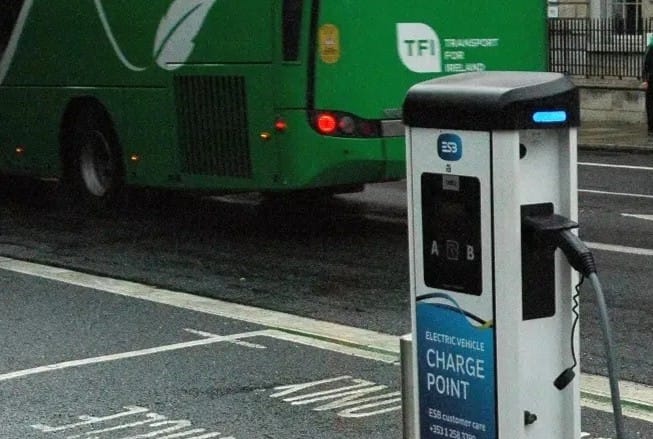
And then, in addition to public charging hubs, there'll be cross-path charging, it seems. Keeley said that a lot of work within the council has “been considered and done” on that.
Celina Barrett, another of the council's assistant chief executives, said cross-footpath charging raises issues involving standards, public liability, regulation, and planning. “Not least of which is the process – you know, what standards would we apply?" she said.
“Government are very conscious that there needs to be kind of a unified approach to a solution,” Barrett said. The Department of Transport are convening a working group to look at all of the issues, she said.
“So hopefully we'll be able to report back to the members in a short amount of time once that group is up and running on what progress has been made about putting in place a solution that can be implemented if the council adopted a policy within Dublin City,” she said.
At the meeting, support for more charging options was accompanied by caution about what widespread installation could mean for streets.
Green Party Councillor Michael Pidgeon said he was concerned that, as electric vehicles became more common, wires from homes could effectively result in an assumption that public parking spaces outside a home are the sole property of that individual household.
“And I know we wouldn't fully ever legally accept that, but a bit like footpath parking, it's something that I think could creep in, and if one space, if one kind of charger is allowed, all of them have to be,” he said.
While there is an obvious need here, he said, he would be a “little less gung ho and maybe a bit more cautious."
"Because as the technology is changing and the charge speed is changing rapidly, I just worry that in 20 years we could have this at every single home, and is that actually a desirable outcome for the city? I'm not sure," Pidgeon said.
There is a need for charging options for terraced parts of the city, he said. “Private Wires is going to be a big part of that, but I wouldn't just be kind of like, 'Let loose on this,'” he said.
Other councillors worried about whether footpaths dug up to run EV-charging wires underneath would be restored to a good enough standard.
O'Driscoll also warned that the condition of footpaths would need to be central to any scheme.
“If we are opening them up in a way, and we see services open up footpaths on a regular basis, and don't put them back in a good enough condition for the most vulnerable to move around safely,” she said.
And, said Green Party Councillor Donna Cooney, “once it’s done, that there isn't a cost to us as Dublin City in terms of the repairing of the pavements".
“So that if it's basically government policy, I think they need to be supplementing us in a way with that as well,” she said.
McAdam, the Fine Gael councillor, urged the council to begin developing a policy and examining examples from elsewhere.
In Northern Ireland, he said, some local authorities had provided pavement gullies – narrow channels cut into public footpaths that let homeowners without driveways safely run a temporary charging cable from their house to the kerbside, while keeping the surface smooth and safe for path-users.
He was not the only councillor to urge the council to look to other jurisdictions for ideas and lessons learned.
Green Party Councillor Feljin Jose said the UK had similar roads and housing types and that research there could help inform policy.
Pidgeon, meanwhile, pointed to Bristol, where there is “good share-charging”, which the council should investigate, he said. “Particularly in areas of high terraced homes, not just putting them in the distant suburbs where there's a lot of driveways already.”
Hogan, who brought the motion discussed Monday, said that, when it comes to cross-footpath charging wires, he did not want the council to wait around for the government to move on national legislation.
“I want this to be ready so we can hit the ground running and show residents this is exactly how you can do this quickly and easily as soon as the legislation is enacted,” Hogan said.
“I got a reliable response saying that planning permission is actually not required for trenching a wire through a footpath, but what is required is a road opening license, and so that's one of the things that we need to approach as a council before this legislation is passed,” he said.
He said residents were prepared to pay for the work and that the council’s task was to establish a safe, straightforward route for them to do it.
Funded by the Local Democracy Reporting Scheme.

Grazing in public parks means other uses are being pushed out, and adding momentum to calls for an equine centre and stable club to properly support horse culture in the area.

The chapel on the ground floor is too small for a theatre “but it's the kind of place where you could have recitals, a piano player or string quartet”, says Diego Fasciati, the executive director.

Dublin City Council's planning committee backed a motion on Monday to call on the Minister for Housing to broaden the legal definition to include long-term vacancy.

Some experts worry about the impact of the new rules, especially on more vulnerable households, as they await guidance on the details of how they will be implemented.