

Tusla says it's an offence to run an unregistered children’s home, but it places children in them anyways
So how does it square the circle?
Three quarters of the children placed in residential care in Ireland live in commercial accommodation. Investors have entered this growing industry, where inspections of the largest owners’ children’s homes show a mixed record.

On any given day, hundreds of children in Ireland are living in residential care organised by Tusla, the child and family agency responsible for any minor whose parents or guardians are not in a position to look after them. A growing majority of these children live in homes run by commercial companies.
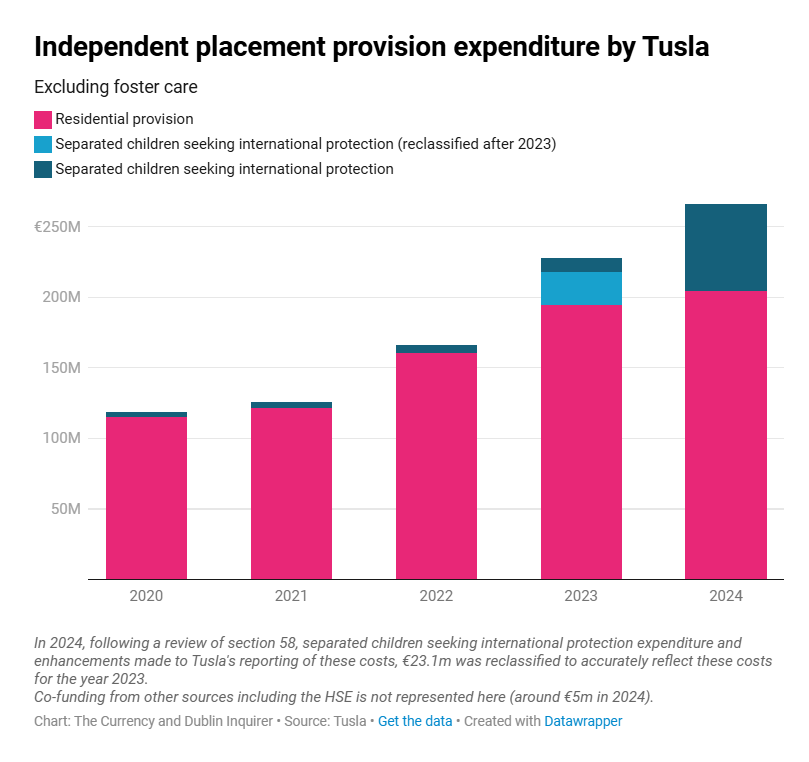
In 2024, private entities contracted to Tusla under section 58 of the Child and Family Agency Act to provide full-time care for children under the agency’s responsibility received more than €300 million for the first time.
Some €270 million of those taxpayer funds (including €5 million in provisions and co-funding from the HSE) went to private entities providing residential care to out-of-home children, including those seeking international protection.
Another €33.3 million went to agencies organising placements with foster families, which are not covered in this article.
In return, these private operators must deliver care according to national standards enshrined in their contracts with Tusla.
The players in this industry, which is increasingly attracting financial investors, have been sharing a rapidly expanding pie. Tusla’s payments to the owners of private children’s homes have grown faster since the acceleration in inflation and in the arrivals of unaccompanied children after the full-scale invasion of Ukraine.
Tusla inspection reports from October 2024 to July 2025 found some companies provided high-quality services while others had high staff turnover, short staffing and failed to meet the standards for training and supervision. In some homes, the staff struggled to manage the facilities safely for those in their care.
Tusla inspects and regulates these children’s homes itself. The agency can apply formal conditions to the registration when standards aren't met, but it has done that much less in more recent times than the past.
Unlike healthcare settings or nursing homes, most children’s homes are not inspected by the Health Information and Quality Authority (Hiqa) – unless they provide medical services such as disability care or are run directly by Tusla.
Instead, when Tusla contracts charities and private companies to run children’s homes, it also inspects them.
A spokesperson for the Department of Children didn’t explain why it is set up that way, with the main customer also being the regulator.
Tusla’s Alternative Care Inspection and Monitoring Service (ACIMS) is responsible for the registration of children’s homes run by private companies and charities, which it inspects against the national standards.
If there are issues in a home, inspectors put in place a corrective and preventative action plan. It then re-inspects to see if the action plans have been implemented.
If the home doesn’t comply with the standards, Tusla can attach conditions to the registration.
“Conditions are added as part of a regulatory escalation process that Tusla will take to direct a provider to take actions or implement a specific action that cannot be addressed through other regulatory interventions,” said a spokesperson for the agency.
Those conditions can be time-limited, and decisions to attach, amend or remove a condition are made by the National Registration Enforcement Panel, she said.
In 2021, Tusla attached conditions to the registration of 15 facilities and closed one. In 2022, it attached conditions to the registration of 21 facilities and closed one, said a Tusla spokesperson.
Recently, the agency has attached conditions a lot less frequently, inspection reports show.
In the nine-month period from October 2024 to July 2025, Tusla attached a condition to one registration, a Daffodil facility (which met the condition soon afterwards and it was removed). Tusla closed one children’s home run by Terra Glen following a report issued in November 2024.
“Tusla does not comment on individual cases or provide information on individual centres or the individual findings,” said the Tusla spokesperson.
As to why Tusla is sanctioning less overall, she said that in 2022, staffing levels and qualifications were sometimes the reason that conditions were attached.
“Requirements on staffing numbers and qualifications were subsequently reviewed, and the list of qualifications deemed suitable was expanded,” said the Tusla spokesperson.
In recent times too, Tusla inspectors found that there were not sufficient staffing levels to meet the legal requirements in some facilities, for example in an Ashdale facility in April 2025, but didn’t attach conditions to the registration.
Meanwhile, seven reports in total – four of which were for large companies examined in this article – found problems with the use of physical restraint in children’s homes either currently or previously, including cases of staff members attempting to restrain children when not trained to do so, and attempting to manage behaviour through the use of restraint.
“Staff members who are not trained in physical interventions are not permitted to engage in physical interventions with children and young people,” a Tusla spokesperson said. “The restraint of a young person is only used in exceptional circumstances and in cases of violent physical assault.”
Tusla doesn’t issue guidelines, it says, but each provider should have its own policy and procedures, which Tusla checks as part of the inspections process to ensure they meet with national standards.
“Where it is absolutely necessary to restrain a young person, it is done in line with specialised training,” said the spokesperson.
Tusla has a primary responsibility to promote the safety and welfare of children, said the Tusla spokesperson. Inspectors review all incidents – including records and CCTV footage where available – where a young person was restrained, she said, and child protection referrals are assessed in line with Children First guidance.
Only one facility out of the seven where this issue arose had conditions – albeit briefly – attached to its registration and in that case due to staffing, rather than use of restraint.
A Tusla spokesperson said its inspectorate “adds conditions as part of a regulatory escalation process to direct a provider to take actions or implement a specific action that cannot be addressed through other regulatory interventions.”
Tusla also contracts private companies to run unregistered facilities, through what it calls special emergency arrangements.
A spokesperson for Tusla said it has brought enforcement action against 11 different emergency providers in the last three years.
“Where concerns are identified, Tusla takes immediate and swift action to address them directly with the provider in order to come to a resolution that is in the best interest of the children and young people in care,” said the spokesperson.
When Tusla identifies providers that don’t meet standards for staff training, qualifications, references and vetting, it stops contracting them, she said.
The 2022 annual report of the special rapporteur on child protection, Conor O’Mahony, flagged issues with the State’s reliance on private providers to run children’s homes based on international research.
Challenges include risks that private operators might not always be best placed to meet the needs of children, lower levels of qualifications and retention among staff, difficulties in ensuring quality through inspection and oversight, and risks of “distress purchasing” whereby social services take on placements out of desperation, said the report.
“To the extent that data is available, these challenges appear to have been replicated in the Irish experience,” it said. “At best, the quality of care is unlikely to be better than in the public sector; at worst, it may be markedly inferior.”
“Crucially, all of the above risks arise in a context where privatisation fails to meet two of its own claimed advantages: it has not lowered costs, and international evidence suggests that it has also failed to reduce bureaucracy,” said O’Mahony in the report.
In its strategic plan for residential care 2022 to 2025, Tusla said it aimed “to incrementally reverse our disproportionate dependency on private residential care” from 60 per cent to 50 per cent – increasing the share of residential beds run by Tusla itself or by charities.
But it failed to do so. Private provision has increased, in real numbers and proportionately.
Figures released by Tusla in September 2025 for all types of homes – including for asylum-seeking children – show that private providers accommodated 733 children (77 per cent), Tusla accommodated 129 children itself (14 per cent), and charities accommodated 85 children (nine per cent).
A spokesperson for the Department of Children said it “recognises that an over-reliance on private providers increases the risk of over-reliance, sustainability, value for money, and capacity”.
The Minister for Children, Fianna Fáil TD Norma Foley, has called on Tusla to increase its residential care capacity from 2024 to 2026, and to progress commitments to reduce reliance on private provision, the Department of Children spokesperson said.
Meanwhile, Tusla is desperate for beds.
In May 2025, there were 208 children on waiting lists for residential placements, often living in temporary set-ups, including unregistered emergency accommodation, or staying on in foster families even though those placements had in reality broken down.
Tusla’s strategic plan for residential care, from 2022 to 2025, had said that it would open 104 new beds in publicly run or non-profit children’s homes to address the shortage of placements.
But as that period neared its end, as of May 2025, the agency had opened only 31 of those new beds. Tusla hasn’t responded to several requests for an up-to-date figure.
Terry Dignan, a spokesperson for the Children’s Residential and Aftercare Voluntary Association, representing the charities that run children’s homes, said that charity providers are willing and able to expand.
“We would be happy to staff and run more children’s homes,” said Dignan. “We want to increase capacity.”
Charities have good rates of staff retention, which is the key to providing good quality care, he said, but they don't have the resources to secure buildings.
Dignan said that in January 2025, Tusla officials said they’d look into providing buildings for charities to run homes but they failed to come back with any. Charities are still willing to run more services if the state can provide them with the buildings, said Dignan.
A spokesperson for the Department of Children, Disability and Equality said that it, and Tusla, are committed to promoting safe and high-quality practice in all areas of alternative care.
Officials within the department regularly review Tusla’s inspection reports “that are deemed significantly non-compliant to determine any practice issues which can be escalated where deemed necessary", said the spokesperson. It can monitor themes and patterns this way, they said.
Tusla’s budget for 2026 is more than €1.4 billion, and a 14 percent increase on 2025, said the spokesperson. It includes an extra €53 million for residential care, they said.
There has been a 500 per cent increase in the number of separated children seeking international protection since 2022, the spokesperson said.
“Tusla makes every effort to ensure these minors seeking international protection are kept safe,” they said. But the increase “represents a significant and ongoing challenge for Tusla in sourcing appropriate accommodation”.
The Currency and the Dublin Inquirer have analysed Tusla’s payments to private service providers from two sources.
One is the agency’s annual report for 2024, which includes the total amount paid to each independent placement provider under section 58 that year but does not detail the type of placement provided. The other source is the quarterly list of purchase orders disclosed by Tusla, which excludes those under €20,000 but offers more detail on the types of services paid for.
This does not include €217 million in funding Tusla gave separately to community, voluntary and charitable organisations for the provision of health and personal social services, including the majority of charity-run children's homes. Those payments are not detailed in purchase orders.
Although some charities provide residential services under section 58, the vast majority of €270 million in 2024 residential payments under this category went to commercial companies.
We cross-referenced the two sources to identify the largest recipients of payments for private residential care in 2024, and checked against 2023 figures to verify that there wasn’t any change in the list of leading service providers. These services include long-term care, both for children with disabilities and those without, as well as special emergency arrangement providers.
We then identified the owners of private residential care providers and the groups they form when several companies have common ownership or control. The 11 largest recipient groups – those with more than €7 million each in payments in 2024 – together received €165 million from Tusla, accounting for almost two-thirds of such payments.
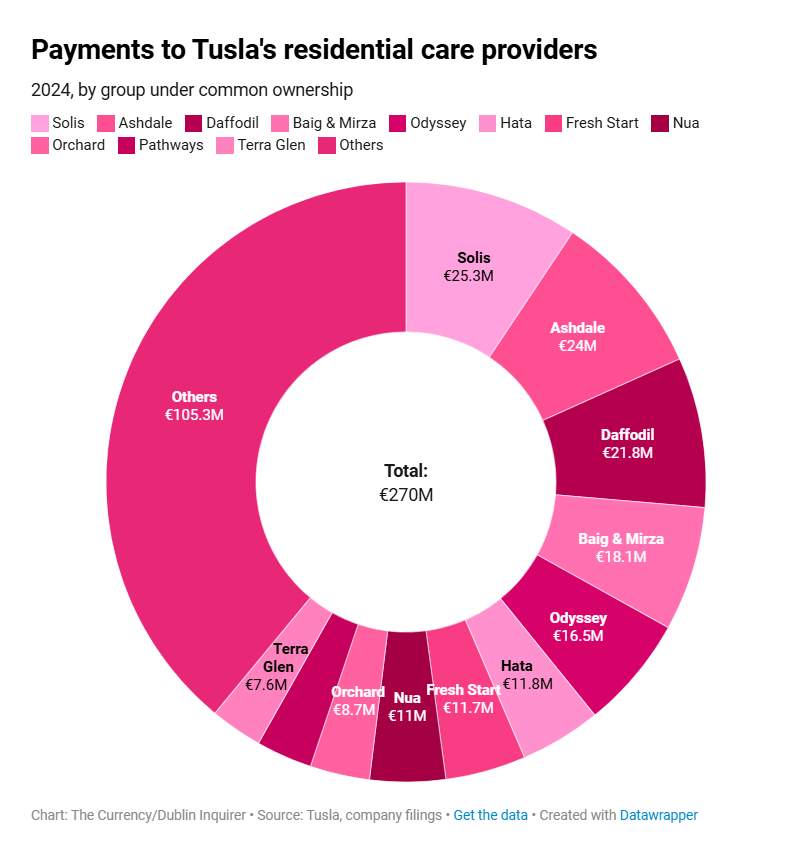
The vast bulk of the payments to these 11 groups, €151.1 million, could be traced to published purchase orders for private residential care, including special emergency arrangements.
We then analysed all inspection reports from Tusla for the companies in these 11 groups from October 2024 to July 2025. This gave a recent view of their performance against the standard of care expected by Tusla under their contracts, with one exception – Baig and Mirza Health Services, as detailed below, is the only one of the top 11 providers that is primarily a provider of special emergency arrangements. This has excluded it from the scope of inspections.
Another caveat is linked to the scale and structure of the groups below. As each children’s home can expect several inspections each year, any owner operating several homes is likely to be exposed to more intense scrutiny than those focusing their activity on a single site.
It is also important to note that Tusla allocates children to specific facilities depending on individual needs and the capacity available from different operators. Those companies investing in a more advanced skillset among their staff are therefore more likely to receive more challenging cases.
With those explanations out of the way, who are the largest commercial providers of children’s residential care, how much money do they make for their owners, and what quality of service do they deliver to Tusla and the children in their care in return?
MMC Children’s Services, a company trading under the Solis name, was paid €25.3 million by Tusla in 2024. There are four related children’s care companies at the same address – Solis GMC Children’s Services Ltd, DMC Children Services Ltd, SMC Children Services Ltd, and Solis EMC Children’s Services Ltd – but Tusla has not reported making any direct payments to them.
As small companies, their reporting obligations do not cover the disclosure of further payments between them, if any.
Reports for facilities run by the Solis group show that in the period from October 2024 to July 2025 there were challenges with short staffing to different degrees in four locations, including a period during which staff worked back-to-back shifts in one of those.
One of the nine facilities inspected, operated by Solis GMC, had multiple issues previously. The owners decided to close it for four months in the middle of 2023. Before the closure, there had been a protected disclosure about unsafe practices at the centre, according to a December 2022 report.
Some issues flagged in reports included fire safety at a Solis EMC home training and supervision at a Solis SMC facility.
A Solis GMC report noted previous issues in 2023 with child protection, safeguarding and room searches had mostly been addressed.
Companies in the Solis group didn’t respond to questions put to them by phone and email.
Inspectors found mixed results including evidence of good practice, too, within some of the homes. For example, at a Solis SMC home inspectors found that social workers for the children said that staff in the children’s home were working hard to advocate for young people and promote their rights.
“There was evidence of staff providing genuine care for the young people and responding effectively to their individual needs,” it says.
MMC Children’s Services, based in Donegal, is owned by Martin and Margaret McCaul, with Martin holding a majority 80 per cent stake. Younger family members sit on its board. They include Edel McCaul, who owns 70 per cent of Solis EMC Children’s Services, Darren McCaul (70 per cent of DMC Children Services), Stephen McCaul (60 per cent of SMC Children Services), and Gary McCaul (90 per cent of Solis GMC Children’s Services).
MMC Children’s Services swung from loss to profit in 2024, generating €116,107 in net profit and paying €185,000 in dividends to its owners. It also paid €26,000 towards their pension contributions. After that, it was sitting on €1.5 million in past accumulated profits.
MMC Children’s Services had no debt and employed 34 people, down from 56 in 2023.
Solis GMC employed 65 people in 2024. It paid €137,599 in dividends and €224,072 in directors’ remuneration to its owners, Gary and Kellie McCaul, and ended the year with €334,176 in accumulated profits.
Solis EMC had 98 staff and paid €250,000 in dividends as well as €933,156 in directors’ remuneration to its shareholders Edel McCaul and Declan Gill, ending 2024 with €324,693 in accumulated profits.
SMC Children Services had 100 employees in 2024 and returned a net profit of €284,550. Its owners Stephen and Lesely-Ann McCaul collected €752,000 in dividends and €216,438 in remuneration and pension contributions, leaving the company with a deficit of over €430,000 including a €200,000 debt liability.
DMC Children Services, with 37 employees, made a €146,595 profit in 2024. After paying its owners Darren and Shauna McCaul €158,649 in directors’ remuneration and pension and €38,400 in dividends, it ended the year with €132,000 in retained earnings and owed just over €55,000 in debt.
Tusla paid €24 million in 2024 to Ashdale Care (Ireland) Ltd.
Tusla inspected 12 children’s homes run by Ashdale and issued reports between the start of October 2024 to the end of July 2025. They flagged issues with the inappropriate use of physical restraint in one of those homes on a previous occasion and poor management of the risk of violence in another.
Meanwhile, they also flagged seven homes for issues with high staff turnover or short staffing. One of those was using staff that weren’t vetted and five facilities had deficits in training or supervision.
Some reports were mixed with elements of good practice as well as some standards not met, according to the inspectors.
One report, issued on 2 July 2025 was mostly good. “Three children interviewed by the inspectors confirmed they felt well cared for in the centre and that the adults caring for them helped them in lots of areas of their life,” it says.
Another report issued on 23 December 23 was very positive. “Following a review of care records, talking to the young person and the care team and observation throughout the inspection it was evident that the team made every effort to support young person to lead a healthy lifestyle and reach their full potential,” it says.
A November 2024 inspection report for one facility for children with high-level needs referred to major issues the previous year, which had been relayed in a report in November 2023. Inspectors had found that physical restraint was used in ways that were not appropriate in 2023.
Staff in the Ashdale-run children’s home had physically restrained a child 78 times, that earlier inspection found. Physical restraint was being overused, while it should only ever be used as a last resort, the report said.
“It was clear that the child had not developed positive relationships with staff which had resulted in the staff team not being able to manage their behaviours effectively and, in the child, not developing strategies to manage their own behaviour,” the 2023 report said.
Staff were inexperienced, there was high staff turnover, and staff felt they had no one to learn from, that same report said.
The report in 2023 related the staffing challenges to the issues around how they managed behaviours. The facility needed to strengthen its practice and focus on learning how to de-escalate the child’s behaviour in ways other than physical restraint, it said. “The stabilisation of an experienced staff team is crucial for all of this to occur.”
Tusla did not attach any conditions to the registration of the facility.
In the 2024 report, inspectors found that staff had reduced the use of physical restraint, using it only when proportionate. Outstanding issues around short staffing remained as did high staff turnover, it said.
“The centre is continuing to operate below the minimum requirements in terms of staffing. There had been 11 staff members who had left or moved within the organisation since the last inspection in September 2023,” said the 2024 report.
“Ashdale provides enhanced residential care to some of the most traumatised and high-needs young people in the care of the State,” said a spokesperson for the company. “Our focus is always on prevention and de-escalation.”
Ashdale staff complete a three-week induction and are trained in therapeutic crisis intervention, and that training is refreshed every six months, said the spokesperson.
“We have also invested heavily in the CARE model from Cornell University, which has reduced incidents of violence and aggression across our homes by 60 per cent,” said the Ashdale spokesperson.
In one Ashdale home for children with complex needs, where one young person had assaulted and threatened other young people in the centre, inspectors identified issues with the ways behaviour and risks were being managed.
“Some of these risks included prolonged lack of engagement and isolation from the staff team, prohibited phone use, online safety, concealing of weapons, suicidal ideation and assault and threats to other young people,” says the report.
One social worker had said that they didn’t think there were enough staff supervising the young people when some incidents happened, according to the December 2024 inspection report.
“Room searches were not contained in the preventative strategies at the time knives had been found in one young person’s bedroom and where the risk was high of assault on another young person,” said the inspection report.
In a different Ashdale facility, inspectors found “no safety plan specifically addressing the young person’s health and safety matters related to biting and/or assault,” said a March 2025 inspection report.
But it said overall the child, who had needed to be restrained on multiple occasions, appeared to be making progress.
The Ashdale spokesperson said: “The safety of our young people and employees is core to everything we do. Risks are assessed on referral and updated as young people’s needs evolve.”
He said that Ashdale is the only children’s home provider in Ireland with an in-house, clinical multi-disciplinary team, which includes psychology, behaviour therapy, occupational therapy, trauma-informed teachers, and art psychotherapy.
“This team works directly with staff to guide therapeutic responses and risk-reduction planning,” said the spokesperson.
In another Ashdale facility, inspectors found that staff turnover was so high – with 12 staff having left in the previous 12 months – that it was affecting the children’s care, according to an April 2025 report.
Two young people’s stays had broken down in the past year. “High turnover and inconsistency in staffing was identified as a factor in the ending of these placements,” says the report.
At a different Ashdale children’s home in a report issued the same month, inspectors flagged high staff turnover and training deficits, adding that the staff didn't understand the risks in relation to safeguarding. “This area of practice requires immediate action,” said the April 2025 report.
In another facility, inspectors found staffing deficits, that many of the staff were agency staff, and that there was inadequate vetting, according to a June 2025 report.
“Inspectors found that the implementation of the relationship-based aspect of the model of care was impacted by deficits in staffing resources,” that report also says.
The spokesperson for Ashdale said: “Children’s residential care is a highly specialised sector with a nationally restricted labour pool, and the demand for placements is unprecedented.”
Ashdale prefers to employ staff directly, he said, and where it uses agency staff, they are vetted, and those workers cover less than one per cent of all hours worked within the organisation.
In Ashdale’s Quality Report 2024, the company’s CEO, Caroline Grey, wrote: “Our homes received excellent feedback from inspections, many of which were unannounced, reflecting the consistency and quality of care we provide.”
When asked about some of the reports highlighted above, the spokesperson said that since Ashdale supports the most complex-needs children, issues do and will arise and when they do, the company acts immediately.
“Where improvements are identified, we implement action plans within the required timeframe,” he said. “Overall, inspection feedback, including verbal feedback delivered on the day, has been very positive, and the CEO’s comments reflect that.”
Ashdale Care was founded in Northern Ireland in 1998 by Paula Kane. It is now under the control of its second consecutive private-equity investor. MML Ireland acquired a majority stake in the business in 2017, and sold it in 2021 to Cardinal Capital.
The business of Ashdale Care in the Republic is divided between two companies: a real-estate vehicle, Daleash Properties Ltd, and Ashdale Care (Ireland) Ltd, which provides residential care services. A related company, Care (Ireland) Ltd, operates in Northern Ireland.
The Dublin-based private-equity firm Cardinal Capital owns 81 per cent of the group, while Paula Kane and her family retain 15 per cent, and minority shareholders including senior employees hold the remaining four per cent.
Ashdale’s directors include former HSE chief executive Paul Reid, who chairs its board, and former senior government official Jim Breslin, who was secretary general of the Department of Health from 2014 to 2020.
Ashdale Care is primarily funded by debt. It owed €13.3 million to AIB at the end of March 2024 under loans secured against its properties. It owed another €38.3 million to Cardinal Capital itself, under shareholder loans attracting an interest rate of 12 per cent. This was the primary channel for the private-equity firm to collect returns from the business, as it was otherwise loss-making.
In the year ending in March 2024, the group had €20.3 million in revenue. The vast majority of this sum came from Tusla payments.
After accounting for operating expenses, it recorded a €7.8 million loss that year. Most of this, however, arose from €5 million in amortisation of goodwill. This was the €50 million value its current owners paid above and beyond the book value of its assets when they acquired it, which reflected their belief in its growth potential. They are allowed to offset this value against taxable profits over 10 years.
The Ashdale group also recorded a €5.6 million interest charge in favour of Cardinal Capital under shareholder loans, and another €900,000 in mortgage interest to AIB.
This left it in negative equity to the tune of €18.4 million, but this doesn’t mean it is in financial trouble. This is a common financial position among companies funded by their private-equity investors through intercompany debt.
Reid signed off on the accounts on the basis that the business was forecast to generate sufficient profits to meet its obligations. Notes added that this going concern basis was valid until the majority of its debt falls due in August 2026.
Cardinal Capital declined to comment when contacted with questions about its investment in Ashdale.
Cardinal’s second investment in children’s homes
Separately from Ashdale, Cardinal Capital also acquired a 40 per cent stake for €3 million in 2025 in Lotus Care. This company controlled by the Corboy family received €4.6 million in total payments from Tusla in 2024. Lotus Care made €171,459 in net profit in 2024 after paying its five directors a total of €284,582 in remuneration and €1.2 million in pension contributions.
The directors were owners and co-CEOs David and Madeline Corboy; former HSE director general Tony O’Brien; Louise Niemann, a non-executive director sitting on the board of several Cardinal Capital portfolio companies; and solicitor Brendan O’Sullivan, acting as an investor representative.
The Corboy family separately owns 90 per cent of another company, Clover Care, which received over €1.5 million from Tusla in 2024 for residential care services. No investment by Cardinal Capital has been reported in Clover Care. The remaining 10 per cent are held by Clover Care’s director of services Ciara Nicastle. In 2024, the Corboys bought out their minority partners since the establishment of Clover Care in 2023, Bernie Breen and Vivian Molloy.
Daffodil Care Services Unlimited received €17 million in payments from Tusla in 2024, while its sister company Misty Croft Ltd was paid another €4.8 million. Of the total €21.8 million, €18.2 million appeared in purchase orders for residential care services.
Tusla inspectors visited 12 Daffodil facilities covered by reports issued between October 2024 and July 2025. In two reports, inspectors noted issues with the use of physical restraint or reviews of its use.
“Physical intervention was used by staff on duty during the incident; however, they were not experienced in the techniques of the model,” says a report issued in May 2025. “There was no review of the use of physical restraint by the staff team completed from this incident.”
Also, some staff did not appear to understand behaviour management techniques, that report said. “They did not demonstrate a good understanding of the underlying causes of specific behaviours that could assist children to manage their own behaviours and development needs.”
Inspectors also found that staff in that facility had not handled a complaint from a child in line with the facility's own policies and procedures.
A report issued on 30 October 2024 for another facility noted that it hadn’t reviewed its past use of physical restraints in the way that a previous Tusla report had meant.
“It did not however review restraints in the context of the recommendation of the inspection report which highlighted that at times there was difficulty maintaining physical holds and staff members were hurt as a result,” the report said.
At a different children’s home run by Daffodil, inspectors said staff should receive more training to better manage the child’s behaviour, as they were over-reliant on sanctions.
There were “staff not responding from a trauma-informed perspective when young people presented in crisis”, said the report, published in May 2025.
In that same home, staff had failed to check up on a high-risk young person who was missing from care at night, it said. “The inspectors found that given the needs of this young person and the known concerning risks while out in the community the practice of not attempting to check in on their wellbeing during the night when missing from care was not safe care.”
Four of the 12 facilities had inadequate levels of staffing or high turnover, and seven mentioned inadequate training, according to inspection reports for the period reviewed.
Among those that were shortstaffed, one facility had been 13 months without a permanent centre manager, according to an October 2024 inspection report.
High turnover hindered consistent care, the report found, with young people finding it difficult to build relationships with the team given the rotating staff.
The centre’s two social care leaders had “insufficient relevant experience” for their roles, it also said. And “some of the agreed behaviour management interventions could not be implemented due to an insufficient number of staff with the required behaviour management training”.
In a report for another facility, also published in October 2024, Tusla inspectors spot-checked the roster and found out of the “63 day period, 23 days could not be staffed with the required day shift”.
Staffing was below the minimum staff levels and qualification for registration, the report said. Tusla, briefly, attached conditions because of the inadequate staffing.
A March 2025 report for another home also found high staff turnover. Staff who completed exit interviews said they left for better working hours and flagged low pay as an issue, it said.
The inspectors’ report said that “Due to the level of turnover it was difficult to assess compliance with the action plan set out in [the staffing section of] the previous inspection report.”
Among the training issues raised, a May 2025 report for a facility noted that “it was evident to inspectors that a large number of the team had not had direct children’s residential care experience”. That placed significant demands on managers as they built up team competency, it said.
This report mentioned a high number of incidents but doesn't specify what they were. At a previous inspection in June 2024, seven out of ten staff didn’t have the required mandatory training in behaviour management, it said – which had since been reduced to two members of staff.
The deputy manager wasn’t doing formal supervision meetings of staff as required, the inspectors found.
In another children’s home run by Daffodil, three staff members were found to be speeding with children in a car and little action was taken as a result of this safety issue, according to an inspection report dated October 2024.
At Daffodil’s sister company, Misty Croft, inspectors reviewing previously issued corrective and preventive actions (CAPA) found in October 2024 that some “deficits identified by inspectors during this CAPA review process were not identified and actioned by management”.
Children who were fasting during the day for Ramadan were only allowed 30 minutes to have their meals later, it said, and if they stayed longer in the kitchen, they would set off centre alarms. Some of the young people asked for more time, but the request was refused, the report says.
Staff also failed to handle complaints properly, the report said. Tusla inspectors re-registered the facility, despite the fact that all issues were not resolved at re-inspection, as actions had been scheduled.
Paul Carroll, a co-founder of the successful recruitment business CPL Resources, also co-founded Daffodil Care in 2008 with Pat Hayes, then in charge of CPL’s healthcare division. Carroll later went on to sell CPL in a €317 million deal.
The two men continue to co-own the Daffodil Care group, with a 70 per cent stake for Carroll, 25 per cent for Hayes, and five per cent for its director of services Carlos Kelly.
In October 2023, Daffodil acquired another care provider already contracted to Tusla, Misty Croft Ltd. The seller, a holding company for the O’Connor family of Dublin accommodation providers, disclosed a €3.6 million profit on the disposal of investments that year, with Misty Croft the only investment it reported disposing of.
The latest accounts available for Daffodil Care were to the end of September 2020, when it employed 165 people. That year, it made a €2.9 million profit and distributed €2 million of that to its shareholders as dividends. Its directors, Hayes and Carroll, also shared €408,300 in salaries and €60,053 in pension contributions. The company owed just over €225,000 in bank debt.
Since then, Daffodil Care companies have been re-registered as unlimited and stopped publishing financial information.
Meanwhile, accounts for Misty Croft to the end of April 2024 showed it had 60 employees. It made €915,393 in profit and paid €1.4 million in dividends during the year it was acquired by Daffodil. It also paid €72,239 in salary and €190,000 in pension contributions to its directors, who were Theresa Fitzsimons at the start of the financial year, and Carroll and Hayes at the end of the period.
Following the integration of Misty Croft into Daffodil Care, the group refinanced its debt with Bank of Ireland last December. On that occasion, a filing by Misty Croft showed that it was providing a €4.9 million guarantee for the loans, which were intended to refinance its own acquisition by Daffodil.
Hayes and Daffodil’s director of operations, Louis O’Moore, along with their families, are also co-owners of Comet Care Ltd, a health and social care staffing agency trading under the brand MCMA. Most of the €7.7 million paid to this company by Tusla in 2024 were for agency staff, however the State body also disclosed €246,242 in purchase orders for special emergency accommodation of children by Comet Care.
Daffodil Care didn't respond to repeated queries.
Tusla paid Baig and Mirza Health Services Ltd €17.5 million and Baig and Mirza Real Estate Ltd €648,000 in 2024. Of this €18.1 million total, €13 million could be traced to purchase orders for special emergency arrangements.
In the Dáil in September 2022, the then Minister for Children, Green Party TD Roderick O’Gorman, referred to unregistered children’s homes and other short-term unregistered facilities as “local bespoke emergency placements”.
At the time, there were 35 children in unregistered settings, he said. Unregistered children's homes are not inspected, so there are no inspection reports available.
In October 2025, there were 157 children in unregistered residential settings, which Tusla now calls “special emergency arrangements”. (Of these, 102 children were seeking international protection, according to a Tusla spokesperson.)
“We are exhausting all avenues to continue to increase the capacity of residential care services, to further reduce our reliance on special emergency arrangements (SEAs) in the weeks and months ahead, and we are confident that we will continue to see further reduction,” says the Tusla spokesperson.
Baig and Mirza companies are the largest providers of such unregistered emergency placements.
Baig and Mirza owned and operated the unregistered children’s home in Donaghmede, Co. Dublin, where Vadym Davydenko, a 17-year-old Ukrainian citizen, was murdered in October.
Baig and Mirza Real Estate Ltd became the registered owner of the apartment in the Grattan Wood residential complex in July 2024, and in September 2024, the company applied for a planning exemption to run a “children’s residential house”, which Dublin City Council refused.
According to a Tusla spokesperson, the agency started funding the unregistered children’s home at that location in June 2023. It should have been registered after 30 days, she said.
“Where a non-statutory provider is providing both staffing and a premise for a Special Emergency Accommodation (SEA) to Tusla, the provider is required after 30 days of operation to commence an application for registration … in order to remain operational,” says a Tusla spokesperson.
In September and October 2024, Tusla’s inspection and monitoring service met with all emergency providers to try to get them registered, says the Tusla spokesperson.
“These companies are at various stages of the regulatory process.”
Baig and Mirza started the process to register the children’s home in Donaghmede with Tusla in August 2025, says the Tusla spokesperson.
“It was found that their application required additional documentation,” she says.
“Providers are encouraged to reapply for registration and are supported by Tusla teams upon request until such time as they achieve registered status.”
Dublin-based accountants Muhammad Usman Baig and Farhan Mirza own equal shares in both Baig and Mirza Health Services Ltd and Baig and Mirza Real Estate Ltd.
Baig and Mirza Health Services Ltd also trades as Kare Plus Dublin South under the Kare Plus franchise, offering a range of care services.
Its latest available accounts, for the year ended in March 2023, show that it made a €3.1 million profit that year, leading to accumulated profits of €5.9 million. It had no long-term debt. The combined remuneration of directors Baig and Mirza jumped from €195,833 in 2022 to €866,667 in 2023.
Mirza recently resigned as director of the company, with effect from October 20, 2025.
Baig & Mirza Health Services Ltd has not responded to calls and emails with questions, including why the company hadn’t registered the facility.
A Tusla spokesperson said by phone on 6 January 2026 that this property is no longer in use as a children’s home.
Orchard Residential Care Ltd received €8.2 million in payments from Tusla in 2024, while its sister company Orchard Community Care Ltd was paid another €507,000. Another related company, Orchard Children Services Ltd, also received €8.4 million but this was specifically to organise placements with foster parents.
The five inspection reports for Orchard Care issued between October 2024 and July 2025 were mostly positive, pointing to good individualised care, stable and qualified teams in many homes, and most facilities were well managed.
In one report, inspectors said that all the children’s social workers interviewed were complimentary of the staff in the home.
“The team were described by social workers and Guardians ad Litem (legal advocates for children in care) ‘as being warm and caring, committed, focused on individual needs and accepting of diversity’,” says the report.
“It was also described as ‘a fabulous centre where the team stick with young people’ and ‘go above and beyond to support the children’.”
Short staffing was raised as an issue in one inspection report. In another report “the inspectors found that the internal management structure was not appropriate to the size and purpose of the centre.”
The Orchard Care Group, organised under a company called Sashington Ltd, includes the three subsidiaries contracted to Tusla. The largest shareholder in Sashington is the Dublin investment firm TowerView, founded by former Mater Private Group and NCB Stockbrokers executive Diarmuid McNamee, via a number of channels.
TowerViews owns a 41 per cent stake through a nominee company holding its clients’ interests; it has a small shareholding of its own; and TowerView’s healthcare sector lead Kathryn Holly personally holds a 22.4 per cent stake. Holly did not respond when contacted by phone and email about TowerView’s investment in Orchard.
Orchard Care Group chief executive Natalya Jackson owns 17.9 per cent of the company, while chief financial officer Shane Donnelly and Orchard Fostering managing director Jennifer Sinnott own nine per cent each. Populace Properties Ltd, an English company, holds 0.6 per cent.
The latest accounts available from Sashington consolidate the Orchard Care Group’s business for 2024, when it had 334 employees. It had fast-growing revenues of €31.5 million and returned an operating profit of €4.4 million. After paying interest on a bank debt of €14.4 million, it reported a healthy pre-tax profit of €3.4 million.
This was despite recording a €2 million annual amortisation charge on €11 million worth of goodwill, generated during the formation of the group through the acquisition of several companies by the current shareholders in 2021.
Just like the goodwill booked by Cardinal Capital on the acquisition of Ashdale Care, this charge is deductible from taxable profits but does not represent a cash cost for the Orchard Care Group or its shareholders.
Odyssey Social Care was paid €16.5 million by Tusla in 2024.
Four of nine Odyssey inspections between October 2024 and July 2025 flagged inadequate staffing.
Three inspection reports during the same period raised issues of maintenance or fire safety provisions and one report mentioned previous issues with the handling of an allegation against staff following the use of physical restraint. Another in July 2025 noted issues with the reporting of physical restraint incidents.
There were some positive reports, such as an 16 April 2025 report finding that there was a stable management and staff team in place and a positive atmosphere in one centre. “The inspectors observed the children interacting with the care team and found that the children had a fun and trusting relationship with them,” says the report.
In one inspection report from December 2024, inspectors found that “the level of staffing in the centre was a safeguarding issue”.
The staffing levels were leading to burnout and stress for management and staff, and a child had also put in a written complaint about it, the report says. “Insufficient staffing levels also had an impact on the centre’s systems in place for managing and monitoring other risk-related behaviours.”
In another facility, short staffing meant cleaning wasn’t done to the expected standard and children missed appointments, said the inspection report issued in March 2025.
A spokesperson for the company said staff “prioritised the care of young people and implementation of their plans over cleaning and upkeep of the house. Non-urgent tasks were postponed, and this was evident in the premises during inspection”.
Meanwhile, a July 2025 report from inspectors – related to another facility – found regular back-to-back shifts during a period reviewed.
Over two months in 2025, staff worked for 48 hours at a time on at least 13 occasions, the report says. One relief staff member was doing this routinely on Sundays and Mondays. On other occasions, full-time team members carried out double shifts and a third shift in the week without a risk assessment.
“It was unclear why alternative options were not sought, and the implementation of planned and scheduled back-to-back shifts must cease,” says the report.
A spokesperson for the company said the issues of staff turnover and short staffing have been addressed. “There is a stable and consistent full complement of staff in place in this centre who are trained, qualified and vetted and who are consistently meeting the needs of the young people resident there.”
Among the reports raising issues around maintenance, the findings for a facility published in July 2025 said that repairs to a young person’s room hadn’t been done properly – with a damaged door and unpleasant smell in the ensuite among other issues.
“Inspectors found that the communal spaces were not overly stimulating or enticing for the young person to spend time in,” it said, and at times, there were no working televisions. “Both the internal and external areas of the centre required repair and upkeep in terms of painting and decorating.”
Monthly fire drills hadn’t been happening, and monthly inspection checks of fire safety equipment had not been recorded by the team over the past year, it said.
A spokesperson for Odyssey said that the company employs an independent fire safety specialist who conducts quarterly checks to maintain compliance standards.
Meanwhile, one inspection report also mentioned allegations against a staff member. According to a report published in February 2025, there was a failure to deal appropriately with allegations against staff members at one centre.
“The centre manager must ensure that the children’s ICSPs [individual crisis support plans] are reviewed to specify the physical interventions that are permitted and identify contraindicators to physical restraint where relevant,” says the report.
A spokesperson for Odyssey said that the two allegations referred to two instances of staff members physically intervening to ensure the safety of one young person, who made a complaint afterwards.
“These complaints were investigated by Tusla in accordance with standard practice and determined that the complaints were unfounded,” says the spokesperson.
The report said: “The inspector reviewed documentation and found that the allegations made against staff members prior to the previous inspection had all been concluded by the social work department and adequate steps had been taken in relation to conclusions.”
The inspector noted that senior management had not examined the pattern of complaints and allegations against staff members, nor the impact that staff turnover was having on the young people, says the report.
The managers had changed the model of care and rolled out training for the new model, but no staff member attended all three days of training. “There was no plan presented to the inspector to ensure all staff would be fully trained within a clear timeframe,” says the report.
A spokesperson for Odyssey said: “Internal and external inspections will inevitably identify areas for improvement, and these are used to strengthen our service arrangements.”
“It is evident that no serious concern regarding the safety or quality of the care we provide has been identified or is the subject of any ongoing concerns to Tusla,” they said.
“It is important to note that Odyssey Social Care has no involvement in the provision of private unregulated placements, and all of our services are regulated and registered with Tusla without any conditions attached,” he said.
Odyssey Social Care is part of the Oakglen group, previously known as Brian Crowley Holdings, alongside the group’s main business, the recruitment, home and residential care agency TTM Healthcare.
Odyssey Social Care was established under the Brian Crowley Holdings group in 2022 with an initial €4 million investment and acquired the business of Positive Residential Childcare DAC, which was loss-making at the time. It has been expanding ever since.
Odyssey Social Care does not publish financial information separately from the wider group. Group accounts show that the provision of child care services to Tusla represented just over 10 per cent of revenue in 2024, with TTM a much larger business than Odyssey.
The group had overall revenues of €142.4 million that year and doubled its pre-tax profit to €9.5 million. Again, most of this is attributable to TTM.
Oakglen, owned by Brian Crowley, has a 49.5 per cent stake in Odyssey Social Care.
Its second-largest shareholder with 46.5 per cent is Broadlake Capital Ltd, the investment firm ultimately owned by Pete Smyth, in which Brian Crowley is an executive director. Broadlake did not respond to questions about its investment in Odyssey when contacted by phone and through Smyth and Crowley’s email.
Broadlake’s head of strategy Tom Smyth owns the remaining four per cent of Odyssey through an investment vehicle called Annapam Ltd.
Jim Breslin, a director of Ashdale Care as detailed above, was also a strategic advisor to Broadlake until late 2025. The Currency understands that Breslin’s role at Broadlake did not cover Odyssey because of his interest in competitor Ashdale. The former senior civil servant declined to be interviewed for this article.
Yeria Unlimited received €8.3 million from Tusla in 2024 and trades under the names Dún Na nÓg and Hata Care. Websites for both brands indicate that they care for Ukrainian children.
Its sister company Glenarm Care Ltd, meanwhile, uses the trading name Hata Homes. “Hata” translates as “cottage” or small house in Ukrainian. Tusla paid the company €3.5 million in 2024.
There were three inspection reports for Yeria and one for Glenarm during the period October 2024 to July 2025.
In a Yeria report, inspectors found children were happy living in the centre. “The staff team were focused on the safety of young people living in the centre and their care and welfare were very well promoted and protected,” says the report.
The young people who spoke to inspectors said they felt safe and could talk to any of the staff if they had a concern. “They outlined how happy they were and wanted to live in the centre for longer,” says the report.
In another Yeria inspection report inspectors found a failure to manage complaints in line with the company’s own procedures, short staffing and one staff member alone on duty for eight young people when there should be two staff. This occurred at least ten times in the three months previous.
“The registered proprietor must ensure there are sufficient staffing numbers in the centre to cover all shifts and that managerial oversight in the centre is consistent,” the report added.
Staff accepted a referral for a child they had already discharged. “The organisation must have a robust referral system in place to ensure it safeguards the risks to young people currently in the centre and to safeguard the staff from any known risks.”
No risk assessments were carried out for shared rooms. Young people had previously complained about insufficient food, which had been resolved.
Children flagged concerns, including not having information around education, not knowing where they would go when they turned 18, and not having somewhere safe to store personal items.
An inspection of a Glenarm home found that, with five young people sharing one bedroom, this was leading to fire safety issues because of plug sockets overloaded with extension leads.
“Inspectors required the purchase of surge-protected extensions in the interim with an urgent review by an electrician to be completed on the sockets and capacity in the room,” the report said.
It wasn’t recorded that staff used translators when discussing incidents and complaints with young people, the report also said.
Howth-based Paddy Hassett and Ciara Marjoram equally own both Yeria and Glenarm Care. Yeria employed 59 people during the 18-month period that ended on 30 June 2024. It acquired property worth €4.4 million that year, growing the value of its portfolio to €6.4 million. It had €3.7 million in bank debt secured against its property.
After paying Hasset and Marjoram €120,000 in director’s remuneration, it ended the 2024 financial year with €2.5 million in accumulated profits, including €1.6 million earned in those 18 months. Yeria has since re-registered as an unlimited company and no longer discloses financial information as a result.
Glenarm had no employees or property, but rented premises owned by Marjoram for €90,000 during the 18-month period ended on 30 June 2025. It also paid Hassett and Marjoram almost €350,000 in directors’ remuneration in that period. Glenarm returned a €1.9 million profit during those 18 months, bringing its accumulated profits to €3 million.
Yeria and Glenarm were linked through intercompany debt funding arrangements.
The Hata group did not respond to questions when contacted by phone and email.
David Durney owns two companies contracted to Tusla: Fresh Start Support Services Ltd, which received €10.5 million in payments in 2024, and New Beginnings Childcare and Residential Services Ltd, which was paid €1.6 million.
Out of seven inspection reports, positive findings were noted in most, including staff liaising closely with children’s families and social workers, celebrating events like birthdays and encouraging children to engage in sports and other activities.
For example, a May 2025 report noted how staff worked hard to encourage family contact.
“Staff in the centre promoted positive relationships with family and the young people,” it says. “Significant work had occurred resulting in building positive relationships with those who were important in the young people’s lives.”
The children engaged in a range of activities including kick boxing and horse riding, birthdays were celebrated as were school achievements.
There were issues with staff turnover flagged in two reports in October and November 2024. The one from October 2024 noted an ongoing issue of short staffing carried over from a previous report.
“In 18 years of operating, we have never had issues with high staff turnover previously,” said David Durney by phone in November. “Unfortunately, due to certain circumstances, there was a period of high staff turnover.”
“We now have a full staff team again,” he said.
Fresh Start had 167 employees in 2024 and returned a net profit of €630,569. The company redeemed shares worth €350,000 and distributed this capital up Durney’s holding structure. It also paid remuneration totalling €297,884 to its directors, CEO Durney and deputy CEO Sean Denn.
This left Fresh Start with accumulated profits of €1.8 million at the end of 2024. The business had €1.4 million in bank borrowings owed by its parent company Fresh Start Care Holdings Ltd on that date.
The smaller company New Beginnings Childcare & Residential Services, which is owned in equal parts by David and Sharon Durney, is not obliged to disclose annual financial performance details or payments to shareholders and directors due to its size. Its accumulated profits were just under €100,000 on June 30, 2024, down from €273,487.
Durney is the vice-chairperson of the Social Care Ireland industry association.
Nua Healthcare Services is a nationwide provider of services focusing on people with mental health conditions and intellectual disabilities. It received €11 million in payments from Tusla in 2024, of which €2.8 million was detailed in purchase orders for private residential disability care and another €5.6 million simply for private residential care.
Five inspections carried out by Hiqa for children’s residential disability services have been published since October 2024. Inspectors found that most aspects of care were compliant or substantially compliant in those reports.
One report in January 2025 found the facility was non-compliant in respect of management and governance as well as “notification of incidents”.
Issues included errors in the administration of medicine and a failure to report adverse events to the regulator as required. The training of new staff, including those who had no qualifications or prior experience was not sufficient, inspectors said. Supervision of staff was also not sufficient.
“Information pertaining to Nua Healthcare Services’ quality performance may be accessed through regulatory portals, including Hiqa and the MHC” (Mental Health Commission), said a spokesperson. “Any other enquiries should be directed to the HSE and/or Tusla.”
Nua Healthcare was founded in 2004 by entrepreneur Ed Dunne. In 2015, he brought in majority private-equity investment from Fastnet Capital, the family office of former PwC international accountant and Ion Equity co-founder Ulric Kenny, to grow the business.
In 2020, Kenny and Dunne sold Nua Healthcare in a management buy-out with financial backing from the London-based investment firm Icon Infrastructure. The deal was conducted through a holding structure in the Isle of Man, where no financial information is available, and the exact shareholdings of Icon and Nua’s Irish executives are not reported.
However, filings in Ireland and in the Isle of Man show that managers at Icon and Nua each have three board seats on the company’s ultimate parent company Indigo Care IOM 1 Ltd. The seventh seat is occupied by Dr Matthew Patrick, a medical consultant who acquired a minority stake in Nua as part of the 2020 transaction and chairs the company.
Among Nua management, the largest shareholder at the end of 2023 was its current chief executive Noel Dunne. Next was then-chief financial officer Niall Devereux, who left the company in 2025. Chief operating officer Shane Kenny owned a smaller shareholding.
Nua Healthcare grew its turnover to €134.8 million in 2023, when it employed 2,467 people across adult and child services. It returned an operating profit of €7.5 million and distributed half of this in dividends. The company owned €60.1 million worth of property on its balance sheet, and owed €4.8 million in bank debt.
In April 2025, Nua Healthcare refinanced this debt facility with the same group of lenders backing it since the 2020 deal, led by AIB and the German private bank Hauck Aufhäuser Lampe.
Its accounts do not detail how much of its business is attributable to child services contracted to Tusla, but the ratio between its revenue and payments reported by the state agency suggests that this is under 10 per cent.
Icon Infrastructure did not respond when contacted by phone and email about its investment in Nua Healthcare.
Kildare Community Kare Ltd, a company trading under the name Pathways Ireland, reports on its website that its business is to provide residential care services in direct partnership with Tusla at 10 centres across the midlands. It received €8.2 million from the agency in 2024.
Three out of four inspection reports from October 2024 to July 2025 were generally positive with inspectors noting the homely environment and personalised care the children received.
“The inspectors found that the staff were very attuned to the young people’s needs and ensured that their voice was heard within the décor of the centre which was evident in the communal areas and the young people’s bedrooms,” says a July 2025 report.
One report published in October 2024 said that the facility had issues with short-staffing, handling of complaints, as well as with cleaning and maintenance.
Pathways did not respond to multiple email queries in time for publication.
The company, owned in equal parts by Maureen and Martin Flinter, discloses abridged accounts only because of its small size. Its retained reserves decreased slightly in the year ending on 30 June 2024, leaving it with €2.6 million in net assets. Its assets were held about half in cash and half in property. The company owed €184,313 under AIB mortgages on two properties.
The Flinters provide directors’ loans and personal guarantees for some of the business’s debts, and lease two buildings they own to the company.
Terra Glen Respite Services Ltd trades under the name Terra Glen Residential Care Services, reflecting the fact that its offering extends beyond respite to a variety of services in its children’s homes.
Of €7.6 million in payments from Tusla in 2024, €3 million was under purchase orders for disability services.
Tusla inspectors published three reports for homes run by the company, between October 2024 and July 2025.
An inspection report published in November 2024 said that the Terra Glen children’s home in question had been de-registered the month before.
The National Registration and Enforcement Panel “were not assured that the governance and the management of the centre was in accordance with the standards expected to ensure the wellbeing of young people at this time”, the report said.
“The efforts of the centre management to maintain appropriate oversight and quality of care had been insufficient,” it said.
The body of the report also said that during a visit, inspectors found “significant health, safety and fire concerns”, including because of poor maintenance, and safeguarding risks because of a lack of a system to track external personnel coming into the centre.
Meanwhile, inspectors found that “the quality, safety and continuity of care provided to children in the centre was not effectively reviewed to inform improvements in practices and achieve better outcomes for the young person”.
Terra Glen had taken part in a process to implement corrective and preventive actions since May 2024, when the draft inspection report was issued, but the facility was found to remain non-compliant.
In a December 2024 report for another Terra Glen home, inspectors found that staff didn't have the necessary training to care for a child with complex needs that they accepted for special care. The placement had ended in an “escalated” discharge.
“There were significant gaps highlighted in the provision of core training – including model of care and training in a therapeutic model of response to crisis behaviours – that should have been considered and addressed prior to the admission of this young person,” said the inspection report.
A July 2025 inspection report for another home found that it was relying on relief and agency staff to fill gaps in its rota, some of whom were not trained, and that staff didn’t meet minimum standards for qualifications.
“It was the inspectors’ findings that, since the centre commenced operation in October 2024, it had not provided safe and consistent care and support to young people through the provision of a stable and knowledgeable staff team, in line with its own statement of purpose."
In response to questions about these inspection reports, Terra Glen said: “We refer to your email wherein you indicated that you intend to publish and/or issue statements which are factually incorrect concerning the services referred to therein and we have nothing to add to what is already a matter of public record.” The company did not identify what might be factually incorrect in the questions put to it.
The company’s parent, BPR Care Services Ltd, is owned by its directors Ronan McKernan (40 per cent), Barbara McKernan (31 per cent) and Paul Clarke (29 per cent), who founded the business in 2011.
In the year ended on March 31, 2024, Terra Glen made a net profit of €869,654 after paying its directors a total remuneration of €529,998. It also paid €54,000 in rent for a property owned by Ronan McKernan.
The company had 120 employees and owed €294,434 in bank debt. It had net assets of €2.4 million, half of it in cash.
As detailed above, the growing outsourcing of children’s homes to commercial operators offers a partial level of transparency into the hundreds of millions of euro Tusla pays to private companies annually and the quality of service children in its care receive in return.
Tusla’s annual report for 2024 was the first one to detail the sums it paid to each private entity under section 58 funding. Details of quarterly purchase orders over €20,000, while incomplete, give an accurate indication of the types of services procured with this money.
Inspection reports are publicly available, too, and provide insights into each company’s compliance with care standards (though they do not disclose which locations were inspected).
Individual companies, meanwhile, provide various levels of access to their financial information in accordance with company law. While most of the top 11 service providers to Tusla publish at least a basic level of information about their profits, the third-largest, Daffodil Care, has not been required to do this since 2020 after it became an unlimited company.
All others were profitable in 2024 (Ashdale Care, while it posted a net loss, was likely profitable for its investors as it generated positive cash flow and returned multi-million intercompany debt interest to its shareholder).
Analysis of Tusla’s leading private residential care providers shows no correlation between any particular financial model and performance against required quality standards. Seven of the top 11 companies are founder-owned, while four have taken on various forms of majority private-equity investment. Some apply high levels of debt to their business, others don’t. Each corporate model was just as likely to result in success or failure in inspections.
To address the staff shortages widely identified during inspections, Tusla and some private service providers have run pilot programmes allowing the recruitment of care workers with lower formal qualifications but with other relevant experience.
A Tusla spokesperson said it launched the pilot in September 2025 to allow people with level 5 and 6 qualifications – certificates rather than degrees – to work in children’s homes.
“There are set criteria that private providers must meet in order to be included in this pilot, inclusive of robust processes for onboarding, induction, training, clear roles/responsibilities, supervision and support of staff members,” says the spokesperson.
He couldn’t answer what they would be paid. “Tusla does not set the rates of pay for individual staff members on this pilot, or in any private provider centre.”
Now the agency is in the process of renewing its panel of private residential care providers. Tusla invited tenders from commercial and charitable organisations between August and September 2025 and contract winners have yet to be announced. It is not yet clear whether all existing private providers will be re-appointed.
Tender documents listed 24 national and international pieces of regulations applicants must comply with, ranging from the UN Convention on the Rights of the Child to the National Standards for Children’s Residential Centres.
Tusla set a “fair price” providers must commit to for each child placement. For-profit companies are allowed to charge 10 per cent more than charities, resulting in rates ranging from €6,600 per week to a maximum of €19,500 per week for “complex high-dependency” children who must be placed in single-occupancy units with tailored support.
Then on 27 November 2025, the children minister Foley announced that €188 million of her department’s €795 million capital allocation for the next five years under the National Development Plan would go towards Tusla. This includes buying houses to convert them to state-run children’s homes, with more details expected this January.
“The process for delivering new statutory centres involves a significant property search, design, renovation and equipping in order to provide residential centres that are statutorily compliant under HIQA and building regulations and energy efficient,” the department’s NDP investment plan stated, as well renovations in existing Tusla homes and new joint facilities with the HSE.

So how does it square the circle?

But while the numbers of foxes in cities has been steadily creeping upwards, is it a problem or, if humans respond right, a boon?

Richard Shakespeare recently held a closed-doors briefing for councillors, giving them a presentation that was watermarked so they could be caught if they shared it.

Council officials want to keep renting it for about the next five years to the wastewater plant operators.