

Maybe people shouldn't be able to collect social welfare at GPO, Arnotts lobbies
The company behind the Henry Street department store raised the idea with the man in charge of the regeneration of the city centre, returns show.
Their exhibition, Only Handle It Once runs, in the Royal Society of Antiquaries of Ireland until 30 August.

The first-floor reception room in the Royal Society of Antiquaries of Ireland (RSAI) on Merrion Square was filled with pale pink plinths.
Some of the plinths were shaped like ramps. Others were stacked like steps. Each hosted a few objects.
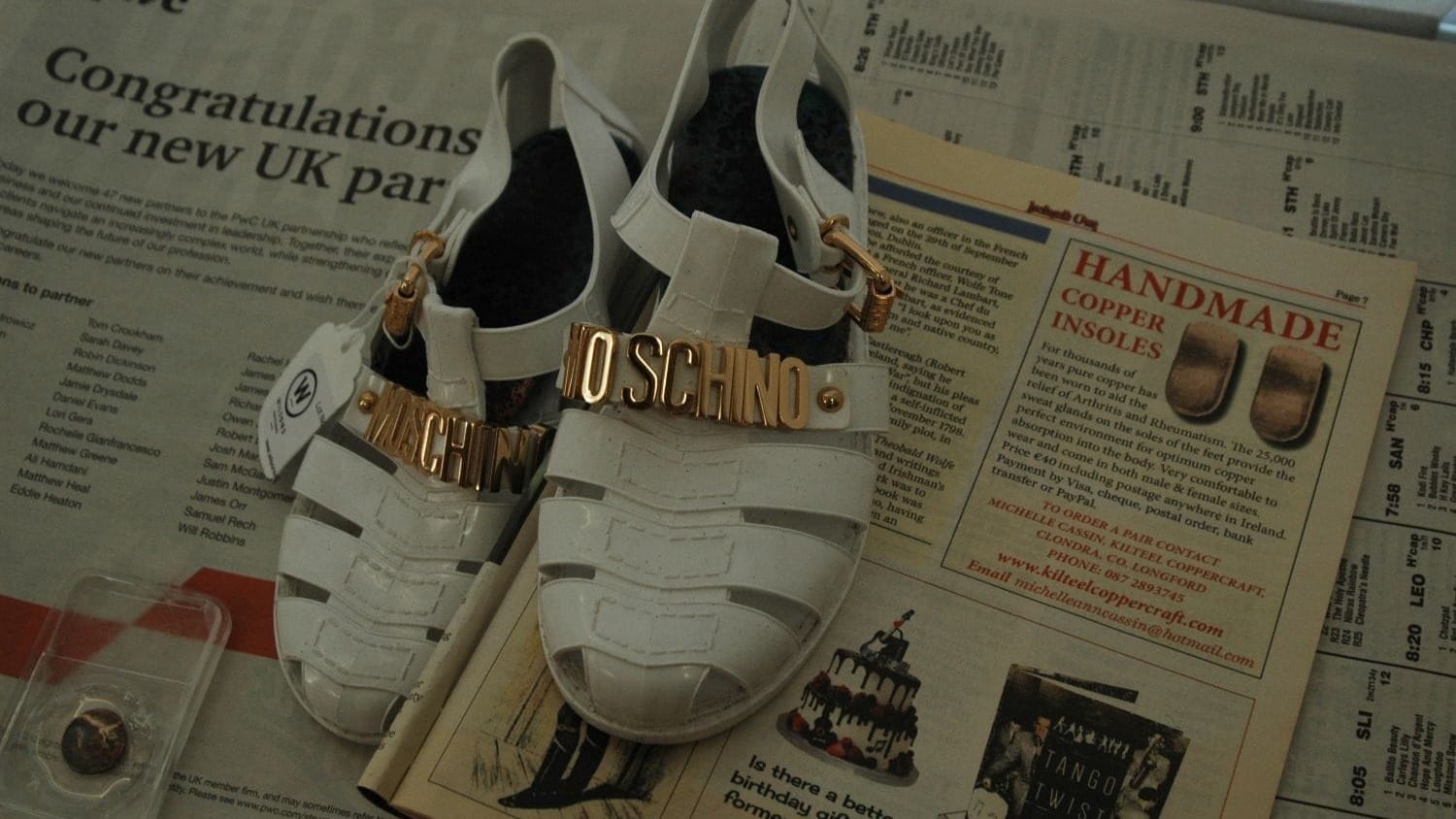
There were piles of old pound coins on newspapers, patinated copper trinkets in the shape of sting rays and angler fish, and copies of magazines for metal detectorists.
Bundles of newspapers — The Sun, The Racing Post — were pushed up against the walls.
Around the room, there were bookshelves holding the archives of journals including The Pennsylvania Magazine of History and Biography and The Montgomeryshire Collections, an annual journal produced by a Welsh historical society.
Also, copies of Survive, a magazine devoted to emergency preparedness, and the Revenue Commissioners' print publication known as RevInniu.
“They don’t make hard copies anymore,” said artist Cóilín O’Connell, referring to RevInniu.
It was hard to tell where the RSAI’s collection ended and Only Handle It Once, the new exhibition devoted to the concept of hoarding by artists Cillian Finnerty and O'Connell began.
Behind one of the bookshelves, somebody had left a sunburst comb.
O’Connell leaned down to inspect it.
It wasn’t installed by them, he said. “That’s just a comb.”
Only Handle It Once is the latest installation in Finnerty and O’Connell’s ongoing project known as Permanent Mirage.
The project, which began with a show in Amsterdam during 2024, scrutinises the dual meanings of the terms “hoard” and “cache”, Finnerty said on Wednesday afternoon.
They are flexible, subjective terms, Finnerty says. “It’s the degree of organisation that defines hoarding. Like, like if somebody has one thousand stamps, that’s a collection.”
The word “hoard” can refer to an invaluable trove in some cases, he says. “Like the archaeological hoard.”
Value gets sucked out of the objects that a hoarder gathers in their home, he says. “Things lose value there. But in wealth hoarding, things appreciate in value.”
The second installation in the project, Finite Space and Limitless Possibilities was a digital exhibition composed of PDF files that included essays on clutter, and collages of old comic strips and photo archives from the Criminal Assets Bureau’s Facebook page.
This latest installation, their third in the series, shifts direction, Finnerty says. “It’s morphed slightly more towards questions of value, especially in terms of sources of value that are hoarded away. Like archives, for instance.”
A lot of their work in Only Handle It Once is focused on the Revenue Museum in Dublin Castle, O’Connell. “An incredible museum. They lent us a lot of objects from there.”
O’Connell and Finnerty stand over a small plastic box of Revenue-branded floppy discs.
“They have so many forms of data in there that can no longer be read,” Finnerty says.
As part of the exhibition, the duo published a book which shares its name. It features images from within the Revenue Museum’s store room, of files blackened by toner ink and oversized versions of the floppy disc known as diskettes.
They can only be read by a tiny number of computers now, Finnerty says. “There’s probably only a handful of computers in the country that could like work out what’s on them.”
It’s a fascinating archive to be in, O’Connell says. “Because it’s kind of chaos but it’s also the history of the state.”
They stroll through the reception room, and approach a hexagonal glass and metal box next to a few copies of RevInniu.
Inside was a horizontal golden bar with what resembled a dark metal arrowhead at its top.
The two artists took a while in the Revenue archive to work out what, exactly, that was for, Finnerty says. “We worked out that it’s like a finely tuned weighing scale for when a tax is charged on particular materials.”
This enigmatic and arcane weighing scales was used to detect whether a material is forged, he says. “It looks like an atmospheric reader. But it actually looks at what is real and what’s fake. What’s valuable and most valuable.”
They like that the purpose of certain objects in the exhibition were forgotten over the years, he says. “There is this thing of knowing that this was important to the narrative of the state, but nobody knows what it is, or where it came from.”

Lauren Fernandes noticed menus and flyers all over with the same sterile look, and thought: what if she could help out small businesses which can't afford creative work, usually?

The musician says her new album, Draw the Outline, brought her “great solace and peace in writing it. I hope it can do the same for whoever needs it.”

Ross McClean’s new documentary is playing on Saturday as part of the Irish Film Institute’s Documentary Festival 2026.

She didn’t expect to become "Facebook famous" at 61. “It's gas. I don’t like front-of-house,” she says, “keep the head down.”