

Maybe people shouldn't be able to collect social welfare at GPO, Arnotts lobbies
The company behind the Henry Street department store raised the idea with the man in charge of the regeneration of the city centre, returns show.
It's been in place on buses in Waterford since July, and is due to be rolled out now nationwide – including on Go Ahead's Naas-based Dublin commuter services this past weekend.

A new system to improve tracking of buses, and provide better information to passengers about whether and when theirs might show up, has been in place in Waterford since July.
The system appears to have reduced the number of ghost buses – those that exist only on the digital displays at stops, and on apps like TFI Live, but never arrive – and increased the number of buses shown on systems as cancelled, local councillors say.
"I would say that I've had reduced reports of ghost buses in the last few months but more cancellations seem to be happening," said Councillor Adam Wyse, of Fianna Fáil, the Mayor of the Metropolitan District of Waterford.
"I have checked with some of my [councillor] colleagues and our take away is that there has been a noticeable drop in complaints about ghost buses but there has been an increase in complaints about buses labelled as 'cancelled'," said Councillor Eamon Quinlan, also of Fianna Fáil.
Now that this next-generation automatic vehicle location (NGAVL) system has been tested in Waterford, the plan was "going live with a second operator, Dublin Commuter (DCOM) services operated by GoAhead Ireland, starting this weekend", a spokesperson for the National Transport Authority (NTA) said on Friday.
Then on to the Go Ahead Ireland "Outer Metropolitan Services", and eventually across the whole country, including Dublin Bus and Bus Éireann, during 2027, the spokesperson said.
Of course, giving passengers more accurate information on whether there's really a bus on the way, or whether it's actually been cancelled but their bus operator, is only part of what's needed.
“Passengers need two things: accurate information about when their bus will arrive and enough capacity to get on it," said Emer Currie, a Fine Gael TD who represents Dublin West, and has put in a series of parliamentary questions about the roll-out of the new AVL system.
"Success means passengers can trust the arrival information, get their buses and reach their destination,” she said.
The NTA in December 2023 awarded a €68.5 million contract to Trapeze Group UK Ltd to bring in the new automatic vehicle location system.
“The solutions to be implemented by Trapeze will address both ‘ghost buses’ and ‘disappearing buses’,” the NTA spokesperson said in September 2024.
At that time, the NTA spokesperson said that if all went well, the roll-out would be completed by late 2026.
 Sam Tranum
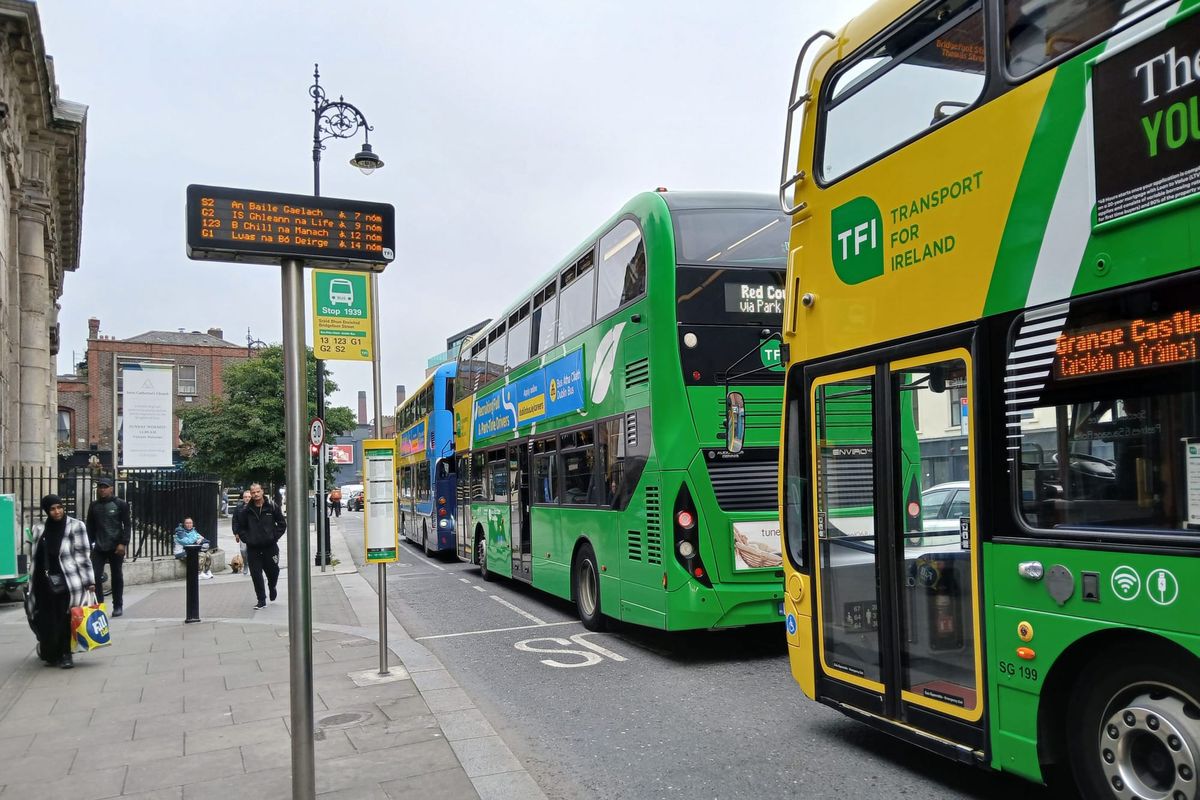
The start of the pilot in Waterford was a bit delayed, "following the identification of a higher-than-expected number of issues in both supplier and NTA testing phases", an NTA spokesperson said Friday.
But "The pilot implementation of NGAVL went live in early July in Waterford following successful NTA acceptance testing", the spokesperson said.
"Since the initial deployment, NTA has expanded the number of buses equipped, and has linked in the NGAVL system to TFI Live and the on-street display signs," he said.
Currie, the Fine Gael TD, said that information received through parliamentary questions "confirm that it is feeding arrival predictions into the TFI Live app and that these have been validated as accurate".
The NTA spokesperson said that there are "several causes of ghost buses", and the new automatic vehicle location system "will improve the situation by virtue of better prediction algorithms and better tools for operators to manage their services including services that are not being operated".
But "it will not on its own fix every problem", they said.
Critically, it won't keep buses from being cancelled – it'll only do a better job letting would-be passengers know they are not coming.
"Service cancellations unfortunately can and do occur for a variety of reasons, such as a shortage of drivers or mechanics preventing services from operating," the NTA spokesperson said.
"It can also be due to incidents occurring in service, such as traffic accidents/incidents, health emergencies, and/or bus breakdowns," he said. "Notwithstanding these issues it is NTA’s objective to provide better quality information."

The company behind the Henry Street department store raised the idea with the man in charge of the regeneration of the city centre, returns show.

"His inability to work will have a direct impact on the provision of the medical services and our ability to maintain adequate staffing and patient care,” reads a letter from the Rotunda to the Department of Justice.

"Please note, I am only looking for the restitution of €2.75 – the fare cost."

“It's extremely disappointing to hear once again that the children have been left short, and it's disappointing given the incredible work that the youth workers in the country do for us.”