

Councillors back renewed focus on serious anti-social behaviour in council complexes
“We know there are issues,” said Dublin City Council Assistant Chief Executive Mick Mulhern, at a recent housing committee meeting.
Emergency works should start soon, said a council official on 19 March – followed, if permitted, by a more extensive intervention.

Emergency works to slow the erosion of Portrane’s coastline at Burrow Beach should start soon, Kevin Halpenny, Fingal’s senior parks and landscape officer, told councillors on 19 March.
Meanwhile, the council filed a planning application for a longer-term solution to the disappearing sands with An Coimisiún Pleanála early last month, too.
The first of the measures, the short-term one, involves building 300 metres of rock armour, Halpenny said, at a meeting of Fingal’s Marine and Coastal Management Strategic Policy Committee meeting.
But the longer-term change, if approved, is for about seven “fishtail groynes”, among other measures, he said.
These are Y-shaped concrete-and-rock walls sticking about 110 metres out from shore into the sea.
It’s the first time those have been used in Ireland, said Halpenny.
The aim, say council planning documents, is to mitigate the ongoing coastal retreat, enhance the recreational value of the beach, and enhance and protect the dune systems which suffer from chronic and acute erosion.
Or, to put it another way: to save the coastline.
On Monday evening, rocks and shells lay like a ripple of scales in the long stretch of sand revealed by the low tide on Burrow Beach.
The sea was at a safe distance, now.
But it has been rapidly washing away the land, eroding the shoreline at a rate of between 2 metres and 4 metres a year over the last 50 years, say council planning documents.
Some years have seen more brutal erosion on the coast than others. In 2018, “Storm Emma and a succession of other events resulted in the shoreline retreating by more than 20m along some sections of the Burrow,” the document says.
Given rising sea levels, “retreat of the coastline along the Burrow could result in between 17 and 243 buildings being lost to erosion over the next 50 years”, the document says.
At about 5.15pm on Monday, the only figures on the beach were Ciarán Ó hAoláin, his partner, and their coat-wearing dog.
They had driven over for the walk, they said.
Ó hAoláin and his partner had looked at buying a home in Portrane. He pointed to a house just up the beach, a yellow house with a slanted roof – that one.
"You could see. It was a gorgeous view out the window. And everything like that. But it was very risky,” he said.
“Risky to think about buying something like that,” he said. "We were trying to figure out if we bought the house, how long it would be before it was underwater."
It may have been okay for 20 years, but the road was set to disappear sooner even, he said, and the chance of a mortgage was slim and insurance non-existent.
They decided to move to Donabate instead, he said, as they continued walking up the empty shore.
A row of concrete “seabees”, big pieces of concrete infrastructure that look like enormous hexagonal nuts, protect the beach at the moment.
But in December, big storms meant the council had to relocate some seabees that had been there since 2018, said Halpenny, at the council meeting.
“To add additional protection for the most vulnerable section of the coastline that was at risk from collapse there,” he said.
“That was a sort of stop-gap situation,” he said.
Council officials met with the Office of Public Works and the Department of Housing and agreed what emergency works should take place, and got funding approved for that rock revetment.
They have a contractor lined up, he said.
But these are a further stop-gap, Halpenny said, in anticipation of the longer-term project which they have applied for permission from An Coimisiún Pleanála.
The longer-term plan is for the seven fishtail, or Y-shape groynes and a beach renourishment scheme.
The groynes expand out into the sea and break the wave energy while trapping sand.
The beach renourishment will involve transporting dredged material and pumping it ashore, into each of the cells created by the groynes.
The longer-term works also include building a 190-metre embankment at the end of Burrow Road, among other measures.
At the meeting last Thursday, Halpenny indicated the current path forward isn’t the only solution, but rather the best path forward available to them.
“We're having to intervene interim to the longer term solution because of the urgency of the situation,” Halpenny said.
“Nationally, it's very limited what options are available on a policy basis, and that's something we hope would be addressed at national level through legislation.”
“I've often questioned how the whole beach was treated,” said Bríd Moynihan on Monday.
She and her husband, Michael Moynihan own the Brook Pub on the shore of Portrane. They sat at a table on the side of the pub beside stacks of wooden stools.
The couple is invested in the shoreline.
Michael Moynihan’s dad bought the pub in 1959. Now, they also have an ice cream parlour next door, and an Italian restaurant too.
They said they’ve been involved in trying to protect the shoreline effectively for decades.
“We filled sandbags trying to protect the neighbours houses all through the years, we did. We did everything. Contacted local politicians, councillors,” said Bríd Moynihan.
In general, the couple both said: the erosion has noticeably sped up in the last decade. And the community has been calling for a governmental response.
But “It’s been torturously slow,” said Moynihan.
They brought up videos on their phones from the last storm of waves pounding on the shoreline metres away from where they sit, and more videos of council staff rapidly throwing down sandbags, and making a channel for water to flow back down to the sea.
They welcome both the emergency measures and long-term plans, they said.
Residents have spent thousands and thousands themselves, investing in sandbags, fences and heavy rocks, said Des McGuinness, whose home is under threat.
McGuinness said he’s seeing the shore reach his neighbours too. “It's been in my neighbour’s garden. That's never – it's never been in, kind of before, really.”
There is no national policy on coastal erosion and that’s a problem, says Labour Party Councillor Corina Johnston.
There’s no mechanism for how to respond when a home is lost to erosion, she says. “If their house falls into the sea, there’s no compensation package.”
Policy options could be wider, says Iris Möller, professor of geography at Trinity College Dublin.
Managed retreat could be an option, she said. Moving residents away from the coastline by planning and paying for relocation.
That’s something other coastal and climate researchers have said there needs to be a conversation around, too.
 Lois Kapila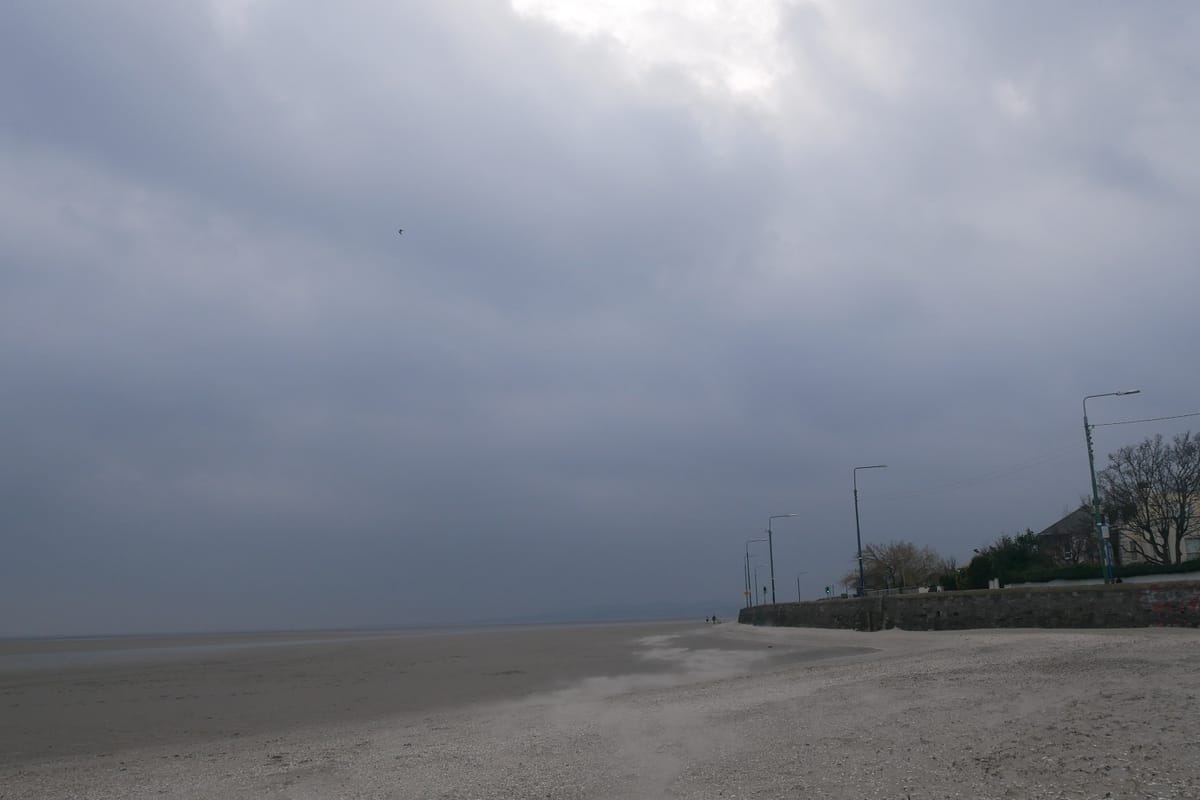
Möller says that this needs to be done in a positive way. "We tend to look at this through a very negative lens, along the lines of giving up and giving in,” she said.
But if the community moved inland had access to a much more naturally beautiful coastal area that not only offers much nicer space for recreation, but also stores carbon, you know, does lots for biodiversity, she said.
"It's just finding a positive way of achieving that with the community and involving the community in the design of whatever will be the alternative for them to live in, and that is the mechanism that we don't have at the moment," she said.
These changes would all, of course, take planning and funding, she said.
The council’s planning documents note that there are other approaches to the ones it is taking – such as doing nothing, managed realignment, or yes, managed retreat.
But it has opted for “hold the line”, it says. Given the social impact, and the lack of national policy too, it says.
The idea of relocating doesn’t appeal, said McGuinness, who lives by the shore.
There’s just a short field between his home and the shore during storms, he says.
The water was once ages out and now he feels it on his doorstep but he’s not interested in moving house, he says.
“I'll be there until the water's coming in my door,” he says.
“I don't think that far ahead. Because I can't. I just, I'm kind of, I'm kind of in denial. To be honest with you,” McGuiness said. “Now, if I win the lottery, I’ll sort the whole beach out … that's what keeps me going.”
Funded by the Local Democracy Reporting Scheme.

There’s DJ nights, comedy open-mic nights, musical performances. And plans for board games and movie nights.

While costs of basic items have risen, including snacks bought from the prison shop to fill long gaps between meals.

Drivers would also be limited to leaving their cars in spots on the road for a maximum of three hours.

The new active travel plan for the village, which sits about 2.5km south of Balbriggan's town centre, includes a one-way system, among other measures.